
Antisemitism in Real Time, Part III: "Israel Made America Do It" — YouTube Reactions to the US–Israel Campaign Against Iran

AddressHate Research Scholar at NYU’s Center for the Study of Antisemitism | Postdoc, University of Cambridge | Lead, Decoding Antisemitism | Research Advisor, AddressHate | Editor-in-Chief, Digital Hate Review
Introduction
On February 28, 2026, Israel and the United States launched Operation Epic Fury, a joint military campaign targeting Iran’s nuclear infrastructure, missile and drone production facilities, IRGC command centers, and political leadership. Supreme Leader Ali Khamenei was killed in a strike on the Leadership House compound in Tehran; Iranian state media confirmed his death in the early hours of March 1. Iran declared 40 days of mourning and launched retaliatory missiles and drones against Israel, US military bases, and Gulf states across the region.
By March 7, Iranian authorities reported a death toll exceeding 1,300, a figure not independently verified. Iran launched over 500 ballistic and naval missiles and nearly 2,000 drones since February 28; hundreds of US–Israeli strikes targeted facilities across most of Iran’s provinces. The Strait of Hormuz was severely disrupted, with commercial traffic effectively suspended. Hezbollah launched cross-border fire from Lebanon. Among the incidents that generated the most sustained online commentary was a strike on a girls’ school in Minab: Iranian authorities reported roughly 150–175 fatalities; independent investigators have confirmed a mass-casualty event but have not certified a precise toll. Preliminary US inquiries suggest US forces were likely responsible; Israel stated it had no operations in the area. No official investigation has issued a final conclusion. The Minab strike became a significant focal point in the comment sections analyzed below.
This article is the third installment in the Antisemitism in Real Time series, which tracks how antisemitic discourse adapts to, and is activated by, breaking geopolitical events in YouTube comment sections beneath major U.S. news coverage. The first two parts (Part I; Part II), published in June 2025 following Israel’s preemptive strike on Iran and Iran’s subsequent retaliation, established the baseline discursive patterns: demonization, Holocaust inversion, conspiracy narratives, and the normalization of Jewish suffering. This installment examines how those patterns have evolved — and in several cases dramatically intensified — in response to an escalation of categorically greater violence, political complexity, and symbolic weight.
Discursive Shift Across Three Studies: A Category Trajectory
The decline in mean antisemitic content rate between the June 2025 studies (18.5%; 19.1%) and the February–March 2026 dataset (12.6%) is not attributable to a difference in method: all three studies apply the same annotation protocol. The structural explanation lies elsewhere — in the altered geopolitical context itself.
When Israel acted alone in June 2025, antisemitic discourse could project its full weight onto a single target. The dominant registers were theological and dehumanizing: demonology, deicide, Nazi analogy, Holocaust inversion. These formations require Israel as sole agent — an undiluted vessel for antisemitic projection. When the United States became a full co-belligerent in February–March 2026, that total demonization became structurally harder. Commenters cannot cast the operation as purely Jewish evil without simultaneously implicating the US military, American foreign policy, and their own country. The rhetorical problem this creates is resolved by a shift in register: from Israel is demonic to Israel made America do it. Demonology gives way to conspiracy; theological vilification gives way to the subordination frame. The antisemitism does not diminish — it migrates into a register better suited to the political facts on the ground.
This trajectory is visible in the category data across all three studies:
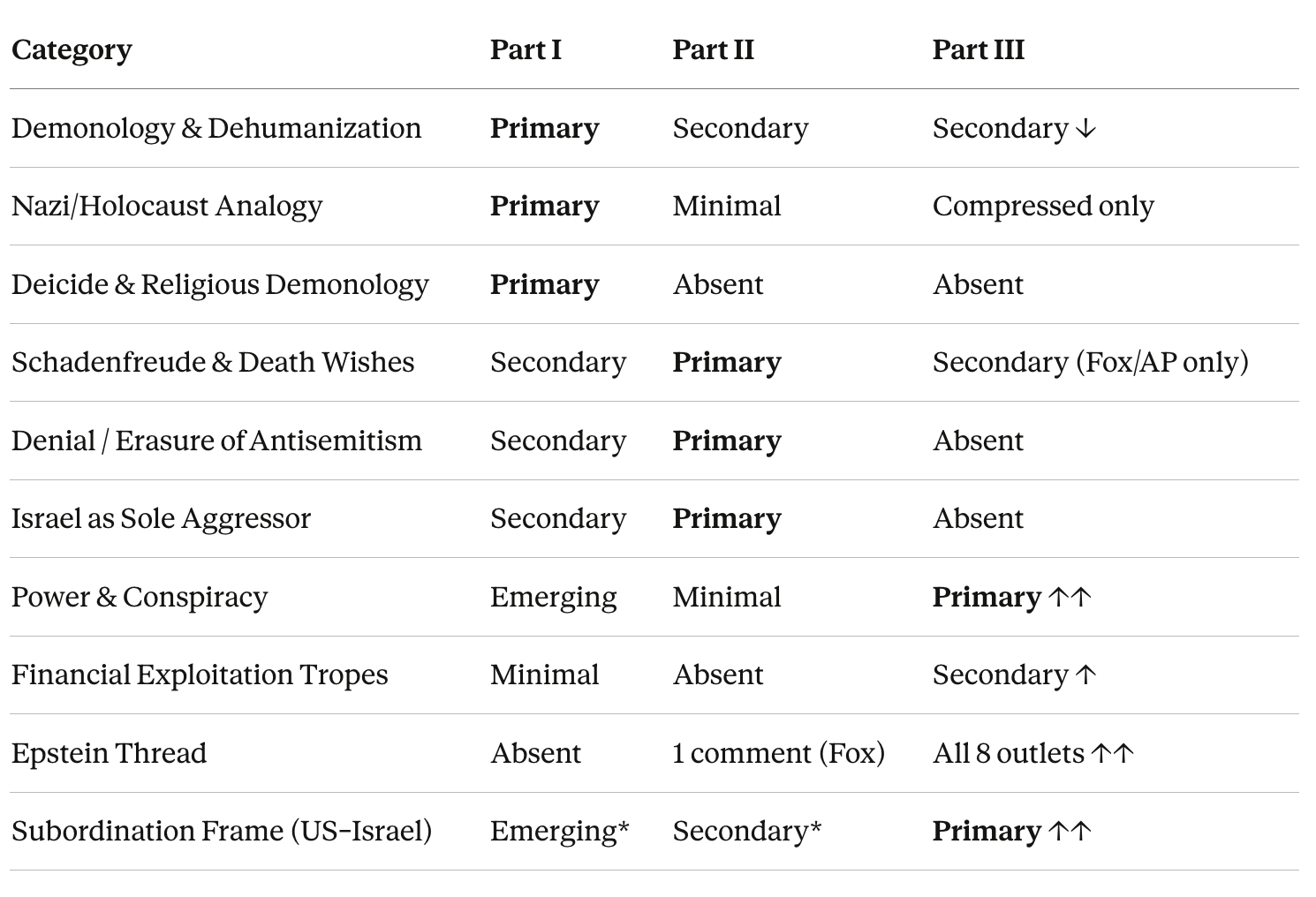
* The subordination frame appears in incipient form in Parts I and II — as a byproduct of conspiracy claims rather than an independent organizing register. In Part I, comments such as “Congress is controlled by Mossad” and “Israel will drag the USA into this” imply US subordination without foregrounding it. In Part II, the CNN false-flag claim and the AP Khazar comment similarly cast the US as an instrument of Israeli interests. The explicit rhetorical vocabulary of personal submission — puppet, master, “good boy,” bodily subordination — plays a markedly less prominent role in both 2025 datasets than in Part III, where it constitutes an autonomous primary formation with its own consistent lexicon, operating independently of conspiracy elaboration rather than as a byproduct of it.
Several findings from this table warrant analytical emphasis. First, the theological register — deicide, Satan, synagogue of Satan, religious demonology — is prominent in Part I and entirely absent by Part III. Its disappearance is not incidental: these formations depend on Israel as a metaphysically singular evil. The presence of US co-belligerence disrupts that singularity. Second, the Nazi/Holocaust Analogy, which appeared in expansive and explicit form at CNN and ABC in Part I (”modern-day Hitler,” “doing to others what was done to them”), survives in Part III only in compressed, portable shorthand — “ZioNAZIs” as a single portmanteau — adapted to a context where the analogy can no longer bear the full weight it carried when Israel acted alone. Third, Power and Conspiracy narratives follow the inverse trajectory: emerging in Part I, minimal in Part II, dominant across all eight outlets in Part III. The Epstein thread — a single isolated comment at Fox News in Part II — consolidates into a near-ubiquitous cross-platform formation in 2026, appearing at all eight outlets under the portmanteau “Trumpstein.”
The implication is analytically significant: the rate drop between 2025 and 2026 should not be read as evidence of declining antisemitism in these comment ecosystems. It reflects, in part, a structural adaptation — antisemitic discourse reorganizing itself around the political facts of US co-belligerence, finding in the conspiracy and subordination register a more contextually plausible vehicle than the theological demonology that dominated when Israel acted alone.
Two further findings from this dataset warrant emphasis.
First, US military involvement has reshaped the antisemitic register in two related ways. Demonizing projections — the theological vilification, Holocaust analogies, and dehumanizing tropes that dominated the June 2025 datasets — are less prevalent in 2026: when the United States is a full co-belligerent, commenters cannot cast the operation as purely Jewish evil without implicating their own country and military. What fills that space is a marked increase in the directness of power and conspiracy allegations. Tropes that in 2025 were largely coded, insinuated, or metaphorically displaced now appear in unambiguous, unelaborated form. Commenters no longer hedge. When the geopolitical context already supplies the conspiratorial scaffold — a US president publicly committed to regime change alongside Israel — antisemitic interpretive frameworks require less rhetorical work to appear plausible. The political facts lower the threshold for explicit statement. Both shifts are documented empirically across all eight outlets and addressed in the analytical sections below.
Second, this is not a phenomenon confined to one end of the political spectrum. CNN — consistently associated with left-leaning audiences — and Fox News — consistently associated with right-leaning audiences — produce the two highest antisemitic response rates in this dataset: 21% and 20% respectively, separated by a single percentage point and both well above the dataset mean of 12.6%. The antisemitic content at Fox News’ YouTube comment section spans Power and Conspiracy narratives, demonological and dehumanizing tropes, and explicit Death Wishes — including the most extreme exterminatory rhetoric in the corpus. The data indicate that antisemitism in online comment culture is a societal problem that does not stop at the boundary of any political identity or partisan affiliation (see also my Substack article “The Platform Infrastructure Behind Generational Antisemitism”).
From June 2025 to February 2026: Continuity, Rupture, and Escalation
The June 2025 case studies established what might be called the rhetorical grammar of antisemitic online response to Israel–Iran conflict: a stable repertoire of inversions, projections, and dehumanizing tropes that was activated rapidly and at scale across ideologically diverse platforms. What distinguished those earlier episodes was the speed and internal coherence of the antisemitic response — Israel cast as aggressor, Iran as victim; Israeli suffering treated as deserved or dismissed entirely; conspiracy narratives framing Jewish actors as the hidden architects of regional instability. The June 2025 episodes thus function as discursive groundwork: they seed the conspiratorial interpretive frameworks — Jewish control of Western policy, Israel as permanent aggressor, US co-responsibility as proof of Jewish power — that commenters reactivate and intensify in their responses to the 2026 war.
The February–March 2026 escalation shares this discursive architecture but unfolds in a fundamentally altered context. Several factors distinguish this episode from the June 2025 escalation and are legible in the comment data.
Scale and US co-belligerence. The June 2025 strikes were Israeli operations. Operation Epic Fury is a joint US–Israeli campaign explicitly aimed at regime change — a goal stated publicly by President Trump on Truth Social within hours of the opening strikes. The direct involvement of the United States has materially shifted the discursive landscape: conspiracy narratives about Jewish control of American foreign policy, which in June 2025 largely appeared in coded or insinuated form, now operate in a context where the US is actively at war alongside Israel. Commenters no longer need to allege manipulation; they can point to observable political fact and allow antisemitic interpretive frameworks to supply the explanatory logic. The result is a significant migration of Power and Conspiracy tropes from latent to overt across all eight outlets analyzed.
The killing of Khamenei. The assassination of Iran’s Supreme Leader introduces a register of martyrology and symbolic grief that was absent in June 2025. Online, this has generated a distinct discursive response: the valorization of Iranian suffering as righteous, the framing of the strike as an act of desecration, and — at the antisemitic extreme — the reactivation of structures in which Jewish actors are cast as killers of a sacred or prophetic figure. Some comments draw explicitly on Christian eschatology to frame these events, echoing the deicide structures documented in Part I.
The Minab school strike. A strike on a school in Minab — in which Iranian authorities report roughly 150–175 people, mostly school-age girls, were killed, a toll not yet independently certified — rapidly became a focal point in online comment sections regardless of its evidentiary status. Current evidence and preliminary U.S. inquiries suggest U.S. forces were likely responsible, with Israel stating it had no operations in the area; no official investigation has yet issued a final public conclusion. For the purposes of this analysis, what matters is not the verified death toll but the discursive function the event assumed: it became an anchor for demonizing rhetoric, attributed deliberate intent to Israeli and American actors, and served as the primary referent for Nazi/Holocaust inversion, with commenters explicitly reaching for analogies to the targeting of Jewish children during the Shoah.
The explicit regime change framing. Trump’s public statement of regime change as a war aim, and Netanyahu’s direct address to the Iranian people in Farsi, give existing conspiracy tropes a factual scaffold. In June 2025, the characterization of Israeli actions as aimed at regional domination was presented by commenters as conspiratorial revelation. In February–March 2026, it is official US policy. This has the effect of normalizing the conspiratorial interpretive framework — and of intensifying its antisemitic valence when it migrates from political criticism to ethno-religious attribution.
Structural Shifts Between June 2025 and February–March 2026: Quantitative Overview
A third finding cuts across both observations and recurs consistently across all three studies in this series: CNN (left-leaning) and Fox News (right-leaning) produce the highest antisemitic response rates in every dataset. In Part III, CNN leads at 21% and Fox News follows at 20% — separated by a single percentage point, and together significantly above the dataset mean of 12.6%. This cross-ideological symmetry is not incidental. It reflects a structural feature of high-traffic, politically polarized comment ecosystems: antisemitic discourse does not map onto a single point on the political spectrum but is activated, in different registers and with different surface framings, at both ends of it. The finding should caution against any assumption that antisemitic comment culture is a phenomenon of the political right or left alone.
Two cross-cutting observations structure the dataset as a whole and recur across outlets regardless of political leaning. The dominant logic across the comment sections is one of Israeli control over the United States — expressed overtly through Power narratives (Israel commands, Trump obeys) or covertly through Conspiracy tropes (AIPAC, Mossad blackmail, political blackmail). This overt/covert axis is the organizing spine of antisemitic discourse in this dataset in a way that has no precise equivalent in the June 2025 case studies, where US involvement was not yet a fact. A second, related formation recurs across all eight outlets: commenters present Trump’s prosecution of the war as a deliberate distraction from the Epstein files, alleging that the conflict serves to suppress evidence linking Jewish elites to sexual exploitation and blackmail. This is frequently condensed into the portmanteau “Trumpstein.” The formation connects to the broader power-conspiracy frame — in both cases, Jewish actors are cast as the hidden authors of American political conduct — but its specific content (the Epstein network, file suppression, blackmail) is distinct enough to warrant separate identification.
Per-outlet antisemitic content rates across three case studies
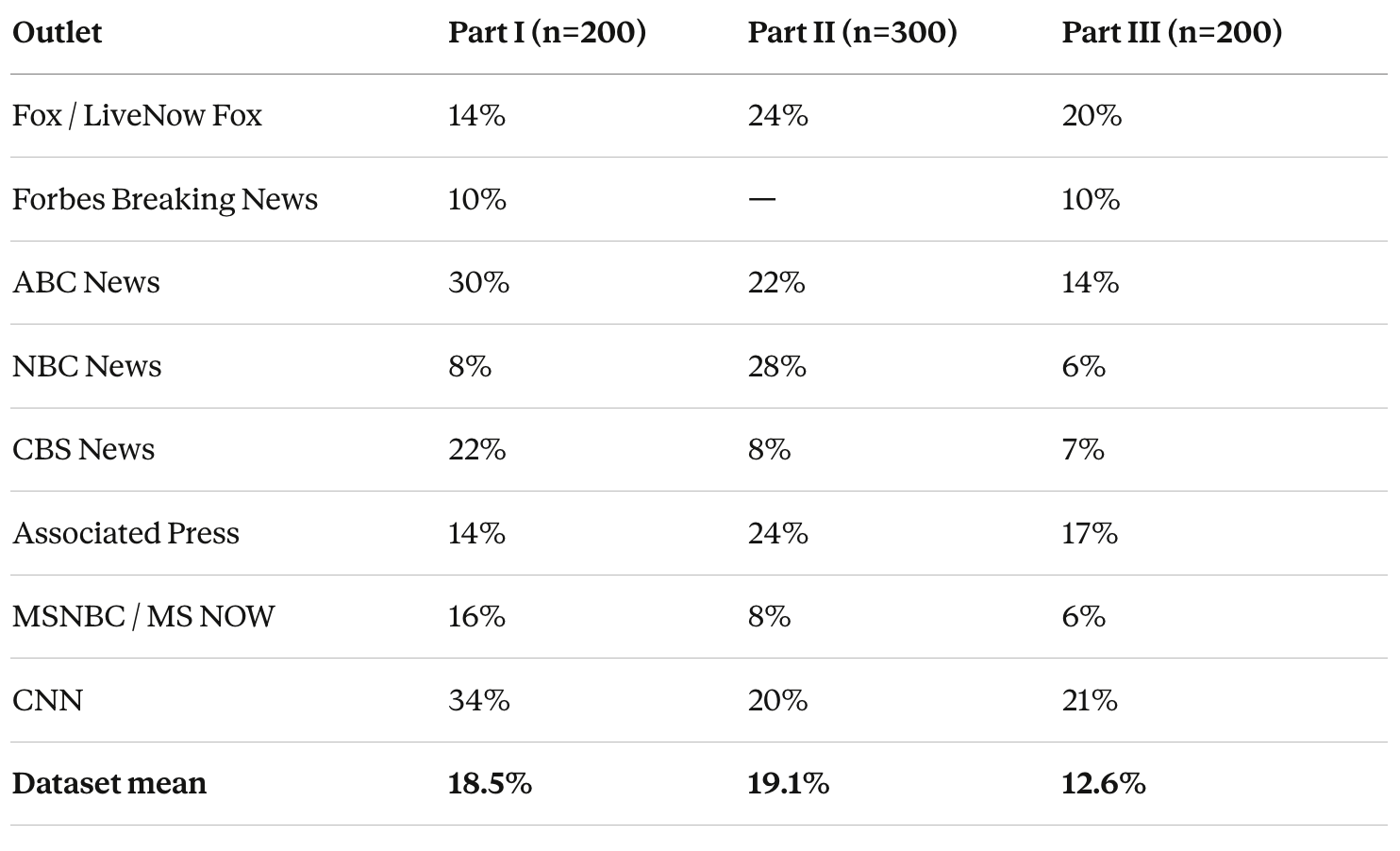
Note: Forbes Breaking News was not included in the Part II sample. The lower Part III mean should not be read as a decline in antisemitic prevalence; all three studies apply the same annotation protocol. The structural explanation for the rate difference is discussed in the opening section.
Several observations are robust across all three studies. CNN and Fox News consistently produce the highest antisemitic content rates in their respective datasets, confirming a cross-ideological pattern in which the most-watched outlets at opposite ends of the political spectrum generate the most hostile comment environments. ABC News was the most antisemitic centrist outlet in Part I (30%) and Part II (22%), declining to 14% in Part III (28 hits in 200 comments), it remains the highest centrist outlet in the current study. NBC News showed an anomalous spike in Part II (28%), likely reflecting the specific framing of Iran’s retaliatory strike as morally justified; it returns to a comparatively low rate in Part III (6%). MSNBC / MS NOW is consistently among the lowest across all three studies, ranging from 6% to 16%.
Dominant concepts across the three case studies
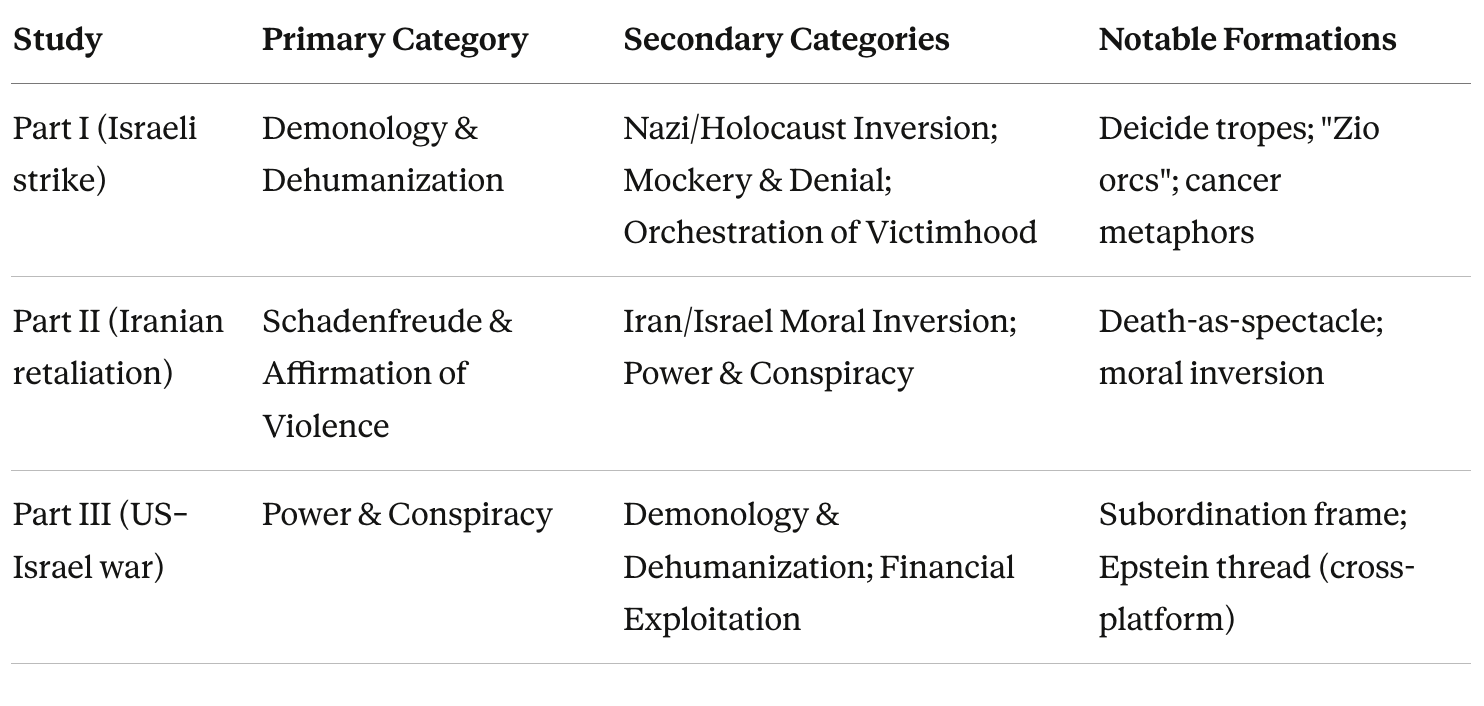
The trajectory across the three studies is analytically significant. Part I, responding to an Israeli military operation, generated the broadest and most theologically grounded antisemitic repertoire: demonization, deicide, Holocaust inversion, and the orchestration of victimhood. Part II, responding to Iranian retaliation, pivoted sharply toward affective registers — schadenfreude, death wishes, glorification of violence — as the moral inversion calculus was resolved in Iran’s favor and Jewish suffering became a source of satisfaction rather than contested meaning. Part III, responding to a qualitatively different war involving US co-belligerence and explicit regime change objectives, consolidates Power and Conspiracy as the dominant frame: the structural conditions of the conflict have given conspiratorial logic a factual scaffold, enabling it to displace the more explicitly theological and dehumanizing formations that characterized Part I while absorbing the affective intensity documented in Part II.
The emergence of the Epstein thread as a cross-platform organizing motif represents one of the most significant new developments in this dataset. While an isolated precursor appeared in the Part II Fox News dataset — a single sprawling emoji-coded comment listing approximately ninety public figures — it was absent as a cross-platform formation from both June 2025 studies. Its consolidation here across the dataset — appearing in comment threads at all eight outlets, often under the shorthand ‘Trumpstein’ — marks a qualitative shift specific to the February–March 2026 context, in which the direct involvement of the Trump administration in a war alongside Israel has given pre-existing conspiratorial narratives about Epstein’s alleged ties to Israeli intelligence a new geopolitical anchor. The thread functions as a shorthand that links the current war to a broader narrative of Jewish elite conspiracy, political blackmail, and information suppression — and its cross-platform prevalence in 2026, where it was entirely absent in June 2025, is itself an analytically significant finding.
Dataset & Methodology
The dataset comprises 1,600 user comments collected from YouTube videos posted by eight major U.S. news outlets in response to the US–Israeli strikes on Iran beginning February 28, 2026. Videos were published on February 28–March 1, 2026 [URLs to be verified before publication]. Comments were drawn from top-level comment threads beneath breaking news and live coverage videos. The standard sample size is 200 comments per outlet. PBS NewsHour was excluded as comments were disabled; NPR was excluded due to insufficient comment volume (fewer than 100 comments on a single clip). The outlets span the ideological spectrum of mainstream US television and digital news:
Left-Leaning/Liberal: CNN; MS NOW (formerly MSNBC)
Centrist: ABC News; NBC News; CBS News; Associated Press
Right-Leaning/Conservative: Fox News; Forbes Breaking News
Each comment was analyzed qualitatively using linguistic and multimodal close reading, supplemented by sequence and relational analysis. The analytical framework is guided by the Decoding Antisemitism Lexicon, a research-based instrument for identifying explicit and implicit antisemitic discourse in digital environments. The Lexicon accounts for dog whistles, sarcasm, irony, visual and emoji-based signaling, and inversion structures, enabling systematic identification of hostile speech that would evade surface-level keyword filtering.
A note on cross-study comparability. All three studies in this series apply the same annotation protocol and counting unit. The lower mean antisemitic content rate in Part III (12.6%) compared to Parts I (18.5%) and II (19.1%) therefore does not reflect a methodological difference. As argued in the opening section of this article, the rate difference is better explained by a structural shift in discursive register — from theological demonology and Holocaust inversion, which dominated when Israel acted alone, to Power and Conspiracy narratives, which have become primary in the context of US co-belligerence. The total dataset for Part III comprises 1,600 comments across eight outlets at 200 comments each. Within-study outlet comparisons and cross-study directional observations remain analytically robust.
Summary of Comment Patterns by Outlet
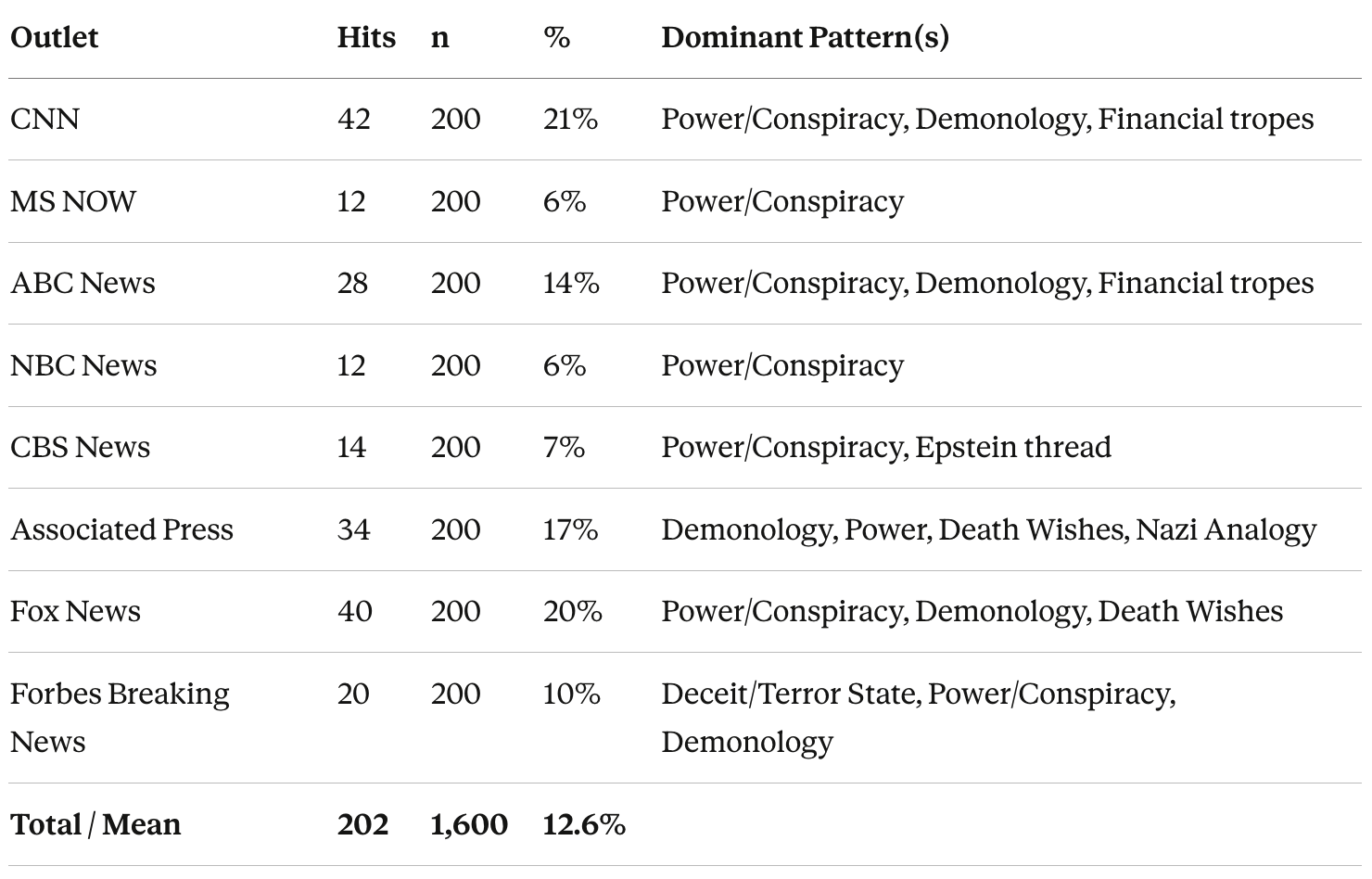
CNN (42 hits, 21%): The highest antisemitic hit rate in the dataset, consistent with the June 2025 findings. Power and Conspiracy narratives dominate (14 cases), followed by Demonology (12 cases) and Financial/Exploitation tropes (10 cases). The most structurally complex antisemitic comment in the entire dataset appears here: a theological conspiracy passage linking Orthodox Jewish religious authority to demonic political power, Third Temple conspiracism, and the “Synagogue of Satan.” Financial tropes are more prevalent at CNN than at any other outlet.
MS NOW (12 hits, 6%): Low hit rate, concentrated in Power and Conspiracy. Framing of Trump as Netanyahu’s instrument and characterization of the “Israel lobby” as having captured Congress and the billionaire donor class. Comments operate through political critique that slides into antisemitic attribution without overt markers.
ABC News (28 hits, 14%): A broad spectrum of antisemitic content, including Power and Conspiracy, Demonology, and financial and resource exploitation tropes. AIPAC references and the “sold us out for some silver” comment position Jewish actors as extracting blood and treasure from American citizens. The Mossad/Trump blackmail frame appears. One comment introduces the classical financial trope in its most explicit economic form (usury as Israel’s only export). Media control tropes also surface (”Disney is owned by Israel”).
NBC News (12 hits, 6%): Antisemitism surfaces almost exclusively through Power and Conspiracy tropes, often via implication rather than explicit statement. The Friday night timing of the strikes is used to insinuate Jewish orchestration; references to Israeli “supreme leaders” perform a rhetorical inversion of political hierarchy.
CBS News (14 hits, 7%): Low overall volume, but the cases present are analytically significant. Power and Conspiracy narratives dominate, with AIPAC invoked directly. The dataset includes a notable instance of visual antisemitic coding — the “imprint of his hat” comment — in which Jewish identity is read onto a political figure’s physical appearance to imply hidden allegiance. The Epstein thread makes a direct and maximally explicit appearance: “BREAKING NEWS: The Protocols of Zion are real.”
Associated Press (34 hits, 17%): The most diverse antisemitic repertoire in the dataset, spanning all five analytical categories and including the only clear Nazi Analogy in the corpus (”Again U$ joins ZioNAZIs and there are no rules”). Demonology is prominent — dehumanization (”Zionist rats”), cancer metaphors, and the “god’s chosen people you know” sarcasm. Death Wishes are explicit and extreme, including a call for nuclear annihilation (”I wish Israel to turn to glass”) and what appears to be a transliteration of an Arabic militant phrase calling for the destruction of Tel Aviv. The Khazarian Mafia conspiracy appears in concentrated form (”KHAZARIAN MAFIA BIG BO$$ BATTLE”), and “ZOG” (Zionist Occupation Government) appears as a bare neo-Nazi code term.
Fox News (40 hits, 20%): High volume of overtly hostile content alongside CNN. Antisemitic discourse spans three distinct sub-categories: Power and Conspiracy narratives (16 cases), Demonology and dehumanizing tropes (12 cases), and Death Wishes or glorification of Iranian violence against Israel (6 cases). The “Epstein Files” motif recurs as both a distraction narrative and a coded reference to Jewish elite conspiracy. Framing of the US as a subordinate actor to Israeli command is explicit and recurrent. The platform also hosts the most extreme exterminatory rhetoric in the dataset.
Forbes Breaking News (20 hits, 10%): Antisemitism surfaces primarily through Deceit and Terror State framings — Israel cast as a conspiratorial expansionist actor pursuing “Greater Israel” (”War for greater Israel has begun again”; “they want the Nile to the Euphrates”). Power and Conspiracy tropes are present, including explicit Jewish control of US policy (”The Jews wanted it, so the USA must do it”; “Trump on his knees before his master”). Demonology appears in both religious and animalistic register. The “Khazarian” reference and Zelensky-as-Jewish-agent comment place this outlet at the intersection of classic and contemporary conspiratorial antisemitism.
Breaking Down the Predominant Concepts of Antisemitism in YouTube Responses
1. Power and Conspiracy Narratives
By a significant margin, Power and Conspiracy narratives constitute the dominant antisemitic register across all eight outlets in the February–March 2026 dataset. This represents a structural shift from the June 2025 case studies, where power tropes competed with demonization, Holocaust inversion, and schadenfreude for discursive primacy. The shift is directly attributable to the altered geopolitical context: with the United States as an active co-belligerent in a war explicitly framed by its own president as aimed at regime change, the conspiratorial claim that Israeli interests control American foreign policy has acquired a degree of apparent factual grounding that it lacked in June 2025.
The most common structural form is the subordination frame: the US is rendered as Israel’s instrument, its president as Netanyahu’s functionary, and its military as a mercenary force deployed in Jewish interests. This framing is expressed with varying degrees of explicitness:
“Trump is such a good boy for his master Bibi!” (Fox News)
“When daddy says attack, The US will attack” (Fox News)
“Israel puppet” (Fox News)
“Israel owns our government we always do what they say. MAGA is Israel first, America second” (Fox News)
“Netanyahu’s Fool = Trump 😮” (MS NOW)
“Not just an ally, they know how to work dumpty don to do their dirty work” (CNN)
“Israel’s bitch” (CNN)
“you spelled puppet wrong” [in reply to “US is ally of Israel”] (ABC)
"United States of Israel" (Forbes)
The final comment in this cluster is the most compressed: a renaming of the country itself. By substituting “Israel” for “America,” the commenter performs the subordination frame at the level of national identity — not merely asserting that the US acts in Israeli interests, but that the distinction between the two states has collapsed entirely.
— criticism of the US–Israel relationship and of Trump’s political alignment with Netanyahu falls within legitimate political discourse. What converts these comments into antisemitic statements is the structural logic they invoke: not that a specific government has pursued particular policies, but that Jewish power operates as an invisible commanding authority to which American political agency is categorically subordinate. The agency attributed to “Israel” or “Bibi” is not political but ethno-conspiratorial — it functions, within the comment’s logic, as a property of Jewishness rather than of a state.
Among the subordination frame statements in the dataset, two warrant particular analytical attention for the clarity and directness with which they express this logic.
“The Jews wanted it, so the USA must do it...” (Forbes)
This is arguably the most syntactically unmediated statement of Jewish command over American foreign policy in the entire corpus. There is no metaphor, no coding, no rhetorical indirection: Jewish collective will is the subject; American state action is the predicate; causation is absolute. The comment strips away the institutional scaffolding — AIPAC, the lobby, Netanyahu — that other comments rely on to perform the same assertion, and states the subordination frame in its purest form. Its very plainness is analytically significant: it signals a commenter for whom this logic requires no justification or elaboration, only statement.
“Trump on his knees before his master. 😮” (Forbes)
Where most subordination frame comments use the language of obedience (”good boy,” “puppet,” “daddy says”), this comment deploys a posture of bodily submission — kneeling — that introduces a dimension of sexual humiliation absent from the others. The master/slave dynamic is intensified by the physical image: Trump is not merely instructed but prostrated. The shocked emoji (😮) performs a performative incredulity that simultaneously distances the commenter from direct endorsement and amplifies the degradation on display.
Another comment performs the subordination logic in a visually distinct register — reading Jewish power onto the body of a political figure rather than expressing it through command:
“I see the imprint in his hair for his little round hat. I bet he’s happy.” (CBS)
This comment claims to detect the mark of a kippah beneath Trump’s hair — interpreting a physical trace as evidence of concealed Jewish identity or allegiance. The operative logic is that of the dog whistle in reverse: rather than a speaker encoding a hidden message for a knowing audience, here a reader claims to decode a hidden identity from a physical sign. Jewish power is not asserted but detected — inscribed on the subordinate’s body as proof of his master’s command. The verb “happy” implies that the conflict serves Jewish interests in ways invisible to ordinary observers, completing the subordination frame through somatized conspiracy.
This logic is made more explicit in comments that invoke institutional proxies — AIPAC in particular — as evidence of systemic Jewish capture of US democracy:
“That’s why A¡pac invested heavily on both sides of the election — now that investment is paying off.” (ABC)
“Because of AIPAC” (ABC)
“Free America from criminal AIPAC!” (CBS)
“billions and billions of taxpayer money spent on Israel First isn’t doing us any good either.” (MS NOW)
“This is Israel control the United States Republicans party... billionaires class support Israel” (MS NOW)
“Our kids will be living under intense Israeli surveillance forever. Israel lobby owns Trump and most of Congress. America is dead.” (MS NOW)
The AIPAC trope has a long history in American political discourse and exists on a spectrum that includes legitimate critique of lobbying influence. What distinguishes its antisemitic variant is the shift from describing political activity to asserting ethno-religious domination: “Israel lobby owns Trump and most of Congress” performs not a critique of campaign finance but an assertion of total Jewish capture of American democratic institutions.
The Epstein thread constitutes a distinct and analytically significant sub-pattern, appearing across all eight outlets — and entirely absent as a cross-platform formation from both June 2025 datasets. Its emergence as a cross-platform motif is specific to the 2026 context, in which direct US military involvement alongside Israel has given pre-existing conspiratorial narratives about Epstein’s alleged ties to Israeli intelligence a new geopolitical anchor. The thread functions as a shorthand for Jewish elite conspiracy:
“a friday night strike who would have guessed? Wag the dog. Release the Epstein Files. The President of Peace??” (NBC)
“All this is a distraction to hide the files, Why we should go in war for Israel??” (Fox News)
“Anything to distract from the Philes [= Files; alternate spelling used to evade content moderation] 🙄” (Fox News)
“It’s the so-called Epstein War.” (NBC)
“YEA YEA YEA WHAT ABOUT THE EPSTEIN FILES WITH ALL THOSE jewISH/ISRAEL TIES!!!!!!!!!!” (CBS)
“Because Mossad had dirt on Donnie” (ABC)
The Epstein thread operates on two levels simultaneously. On the surface, it invokes a legitimate political question about the release of files related to Jeffrey Epstein’s network. Beneath this surface, it activates a conspiratorial interpretive frame in which Jewish actors — indexed through the capitalized “jewISH/ISRAEL TIES” or the reference to Mossad — are alleged to have orchestrated both the current war and the suppression of evidence connecting Jewish elites to sexual exploitation and blackmail. The distraction narrative (”all this is a distraction to hide the files”) presents the war itself as an instrument of Jewish information control. This is among the most structurally complex antisemitic formations in the dataset, and one that has dramatically intensified and become cross-platform in the 2026 context: it links Jewish sexual deviance (a classical trope), Jewish financial power, Jewish media control, and Jewish manipulation of heads of state into a single conspiratorial edifice.
The most elaborate instance of this sub-pattern appears on CNN, where a commenter assembles a theological conspiracy narrative explicitly linking Jewish religious authority to demonic political power:
“The Orthodoxy Jews anointed the #Beast666 their Savior of Israel” / “made the THIRD TEMPLE COIN THAT SAYS TRIBUTE COIN THAT WILL BE REQUIRED” / “the false priesthood of the Jewish messiah will end” / “the THIRD GOLDEN TEMPLE IN JERUSALEM” (CNN)
This comment draws on Christian eschatological tradition to cast Orthodox Jewish religious leadership as collectively aligned with a demonic political figure, invoking the Third Temple as a symbol of secretly orchestrated world domination. The “false priesthood” construction echoes classical anti-Judaic formulations of Jewish spiritual illegitimacy. Combined with the #Beast666 reference — a direct invocation of the Antichrist — the comment exemplifies how conspiratorial and theological antisemitism converge in digital environments, producing a framework in which Jewish actors are simultaneously politically omnipotent and spiritually corrupt.
A further sub-pattern, not prominent in June 2025, concerns power over media institutions:
“What do you expect? Disney is owned by Israel.” (ABC)
The Disney comment instantiates the classical trope of Jewish media control in a contemporary corporate idiom — Jewish ownership of a major entertainment conglomerate presented as self-evident proof of broader informational control. A distinct but related formation appears at Forbes Breaking News:
“I guess Ukrainian bots are all here now. Jewish president Zelensky is paying with our money” (Forbes)
This comment operates through the logic of virtual orchestration: dissenting voices in comment sections are recast not as genuine public opinion but as coordinated Jewish-funded disinformation, with Zelensky — identified as Jewish — positioned as the financial conduit. The effect is double: it delegitimizes any pro-Israel or pro-Ukraine commentary as astroturfed, and it asserts Jewish control not merely over media institutions but over the comment space itself — the very arena in which this study’s corpus was collected.
The dataset’s most compressed and historically loaded power formulations appear at the Associated Press, where bare neo-Nazi code terms surface without elaboration:
“ZOG” (AP)
“KHAZARIAN MAFIA BIG BO$$ BATTLE” (AP)
“ZOG” — Zionist Occupation Government — is one of the oldest and most explicitly neo-Nazi acronyms in anglophone white supremacist discourse, asserting that Western governments are secretly controlled by Jewish forces. Its appearance as a standalone comment, without any surrounding elaboration, signals a commenter who expects the audience to be familiar with the term — a marker of community membership in extreme-right online spaces. “KHAZARIAN MAFIA BIG BOBATTLE”invokesthediscreditedKhazartheory—theclaimthatAshkenaziJewsarenotdescendedfromancientIsraelitesbutfromamedievalTurkicpeople,andthereforehavenolegitimateconnectiontothelandofIsrael—combinedwiththe“KhazarianMafia”conspiracythatportraystheseputativeKhazariandescendantsassecretlyrunningglobalfinanceandpolitics.Thedollarsignsubstitution(”BO”) reinforces the financial control dimension of the trope. Together, these two comments represent the most extreme end of the conspiracy spectrum in the dataset: not coded insinuation but bare ideological assertion in the language of organized antisemitic movements.
A further conspiratorial sub-pattern — less explicit but analytically significant — involves territorial expansionism as hidden Israeli motive: the claim that the current war is not a security operation but a pretext for the realization of a vast imperial project. This formation, which appeared as a standalone “Deceit” category in Part I of this series, surfaces here primarily at Forbes Breaking News:
“War for greater Israel has begun again it seems.” (Forbes)
“they want the Nile to the Euphrates” (Forbes)
The “Greater Israel” allegation invokes a long-standing antisemitic conspiracy theory — that Israeli leaders secretly pursue the establishment of a Jewish state stretching from the Nile to the Euphrates, encompassing large parts of Egypt, Jordan, Syria, Iraq, and Saudi Arabia. The claim derives from a tendentious reading of the biblical covenant in Genesis 15:18, selectively appropriated and decontextualized to assert a covert Jewish imperial agenda. “The Nile to the Euphrates” functions as a coded shorthand recognizable to those familiar with the conspiracy, operating as a dog whistle that simultaneously invokes territorial ambition, biblical mandate, and the concealment of true objectives behind the language of security. In this reading, Operation Epic Fury is not a preemptive military action but the opening move of a millennia-old land-grab — and the Trump administration is its unwitting or complicit instrument.
2. Demonology and Dehumanization
The second most prevalent antisemitic category in the dataset draws on a long tradition of representing Jewish actors as spiritually, morally, or ontologically corrupt — not merely politically objectionable, but evil in an absolute or metaphysical sense. As in the June 2025 case studies, these framings blend classical religious motifs with contemporary political language, producing a hybrid rhetoric in which theological vilification and geopolitical accusation reinforce each other.
The most compact expressions operate through symbolic condensation — single phrases that activate dense networks of antisemitic meaning:
“Small hats — big problems.” (Fox News)
This comment is structurally minimal but semiotically dense. The “small hat” (kippah) functions as a metonymic marker of Jewish identity, transforming an item of religious observance into a symbol of danger and malevolence. The rhyming structure performs a casual, mocking tone that intensifies rather than mitigates the hostility, casting Jewish identity itself as the source of global harm.
“Zionism is a okague [plague]” (Fox News)
The identification of Zionism — functioning here as a synonym for Jewish political self-determination — as a plague enacts a dehumanizing metaphor with specific historical resonance: pathological framings of Jews as disease, contamination, or pestilence form one of the oldest and most lethal strands of antisemitic rhetoric.
“God doesn’t bless Jewish demons” (Fox News) [in reply to “God bless us every one”]
This exchange uses the form of a benign greeting to introduce a theological accusation of demonic Jewish nature, drawing directly on Christian demonological tradition.
“Israhell” (CNN)
The “Israhell” portmanteau — combining Israel and Hell — recurs across platforms and represents one of the most widespread forms of symbolic demonization in digital antisemitic discourse. It condenses theological vilification with national delegitimization, suggesting that Israel’s very existence is infernal.
“Because Israel is an evil fascist state” (CNN)
“Are they really ur ally? U got friends that keep getting u in trouble?” (CNN)
This question — ostensibly rhetorical — enacts a dehumanizing move through the register of street vernacular: Israel is not cast as a dangerous state actor but as a bad friend, a troublemaker whose malevolent character is self-evident. The informality of the phrasing (”ur ally,” “getting u in trouble”) performs a knowing contempt, as though the speaker is incredulous that anyone could still be defending the alliance.
The most structurally complex demonizing statement in the dataset is a multi-turn exchange at CNN that fuses dehumanization with conspiracy and theological condemnation:
A: “WOMD [= WMD, Weapons of Mass Destruction] 2.0. What exactly are the American poor people about to die for?!”
B: “The Epstein Billionaire Class and the Synagogue of Satan. In other words, business as usual, and yes we are going to Hell if not already there...” (CNN)
The reply performs several antisemitic operations simultaneously. “The Epstein Billionaire Class” indexes Jewish elite conspiracy and sexual criminality as the beneficiaries of American military sacrifice. “The Synagogue of Satan” — drawn from Revelation 2:9 and 3:9, and one of the most historically consequential anti-Judaic formulations in Christian scripture — identifies the same elite as spiritually demonic. The phrase “business as usual” normalizes this framework as obvious, self-evident, and long-established. Together, the reply constructs a single conspiratorial-theological formation in which Jewish actors are simultaneously financially parasitic, sexually deviant, and satanically evil.
Two further exchanges illustrate how demonization operates through apparently neutral dialogue structures, with the antisemitic payload delivered in the final turn:
A: “Imagine how much peace the world would have without the Middle East”
B: “Israel to be precise.” (Fox News)A: “War 🤬 what is it good for, absolutely nothing”
B: “Jews” (Forbes)
Both exchanges share the same rhetorical structure: an opening statement that appears to express general frustration is redirected by the reply to identify Jews or Israel as the specific cause. The Forbes exchange is maximally compressed — a single word answers a classic anti-war sentiment by attributing war itself to Jewish agency. Its brevity is not incidental; it performs the antisemitic attribution as self-evident, requiring no elaboration or argument.
“A world with Izrale [= Israel] is a world always filled with wars...” (AP)
“USA, Israel cancer of the world peace.” (AP)
The cancer metaphor — like the plague metaphor — carries a specific historical charge, having functioned as a central trope of exterminatory antisemitism. Its appearance in conjunction with calls for world peace renders Jewish existence as the obstacle to global harmony, echoing precisely the logic that historically preceded calls for elimination.
Several comments extend demonization of Israel as a state to the dehumanization of Jewish and Israeli people:
“they don’t act like allies. They act like parasites.” (CNN)
“I’m so tired of these Zionist rats and their wars...” (AP)
“Prayers for the Iranian people as they fight a joo [= Jewish] invasion 😢” (Forbes)
The parasite and rat metaphors carry a specific historical charge as central tropes of exterminatory antisemitism. “Joo” is a common phonetic misspelling used to perform both ethnic identification and contempt simultaneously.
The most extreme demonizing statements escalate from metaphor to explicit exterminatory rhetoric:
“No declaration of war is a war crime. Nuke the Zionist squatters now and all of the world’s problems will end instantaneously.” (Fox News)
“god’s chosen people you know” (AP) [sarcastic inversion]
The nuclear annihilation call frames genocide not as hatred but as a solution to a universal problem — precisely the rhetorical structure of historical exterminatory movements. The phrase “all of the world’s problems will end instantaneously” positions Jewish death as a therapeutic global act.
Blood Libel
A distinct and historically weighted sub-pattern within the Demonology category involves the transposition of the medieval blood libel — the accusation that Jews murder children and consume or exploit their blood for ritual or instrumental purposes — into a contemporary geopolitical register. The blood libel is one of the oldest and most lethal antisemitic formations in Western history, having directly precipitated pogroms, expulsions, and mass killings across centuries. Its appearance here is not in its classical ritual murder form, but its structural logic is intact: Jewish actors are cast as the consumers of children’s blood, and American families are cast as the involuntary sacrificial donors.
“America children blood is available free for spillage — long live Israel — First Israel needs protection — American parents should work 24/7 and provide aid to First Israel” (Fox News)
This comment frames American children’s lives as a resource freely extracted by Israel — blood as tribute, parental labor as subsidy. The sarcastic register (”long live Israel”) performs a bitter irony in which American sacrifice is inverted into Israeli glorification. Israel is not an ally receiving support but a sovereign demanding blood payment from its subjects.
The Forbes exchange enacts the same structure through dialogue:
A: “Gotta feed the war gods with the blood of our children.... 😢😢😢”
B: “Iran wouldn’t have it any other way”
C: “you misspelled Israel” (Forbes)
The opening comment frames the war in terms of sacrificial religion — “war gods” demanding child sacrifice — with genuine grief signaled by the crying emoji. The second reply deflects toward Iran. The third and final reply corrects the attribution with casual, devastating precision: it is Israel, not Iran, who is the true “war god” consuming American children. The dialogic structure performs an ideological sorting in real time, with the blood libel logic arriving as the authoritative final word. The brevity and confidence of “you misspelled Israel” — offered without elaboration — signals a shared conspiratorial understanding between commenter and assumed audience.
3. Schadenfreude, Death Wishes, and Glorification of Violence
In the June 2025 data, schadenfreude was distributed across multiple platforms. In the February–March 2026 dataset it is most sharply concentrated at Fox News and the Associated Press — a cross-ideological pairing that reflects the specific audience dynamics of those comment ecosystems rather than a uniform platform pattern.
At Fox News, Death Wishes take the form of gleeful anticipation of Iranian retaliation against Israel:
“Time for Iran to send their tens of thousands of drones after Israel along with hundreds of missiles.” (Fox News)
“I CANT WAIT FOR IRAN’S SPECIAL OPERATIONS 😅 I HOPE YOUR KIDS WEAR SUNGLASSES 😅” (Fox News)
“Iran should attack on Israel and America with 1000s missiles” (Fox News)
The second comment is analytically significant. “I hope your kids wear sunglasses” references the blinding flash of a missile detonation or nuclear strike, expressing the hope for mass casualties among Israeli children as a source of entertainment. The laughing emoji converts a death wish into a performance of gleeful anticipation, deploying humor as affective cover for genocidal fantasy.
The Associated Press comment section produces the most extreme Death Wish formulations in the dataset, including statements that move from conventional military framing into explicit annihilationary language:
“The world will benefit immensely from millions of d3d [= dead] israLIEs and Zi0nshytz [= Zionist sh*ts]” (AP)
“I wish Israel to turn to glass” (AP)
“Boom boom Tel Aviv is coming soon 🇮🇷” (AP)
“Iran destroy Israel very soon... Wate [= Wait] and See” (AP)
The “turn to glass” formulation warrants specific annotation. The phrase derives from nuclear weapons imagery: when a nuclear device detonates, the extreme heat melts sand and soil into glass-like material (historically called trinitite, after the first nuclear test at Trinity site). The expression “turn to glass” circulates in online discourse as a coded call for nuclear annihilation, functioning as a dog whistle that is legible to those familiar with the reference while maintaining plausible deniability. In this context, its meaning is unambiguous.
One comment from the AP dataset requires particular care in analysis:
“From Iran: The Iranian people stand with the Iranian government Ha Admaro Tel Aviv” (AP)
The phrase “Ha Admaro Tel Aviv” appears to be a phonetic approximation of the Arabic militant phrase هدم تل أبيب (hadm / haddam Tel Aviv) — “Destroy Tel Aviv.” If a commenter heard this phrase and attempted to transcribe it without knowledge of Arabic orthography, the result would plausibly approximate what appears in the comment. This reading is consistent with the comment’s framing as a statement of solidarity with the Iranian government and with the broader pattern of Arabic-language militant slogans circulating in anglophone comment sections. The comment thus functions as a translingual vehicle for a call to violence against Israeli civilians.
4. Nazi Analogy
The Nazi Analogy — the comparison of Israeli actors, policies, or military operations to Nazi Germany — was documented extensively in Parts I and II, particularly at CNN and ABC News. In the current dataset it appears with notable concentration at the Associated Press, where the most explicit instance in the corpus is found:
“Again U$ joins ZioNAZIs and there are no rules” (AP)
The portmanteau “ZioNAZIs” merges Zionist and Nazi into a single term, asserting an identity between Jewish political self-determination and National Socialist genocide. The prefix “Again” implies historical recurrence, casting this moment as a continuation of a pattern of Jewish-Nazi equivalence. The “U$” spelling — substituting the dollar sign for “S” — simultaneously invokes financial conspiracy, reinforcing the associative chain between Jewish power, American subordination, and Nazi ideology.
This formation is analytically distinct from the more diffuse Holocaust inversion documented in Parts I and II, where commenters typically reached for Nazi analogies through extended rhetorical elaboration. “ZioNAZIs” performs the inversion in a single compound, making it maximally portable as a hashtag, meme caption, or comment prefix — a characteristic of digital antisemitism’s adaptation to the compressed attention economy of social media.
The Nazi Analogy also surfaces implicitly in comments that invoke the Protocols of the Elders of Zion, the foundational text of modern antisemitic conspiracy theory, which was produced by the Tsarist secret police and subsequently adopted and promoted by the Nazi regime:
“BREAKING NEWS: The Protocols of Zion are real.” (CBS)
Presenting the Protocols as factual — framed here as a news announcement — performs a double move: it validates one of history’s most consequential antisemitic fabrications while deploying ironic news-headline form to suggest that the current war has finally confirmed what the Protocols alleged. In this reading, Operation Epic Fury is not a geopolitical event but documentary evidence of Jewish world domination.
5. Classic Financial and Resource Exploitation Tropes
A recurring sub-pattern across ABC and CNN, with additional instances at Forbes and Fox News, involves the invocation of financial and resource exploitation tropes that position Jews or Israel as extracting material wealth — blood, money, and labor — from American citizens. These tropes are among the oldest in the antisemitic repertoire, and their appearance in the context of US military expenditure and foreign aid gives them a contemporary political scaffold:
“Israel has no natural resources and the only thing they export is usury.” (CNN)
A multi-turn CNN exchange makes the financial exploitation logic explicit through a cumulative dialogue structure:
A: “Why is that wrong to have Israel as an ally?”
B: “Because they hate Jews”
C: “Because Israel is an evil fascist state”
D: “Because they bleed you of resources to the tune of billions annually and stir up forever wars for your children and not the politician’s children to fight in” (CNN)
The thread is analytically significant because it enacts a process of ideological sorting in public: multiple positions are offered in sequence, and the final reply — the one with the highest rhetorical investment — lands on financial exploitation and the blood of American children as the definitive answer. The phrase “bleed you of resources” activates the classical parasitic-financial trope; “forever wars for your children” invokes the blood toll framing; the contrast with “politician’s children” adds a class dimension that anchors the antisemitic claim in a populist register.
“Exactly and use their money, instead they use our kids[,] our money and then we give them billions just because our government sold us out for some silver.” (ABC)
“WE AMERICANS ARE TIRED OF YOUR PEOPLES NEVER ENDING THIRST!” (ABC)
“America children blood is available free for spillage — long live Israel” (Fox News)
“Wall Street > military industry > Israel >>>> US foreign policy.” (Forbes)
Although appearing only once in the dataset, the usury comment activates one of the most historically embedded formations in antisemitism: the identification of Jews with predatory lending as their primary economic and social contribution. The “sold us out for some silver” comment introduces a biblical register — the thirty pieces of silver paid to Judas for the betrayal of Jesus — repurposing a foundational narrative of Christian antisemitism to frame US support for Israel as an act of treason purchased with Jewish money. The Forbes comment constructs a causal hierarchy — Wall Street feeding the military-industrial complex feeding Israeli interests feeding US foreign policy — that maps the classical conspiracy of Jewish financial control onto a contemporary institutional infrastructure.
Conclusion
The February–March 2026 dataset — 1,600 comments across eight US news outlets, with a mean antisemitic content rate of 12.6% — confirms and significantly extends the patterns documented in Parts I and II, while revealing several structurally significant shifts.
Power and Conspiracy Narratives have consolidated as the dominant antisemitic register across all eight outlets, a development directly conditioned by the geopolitical context of US co-belligerence and publicly stated regime change objectives. The Epstein thread — documented in isolated form in the Part II Fox News dataset but absent as a cross-platform formation — has consolidated in the 2026 context into a near-ubiquitous organizing motif, appearing across all eight outlets, frequently under the shorthand ‘Trumpstein files,’ which fuses Trump’s political vulnerability to the Epstein network with the allegation that the current war serves as a deliberate cover. The Nazi Analogy — particularly the “ZioNAZIs” portmanteau at AP and the Protocols of Zion reference at CBS — now circulates in compressed, maximally portable forms adapted to the attention economy of social media. Death Wishes at AP and Fox News have escalated to explicit calls for nuclear annihilation and translingual militant slogans. Financial exploitation tropes are more prevalent as a standalone sub-category than in either June 2025 study.
CNN (21%) and Fox News (20%) again lead the dataset — as they did in both June 2025 studies — confirming what is now one of the most consistent empirical findings across the series: antisemitic comment culture is a cross-ideological phenomenon. The outlet at the top of the left-leaning spectrum and the outlet at the top of the right-leaning spectrum produce near-identical antisemitic response rates, separated in Part III by a single percentage point. The surface framings differ — CNN comment sections tend toward financial conspiracy and theological demonology; Fox News toward subordination, death wishes, and Epstein distraction narratives — but the underlying antisemitic logic is structurally homologous. This symmetry is analytically significant precisely because it resists reduction to a partisan explanation: antisemitism in these comment ecosystems is not a pathology of the right or the left but a cross-ideological formation that draws on a shared repertoire of tropes, adapted to the rhetorical register of each platform’s audience. The Associated Press produces the most diverse repertoire — spanning all five analytical categories, including the only unambiguous Nazi Analogy and the most extreme Death Wish formulations in the corpus. Forbes Breaking News, absent from Part II and appearing here with a complete sample for the first time, contributes a distinct Deceit/Terror State framing alongside Power and Conspiracy content, and introduces the “The Jews wanted it, so the USA must do it” formulation as one of the most explicit statements of Jewish command over American foreign policy in the dataset.
Together, these findings — across five analytical categories: Power and Conspiracy, Demonology and Dehumanization, Schadenfreude and Death Wishes, Nazi Analogy, and Financial Exploitation — confirm that the current escalation has not produced fundamentally new antisemitic formations, but has dramatically intensified and reorganized existing ones — providing factual scaffolding for conspiracy narratives, new focal events for demonizing projection, and a geopolitical context in which the rhetoric of Jewish omnipotence and American subordination can circulate with an appearance of empirical grounding. When political facts are themselves amenable to antisemitic interpretation, the work of identifying and contesting antisemitic rhetoric requires not only lexical precision but sustained contextual and historical analysis of the kind the Decoding Antisemitism Lexicon is designed to support.
This article is Part III of the Antisemitism in Real Time series. Parts I and II were conducted under the Decoding Antisemitism project at King's College London and the University of Cambridge (June 2025).
Part III marks the continuation of this work under Decoding Hate, the expanded research hub at NYU’s Center for the Study of Antisemitism. All three parts draw on the Decoding Antisemitism Lexicon.