
Charlie Kirk’s Murder and the Digital Afterlife of Political Violence
A YouTube Discourse Analysis

Lead, Decoding Antisemitism, University of Cambridge
Research Lead, AddressHate

Acknowledgement
This analysis was made possible in part through the generous data support of the Bright Initiative.
Introduction
The assassination of Charlie Kirk at Utah Valley University on September 10, 2025, was a political shock and cultural rupture alike. In the hours that followed, reactions across digital and physical arenas revealed how deeply polarized, conspiratorial, accusatory, and corrosively ironic public discourse around violence has become. Celebrations of Kirk’s death appeared not only in ad-hoc surveys, street demonstrations, vigils, and university spaces but also in the comment sections of mainstream media platforms — evidence of how hatred, mockery, and conspiracy narratives now circulate seamlessly between embodied protest and digital publics.
These responses illustrate a broader shift: political debate or reflection on the causes of violence is increasingly displaced by the demonization and delegitimization of opponents, a discursive move that normalizes destructive attitudes. Notably, the projections of blame sparked by Kirk’s murder extended beyond partisan divides, fusing with anti-elitist and antisemitic worldviews and underscoring how entrenched discursive patterns structure the digital afterlife of political violence.
This study sets out to look directly into the face of hate as it emerges in the immediate aftermath of a hate crime in our time. By capturing digital reactions in unfiltered form, it seeks to document how online publics respond to violence not with mourning or restraint but with Schadenfreude, projection, and conspiracy claims — exposing the rhetorical repertoires that fuel the digital afterlife of political violence.
Although political polarization and online hate have been widely studied, far less attention has been paid to how acts of political violence are discursively processed in real time on platforms such as YouTube. The immediacy and visibility of these reactions make comment sections uniquely revealing sites for examining how violence is rationalized, celebrated, or denied, and how existing ideological repertoires are mobilized in the wake of shocking events.
This article does not seek to assess whether Kirk’s rhetoric amounted to hateful or exclusionary speech. Instead, it examines the discursive consequences of his assassination: how the event was framed, contested, and appropriated across digital publics. At its center is a case study of YouTube comment sections on twelve widely circulated clips from leading U.S. media outlets, spanning the political spectrum from left to right. By analyzing 2,400 comments collected within the first 24 hours after the attack, the study captures the immediate responses before narratives were reframed by subsequent news cycles. Combining quantitative coding with qualitative multimodal analysis, it highlights how discursive schemata — from Schadenfreude and empathy refusal to antisemitic tropes and conspiracy narratives — shaped the digital afterlife of Kirk’s murder.
Kirk as a Polarizing Figure
Kirk, the 32-year-old co-founder of Turning Point USA, had become one of the most visible figures of the U.S. conservative movement. He built a powerful youth organization, cultivated links to the Republican establishment, and drew equal measures of admiration and condemnation for his combative style. To his supporters, he embodied the defense of free speech, Christian conservatism, and an unapologetic defense of Israel. To his critics, he symbolized the mainstreaming of conspiratorial thinking and culture-war rhetoric that fueled U.S. polarization.
Any account of Kirk’s legacy must also confront the ambiguity of his positioning on antisemitism. Critics pointed to his references to the Great Replacement theory and his claims that Jewish donors disproportionately financed “anti-white” or “cultural Marxist” causes (FactCheck, September 12, 2025). At the same time, Kirk often issued some of the sharpest denunciations of antisemitism in contemporary politics. In July 2023, he posted on X: “Jew hate has no place in public discourse, period, end of story.” At other events, he rebuked questioners who attempted to bait him with conspiratorial attacks on Judaism by calling antisemitism “demonic” and “in the pit of Hell” (Washington Free Beacon, September 12, 2025).
After his death, these ambiguities gave rise to public controversy. The New York Times initially attributed an antisemitic statement to Kirk himself before issuing a correction clarifying that he had been quoting and then critiquing it (NYT, September 11, 2025; Washington Free Beacon, September 12, 2025). Supporters accused mainstream outlets of smearing him, while detractors pointed to his alignment with Elon Musk in claiming that “some of the largest financiers of left-wing anti-white causes have been Jewish Americans” (Media Matters, November 16, 2023). Others highlighted how his rhetoric drew on older antisemitic tropes of Jewish power and influence, including claims that Jewish donors were behind “cultural Marxism” and anti-whiteness in Hollywood and academia (TRT, September 11, 2025). Kirk’s memory thus became a contested site: for some, a dog-whistler drawing on classic antisemitic tropes of Jewish influence; for others, one of the most forceful conservative voices rejecting antisemitism.
Kirk’s polarizing reputation extended beyond antisemitism. He disparaged diversity, equity, and inclusion (DEI) programs as “anti-White,” expressed skepticism about professional diversification — remarking of a Black pilot, “boy, I hope he’s qualified” (Washington Post, September 13, 2025) — and urged women to “submit to your husband” while rejecting feminism (Atlantic, September 16, 2025). He also opposed men working as preschool teachers and resisted women in combat roles (Media Matters, August 18, 2023). As a whole, these positions aligned his rhetoric with conservative gender norms and positions critics viewed as racist. Supporters, by contrast, framed them as opposition to race-based policies, further intensifying his polarizing image.
Shooter’s Trajectory in Hyper-Online Subcultures
The primary suspect, Tyler Robinson (22), followed a markedly different trajectory from the figure he targeted. Once described as a high-performing student, Robinson graduated from Pine View High School in St. George in 2021 and briefly attended Utah State University on a scholarship before dropping out after his first semester. For several years afterward, he appeared disengaged from politics. Family members and acquaintances later recalled that his political interest grew only in 2024–25, when he expressed strong disdain for Kirk, calling him “full of hate and spreading hate” at a family dinner shortly before the Utah event (CNN, September 13, 2025).
Robinson’s background complicated easy explanations. He came from a middle-class family in Washington, Utah, where his father — a 27-year veteran of the county sheriff’s department — ultimately turned him in after the shooting. His mother worked in disability support services, and family photographs depicted him with two younger brothers on vacations and at family celebrations. The household lived in a six-bedroom home valued at around $600,000, far removed from stereotypical profiles of marginalization or deprivation.
Material evidence pointed less to a coherent ideology than to Robinson’s immersion in digital subcultures. Investigators recovered bullet casings with engraved inscriptions ranging from antifascist slogans (“Hey Fascist! Catch!”, “Bella Ciao”) to ironic provocations (“If you read this, you are gay lmao”) and meme-based humor from gaming and furry role-play (“Notices bulges / OwO what’s this?”). One casing bore the sequence “↑ → ↓↓↓” — the exact Helldivers 2 code for triggering the Eagle 500kg Bomb — next to the taunt “Hey Fascist! Catch!” Released in 2024, Helldivers 2 is a satirical co-op shooter in which players fight for “Super Earth,” a parody of fascist militarism explicitly modeled on Starship Troopers (see Wired; Cosmic Book; Polygon; KSL-TV, September 12, 2025). The game itself quickly became a flashpoint as fans moved to distance it from real-world violence, with moderators on Discord and Reddit locking threads overwhelmed by posts condemning the association. Subsequent reporting noted that Utah Gov. Spencer Cox told investigators about alleged Discord messages, including what appeared to be a confession sent hours before Robinson’s arrest; Discord, however, denied that the platform was used to plan or promote the attack, and some of the circulating messages may have been retrospective rather than contemporaneous (Washington Post; CBS; Guardian, September 15–16, 2025). As extremism researcher Alex Newhouse cautioned, it is less the face-value meaning of any inscription than the very act of engraving meme references on bullets that reflects the irony-posting, edgelord aesthetics of deep internet culture.
In this interpretive vacuum, observers stressed that the markings did not amount to a legible ideology but exemplified what Charlie Warzel called “shitposting in real life” (Atlantic, September 12, 2025): a hyper-online style of provocation designed to confuse audiences, bait media attention, and inscribe oneself into the genealogy of infamous shooters. From this perspective, Robinson’s act can be read not only as a political attack but also as a performance within a transnational digital fandom of violence.
Other aspects fueled speculation. Commentators reported that Robinson’s romantic partner is transgender, though authorities have not confirmed whether this detail is central to his motive (Guardian, September 19, 2025). Meanwhile, conspiracy-leaning voices on the right speculated about Robinson’s supposed ties to the Groypers — a claim lacking credible evidence and rejected by both Groypers’ leaders and researchers — but it reflects how rapidly extremist ecosystems move to place new incidents into their existing narratives (Atlantic, September 18, 2025).
These details suggest a profile of a young man politicized in the digital age, who developed deeply negative views of figures like Kirk and sought to set an exemplum. This phenomenon is not rare today, as the norms of democratic debate and the capacity to endure conflict are displaced by:
a lack of empathy, emotional intelligence, and conceptual flexibility,
aggressive self-positioning and the demonization of the other, and
desires for elimination and destruction.
Such attitudes are cultivated across the political spectrum and amplified by the dynamics of online culture. Just as Robinson’s online aesthetic spilled over into real-world violence, so too did public reactions spill outward — from anonymous comment threads into street protests, vigils, and university spaces — where Schadenfreude and mockery of Kirk’s death became highly visible. It is to these public, embodied responses that the analysis now turns.
Street Celebrations and Student Reactions
The aftermath made clear that the celebration of Kirk’s death was not confined to anonymous online spaces. Activists in several U.S. cities held street gatherings where participants mocked his killing. Videos circulated on TikTok and LinkedIn showed young Bob Vylan chanting “We got Charlie in the neck.” At a Seattle vigil, one participant shouted, “I would have killed him myself”; at the University of Texas, another declared, “Someone had to do it.” In Idaho, a man disrupted a memorial shouting “Fuck Charlie Kirk!” (Free Press, September 12, 2025).
At Oxford University, George Abaraonye, the incoming president of the Oxford Union, privately messaged friends: “Charlie Kirk got shot, let’s fucking go.” He later walked back his remarks as “impulsive,” insisting that “nobody deserves to be the victim of political violence.” Still, the case underscored how celebratory rhetoric appeared even within elite institutions.
The Free Press (September 12, 2025) noted how such responses — calling Kirk a “Nazi” or a “Zionist,” dismissing his death as “meaningless” — proliferated in the hours after the shooting. These public displays illustrate how Schadenfreude moved from digital comment threads into embodied and highly visible forms of protest.
Digital Afterlife
Against this backdrop, Kirk’s assassination quickly became a discursive flashpoint. If street gatherings illustrated the embodied dimension of Schadenfreude, the digital aftermath unfolded across multiple platforms, with YouTube providing the most immediate and large-scale record of public reactions. Within hours of the first news reports, tens of thousands of comments accumulated across videos from mainstream U.S. outlets. As the Foundation to Combat Antisemitism (FCAS) observed in its bulletin, Kirk’s killing generated more than 26 million posts globally in just two days (FCAS Bulletin, September 12, 2025).
Beyond YouTube, celebratory rhetoric and conspiracy theories converged on platforms like X, TikTok, and Bluesky. Far-right accounts circulated a doctored Mossad logo with the apocryphal motto “By way of deception thou shalt do war,” insinuating Israeli responsibility. Influencers such as Jake Shields, Jackson Hinkle, and others claimed Kirk had been “asking the uncomfortable questions about October 7,” suggesting his killing was retribution for criticizing Israel. Commentary accounts resurfaced earlier warnings that Kirk might “turn on Israel” and be silenced, while conspiracy broadcaster Harrison H. Smith alleged that Kirk himself feared assassination if he abandoned pro-Israel positions. Adding to this conspiratorial framing, Candace Owens claimed—without evidence—that Kirk had been threatened at a Hamptons gathering by figures such as Bill Ackman, and suggested his assassination was the result of a broader pro-Israel plot (NY Post, September 16, 2025). Tucker Carlson amplified aspects of this narrative, speculating that Kirk had grown disillusioned with Israeli leadership and warning that officials were “hijacking” his death for political ends (MSN, September 18, 2025). These projections exemplify how antisemitic tropes—of Jewish power, Mossad orchestration, or Jewish financiers pulling strings—were woven seamlessly into the celebratory framing of his death, even when based on unverified or demonstrably false allegations.
The YouTube corpus analyzed for this study mirrors these dynamics. Much of the speculation unfolded in the hours before the primary suspect, Tyler Robinson, was identified, when the absence of facts created a vacuum quickly filled by competing projections and conspiracy claims. Users debated who was responsible, expressed satisfaction or even joy, and circulated conspiracy theories. What stands out is not only the polarization of blame but also a striking refusal of empathy — a readiness to see violence against a political opponent as deserved or even welcome. While some comments expressed grief or condemned political violence, a substantial share amplified speculation, mockery, and conspiracy narratives. Many insisted that Kirk had “brought it on himself,” accused mainstream media of manipulation, or framed the assassination as the inevitable outcome of partisan conflict. Schadenfreude was pervasive, often couched in the language of irony or partisan loyalty.
These comment spaces quickly became discursive battlegrounds, where overt hate, Schadenfreude, and dehumanizing jokes interwove with conspiratorial claims. The “blame game” was not random noise but followed recognizable schemata:
Deterministic belief systems — the conviction that discursive conventions, political slogans, or legal frameworks must inevitably lead to violent outcomes.
Blame-game schemata — rapid simplifications of reality that recycled conspiracy narratives and relentlessly framed the killing through the binary lens of the U.S. two-party system, with Democrats and Republicans alternately depicted as culprits or beneficiaries.
The pattern closely parallels my earlier analysis of the Washington Embassy shooting in May 2025 (Becker, Kvetching Intensifies, May 23, 2025). There, too, digital publics refused empathy, mocked victims, and inverted responsibility — often weaponizing antisemitic tropes to reframe Jewish victimhood as manipulation. In sum, the Washington and Utah cases illustrate how the digital afterlife of political violence operates: not as open-ended mourning or reflection, but as an immediate re-inscription of violence into entrenched repertoires of polarization, conspiracy, and antisemitic projection.
Dataset and Method
This study draws on twelve strongly circulated YouTube clips from leading U.S. media outlets, covering a broad spectrum from left to right. The corpus includes:
Left / Progressive: MSNBC, CNN, The Daily Show, The Young Turks (TYT)
Center / Broad Audience: ABC News, NBC News, CBS News, Associated Press (AP), USA Today
Populist / Heterodox: Breaking Points (Krystal Ball & Saagar Enjeti)
Right / Conservative: Fox News, Forbes Breaking News
From each video, the first 200 comments appearing chronologically were collected within the first 24 hours after the event (September 10–11, 2025), resulting in a total corpus of 2,400 comments. This timeframe captures the most immediate reactions, before narratives had settled or been reframed by subsequent news cycles.
The dataset was analyzed using a mixed-methods approach that combined quantitative coding (to determine the frequency of rhetorical strategies) with qualitative multimodal content analysis. Coding and annotation were carried out in MAXQDA, a software package designed for qualitative and mixed-methods research. To ensure consistency, an intercoder reliability test was conducted among team members, with disagreements discussed and collectively resolved. The main categories of analysis included:
Projections of guilt (left, right, media, Kirk himself)
Affirmation and glorification of violence
Non-antisemitic conspiracy narratives
Antisemitic tropes and conspiracy narratives
Threats and Calls for Retaliation
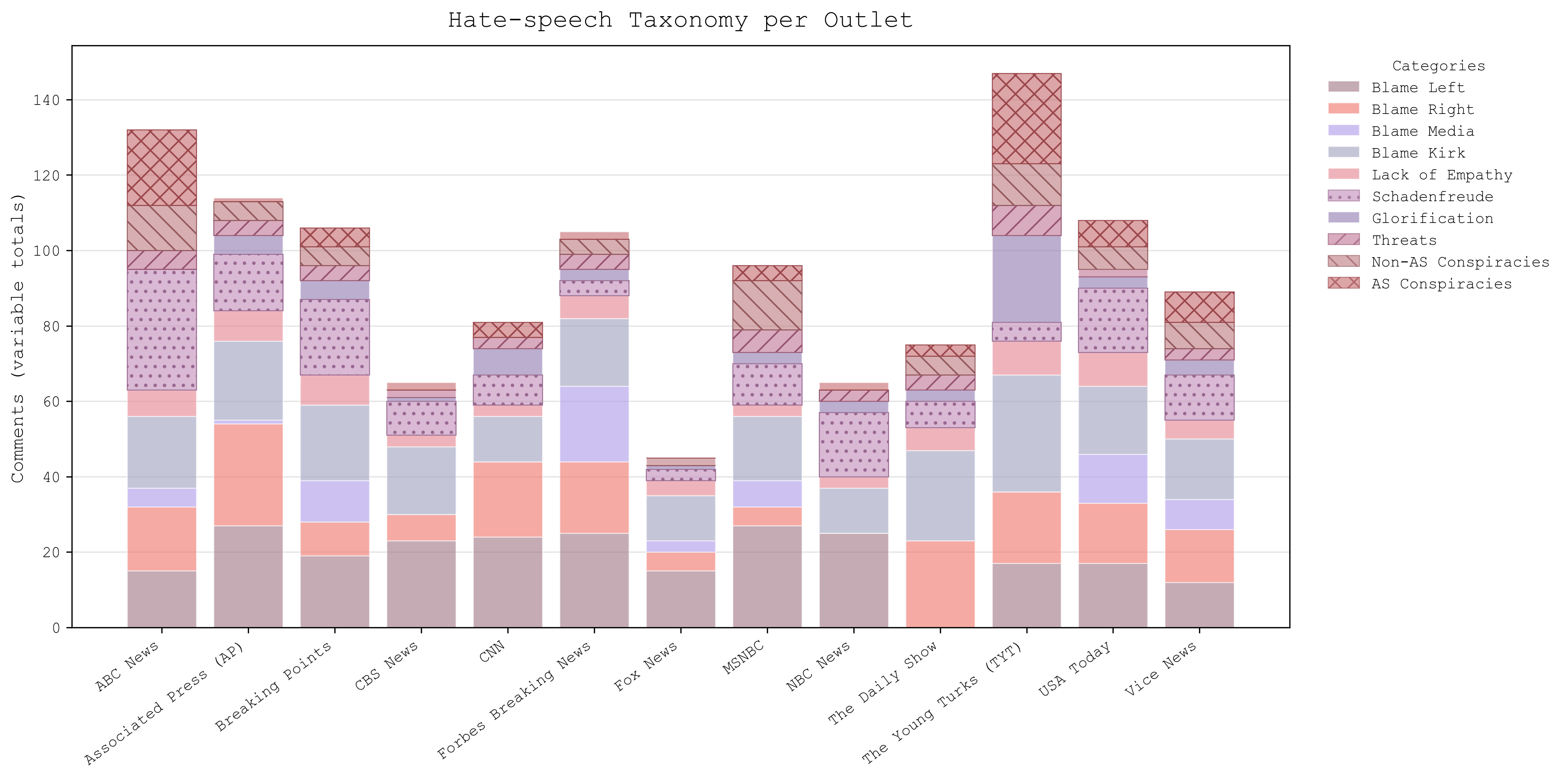
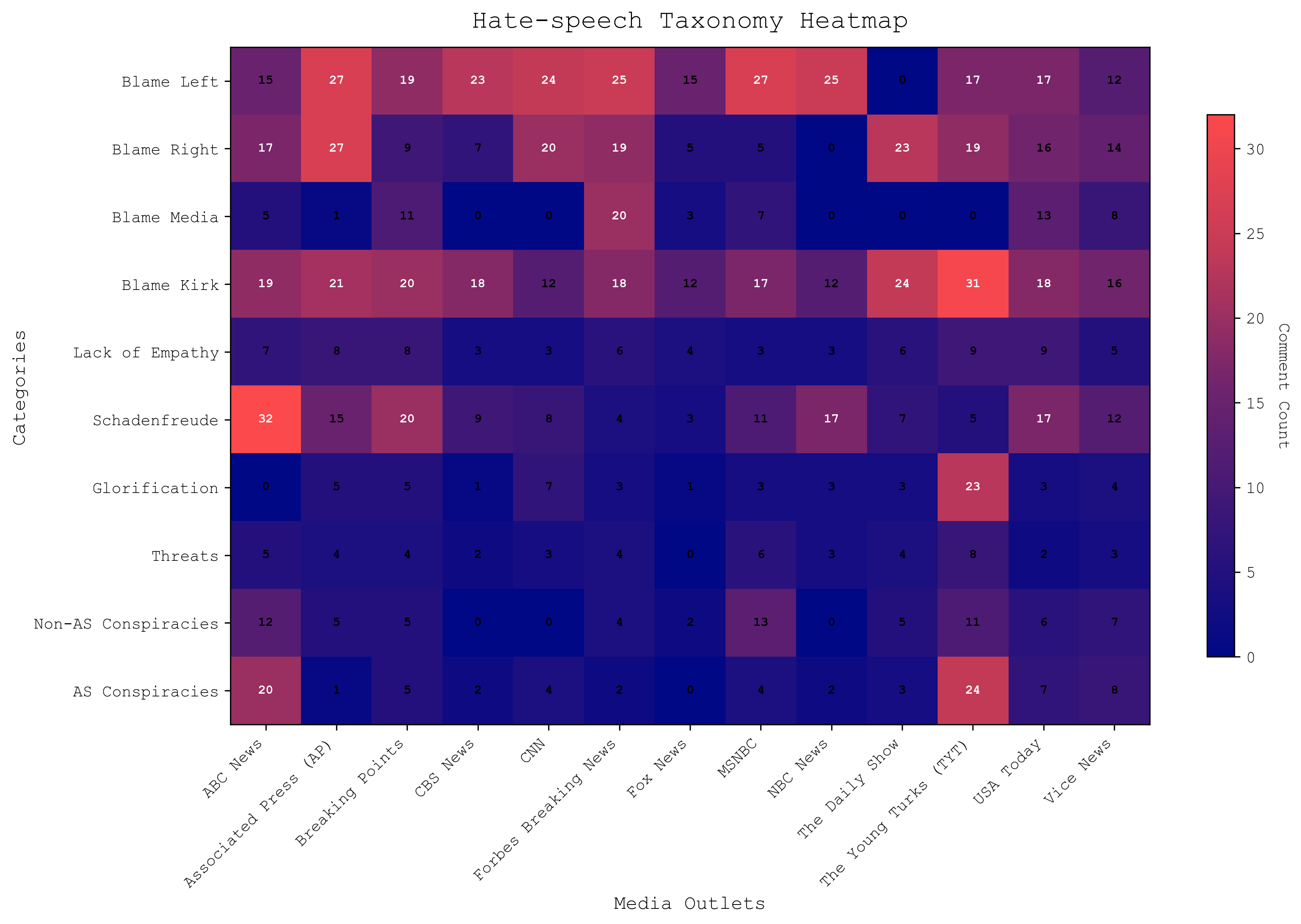
These categories were derived from the Decoding Antisemitism Lexicon (Becker et al., 2024), which systematizes rhetorical strategies and discursive patterns in online antisemitic and adjacent hate speech. This framework also ensures comparability with earlier case studies, such as reactions to the murder of two Israeli diplomats in Washington in May 2025, which revealed strikingly similar repertoires even in ostensibly moderate online milieus. The distribution of repertoires across outlets—for instance, stronger Kirk-blame on progressive platforms, denser antisemitic conspiracies on NBC/ABC/TYT, and predominance of anti-Left blame on Fox/Forbes—is analyzed in detail in the Results and Synthesis sections below.
3. Results
a) Quantitative Overview
Comment volume (200 per video, 2,400 total, distribution across outlets).
Category frequencies (Left’s fault, Right’s fault, Media, Kirk himself, Schadenfreude, Lack of empathy, Glorification of violence, Conspiracy [AS vs non-AS], other antisemitic concepts).
2. Qualitative Findings: Discursive Repertoires
Note upfront: A striking feature of the YouTube discourse is the way commenters collapsed broad political categories into singular, guilty collectives. Just as the conservative camp was frequently equated with the “radical right” or with MAGA extremists, so too were liberals treated as interchangeable with “the Left,” the Democratic Party, or progressive activists. Nuances between institutional actors, grassroots movements, and media figures were flattened, producing a polarized blame game in which entire political segments were cast as responsible for Kirk’s death. This reduction of complex political landscapes into binary camps underscores how online publics process violence through entrenched repertoires of projection, rather than through differentiated analysis of actors or causes.
2.1. Discursive Blame Projections
Public reactions to Kirk’s murder were saturated with blame projections. Commenters sought immediate culprits, rarely engaging in reflection or mourning. Four distinct targets dominated these projections: the political Left, the political Right, mainstream media, and Kirk himself.
a) The Left’s Fault
On MSNBC and CNN, many commenters projected blame almost reflexively onto Democrats and the broader Left. They framed liberals as violent, hypocritical, and intolerant, insisting that this was simply “terrorism from the left AGAIN” or that “Democrats shot an American hero.” Others turned the “tolerance” claim against liberals themselves, arguing that the “peaceful and tolerant left” was in fact dangerous and warning that “things won’t be safe until they are eliminated.”
This projection often intensified through identity politics and conspiratorial cues. On MSNBC, users claimed that “the shooter is a trans Antifa member” or that “Woke and LGBT+ culture laugh and celebrate this, and then ask for understanding and play the victim.” On AP threads, the rhetoric escalated to eliminationism: “the left needs to be stricken from existence.” Forbes threads added a systemic angle, asserting that “It is the MSM and Democrat Party that have all the dangerous rhetoric” or that “Dems are unhinged. Claim to be on the side of love and acceptance until you disagree with one of their views, then they try to take you out.”
CNN comments followed a simpler formula but reinforced the same narrative: “All the violence, every bit of it, is coming from the left … conservatives push for safe gun use.” Across outlets, the underlying logic was consistent: Democrats and liberals were not only responsible for Kirk’s death but represented the principal source of political violence in contemporary America.
Key Examples
“It is the MSM and Democrat Party that have all the dangerous rhetoric.” (Forbes)
“Dems are unhinged. Claim to be on the side of love and acceptance until you disagree with one of their views, then they try to take you out.” (Forbes)
“Terrorism from the left AGAIN.” (MSNBC)
“Democrats shot an American hero.” (MSNBC)
“The left needs to be stricken from existence.” (AP)
These comments portray the Left as hypocritical—claiming to defend tolerance but, in practice, enabling or celebrating violence. In Fox and Forbes threads, this trope dominated, while MSNBC and AP threads escalated the projection into eliminationist or conspiratorial rhetoric.
b) The Right’s Fault
On MSNBC and CNN, many commenters inverted the blame frame and argued that responsibility lay with conservatives themselves. Some insisted that the Right had normalized political violence, claiming that “nearly every single violent crime in the past decade has been from a RIGHT WINGER!!” or that “MAGA is eating its own. A MAGA tried to unalive Trump and another one got Chucky.” Others directed the blame squarely at Trump, writing that “we only have violence when Trump is in office. Blood is on MAGA’s hands.”
This projection often fused accusations against Kirk with broader indictments of the conservative movement. On MSNBC threads, one commenter declared bluntly: “No Trump and Kirk caused this with their hateful rhetoric.” Others personalized responsibility to Trump and his allies: “Trump is president, that’s karma,” or “JD Vance, Donald Trump and Mike Johnson? Yeah they sure need to be held accountable.”
On CNN and Daily Show threads, commenters emphasized pattern and precedent. One detailed catalogue listed: “The man who targeted and killed Rep Melissa Hortman … was a Trump supporter … The man who tried to kidnap Nancy Pelosi and assaulted her husband was a Trump supporter … There is no equivalent list of Democrats committing similar attacks.” Another mocked conservative attempts to externalize blame: “Trump would blame the left if he got a hangnail.”
Elsewhere, the projection focused more directly on Kirk himself as part of the right-wing problem. On ABC threads, one user claimed: “Charlie Kirk was shot as a direct result of Trump’s intentionally hateful rhetoric to ramp up division 😡👀.” CBS threads echoed this framing, with one remarking that “It may be sickening but it is a totally predictable consequence of the Trumpidian coup.” On TYT, a similar causal logic was made explicit: “Call it what it is: if Donald Trump was not president this would not have happened.”
By contrast, on Fox and Forbes threads, such blame-attribution was rare and often countered immediately. Still, even there, isolated voices turned the accusation back onto the right, e.g., “Floyd didn’t make a living with racist and hate speeches … Live by the sword, guess what?”
Key Examples
“Nearly every single violent crime in the past decade has been from a RIGHT WINGER!!” (MSNBC)
“We only have violence when Trump is in office. Blood is on MAGA’s hands.” (MSNBC)
“No Trump and Kirk caused this with their hateful rhetoric.” (MSNBC/Forbes)
“The man who targeted and killed Rep Melissa Hortman … was a Trump supporter … There is no equivalent list of Democrats committing similar attacks.” (CNN/Daily Show)
“Charlie Kirk was shot as a direct result of Trump’s intentionally hateful rhetoric to ramp up division 😡👀.” (ABC)
“It may be sickening but it is a totally predictable consequence of the Trumpidian coup.” (CBS)
“Call it what it is: if Donald Trump was not president this would not have happened.” (TYT)
These comments frame the Right not only as complicit in Kirk’s death but as the structural source of political violence in the U.S. They reflect a mirror-image projection to that seen on Fox or Forbes, where the Left was accused of orchestrating violence.
c) The Media’s Fault
Another recurrent blame frame targeted mainstream media. Commenters accused outlets such as MSNBC, CNN, and Fox of fomenting division, spreading hate, or even inciting violence directly. On MSNBC threads, some declared that “MSNBC and all its HATE FILLED staff have blood on its hands! They encourage a hate filled ideology giving evil and/or unstable people a reason to do terrible atrocities.” This trope of “blood on the media’s hands” condensed widespread resentment into a moralized accusation: the press was not reporting on violence but actively producing it.
On CNN threads, the suspicion was redirected toward conservative networks. Users retorted sarcastically: “I wonder where the shooter gets his news? Hmm. Fox trash news.” Such reversals illustrate how partisan publics refracted the same media-blame schema through their own ideological lens: liberals saw Fox as the corrupting agent, while conservatives saw MSNBC or CNN.
On Forbes and MSNBC threads, media-blame was fused with partisan accusations against Democrats, crystallizing in formulas such as “The Democrats and the mainstream media are evil and contributed to this Charlie Kirk murder” (Forbes) or “CNN and MSNBC must be held accountable for this horrific day 😡” (MSNBC). On NBC and ABC, media-blame comments took a sharper conspiratorial edge. One commenter insisted, “Hey NBC News your hate finally paid off.” Another generalized: “All MSM is complicit in his X’ing!” Such formulations positioned media not only as biased but as participants in a coordinated elimination of political opponents.
Although less frequent on Fox and Forbes, isolated cases of anti-media blame still appeared, often folded into anti-left accusations. The overall picture is one of symmetrical projection: left-leaning publics accused Fox, right-leaning publics accused MSNBC or CNN, and centrist outlets attracted blanket condemnation of “mainstream media” as a hostile force.
Key Examples
“MSNBC and all its HATE FILLED staff have blood on its hands!” (MSNBC)
“The Democrats and the mainstream media are evil and contributed to this Charlie Kirk murder.” (Forbes)
“CNN and MSNBC must be held accountable for this horrific day 😡.” (MSNBC)
“I wonder where the shooter gets his news? Hmm. Fox trash news.” (CNN)
“All MSM is complicit in his X’ing!” (ABC)
These examples show how distrust of the media cuts across the spectrum, with outlets selectively blamed depending on political orientation. In each case, the press was constructed as an active agent of violence rather than a neutral observer.
d) Kirk’s Own Fault
A final projection of blame targeted Charlie Kirk himself. Unlike accusations against political camps or media outlets, this frame personalized responsibility: Kirk’s rhetoric, worldview, and persona were said to have invited the violence. Within this discourse, four interwoven strands emerged: attributions of fault, refusals of empathy, claims that he deserved it (often framed through depictions of evil), and expressions of Schadenfreude.
a) Attributions of Fault
Many commenters argued that Kirk’s own words had normalized violence and therefore rebounded upon him. On MSNBC and CNN threads, users stressed causal reciprocity: “Your words do have consequences” and “If he wasn’t such a hater someone would not have shot him.” On CNN, others recycled his past statements, reminding readers that “Charlie Kirk himself called for violence and defended school shootings.” This “live by the sword, die by the sword” logic framed his death as the predictable outcome of his politics.
b) Refusals of Empathy
Other reactions stripped Kirk of sympathy altogether. Rather than framing his death as deserved, commenters simply refused to mourn. Irony and cold detachment dominated: “Thoughts and prayers. That’s what we do right? Am I doing it right? … WOOO… NAILED IT!” Another wrote: “O well … world keeps rolling … in Palestine they kill 100k people lets talk about that.” By denying Kirk empathy, commenters inverted his own statements — especially his dismissal of “empathy” as a damaging idea — and turned them back against him.
c) Attributions of Deservedness and Evil
A sharper variant cast his death not just as the result of his politics, but as morally justified. Some framed his death as karmic justice: “Karma” (MSNBC), “Racism is very expensive. It’s cost a lot of people their lives” (CBS), or “Blood is on your hands, son. Reap what you sow” (MSNBC). Others were more blunt: “He got what he deserved” (ABC), “this is on him. Full stop” (AP), “Flying too close to the sun has consequences” (ABC), or “Zero prayers. The world is already a better place” (CBS).
Alongside this retributive framing, several comments described Kirk as inherently malign, collapsing his persona into a symbol of evil: “Charlie Kirk is what evil looks like” (Forbes), “He was doing immense harm to the world every day” (MSNBC), and “Why would we help a Devil in human skin? Charlie is Satan’s problem, not ours” (ABC). In such formulations, the denial of empathy and the affirmation of just deserts merge: Kirk’s death is framed not only as earned but as appropriate for someone portrayed as morally corrupt or even demonic.
d) Expressions of Schadenfreude
Finally, many comments reveled in mockery, sarcasm, and irony. Across MSNBC, ABC, CBS, NBC, Fox, and TYT, mock-prayer and joking formulas proliferated: “Protect Ya Neck,” “Charlie Kirk became charlie murked,” or simply “Rip bozo.” Others taunted him with imagined posthumous encounters: “Now Charlie is certain of two things: supporting terrorist Israel will lead to your death and Jesus is not God.”
Additional jibes ridiculed his death in bodily or ironic terms: “Looks like he lost the gun debate” (CBS), “Bro was leaking 😂” (CBS), “He died an hour ago… 😂” (CBS), “OH MY GOD HA HA HA HA…” (NBC), “Gosh, it would really be a shame if something happened to that guy..lol” (Fox), or even “Nazism overdose” (MSNBC).
These comments illustrate how Schadenfreude became the dominant affect in many threads, displacing mourning with ridicule and transforming Kirk’s death into a meme-like spectacle.
While these blame projections dominated much of the discussion, they were not the only form of response. Alongside attributions of responsibility, many commenters framed the act itself in affirmative or celebratory terms, treating Kirk’s killing as either inevitable or desirable. These patterns are explored in the next section on affirmations and glorifications of violence.
2.2 Affirmation and Glorification of Violence
Beyond blame and mockery, a subset of commenters treated Kirk’s killing not as a loss but as something justified or even celebratory. These posts fell into two related repertoires: affirmations of violence, which cast the act as inevitable or deserved, and glorifications of violence, which elevated it as heroic or joyous.
Affirmation of Violence
Some users argued that Kirk’s death was the predictable consequence of his politics and therefore not tragic. On TYT threads, commenters insisted: “No it not tragic! This is the war they wanted. Give it to them!!!!” or “Stop it — he was all for what happened to Palestinians … If you ask me it’s a good start.” Others stressed karmic logic: “Flying too close to the sun has consequences” (ABC), or “He got people killed so who cares, he deserved worse! The world is better today than yesterday for it” (TYT). Here, violence was rationalized as reciprocity — a grim but fitting return on Kirk’s own rhetoric and positions. In many cases, affirmation shaded into claims that Kirk “deserved” his fate, either by tying his pro-gun statements back onto his own killing or by framing his support for Israel as justification for retributive violence.
Glorification of Violence
A smaller but sharper cluster of comments shifted from rationalization to outright celebration. On Forbes threads, one user praised the shooter directly: “We see what a well placed round can do. Nice shootin’, Tex 👍🏼.” MSNBC threads echoed this heroic framing: “Sometimes heroes don’t wear capes.” On ABC, users mocked Kirk with phrases like “Protect Ya Neck” or “Charlie Kirk became charlie murked.” In NBC threads, the tone turned openly eliminationist: “Let’s celebrate another Zionazi is deleted. Great day. America is great again.”
Together, these repertoires show how online publics not only stripped Kirk of empathy but also inverted his death into a lesson or a celebration. Affirmation framed the killing as the grim logic of politics, while glorification turned it into a moment of pride or entertainment. Both displaced mourning and normalized violence as a legitimate mode of political engagement.
The move from affirmation and celebration to conspiracy illustrates another discursive shift: rather than stopping at justification, many commenters sought to explain the shooting through hidden plots or broader ideological tropes. These dynamics are addressed in the following section.
2.3 Non-Antisemitic Conspiracy Narratives
Alongside direct blame attributions and expressions of Schadenfreude, a notable subset of commenters framed Kirk’s assassination as a staged or orchestrated event. These conspiracy narratives did not primarily rely on antisemitic motifs but instead revolved around themes of diversion, manipulation, or political expediency. In these accounts, Kirk’s death was not the result of an isolated perpetrator but rather of calculated design by powerful actors seeking strategic advantage.
One recurrent version was the false flag narrative, casting the shooting as a staged spectacle intended to generate political fallout. On MSNBC threads, users claimed: “FALSE FLAG! It’s a publicity stunt — just like Trump ‘getting shot’ with the obvious blood bag clapped to his ear.” TYT threads hosted similar suspicions, with one commenter alleging: “Wouldn’t put it past Dirty Don to have it done so he could send in military and cause more division n HATE.” These formulations positioned the killing as deliberately engineered deception, with the supposed purpose of sowing unrest or consolidating power.
A second strand invoked diversionary logic, linking the incident to other scandals. Forbes threads featured speculation that Kirk’s killing conveniently distracted from the Epstein case: “Two problems got solved at once … at the expense of one of their own most popular guys who was creating doubt around Trump.” CNN users echoed this linkage: “Charlie Kirk was pushing for the release of the Epstein files … False flag?” Here, the assassination was narrated as part of an effort to neutralize inconvenient voices and redirect public attention.
Finally, some comments generalized the explanation into broader elite orchestration frames. On ABC, one commenter insisted that “Globalists hate people who speak the Truth,” situating the shooting within a familiar populist repertoire in which shadowy, non-specified elites direct political violence.
Key Examples
“FALSE FLAG! It’s a publicity stunt — just like Trump ‘getting shot’ with the obvious blood bag clapped to his ear.” (MSNBC)
“Wouldn’t put it past Dirty Don to have it done so he could send in military and cause more division n HATE.” (TYT)
“Charlie Kirk was pushing for the release of the Epstein files … False flag?” (CNN)
“Two problems got solved at once … at the expense of one of their own most popular guys who was creating doubt around Trump.” (Forbes)
“Globalists hate people who speak the Truth.” (ABC)
These examples highlight how suspicion gravitated toward narratives of staging, diversion, or elite orchestration, framing Kirk’s death as part of a larger strategic manipulation rather than the action of a lone perpetrator.
While these conspiracy frames remained largely secular and politically focused, another subset of comments explicitly mobilized antisemitic tropes. Here, familiar repertoires of Jewish power, Mossad orchestration, and Zionist manipulation came to the fore, linking Kirk’s killing to longstanding conspiratorial imaginaries.
2.4 Antisemitic Tropes and Conspiracy Narratives
While non-antisemitic conspiracy frames attributed Kirk’s assassination to generic “false flag” operations, political diversions, or shadowy state actors, explicitly antisemitic conspiracies singled out Jews or Israel as the orchestrators. These narratives did not emerge as isolated online jokes but as reactive invocations of historically sedimented tropes, including Mossad orchestration, Rothschild control, and the motif of Jewish omnipotence. By embedding the event into longer-standing repertoires of Jewish power, Zionist manipulation, and Israel-linked orchestration, commenters contrasted their claims with the vaguer speculation of non-AS conspiracies and reactivated one of the most durable templates of modern antisemitic discourse.
One recurring theme was the allegation of Mossad involvement. On ABC and TYT threads, commenters suggested that the killing was ordered or executed by Israeli intelligence: “Assassinated by Mossad,” “Sacrificed for Israel by Netanyahu #mossad,” or “Mossad agents did it again.” A variant insisted that the assassin was already “on a private plane to Israel, never to be heard from again.” Such formulations cast Israel as orchestrating eliminations to silence dissent or control political outcomes.
A second cluster revolved around Zionist betrayal and instrumentalization. TYT and NBC threads speculated that Kirk had outlived his usefulness as a pro-Israel spokesman and was discarded by the very movement he once defended: “Zios just saw that he’s useless as spokesperson and got rid of him.” Others inverted his earlier support for Israel, suggesting that he himself had anticipated such an outcome: “Remember Kirk saying he thought Israel would kill him since he went anti-genocide recently.” In these accounts, Kirk’s death was framed as both retribution and proof of Zionist perfidy.
More diffuse, but equally common, were claims about Jewish control and servility. NBC threads alleged that “Jewish federations run both sides of politics,” while Forbes featured the charge that Kirk had “already sold out and kissed the Wall.” These accusations collapsed the event into the broader trope of Jewish omnipotence, casting both victim and perpetrator as pawns in a Jewish-controlled system.
A further layer of antisemitic conspiracism tied Kirk’s killing to false flag, apocalyptic, and diversionary logics. On TYT and ABC threads, commenters described the shooting as a Mossad “false flag,” alleged that “Zionists killed him to accuse Palestinians,” or connected it to Rothschild fantasies: “Ziorats did it. Rest assured. … They need to herd the diaspora to Palestine for their Zionist end times LARP.” Others claimed Israel engineered the murder to distract from political scandals or trigger war: “Tomorrow they’ll find a brown man in the crowd with an Iranian passport & the war will begin 😉 United States/Israeli terrorism play 101,” or “Trump and Israel … are the only ones who can benefit from this.” These comments placed Israel at the center of global manipulation, portraying Kirk’s assassination as part of a transnational plot.
Finally, antisemitic interpretations often blended with Schadenfreude. Some users mocked Kirk’s death as karmic punishment for his pro-Israel stance: “Oh no an Israeli propagandist is dead! :(” or “Now Charlie is certain of two things: supporting terrorist Israel will lead to your death and Jesus is not God.” Such comments combined the denial of empathy with conspiratorial logic, treating his killing as both deserved and orchestrated by Jewish power.
Key Examples
“Assassinated by Mossad.” (ABC)
“Sacrificed for Israel by Netanyahu #mossad.” (ABC)
“Mossad agents did it again.” (TYT)
“Zios just saw that he’s useless as spokesperson and got rid of him.” (TYT)
“Remember Kirk saying he thought Israel would kill him since he went anti-genocide recently.” (TYT)
“Jewish federations run both sides of politics.” (NBC)
“Charlie’s a traitor … already sold out and kissed the Wall.” (Forbes)
“Ziorats did it. Rest assured. … They need to herd the diaspora to Palestine for their Zionist end times LARP.” (TYT)
“Tomorrow they’ll find a brown man in the crowd with an Iranian passport & the war will begin 😉 United States/Israeli terrorism play 101.” (ABC)
“Now Charlie is certain of two things: supporting terrorist Israel will lead to your death and Jesus is not God.” (MSNBC)
These examples demonstrate how conspiratorial suspicion frequently reactivates entrenched antisemitic motifs, positioning Jews and Israel as orchestrators of political violence. In these accounts, Kirk’s assassination was not only politically motivated but also symptomatic of a transnational plot attributed to Jewish power, thereby reproducing one of the most enduring conspiratorial structures in modern antisemitic discourse.
2.5 Threats and Calls for Retaliation
Beyond attributions of responsibility, justificatory rhetoric, and conspiratorial sense-making, a distinct—and consequential—set of comments moved from interpretation to projection: they articulated explicit threats or called for further violence. These posts operate as speech acts that do not merely describe the event but seek to mobilize, intimidate, or normalize future attacks. Four overlapping motifs dominate this repertoire: targeted threats toward left-wing figures, reciprocal threats toward conservatives and MAGA figures, generalized fantasies of civil war or purges, and apocalyptic or antisemitic framings that integrate threats into broader conspiratorial narratives
Threats toward liberal/leftist figures
Some threads contained direct threats or calls to target liberal individuals and institutions. These ranged from personalized menace to exhortations that political opponents should be “held accountable” through violence. Examples include explicit formulations such as “Bs. Hopefully a liberal influencer is next for retaliation” (NBC) and “time to purge the left!!!!!” (NBC/AP threads). In many cases, the rhetoric blended grievance and incitement—presenting violence as a justified corrective rather than a criminal act. Where present, these threats often built on the same demonizing frames described earlier (the left as intolerant or existentially hostile), effectively turning moral condemnation into a mobilizing cue.
Reciprocal threats toward conservatives / MAGA
Conversely, other comments framed conservatives and specific right-wing figures as the next targets. These responses positioned the event within a narrative of retributive justice or in-group policing—e.g., “You’re going to be next,” or reminders of prior right-wing violence used to claim that the Right was now “eating its own.” Some users explicitly suggested retaliatory violence against prominent conservatives or celebrated the idea of internal purging within MAGA circles. Such posts frequently cited precedent (e.g., past assassination attempts or attacks by self-identified right-wing actors) to argue that escalation was both predictable and warranted.
Generalized fantasies of civil war or purging the other side
A number of comments moved beyond individual threats to imagine broader collective violence: civil war, mass purges, or systemic removal of political opponents. Language here is often hyperbolic but nonetheless performative—by articulating scenarios for large-scale conflict, these posts help create a discursive environment in which violence is a legitimate political instrument. Representative formations include calls to “purge” entire political groups or celebratory rhetoric that frames another death as one fewer political opponent (“One less MAGA we have to worry about,” NBC). These fantasies also frequently invoked militaristic metaphors and martyrdom scripts that can sustain longer-term mobilization.
Links to antisemitic/apocalyptic framings (where relevant)
Threat rhetoric sometimes intersects with antisemitic and apocalyptic conspiracies, amplifying both the reach and the severity of calls for violence. For example, conspiratorial narratives that attribute the event to Jewish or Israeli actors (Mossad, “Zionists,” Rothschild-linked conspiracy motifs) are occasionally coupled with exhortations to retaliate against perceived conspirators or their supposed domestic allies. A striking case on TYT threads included an explicit threat directed at Benjamin Netanyahu (“Hopefully Ben is next 🍌🤔”), which tied the call for further violence to an apocalyptic conspiratorial frame. In such hybrid discourses, threats are embedded within a cosmic struggle (“they” are orchestrating events to bring about an apocalyptic outcome), which can naturalize extreme responses as defensive or pre-emptive.
Tone and performativity: rhetorical menace vs. concrete plotting
It is important to distinguish rhetorical menace from credible operational threat. Much of the observed discourse functions performatively—bragging, venting, or seeking attention—rather than representing concrete plans. Nevertheless, performative threats can have real-world effects: they normalize violent imaginaries, signal permissive norms to others, and sometimes escalate into targeted harassment, doxxing, or offline violence. A nontrivial subset of comments blended call-out language with operational language (naming targets, suggesting methods), which raises the risk profile beyond mere rhetorical posturing.
Distribution across outlets
Threats appeared across the platform sample but varied by outlet and partisan composition. NBC and ABC threads contained comparatively high volumes of direct threat language (e.g., “time to purge the left!!!!!”; “Hopefully a liberal influencer is next for retaliation”), while MSNBC and TYT also showed examples of retaliatory rhetoric framed as karmic justice. Fox, Forbes, and CBS threads less frequently contained direct calls for retaliation, but isolated instances and counter-threats (threats against conservatives) were present in those spaces as well. Importantly, threats were not confined to any single ideological camp; they were a cross-cutting phenomenon that reflected polarized moral economies and different imaginaries of political self-defense.
Key Examples
“Bs. Hopefully a liberal influencer is next for retaliation.” (NBC)
“time to purge the left!!!!!” (NBC/AP threads)
“You’re going to be next.” (CNN forum replies)
“what you need is a toaster bath.” (CNN — hostile personalized threat)
“One less MAGA we have to worry about.” (NBC)
“When we rise we will remember people like you!” (CNN/NBC threads)
“The left needs to be stricken from existence.” (AP — eliminationist overlap)
“Hopefully Ben is next 🍌🤔.” (TYT — threat against Netanyahu, linked to AS/apocalyptic framings)
Analytical implications and transition
The threat repertoire completes the chain from blame to justification, from justification to conspiracy, and finally to threat. Even when couched in rhetorical excess, these comments perform crucial social work: they erode normative restraints on political violence, signal permissive group norms, and create discursive precedents for retaliation. These dynamics set the stage for the comparative reflections in Section 4.
4. Synthesis and Comparative Reflections
The analysis of discursive repertoires across eight outlets reveals not only the breadth of reactions to Kirk’s assassination but also their convergence around a set of recurring rhetorical logics. Blame projections, affirmations and glorifications of violence, conspiratorial sense-making (both non-antisemitic and antisemitic), and threats of retaliation constitute a chain of discursive escalation that moves from blame to justification, from justification to conspiracy, and from conspiracy to threat. While each repertoire is distinct, they overlap and reinforce one another, producing a polarized and often eliminationist communicative environment.
These repertoires illustrate how online publics responded to Kirk’s assassination not in isolated fragments but as interconnected steps in a wider discursive process. Section 2 traced these steps sequentially—from blame to justification, from justification to conspiracy, and from conspiracy to threats—while the present section zooms out to compare how these patterns were distributed across platforms, what affective tones they assumed, and what broader implications they carry.
Distribution Across Outlets
Patterns of emphasis differed sharply across platforms. Forbes and Fox threads skewed toward blame attributions—especially projecting guilt onto the Left—while registering relatively few antisemitic conspiracy tropes. MSNBC and CNN threads contained strong reciprocal projections onto the Right, often accompanied by refusals of empathy or Schadenfreude, but relatively little antisemitic content. NBC and ABC stood out for high volumes of antisemitic conspiratorial attributions, especially Mossad and Zionist tropes, alongside recurrent threats. TYT, by contrast, was the most intense case: it not only hosted blame directed in multiple directions but also carried the densest concentration of antisemitic conspiracy narratives, including Rothschild and apocalyptic motifs, coupled with explicit affirmations and glorifications of violence.
Affective Registers
The repertoires differed not only in target but also in affective tone. Blame projections were typically expressed in accusatory and partisan registers. Affirmations and glorifications shifted toward justifying or celebrating violence, with tones of karmic logic, pride, or mockery. Conspiracies frequently carried an ironic or world-weary tone (“false flag again”), but antisemitic variants combined suspicion with moral disdain, invoking historic tropes of Jewish omnipotence. Threats represented the sharpest affective break: they were not descriptive but performative, voiced as menace, vengeance, or mobilizing fantasy.
Escalatory Logics
The progression from blame to threat suggests an escalatory logic at work. Many threads began with blame (assigning responsibility to the Left, Right, media, or Kirk himself), then moved into justificatory frames (he deserved it, karmic return), which in turn blended with conspiracy narratives (“false flag,” “Mossad did it”). Finally, a nontrivial subset of comments pivoted to future orientation—explicit threats, fantasies of civil war, or calls for further elimination (“Hopefully a liberal influencer is next”; “Hopefully Ben is next 🍌🤔”). These stages are analytically separable but discursively entangled: justification opens the door to conspiracy, conspiracy provides narrative coherence, and threats extend the repertoire into projection.
Antisemitism as a Cross-Cutting Vector
While only a subset of comments were explicitly antisemitic, their presence is significant. Antisemitic conspiracy narratives reactivated long-standing repertoires (Mossad orchestration, Rothschild-linked plots, Jewish control of politics) and merged them with more general patterns of blame and threat. In TYT, NBC, and ABC threads especially, antisemitic tropes acted as bridging devices, connecting otherwise partisan blame frames to globalized narratives of manipulation. The Netanyahu threat on TYT illustrates this entanglement: an individualized call for violence couched within an apocalyptic conspiratorial horizon.
Implications for Political Discourse and Public Safety
The discursive environment that emerged after Kirk’s assassination demonstrates how digital publics process political violence through a volatile mix of accusation, mockery, conspiracy, and menace. The normalization of Schadenfreude erodes the expectation of mourning even for political opponents, while the circulation of antisemitic tropes embeds the event into historically sedimented repertoires of scapegoating. Most consequentially, explicit threats—even when performative—signal permissive norms for violence and help construct a moral economy in which retaliatory or preventive violence is imagined as legitimate.
Conclusion and Outlook
These findings show how moments of political violence become catalysts for discursive escalation online. Interpretations quickly migrate from blame to justification, from justification to conspiracy, and from conspiracy to threats of further violence. Antisemitic tropes amplify this process by linking immediate events to broader historical imaginaries of Jewish power and global manipulation, lending conspiratorial narratives both emotional intensity and cultural durability.
The implications extend beyond the case of Kirk’s assassination. Similar repertoires have surfaced in response to other episodes of political or antisemitic violence, from October 7 to the Washington museum shooting, suggesting a transnational repertoire of online reaction. Recognizing these patterns is therefore not only an academic exercise but also a matter of public concern. If left unchecked, such discursive environments normalize eliminationist language, blur the line between irony and menace, and create reservoirs of hostility that can spill into offline violence.
Future research should track how these repertoires circulate across platforms, languages, and national contexts, as well as how they interact with algorithmic amplification and media coverage. For policymakers, the findings highlight the need for more granular monitoring of discursive escalation—not just counting hate speech, but tracing how blame, conspiracy, and threats connect into dangerous chains of meaning. For civil society and education, the challenge is to build resilience against these narratives by fostering critical literacy about both antisemitic motifs and the logics of discursive escalation.
In this sense, the Kirk case is not an isolated eruption but a window into the evolving dynamics of digital discourse: polarized, conspiratorial, and permissive toward political violence.