
From Abuse to "Organized State Policy": A New York Times Column and Its Discursive Afterlife

AddressHate Research Scholar at NYU’s Center for the Study of Antisemitism | Lead, Decoding Antisemitism — PI, Decoding Hate | Research Advisor, AddressHate | Editor-in-Chief, Digital Hate Review
Executive Summary
On May 11, 2026, the New York Times published Nicholas Kristof’s opinion column “The Silence That Meets the Rape of Palestinians,” reporting a pattern of sexual violence by Israeli prison guards, Shin Bet interrogators, soldiers, and settlers against Palestinian detainees and civilians. The column appeared one day before the Times covered the release of the Civil Commission on October 7 Crimes by Hamas Against Women and Children — a development whose timing has become publicly contested between the Israeli Foreign Ministry, which says the Commission “approached the Times months ago,” and the Times, which denies advance knowledge.
This chapter is not a fact-check of individual allegations. Its target is how a prestigious opinion platform constructs moral and institutional conclusions from heterogeneous forms of evidence, and how those conclusions are subsequently amplified and extended by the comment-section readership the platform reaches. The chapter proceeds in two main parts.
The deconstruction. The column advances three substantive claims with substantively equivalent confidence — that individual acts of sexual violence occurred (Claim 1), that such abuse is widespread, repeated across institutional settings, and unpunished (Claim 2), and that it constitutes “an organized state policy” and “standard operating procedure” of the Israeli state (Claim 3) — plus a framing claim of moral symmetry between the column’s subject and the October 7, 2023 Hamas attack (Claim 4). The chapter argues that Claims 1 and 2 are substantially supported by the column’s sources and by independent corroboration including the Sde Teiman indictments, B’Tselem’s case files, Public Committee Against Torture in Israel complaints, and reform-oriented Israeli analysts (Sari Bashi inside the column; Haviv Rettig Gur and Matti Friedman outside it). Claim 3 is not warranted by the same sources. The UN report Kristof cites characterizes the leadership’s relationship to the abuse as “implicit encouragement”; the column drops the qualifier and renders it as “standard operating procedure” and “organized state policy.” Sari Bashi, the column’s named Israeli human rights source, tells Kristof on the record: “I don’t see evidence that it has been ordered.” After publication, former Prime Minister Ehud Olmert — whose quote the column placed near the end as confirmation — issued a Free Press statement disclaiming the policy framing the column built around his words: “I have no knowledge supporting these claims as I said to Mr. Kristof. Therefore, the positioning of my quote after pages of such allegations misrepresents my views.” Claim 4 (the symmetry frame) collapses substantive differences in scale, coordination, and operational character between the two phenomena the column treats as parallel — differences the column’s own author concedes elsewhere in the piece. The chapter identifies six argumentative moves by which the transformation from Claim 2 to Claim 3 is performed: qualifier-dropping, equivalence-by-presentation, selective hearing of named sources, symmetry as ontological claim, structural conditions framed as evidence of policy rather than as the alternative explanation, and institutional placement as authorization. Each is individually defensible as journalistic technique; their combination on a high-salience charge against a state is what produces the inferential architecture the chapter examines.
The reception. Analysis of 696 unique reader comments — drawn from the publicly visible portion of a moderated thread whose closed-thread footer reads 809 — published directly below the column on nytimes.com shows that the readership overwhelmingly accepted the column’s core argument: 92.5% of comments support the column’s claims, 2.0% reject them, 5.5% are non-evaluative. The substantive disagreement visible in the thread is not whether the abuse Kristof documents is real but how far the conclusions drawn from it should extend. Sixty-five unique comments (9.3%) escalate beyond what the column itself argues — into genocide framing (30 instances), rogue-state characterization (14), settler-colonial framing (7), and in six cases explicit denial of Israel’s right to exist. Concept-tagging using the 40-concept Decoding Antisemitism Lexicon (Becker et al., 2024, Palgrave Macmillan/Springer Nature) suggests a structural pattern worth registering: while state-rejection concepts cluster entirely in the escalation tail as expected, inversion and comparison concepts — Nazi Analogy (93%), Holocaust Inversion (89%), Conspiracy Theories (83%) — cluster in the modal confirmation register of the thread, embedded in comments whose explicit policy demand matches the column’s. The discursive registers most active in the comment thread are operating not at the extreme tail but in the ordinary register of Times-reader confirmation.
The two halves of the chapter sit in a relation worth registering as a finding in its own right. The framing operations identified in the deconstruction (qualifier-dropping, equivalence-by-presentation, symmetry as ontological claim, and the others) reappear in the discursive afterlife of this column, documented here through its comment-section reception. Historically-loaded antisemitic registers (Nazi Analogy, Holocaust Inversion, Conspiracy Theories) cluster not at the extreme tail of the discourse but at the modal-reader layer. The relationship between the deconstruction findings and the reception findings is not coincidental. The inferential architecture identified in the first main part is aligned with the comment-section pattern documented in the second. On the evidence available here, the framing and the uptake are aligned in ways consistent with the framing having shaped or facilitated the uptake. The data show correlation, not causation.
The broader analytical point the chapter raises can be stated narrowly. Reporting on individual abuses, even when the abuses are well-documented and the reporting is otherwise solid, does not automatically support the allegation that such abuses are systemic, organized, or constitutive of the institution under scrutiny. The argumentative move from singular event to systemic crime is a distinct inferential step. It is at that framing layer, not at the layer of the underlying reporting, that distortion and bias enter most easily, and that historically-loaded essentializing registers find their opening in the downstream uptake. The chapter does not claim that this is what individual columnists or editors intend. It claims that the inferential architecture, once in the public record, operates regardless of intent.
The chapter places the Kristof column within a small set of prior New York Times coverage episodes — the October 17, 2023 Al-Ahli Hospital headline and the July 25, 2025 Gaza-starvation front page — in which prominently-placed accusations against Israel were followed by Times-issued corrections whose reach was substantially smaller than the original framing. The chapter does not extrapolate beyond these three cases; what they illustrate is how, under contemporary editorial conditions, high-salience accusations can in particular instances outpace verification standards, with correction mechanisms operating more slowly than the mechanisms that produced the original framing. The Kristof column can reasonably be read as continuous with that small set of prior cases. The chapter does not claim more than that.
Introduction
On May 11, 2026, the New York Times published Nicholas Kristof’s opinion column “The Silence That Meets the Rape of Palestinians.” The piece reports a pattern of sexual violence by Israeli prison guards, Shin Bet interrogators, soldiers, and settlers against Palestinian detainees and civilians. It assembles fourteen first-person testimonies, three NGO and UN reports, two surveys, named indictments from the 2024 Sde Teiman case, and an on-the-record interview with former Israeli prime minister Ehud Olmert. Its central rhetorical structure is an appeal to symmetry: supporters of Israel rightly condemned the sexual violence of October 7, 2023, and consistency requires applying the same standard now.
The column appeared one day before the release of the Civil Commission on October 7 Crimes by Hamas Against Women and Children. This is a 300-page report drawing on over 10,000 photographs, thousands of hours of video, and more than 400 testimonies, much of it sourced from Hamas’s own GoPro footage. The Commission found October 7 sexual violence to be “systemic, widespread, and deliberate,” “carried out with exceptional cruelty,” and introduced the legal concept of kinoide for forcing family members to witness or perform sexual acts against one another. Former Canadian Justice Minister Irwin Cotler served as a principal contributor to the report. Named endorsers include Sheryl Sandberg, Hillary Clinton, Alice Wairimu Nderitu (former UN Special Adviser on the Prevention of Genocide), David Crane (former chief prosecutor of the UN Special Court for Sierra Leone), and Aharon Barak (former President of the Israeli Supreme Court). The Commission’s report is titled “Silenced No More.” Kristof’s column, published the day before it, is titled “The Silence That Meets the Rape of Palestinians.” The titular relationship between the two pieces, published twenty-four hours apart in the same week, is a discursively significant fact the chapter records without adjudicating intent.
Whether the New York Times had advance knowledge of the Commission’s release timing is disputed on the record. The Israeli Foreign Ministry has stated that the Commission “approached the Times months ago regarding its then-forthcoming report” and that the publication “said it was not interested.” Michal Cotler-Wunsh, former Israeli Special Envoy for Combating Antisemitism and now CEO of the International Legal Forum, has characterized the sequencing as a “complete burial of the commission report” and argued that the Kristof column “took up all the airspace.” Times spokesman Charlie Stadtlander has stated that the Times “never passed on the Civil Commission report and wasn’t told about its completion or the timing of its release” and that the Commission’s work “had no bearing on Nicholas Kristof’s opinion column or its publication timing.” The two positions are in substantive tension: “approached about a forthcoming report” and “told about its completion or timing of release” describe different events, but the institutional question of whether the Times engaged with the Commission’s existence before publishing Kristof’s column is now publicly contested. What is not disputed is the temporal fact: the column was published first, and the Commission’s findings entered the news cycle nearly twenty-four hours later, during the period in which the UN Secretary General was weighing which state actors to place on a sexual-violence blacklist. The chapter records the dispute as part of the case file and does not adjudicate it; what is analytically relevant for what follows is the temporal sequencing of two publications and the differences in reach between them, which obtain regardless of intent.
Within forty-eight hours the column had drawn detailed response from multiple Israeli and Israeli-American voices: Haviv Rettig Gur, Matti Friedman, Dan Senor, as well as a clarifying statement from Olmert himself distancing his on-the-record words from the article’s strongest claims. The article’s reception in the New York Times‘s own comment thread, the public-discourse trace the column left in the venue it was published in, is the subject of the second main part of this chapter.
This chapter proceeds in two main parts. The first deconstructs the column itself: what it argues, what its sources support, and where the inferential structure separates from the evidentiary structure. The second documents how that column was received in the comment thread published directly below it on nytimes.com: which claims the readers carried forward, which they let drop, and what registers of antisemitism-adjacent discourse saturated the uptake.
The chapter distinguishes the three substantive claims and one framing claim the article advances, enumerated in the dedicated claims section below. It accepts that the abuses Kristof reports occurred and that the case for them being widespread and unpunished is substantially supported. The case for claim 2 is corroborated independently through the Sde Teiman indictments, B’Tselem’s case files, the Public Committee Against Torture in Israel’s hundreds of complaints, Breaking the Silence testimony, and on-the-record acknowledgment from former and current Israeli officials. Reform-oriented Israeli analysts (Rettig Gur, Friedman) arrive at this assessment without needing the symmetry frame Kristof imposes.
The chapter’s argument is that Kristof’s piece does something beyond establishing the existence of the problem. This additional work, performed by editorial and framing choices rather than by the underlying evidence, slides the article from claim 2 to claim 3 in ways the evidence does not support and the article’s own sources explicitly contradict. Sari Bashi, executive director of the Public Committee Against Torture in Israel, tells Kristof on the record: “I don’t see evidence that it has been ordered. But there’s persistent evidence that the authorities know it’s happening and are not stopping it.” That is a precise statement of claim 2. The column prints it. It then proceeds, in Kristof’s own voice, to assert claim 3. Olmert, after publication, issued a Free Press statement explicitly denying that his quoted words supported the column’s stronger conclusions.
The distinction between condoned and organized is not a quibble. It determines what reform would address and how the Israeli state itself is to be characterized. It also determines what the discourse downstream of the column, in the comment thread, the topic of the second main part below, will repeat, escalate, and inscribe into the public record.
A note on what this chapter is and is not doing. It does three things and no more. It accepts that individual acts of sexual violence by Israeli personnel against Palestinians have occurred, and that there is substantial evidence of repeated, unpunished abuse across institutional settings. It examines, narrowly, whether the further step taken in Kristof’s column, that these abuses constitute an “organized state policy” and “standard operating procedure,” is warranted by the sources he cites. And it places that examination within the discourse context in which the column was written, edited, and read. The chapter does not claim that Kristof or his editors acted in bad faith. It does not claim that the New York Times intentionally amplifies anti-Israel narratives. It does not claim that all advocacy-sourced reporting is structurally compromised. Those would be different arguments requiring different evidence. The argument here is narrower and, for that reason, harder to dismiss: a specific inferential move in a specific column, examined against the column’s own sources.
The analytical question the chapter raises through this case is general even if its evidence is local. The move from reporting individual abuses to alleging systemic, organized state crime is an inferential step that the underlying reporting does not automatically license. It is at that step, not at the level of the documented misconduct, that framing, generalization, and downstream essentialization gain their structural opening.
The chapter proceeds in five steps. It sketches Kristof’s positioning as a columnist and the authority readers project onto the byline; specifies the substantive and framing claims the article advances; tests those claims against the sources the column itself cites; situates the column within a small set of recent New York Times coverage episodes; and turns finally to the comment thread published directly below the column on nytimes.com, asking which of the column’s claims its readership carried forward, which it let drop, and what discursive registers saturated the uptake.
Nicholas Kristof’s positioning, and the authority readers project onto the byline
The column did not arrive as anonymous testimony. It arrived under one of the most recognizable bylines in American opinion journalism, attached to a reporting tradition with specific epistemic features. Three observations about that positioning are relevant for what follows, and they are about positioning only — not about motive, sincerity, or character.
Kristof has been a New York Times opinion columnist since 2001 and a Times journalist since 1984. He is a two-time Pulitzer Prize winner — for international reporting on Tiananmen Square (1990, shared with Sheryl WuDunn) and for commentary on Darfur (2006). His reporting and column work over four decades has centered on humanitarian crises, mass atrocities, sex trafficking, and wartime sexual violence in contexts including Cambodia, Sudan, the Democratic Republic of the Congo, Myanmar, Tigray, and most recently Sudan and Gaza. He has worked across this terrain longer and more publicly than any sitting American op-ed columnist.
That reporting tradition has shaped how a piece under his byline is received. The convention his readers have come to expect is what could be called moral-witness journalism: the reporter travels to a site of atrocity, conducts in-person interviews with survivors whose accounts mainstream Western audiences have not heard, and constructs the column as a vehicle for testimony that institutional power has failed to register. The trust readers extend to such a column rests not on the column’s internal evidentiary apparatus — readers cannot evaluate Sde Teiman indictments or NGO methodology in real time — but on the byline’s accumulated record of having gotten this kind of reporting substantially right in prior cases. The authority is transferred from the prior cases to the present one, before the present case has been adjudicated on its own evidence.
This is the epistemic configuration the column operates within. A claim under this byline does not enter the discourse with the evidentiary weight intrinsic to its sourcing; it enters with the additional weight of the moral-witness tradition. That additional weight is what permits an opinion-section piece to function, for many readers, as documentation. It is also what makes inferential slides under this byline particularly consequential. A claim that would be hedged or qualified in a news-side report — published as opinion by Kristof — circulates as documented atrocity. The deconstruction that follows is, in part, an attempt to read the column as it would be read in a strict evidentiary register, with the moral-witness premium temporarily suspended, in order to see what the underlying source-base actually supports.
The chapter does not contest the moral-witness tradition as such; it is a legitimate genre with a long and serious record. What the chapter contests is the assumption that a specific column’s specific inferential moves can ride on the genre’s accumulated authority without being independently examined.
The article’s claims
Before the deconstruction proper, it is worth fixing the target. The column advances three substantive claims about Israeli conduct, treated in the column with substantively equivalent confidence, plus one framing claim that organizes the column’s rhetoric:
Claim 1. Individual acts of sexual violence occurred against Palestinian detainees and civilians, as reported in the column’s 14 first-person testimonies and supporting documentation.
Claim 2. Such abuse is widespread, repeated across institutional settings (prison guards, Shin Bet interrogators, soldiers, settlers), and effectively unpunished. A pattern of tolerated misconduct under conditions of impunity.
Claim 3. Such abuse constitutes “an organized state policy” and “standard operating procedure” of the Israeli state. A claim about design, not failure.
Claim 4 (framing claim). The sexual violence committed by Hamas on October 7, 2023, and the sexual violence committed by Israeli actors against Palestinians are morally and structurally commensurate, such that “consistency requires” applying the same moral standard to both.
The chapter accepts Claim 1 as well supported. It argues that Claim 2 is substantially supported by the column’s sources and by independent corroboration. The chapter examines, narrowly, whether Claim 3 and Claim 4 are warranted by the same sources. Its argument is that they are not. Claim 3 represents an inferential step beyond what the underlying evidence supports, contradicted in places by the column’s own quoted sources. Claim 4 collapses substantive differences in scale, coordination, and operational character between two phenomena the column treats as parallel.
Deconstruction: testing the claims against the evidence
The sections that follow read the column as if the byline’s accumulated authority were temporarily suspended, in order to see what the underlying source base, on its own terms, supports and what it does not. They begin with what the column draws on and where its reporting is strong. They then identify where the inferential structure separates from the evidentiary structure. They close with the column’s diachronic context within the Times itself.
1. What the article is built on
Kristof draws on: 14 first-person interviews with men, women, and children reporting sexual assault by Israeli detention staff or settlers; supplementary interviews with family members, lawyers, social workers, and investigators; a 2025 UN Independent International Commission of Inquiry on the OPT report describing sexual violence as part of Israel’s “standard operating procedures” with “implicit encouragement by the top civilian and military leadership”; an April 2026 Euro-Med Human Rights Monitor report describing “systematic sexual violence” as “an organized state policy”; a Save the Children survey (July 2023, “Stripped, beaten and blindfolded”) of detained Palestinian minors; a Committee to Protect Journalists survey of 59 released Palestinian journalists; documentation by B’Tselem, and a Norwegian Refugee Council–led West Bank Protection Consortium report; testimony collected by Breaking the Silence; and on-the-record statements from the Israeli Prison Service, Itamar Ben-Gvir, Benjamin Netanyahu, and Ehud Olmert.
2. Where the reporting is strong
The sourcing is triangulated: testimony, NGO reports, surveys, named indicted cases, and acknowledgment from inside Israeli legal and political circles.
The Sde Teiman case is a hard empirical anchor: a Palestinian prisoner was hospitalized in July 2024 with a torn rectum, cracked ribs, and a punctured lung; when military police detained reservists for questioning, a mob stormed the base; five reservists were indicted in February 2025; the charges were dropped in March 2026. The settler attack on the farmer Suhaib Abualkebash in the Jordan Valley is similarly well-documented. Matti Friedman, discussing the column on Dan Senor’s Call Me Back podcast, classified it as “as far as I know accurate, much to our shame.”
Bashi’s account that her organization has filed “hundreds of complaints” with “not a single case” leading to charges is significant. It is reinforced by the prison service spokesman’s response to Kristof, which declined to say whether any prison staff member had ever been fired or prosecuted for sexual assault. That declination, combined with Bashi’s numbers, is the column’s strongest single piece of structural evidence. Complaints exist in volume. Prosecution does not. This is claim 2 documented at the institutional level.
The piece is methodologically transparent about limits. Kristof writes that it is “impossible to know how common sexual assaults against Palestinians are” and acknowledges that not all cases could be corroborated. Rettig Gur, from inside the Israeli debate, lands in the same place. Many indictments. Case numbers in the dozens and probably the low hundreds across three years. “The problem is real. It’s there, it’s real, and it doesn’t seem to be stopping.” Friedman: putting a politician of Itamar Ben-Gvir’s stated views in charge of Israeli law enforcement creates structural conditions in which “many reasons for concern” become predictable. Two reform-oriented Israeli analysts arrive at this assessment without needing the symmetry frame Kristof imposes. The question for the rest of this chapter is what Kristof’s article does beyond establishing the existence of the problem.
3. Where the reporting is weaker
Corroboration confirms disclosure, not occurrence. When confidants confirm that a victim told them about an assault, this confirms the disclosure happened, not that the underlying event occurred as described. This is standard trauma-reporting practice and not a defect in itself. But the piece treats corroborated and uncorroborated cases as substantively interchangeable in its cumulative argument. The unnamed-source pattern is heavy. Several journalists who reviewed the piece claim-by-claim described it as built around “an unnamed woman, unnamed soldiers, an unnamed location, dogs trained to rape humans, story after story with no date, no place, no name.”
Kristof’s appended editor’s note in the comments section, “in fact-checking we went through it all over again,” functions as a defensive appeal to verification rigor at precisely the points where the column’s verification is weakest. The note inoculates against the charge it cannot answer.
The Euro-Med Human Rights Monitor source is undercharacterized. Kristof describes it as “often critical of Israel.” Euro-Med is a highly contested source. Critics, including Israeli analysts and at least one Palestinian commentator (the writer Ahmed Fouad Alkhatib), have raised concerns about its sourcing methods, the institutional affiliations of its leadership, and its prior circulation of claims that did not survive verification (including the assertions that Israel uses weapons that “vaporize” Palestinians and that Israel harvests organs of Palestinian dead). These criticisms are not uniformly accepted. Euro-Med disputes them. The chapter does not adjudicate the dispute. The chapter notes that a reader weighing the column’s central systemic claim, “an organized state policy,” should be in a position to know that the source from which that formulation derives is the subject of substantive and ongoing methodological dispute. The phrase “often critical of Israel” does not convey this.
The Norwegian Refugee Council/West Bank Protection Consortium report does not establish what Kristof uses it to establish. As Rettig Gur identifies, the report claims systemic sexual violence in the West Bank on the basis of approximately 16 incidents across three years in a region of roughly 3 million Palestinians and half a million Israelis, with some incidents barely meeting the threshold for harassment. That base does not support “systemic” or “one of the mechanisms driving people from their land.”
The Save the Children and CPJ figures float. “More than half” of detained minors witnessed or experienced sexual violence. But the piece gives no sample size, recruitment method, or operational definition. The CPJ figure (3% rape, 29% other sexual violence) comes from 59 journalists. The numbers reflect a serious problem. They do not, on their own, support a systemic-policy claim.
The trained-dogs claim has a contested source lineage. Both Rettig Gur and Friedman trace it to identifiable origins outside the mainstream press. Friedman describes the claim as sitting “within the world of the darkest conspiracies that you hear while riding in cabs in Middle Eastern countries.” Whether one accepts that characterization or not, the claim had been ignored by mainstream press outlets prior to its appearance in the Kristof column. One specific link in the column’s source chain is worth flagging. Kristof’s piece referenced an April 2026 viral tweet by Shaiel Ben-Ephraim, which had compiled secondhand testimony purporting to confirm the dog allegations. Ben-Ephraim left UCLA in 2020 amid accusations of sexual harassment, which he subsequently acknowledged as “inappropriate behavior.” The column does not flag this provenance for readers. The chapter does not claim the allegation is false. The chapter claims it rests on a source chain that overlaps with known propaganda narratives, lacks independently verifiable corroboration, and is presented in the column without any indication to the reader that its evidentiary status differs from that of the named, indicted Sde Teiman case. The equivalence in presentation is the methodological problem.
A further word on the trained-dogs allegation is warranted. The article’s restraint on the truth-value of the claim is principled, not endorsing. Its methodological commitment is to examine how claims of varying evidentiary status are presented under common institutional authority and what readers do with them, not to verify the claims themselves. That said, the substantive plausibility of the specific allegation — that dogs were trained to sexually assault human prisoners — is highly improbable on its face, and the column offers no corroboration that would override that prior. The trope of trained-animal sexual assault has also appeared in earlier atrocity-propaganda contexts and merits editorial skepticism it did not receive here. The article does not adjudicate the underlying factual question. It registers that the column’s editorial decision to present this allegation in the same prose register as the indicted Sde Teiman case is the methodological problem, regardless of whether the allegation is later substantiated. Readers seeking adjudication of the underlying claim should consult Friedman’s discussion on the Call Me Back podcast and any subsequent verification work undertaken by news-side reporters.
4. The central inferential gap: condoned versus organized
The evidence supports Claim 1 and substantially supports Claim 2. Claim 3 is different in kind. It asserts design, not failure.
The most consequential textual evidence here is internal to the column. The UN report Kristof cites characterizes the leadership’s relationship to the abuse as “implicit encouragement by the top civilian and military leadership.” That word implicit is doing significant work. It is the qualifier that distinguishes “leadership tolerates and does not stop” from “leadership orders and organizes.” Kristof prints the UN’s qualifier accurately. Then, in his own framing voice, he drops it. The UN’s implicit encouragement becomes Kristof’s standard operating procedure and organized state policy. The slide is visible inside the column’s own citation chain.
The column’s named Israeli human rights sources reinforce the gap. Bashi: “I don’t see evidence that it has been ordered.” Ben Marmarelli, the other Israeli lawyer Kristof cites, describes prevalence: rape with objects “is going on across the board.” That is a description of frequency, not of policy. Both Bashi and Marmarelli are claim-2 sources. Neither offers a claim-3 source. The column’s own self-undermining sentences sit alongside these: “There is no evidence that Israeli leaders order rapes,” and “It’s impossible to know how common sexual assaults against Palestinians are.” These are claim-2 hedges. They appear in the same column that calls sexual violence Israel’s “standard operating procedure.”
Rettig Gur’s assessment from inside the Israeli debate lands on claim 2. There is a breakdown of discipline. Ben-Gvir and Netanyahu are not interested in fixing it. The problem will fester if not stopped. Serious, named, internal critique. None of it warrants the phrase “organized state policy.”
4.5 The inferential mechanism: how the move from incident to policy is performed
The previous section named the destination: Kristof’s claim that the abuses constitute “an organized state policy” and “standard operating procedure,” a claim the column’s own sources do not warrant. The mechanism is what remains to be shown. By what specific argumentative moves does a competent columnist transform an evidentiary base that supports claim 2 (widespread, unpunished abuse) into a published statement of claim 3 (organized state policy)? The sections that follow examine particular instances. This section names the moves in sequence, so the pattern is visible.
Move 1: Qualifier-dropping. A cited source contains an epistemic hedge — implicit, appears to be, allegedly, consistent with — that distinguishes one claim from a stronger neighbor. The columnist quotes the source accurately. Then, in his own framing voice, he paraphrases it without the hedge. The UN report's "implicit encouragement by the top civilian and military leadership" becomes "standard operating procedure" and "organized state policy" in Kristof's framing voice a few paragraphs later. The qualifier did precise work in the original. The distinction it preserved is between a leadership that knows misconduct is happening and does not stop it, and a leadership that has organized the misconduct as policy. Both are serious; they are not the same. Its removal performs the inferential slide. A reader encountering Kristof's stronger formulation has no internal cue that the original wording was softer.
Move 2: Equivalence-by-presentation. Claims of widely different evidentiary status appear in identical textual registers: same paragraph weight, same source-citation form, same authorial tone. The reader has no internal cue distinguishing a documented case from an uncorroborated allegation. The Sde Teiman case, in which five reservists have been indicted by Israeli military authorities, sits in the same prose pattern as the trained-dogs allegation, whose source chain Friedman and Rettig Gur trace to known propaganda channels. Both are rendered as elements of “the same pattern” of conduct. The equivalence in presentation encourages readers to process the claims as evidentially comparable.
Move 3: Selective hearing of named sources. When a source quoted in the piece offers both a strong claim and a weak claim, the columnist’s framing carries forward the strong claim and lets the weak one drop. Sari Bashi tells Kristof on the record: “I don’t see evidence that it has been ordered.” The sentence is printed. It does not appear in the column’s framing. The same sentence that disqualifies the policy claim is published and then ignored. After publication, Ehud Olmert issues a statement clarifying that his quoted words do not support the column’s stronger conclusions. The statement appears in a different outlet.
Move 4: Symmetry as ontological claim. A rhetorical frame presents two phenomena as morally and structurally parallel: “Whatever our views of the Middle East conflict, we should be able to unite in condemning rape”; “The horrific abuse inflicted on Israeli women on Oct. 7 now happens to Palestinians day after day.” The frame operates as if the comparison were definitional rather than empirical. The column’s own scope acknowledgment contradicts the parallelism: Tigray and Sudan reflect sexual-violence scales “far greater than anything committed by either Hamas militants or Israeli guards or settlers.” That acknowledgment does not displace the symmetry frame from its position in the column’s framing.
Move 5: Structural conditions as evidence of policy rather than as the alternative explanation. The column documents prolonged detention without external oversight, overcrowding, exposure of reservist guards to October 7 attack videos, and an ideological climate set by Ben-Gvir. Bashi inside the column, and Rettig Gur, Friedman, and the Israeli Public Defender's Office outside it, read these same conditions as the cause of widespread misconduct under impunity. That reading supports claim 2. Kristof presents the same conditions as confirmation of claim 3. The observations are identical. The conclusions licensed by them are different, depending on the framing. The stakes of the difference are not interpretive only. A reading that locates the cause of the misconduct in degraded oversight, undertrained reservist staff, and the absence of external accountability mechanisms identifies a set of structural conditions whose remedy is institutional reform. A reading that locates the cause in organized policy identifies the state itself as the object requiring characterization. The factual base supports the first reading. The column's framing licenses the second.
Move 6: Institutional placement as authorization. The piece appears on the opinion page of the New York Times. Material that, by reported newsroom assessment, would not have passed news-side verification reaches readers under the paper’s institutional authority. The byline does the authority-conferring work. A reader has no internal cue distinguishing opinion-page material from news-side reporting. The column’s framing carries that authority into the public record, and, as the second main part of this chapter documents empirically, into the discourse downstream.
Each of these six moves is individually defensible as journalistic technique. Any of them can be deployed in a column where the underlying argument is correct, and the result reads as competent reporting. The methodological problem the chapter is naming concerns what happens when these techniques are deployed in combination on a high-salience charge against a state, with downstream readership numbering in the hundreds of thousands. The inferential architecture transforms a documented pattern of impunity into a published claim of designed policy. No single move is identifiable as the one that performed the transformation. The sections that follow — on the symmetry frame, the Olmert quote, the “American tax dollars” frame, the Abu Ghraib analogy, the NGO source pipeline, and the opinion-page mechanism — examine these moves at the level of individual instances in the column.
5. The symmetry frame
The symmetry frame is what the claims section identified as Claim 4. The piece opens and closes with structural equivalence between October 7 sexual violence and the abuses Kristof documents:
“It’s a simple proposition: Whatever our views of the Middle East conflict, we should be able to unite in condemning rape.”
“Think of it this way: The horrific abuse inflicted on Israeli women on Oct. 7 now happens to Palestinians day after day.”
The two phenomena being compared are structurally different in ways the article does not address. October 7 was a coordinated mass attack by an armed group, executed within several hours, in which sexual violence functioned as a tactic of war against civilians. The Civil Commission characterized it as “systemic, widespread, and deliberate,” documented across more than 400 testimonies and over 10,000 photographs. What Kristof documents is misconduct by individual state actors distributed across institutional settings, over years, under conditions of impunity. The chapter does not claim that comparison between the two is impermissible. Moral consistency is a legitimate frame, and the column’s appeal to it is not in itself the problem. The problem is that the comparison the column draws rhetorically compresses major differences in scale, coordination, evidentiary certainty, and operational character. Both are condemnable. They are not, on the evidence presented, parallel expressions of the same phenomenon.
Kristof’s own scope acknowledgment cuts against his closing. He writes that he has covered places “where the scale of sexual violence is far greater than anything committed by either Hamas militants or Israeli guards or settlers”: Tigray, Sudan. The man writing the “day after day after day” closing concedes, in passing, that both phenomena together are scaled-down relative to mass-rape events he has covered elsewhere. The symmetry frame is performed against that admission.
The publication timing reinforces the frame’s effect. Whatever the Times‘s advance knowledge of the Civil Commission’s release schedule (now publicly disputed; see the introduction), the temporal fact is that Kristof’s column reached Times readers first. The Commission’s findings reached them the following day. Independent of intent at the byline level, the institutional consequence is that the Times‘s first contribution to its readership’s understanding of the comparative scale of wartime sexual violence in this conflict was the symmetry frame. The underlying documentation arrived afterward, into a discourse the column had already shaped.
Dan Senor, on his Call Me Back podcast, offered one reading of what the symmetry frame produces in practice. The column allows readers to argue, in effect, that “Hamas is a sick, depraved society. And now we know, as Kristof albeit says, Israel is a sick, depraved society. Isn’t it a shame that both societies are so broken.” Kristof does not use that language. The chapter does not impute it to him. What the chapter does claim is more limited: the structure of the column’s framing channels readers toward something close to Senor’s formulation, regardless of the framing’s intent at the level of authorial psychology.
6. The Olmert quote and the post-publication clarification
“Do I believe it happens?” he asked. “Definitely.”
“There are war crimes committed every day in the territories,” he added.
Olmert’s printed acknowledgment lends weight to claim 2. It does not lend weight to claim 3. The placement of the quote near the end of the piece, after the “organized state policy” framing has been introduced, encourages the inferential slide. The quote itself does not perform it.
After publication, Olmert addressed the column directly in a statement to the Free Press:
“Mr. Kristof’s article includes claims of extraordinary gravity: that Israeli authorities have directed the rape of children, that dogs have been used as instruments of sexual assault, that systematic sexual torture is state policy. I have no knowledge supporting these claims as I said to Mr. Kristof. Therefore, the positioning of my quote after pages of such allegations misrepresents my views.”
Olmert’s clarification separates two propositions the column rhetorically fuses. He confirms that abuses occur (”Do I believe it happens? Definitely”). He explicitly disclaims having authority for the three escalated claims he names: directed rape of children, dogs as instruments of sexual assault, and systematic sexual torture as state policy. He also names the rhetorical mechanism by which the misrepresentation operates. It is the positioning of his quote after pages of such allegations.
The column’s most authoritative on-the-record Israeli source has, in his own words, separated claim 2 from claim 3. He has stated that the column’s structure performs the inferential slide in his name without his authority. A column that drew an “organized state policy” conclusion from sources who explicitly say only that abuse occurs and is not being stopped did not, even at the level of its own quoted material, ever have the authority for the conclusion its framing implies.
7. The “American tax dollars” frame
“Yet our American tax dollars subsidize the Israeli security establishment, so this is sexual violence in which the United States is complicit.”
This restructures the article from “documentation of abuses by a foreign government” to “documentation of abuses in which the reader is implicated.” The reader’s response is no longer assent or disagreement. It is complicity or repudiation. The column closes by addressing this implication directly to the Trump administration and naming Marco Rubio, now Secretary of State, in the opening as one of those who condemned October 7 sexual violence. The column positions itself as a moral challenge to figures with current policy authority.
The argument from US aid → US complicity → US obligation is defensible foreign-policy commentary. It is also an argument, not a premise. The piece treats it as a premise. The rhetorical effect is to remove the option of analytical distance.
8. The Abu Ghraib analogy and the breakdown-of-discipline reading
Kristof’s interpretive framework is explicit:
“Decades of covering conflict have taught me that a combination of dehumanization and impunity can propel people into a Hobbesian state of nature.”
He invokes Abu Ghraib and the Abner Louima case as comparative anchors. His exact phrasing, that dehumanization-plus-impunity “roughly explains how American soldiers came to sexually abuse prisoners at Abu Ghraib,” is hedged. He does not claim Abu Ghraib was US policy. The same hedge, applied consistently, would foreclose the “organized state policy” framing for Israel.
The structural conditions Kristof himself documents support the breakdown-of-discipline reading. By his own count, Israel has detained 20,000 people in the West Bank since the October 7 attacks. More than 9,000 are still being held. Most have been denied visits from the Red Cross and lawyers since 2023. Closed institutions without external oversight, overwhelmed in capacity, staffed in part by under-trained reservists drafted after October 7 and exposed to Hamas’s own attack videos: these are the conditions Rettig Gur identifies as the proximate cause. They produce predictable patterns of misconduct under impunity. They do not require organized policy. Kristof benefits from the moral force of the stronger framing while his interpretive scaffolding sits with the weaker one.
9. The NGO source pipeline
A piece like this is not assembled from scratch. Matti Friedman, who covered the Israeli–Palestinian conflict for the Associated Press’s Jerusalem bureau (2006–2011) and whose 2014 analyses in The Atlantic and Tablet mapped the structural mechanics of Western press coverage of this conflict, identifies the assembly pattern:
“Nicholas Kristof is not based here. He doesn’t have a handle on events here. What’s happening is that he’s being handed a package by NGOs.”
A note on positionality. Friedman and Rettig Gur, who are central to this chapter’s analysis, are not neutral observers. Both write from within a broadly Zionist frame and have their own substantive disagreements with Western press coverage of Israel. The chapter draws on them not as final authorities but because their factual descriptions of newsroom workflows and Israeli institutional processes are independently checkable and converge with evidence from other sources, including Israeli reform-oriented institutions and at least one Palestinian commentator (Alkhatib) who criticizes the same column from a different starting point. Friedman’s more polemical formulations, for instance his characterization of this article as “essentially an NGO hit job,” are his analytic verdict, not the chapter’s. The chapter uses Friedman’s structural description. It does not adopt his rhetorical conclusion.
The structural pattern Friedman describes is well-documented in press-criticism literature and is not specific to coverage of Israel. As Western press resources have shrunk and production demands have grown, well-funded advocacy NGOs have moved into the gap, producing reports, source packages, and interviewee introductions. NGO documentation is often indispensable in access-restricted environments where journalists cannot independently reach sources. Israeli detention facilities are one such environment. The issue raised by Friedman is not the use of NGO sourcing as such. It is reliance without differentiation, and the migration of advocacy framing into journalistic framing without visible differentiation at the level of presentation.
Kristof tells the reader directly how the reporting was seeded. He writes that he “became interested in reporting on sexual assaults against Palestinian prisoners after Issa Amro” (a public activist) “told me when I previously visited that he had been sexually assaulted by Israeli soldiers and that he believed this was common but underreported because of shame.” Amro’s framing, common but underreported because of shame, became the column’s working hypothesis before the reporting began. The reporting then confirmed the hypothesis. This is what the structural diagnosis names: framing precedes evidence collection, and evidence is gathered in ways consistent with the framing.
This pattern is consistent with how a column can simultaneously include real cases (Sde Teiman, Abualkebash) and contested or unverifiable claims (trained dogs, the “organized state policy” formulation) without an editorial check distinguishing between them. In the NGO-handoff workflow, the reporter is not the primary source-verifier. The NGO is. When the NGO is a contested source, the verification layer is weakened accordingly.
Friedman extends the analysis to Israeli human rights organizations: B’Tselem, Breaking the Silence. He characterizes them as having become “effectively franchises of the international left or the international anti-Israel campaign,” funded “almost completely from abroad” and addressing audiences “in English to audiences abroad.” That characterization is contested. B’Tselem and Breaking the Silence reject it, and their domestic Israeli readership is not negligible. What is harder to contest is that their specific case documentation is in many instances rigorous (Israeli reform-oriented debate draws on it), and that the institutional question of whether they function as a trusted internal mechanism for identifying Israeli moral failures, or as an input to a foreign-audience discourse aimed at delegitimization, is the subject of substantive disagreement inside Israel and outside it. The chapter notes the disagreement and the tangle of documentation-and-campaign at the level of the source apparatus. The Kristof column reflects this tangle and does not name it.
10. The opinion-page mechanism, and the broader pattern of unfact-checked claims
One defense of the column has been that it appeared on the opinion page, where standards differ from those of the news section. Friedman’s response is twofold. First, the distinction is largely meaningless in current practice: “much of what is presented as news coverage is kind of passive aggressive opinion.” Second, the distinction was nonetheless operative in this case in the opposite direction. Several Times newsroom reporters reportedly observed that the column’s central claims, particularly the trained-dogs allegation, “would have never made it through the news process. It only slipped through the opinion process.” That detail is analytically important. The opinion-page placement was not a label disclaiming reporting. It was the route by which material that could not pass news-side verification reached Times readers under the paper’s institutional authority.
Rettig Gur documents the broader pattern. A striking claim about Israeli atrocity is advanced by an NGO, a UN office, or an open letter. It spreads through advocacy networks and into headlines without being checked. When it later proves unsupportable, it fades quietly. The early-2024 mass-starvation predictions for Gaza, repeated throughout 2024 and 2025 in escalating formulations, never materialized at the predicted scale. A Lancet letter projected hundreds of thousands of deaths, not seriously read by most who repeated it. A UN rapporteur claimed 380,000 infant deaths under five, exceeding the actual population of Gazan children under five. Friedman’s stronger characterization of the broader press environment is that the operative question in many newsrooms is “not, is this information accurate? The question is, who does this help?“ That is Friedman’s own diagnosis, made in the context of a sympathetic discussion of reform-oriented Israeli critique. The chapter records it as part of the discursive context the column was edited within, not as an institutional finding about specific Times editors.
The “trained dogs” claim and the Euro-Med “organized state policy” formulation enter the column from this ecosystem. The column’s editorial choice to treat them as equivalent in evidentiary weight to the indicted Sde Teiman case reflects the pattern Rettig Gur and Friedman identify.
11. What this adds up to
The piece is well-reported in the conventional sense. It gathers testimony, triangulates sources, anchors claims in a documented case, names its limits, and includes on-the-record acknowledgment from inside the institution it criticizes.
It is analytically uneven in five respects:
It allows contested sources (Euro-Med, a Norwegian Refugee Council report whose case base does not support its headline) to carry argumentative weight that its own strongest internal source explicitly declines to carry.
It builds an “organized state policy” claim atop on-the-record sources who, when given the chance, deny that their words support the claim. Bashi inside the piece. Olmert in his post-publication clarification.
It drops qualifiers from its own cited material. The UN report’s “implicit encouragement by the top civilian and military leadership” becomes Kristof’s “standard operating procedure” and “organized state policy.”
It frames its findings through a symmetry with October 7 that is rhetorically powerful, analytically unargued, and contradicted by the column’s own scope acknowledgment. The publication timing relative to the Civil Commission report amplifies the effect.
It enters the public record through an editorial pipeline (NGO source handoff, opinion-page placement on material that did not meet news-side standards) that consistently favors advocacy framings over verification.
None of this means the abuses Kristof documents did not occur. The case for claim 2, widespread, repeated, unpunished, is strong on the evidence assembled. The case for claim 3, that this is policy, not breakdown, is not made in the piece. The article’s own sources push back against it in print and after publication.
Senor’s methodological point is worth registering. The instinct to concede the existence of real problems before contesting the column’s framing (”yes, there are problems in the Israeli prison system”) appears to be the principled response. But this concession, made on the column’s terms, accepts the frame the column establishes. The structure of the column channels the discussion not toward whether problems exist in Israeli detention, but toward whether Hamas’s coordinated sexual violence on October 7 and Israeli prison conduct are commensurable expressions of a shared moral failure. Conceding the first as a way of contesting the second draws the conceder into the second discussion on the column’s structural terms. This is an observation about the framing’s effect on subsequent discourse, not a claim about authorial intent.
The reform-oriented Israeli analyst’s framework (Rettig Gur, Friedman, Bashi inside the column) offers a way out of the false binary the Kristof column sets up. Real abuse exists and must be addressed with the seriousness Israeli society has so far failed to bring to it. This is fully compatible with declining to carry forward, into the public record, claims of systematic dog-rape and the unverifiable “organized state policy” formulation on the same evidentiary footing as the documented misconduct. Acknowledging the first does not require accepting the second. The Kristof piece elides the distinction. A reader who wants to take Palestinian suffering seriously needs to hold the distinction more carefully than the column does.
The convergence of perspectives on this analytical point is worth noting. The same critique has been articulated, in the days following publication, by analysts approaching the column from very different starting points. The Israeli policy analyst Eli Kowaz argued that Kristof had “foregrounded the most sensational allegations” while neglecting better-documented material (Ben-Gvir’s rhetoric, a recent Israeli Public Defender’s Office report documenting systematic violence in Israeli prisons), with the predictable result that “by Thursday, the conversation will be about Euro-Med’s credibility and whether unverified accounts can be trusted. The documented case, the one that required no advocacy org, no anonymous source, no unverifiable claim, will be largely beside the point.” The Palestinian writer Ahmed Fouad Alkhatib, a public critic of Hamas, made the same evidentiary point from the other side. While “incidents of sexual abuse have occurred in Israeli prisons” without doubt, Kristof’s reliance on Euro-Med and similar sources, which have “troubling records on accuracy, conduct, and associations,” undermines rather than supports the case for serious investigation. A column intended to draw attention to documented abuse instead produces, by its method of assembly, a discourse in which the documented case is overshadowed by the unverifiable one. That outcome is not what reform-oriented critique of Israeli detention conditions requires. It is the opposite.
It is worth stating plainly, at the close of this analysis, what the column does and does not put into the historical record under the Times byline. Some of what the column reports is supported by named cases and indictments. The most sensational specific allegations, including the trained-dogs claim, rest on source chains that overlap with known propaganda narratives and lack independently verifiable corroboration. Readers of the column cannot tell, from the column itself, that this is so. Olmert, the column’s most authoritative on-the-record source, has explicitly disclaimed the policy framing the column built around his words.
The column gathers a range of allegations of widely varying evidentiary quality, treats them as broadly comparable, and presents them as expressions of organized institutional depravity. The structure shares features with earlier media episodes in which highly emotive accusations circulated faster than verification standards could stabilize them. What the institutional setting of the New York Times affects is the column’s reach, not the mechanism of its assembly.
12. The diachronic pattern: this column in the context of two and a half years of NYT Israel coverage
A note on the claim being made in this section. The Kristof column did not arrive in a vacuum. There are at least two prior instances in roughly thirty-one months in which the New York Times prominently published serious accusations against Israel that subsequently required institutional correction. The chapter does not claim that three episodes establish a stable pattern, prove institutional bias, or demonstrate editorial intent. Three cases do not, on their own, settle questions of that magnitude. What three cases can do is illustrate how, under contemporary editorial conditions and access conditions, high-salience accusations can outpace verification, and how the institutional reach of an initial framing systematically exceeds the reach of any subsequent correction. The Times during this same period has also published reporting damaging to Hamas — the news-side coverage of the Civil Commission’s October 7 report on May 12, 2026, is one example — and the chapter does not claim otherwise. The argument here is narrower: these three episodes raise structural questions about editorial process and correction-asymmetry that the institution itself has not yet addressed. The present chapter does not attempt a systematic content analysis of New York Times coverage overall; the three-case comparison is illustrative, not statistically representative. The cases selected here are not presented as exhaustive, but as illustrative instances in which subsequent qualification materially altered the evidentiary status of the original framing.
October 17, 2023 — Al-Ahli Hospital. Hours after an explosion at the Al-Ahli Baptist Hospital in Gaza City, the Times published the top-of-homepage headline “Israeli Strike Kills Hundreds in Hospital, Palestinians Say.” The number — 500 dead — came from the Hamas-run Gaza Health Ministry and was not independently verified. Subsequent investigation by Israeli, US, French, British, and Canadian intelligence services concluded the explosion was caused by a failed Palestinian Islamic Jihad rocket. US intelligence put the death toll at 100–300; a European official at 50 or fewer. On October 23, the Times published an editor’s note acknowledging that “the early versions of the coverage — and the prominence it received in a headline, news alert and social media channels — relied too heavily on claims by Hamas, and did not make clear that those claims could not immediately be verified. The report left readers with an incorrect impression about what was known and how credible the account was.” By the time the correction appeared, the original framing had circulated globally, contributed to violent protest, and shaped the early international discourse of the war.
July 25–29, 2025 — The Gaza-starvation front page. The Times ran a front-page image of an eighteen-month-old Palestinian child, Mohammed Zakaria al-Mutawaq, held emaciated in his mother’s arms wearing a diaper made from a black garbage bag, under the headline “Gazans Are Dying of Starvation.” The caption stated that the child had been “born healthy.” Within forty-eight hours, independent investigation revealed that the child had been diagnosed with cerebral palsy and a serious genetic disorder; the photographer’s wider image set showed the mother and the child’s older brother both appearing well-nourished. The Israeli Consul General in New York, Ofir Akunis, who had requested the correction, said in a statement: “It’s unfortunate that the international media repeatedly falls for Hamas propaganda. First they publish, then they verify, if at all.” The Times issued an Editors’ Note on July 30 stating that the original article “lacked information about Mohammed Zakaria al-Mutawaq” and that “after publication of the article, The Times learned from his doctor that Mohammed also had pre-existing health problems. Had The Times known the information before publication, it would have been included in the article and the picture caption.” The note was posted on a Times public-relations X account with fewer than 90,000 followers, not on the main Times account, which has over 55 million. The original image, by then, had been reproduced by CNN, BBC, the Daily Mail, The Guardian, The Times of London, and the Daily Express, and had become the global visual emblem of the Gaza famine narrative.
May 11, 2026 — The Kristof column. Trained dogs raping Palestinian prisoners. Israeli sexual violence as “organized state policy.” Olmert quoted as confirmation; Olmert subsequently disclaiming the confirmation. The same shape: a high-salience claim, weak source verification on parts of the claim, prominent placement, and a clarification that arrives, when it arrives, after the original framing’s circulation.
Two observations are consistent with these three cases.
First, each case involves at least one claim that arrived through a source whose institutional positioning would, on conventional verification standards, have warranted significant editorial skepticism. The Hamas-run Gaza Health Ministry. A freelance photograph distributed via a Turkish state agency partnered with Getty. Advocacy NGOs including Euro-Med and the Norwegian Refugee Council. In each case, the Times led with the source’s framing and corrected or qualified afterward.
Second, the corrections did not catch up to the original framings. The Al-Ahli editor’s note appeared six days after the homepage headline. The Gaza front-page correction appeared on an auxiliary X account three days after the original image ran. The Kristof column has not been corrected; Olmert’s clarification was issued not by the Times but by the Free Press. In each case, the asymmetry between the reach of the original claim and the reach of the correction is structural rather than accidental. The original framing reaches readers at scale. The correction documents that the framing did so.
A note on the days following publication. The institutional reaction unfolded along familiar lines and is worth recording as part of the case file. On May 14, Prime Minister Netanyahu announced that Israel was preparing to file a defamation lawsuit against the Times and Kristof. He had previously threatened the step over the Times‘s 2025 starvation coverage but had not taken it. The American Jewish Committee characterized the dog-rape allegation as a “modern-day blood libel.” Michal Cotler-Wunsh, in the JNS interview already cited in the introduction, characterized the column itself as “blood libelous” and argued that “blood libel, once released into the air, has this way of spreading and becoming accepted ‘truth,’ regardless of the failure to provide evidence.” She warned that what such framings normalize is “the ever-mutating lethal hate that’s literally targeting, enabling, fueling the vandalism, violence and even the murder of Jews.” Approximately 200 demonstrators protested at the Times's Manhattan headquarters on May 14, with signs reading "Antizionism gets Jews killed" and "J'accuse" (Dreyfus reference). One protest organizer drew a rhetorical comparison between the column's discursive climate and Der Stürmer in remarks to assembled press. The use of that analogy in this context is itself worth noting as a marker of how the column landed in segments of the affected community. The Times defended the piece in spokesperson statements characterizing Netanyahu’s lawsuit threat as part of “a well-worn political playbook that aims to undermine independent reporting” (Danielle Rhoades Ha). That defense takes the form of changing the subject from the column’s substantive sourcing problems to the political motivations of one critic. Olmert’s Free Press clarification, published in the same window, did not change the subject.
The chapter takes no position on the lawsuit, which raises separate press-freedom considerations that exceed its scope. The reaction is recorded here as documentation of the discourse environment within which the column was received.
Reactions from Times readers: an analysis of the comment-section uptake
The first main part of this chapter examined what the Kristof column does on the page. This second part examines what its readers did with it.
The relationship between Part 1 and Part 2 is not merely sequential. Part 1 named six argumentative moves by which the column transforms documented misconduct into a published claim of organized state policy. Part 2 examines what happens in the discourse downstream when those moves are deployed in combination under mainstream-press institutional authority. The analytical question is whether and how the framing operations identified in Part 1 are registered in the readership’s response — and, if so, whether they are registered at the extreme tail of the thread, where one would expect them by the standard reading of moderated press comment-spaces, or in the modal layer, which would represent a different kind of finding about how high-salience framings move through moderated discourse.
Dataset
The corpus comprises 731 reader comments extracted from the publicly visible comment thread published directly below the column on nytimes.com, captured before the comments section was closed. After deduplication by content hash (35 duplicates removed, paste-capture artifacts from the extraction process), 696 unique comments form the analytical corpus. All counts that follow are exact counts on this set. The page footer for the closed thread reads 809 comments; the difference between 809 (footer) and the 731 captured at the time of extraction reflects a combination of (a) comments held back from the public sort views into which the capture was scoped — the page defaults to “Newest” and “Reader Picks,” which together do not display every comment in the thread — and (b) post-publication moderation actions taken on a subset of comments between the time of the original capture and the time the thread was closed. The analytical corpus is therefore the publicly retrievable subset under capture-time conditions, not the full moderated thread.
Research Design
The coding framework applied here draws on methodology developed in Decoding Antisemitism (2020–2024) — which produced the 40-concept Decoding Antisemitism Lexicon (Becker et al., 2024, Palgrave Macmillan/Springer Nature) and the operational distinction between explicit, coded, and context-dependent layers of antisemitic discourse — and extended in Decoding Hate, its successor project at NYU’s Center for the Study of Antisemitism. The present case study applies the antisemitism-track coding apparatus to a single empirical event, coded manually by the chapter’s author.
Each unique comment was coded along two dimensions.
(i) Position re Kristof’s three claims, using the same 1/2/3 ladder the first main part introduced (claim 1: individual acts occurred; claim 2: widespread, unpunished abuse; claim 3: “organized state policy”). Six position categories, defined and operationalized in §14 below.
(ii) Antisemitism-related concept-tagging, applying the DA Lexicon framework. Coding followed the Lexicon’s published definitions, with each comment coded independently for presence or absence of each of the 40 concepts via pattern-matching against the corpus followed by sample validation. Concept categories were not mutually exclusive; a single comment could receive multiple concept tags when distinct rhetorical operations co-occurred in the same comment. The unit of counting in concept-frequency tables is the concept instance (a single comment carrying three concept-instances is counted three times), because the analysis tracks the distributional weight of each concept in the discourse, not the number of commenters. As with all qualitative discourse coding, category assignment involves interpretive judgment shaped by contextual reading and the operational definitions of the DA Lexicon; the counts reported below should be read as one disciplined application of those definitions rather than as the output of a fully mechanical procedure.
A note on what this corpus is and is not. The New York Times moderates its comment threads. Explicit hate registers are largely filtered out before posting; what passes moderation is a coded layer that carries the relevant concepts through historically-loaded analogy, structural framing, and group-attributed agency rather than through surface markers. The frequencies reported below are accordingly the moderation-filtered floor. What the data show is the patterns the moderation process does not remove — and that finding is informative on its own terms.
13. Pro Kristof, against Kristof
Before turning to the concept-level analysis, the simplest question: how many comments support the column, and how many push back?
The unique comments distribute as follows:
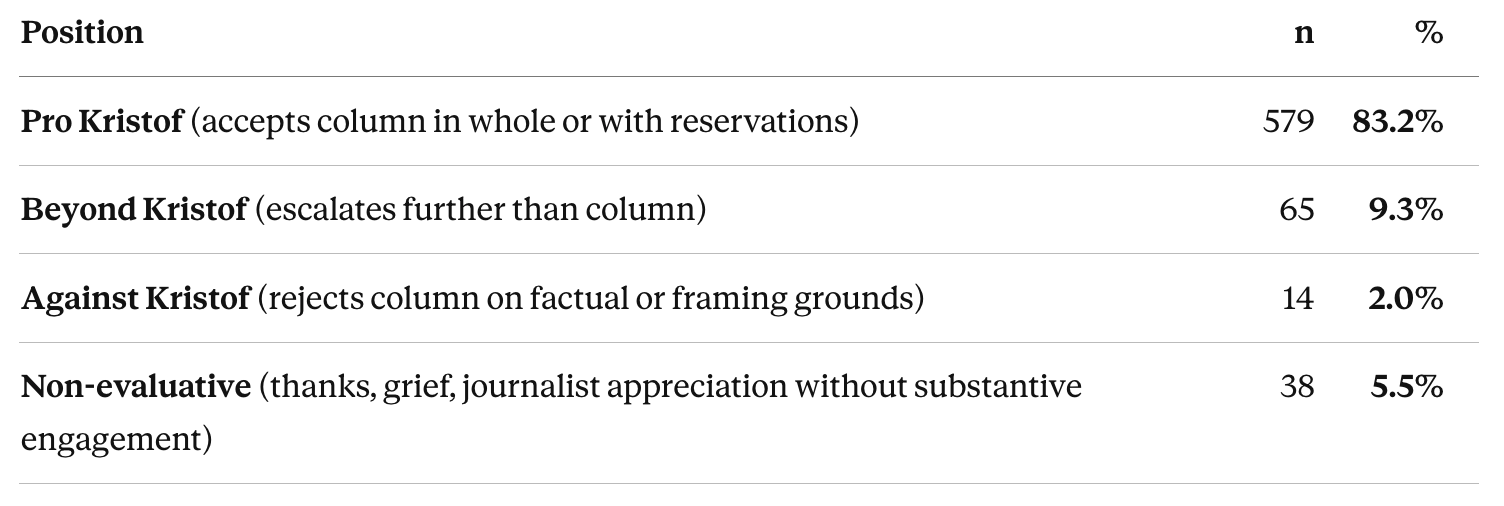
Pro + beyond combined: 92.5% — i.e., the column’s claims, including the strongest of them, are sustained or extended in roughly nine of every ten substantive comments. Against: 2.0%. The thread is not balanced. The Kristof column landed in a readership that overwhelmingly accepted its core argument. The substantive disagreement visible in the thread is not whether the abuse Kristof documents is real, but how far the conclusions to be drawn from it should extend.
A pure pro/against split — collapsing the beyond-Kristof category into the pro side — gives:
For the column’s claims: 644 comments (92.5%)
Against the column’s claims: 14 comments (2.0%)
Non-evaluative: 38 comments (5.5%)
The asymmetry is large enough that it should be named directly. The mainstream-press opinion-section comment thread on a column making the claims this one makes is not, in this case, a contested space. It is a space of broad confirmation. The analytical disagreements that exist visibly inside the column itself — Sari Bashi’s on-the-record disclaimer of the policy claim, Olmert later disclaiming the policy framing the column built around his words — do not enter the comment-section uptake. Bashi’s distinction is invisible at this layer. The “organized state policy” formulation is what readers carry forward.
14. Position categories — the breakdown
The six-category breakdown that produces the headline numbers above:
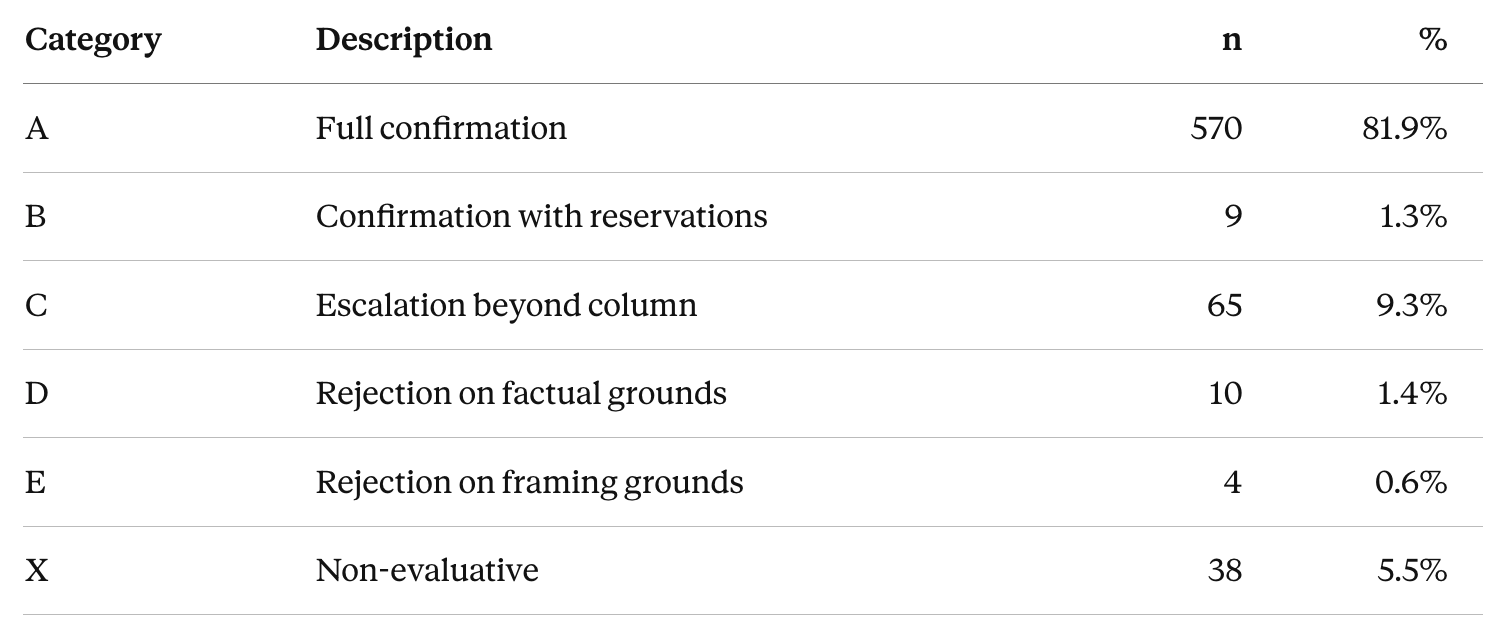
Category A — Full confirmation (n = 570). The modal comment in this thread. Accepts the column in its entirety, including claim 3, and typically calls for policy responses Kristof endorses: cut military aid, condition arms transfers, end administrative detention, prosecute the perpetrators, vote out politicians who support unconditional aid to Israel.
Category B — Confirmation with reservations (n = 9). Accepts that the abuses occurred but flags evidentiary, sourcing, or framing concerns. Linguistically marked by hedging operators: “if true,” “we need evidence and investigations,” “should be independently evaluated,” “demand unfettered access,” “extraordinary rigor required.” Clear exemplars include: “Not saying this didn’t happen — but we need evidence and investigations and proceedings”; “If true, the reported systematic sexual torture of Palestinians … is so far beyond the pale of acceptable activity by an ally, that, at minimum, we should demand of Israel unfettered access, a thorough, independent, international investigation”; “Can medical records for the surgical interventions that Kristof refers to be acquired and independently evaluated…?” The position is the methodological-restraint position, the one closest to the deconstruction’s analytical line. It has 9 comments. 1.3%.
Category C — Escalation beyond column (n = 65). Goes further than the column itself: characterizes Israel as a “vile country,” “rogue state,” “terrorist state,” “abomination,” genocidal, settler-colonial, apartheid, or in six cases as having no right to exist. The column established claim 3 (”organized state policy”) and stopped. Category C readers carry the argument forward into discursive territory the column does not enter. Operationalized rule: any comment carrying at least one of eight escalation-coded concepts (genocide, apartheid, settler-colonial, denial of right to exist, rogue/pariah state, Jewish supremacy framing, anti-Zionist state-rejection register, BDS-adjacent calls) is automatically Category C.
Category D — Rejection on factual grounds (n = 10). Denies, challenges, or characterizes as fabricated specific factual claims in the column. The most analytically forceful instance targets the trained-dogs allegation: “When I read about the supposed training of dogs to rape men… this is completely impossible. Dogs cannot be forced or taught to rape people. … But to write that systemic rape is part of the Israeli prison system for jailed Palestinians is a modern day form of blood libel.” Other instances in this category include: “anecdotal claims and unverified accounts rather than independently confirmed facts”; “How could this be true? This is not the Israel I know”; “Inclined not place much faith in the words of the those that have sworn the destruction of Israel.”
Category E — Rejection on framing grounds (n = 4). Accepts the column’s substance but rejects its framing as one-sided or lacking context. One comment challenges the symmetry frame directly: “Where were you then, Mr. Kristof?” (in reference to the October 7 coverage). Another adds: “the article lacks important historical context. Sexual abuse of prisoners is tragically common across wartime detention systems and prisons worldwide.” A third asks simply: “My only question is why is this published in the Opinion section.”
Category X — Non-evaluative (n = 38). Short comments of thanks, grief, expressions of difficulty in reading, journalist appreciation, requests for organizations to donate to. No substantive evaluation of the column’s claims.
The methodological-restraint cluster (B) and the rejection cluster (D + E) together account for 23 comments — 3.3%. The remaining 96.7% of the corpus either fully accepts the column, extends its argument beyond what it actually says, or does not engage its substance.
15. Concept-tagging results
Of the 40 concepts, 14 had non-trivial presence in this corpus. The remaining 26 were checked for and not observed at the discursive surface — consistent with the comment thread being a moderated mainstream-press space.
Concepts present, in descending order of frequency:
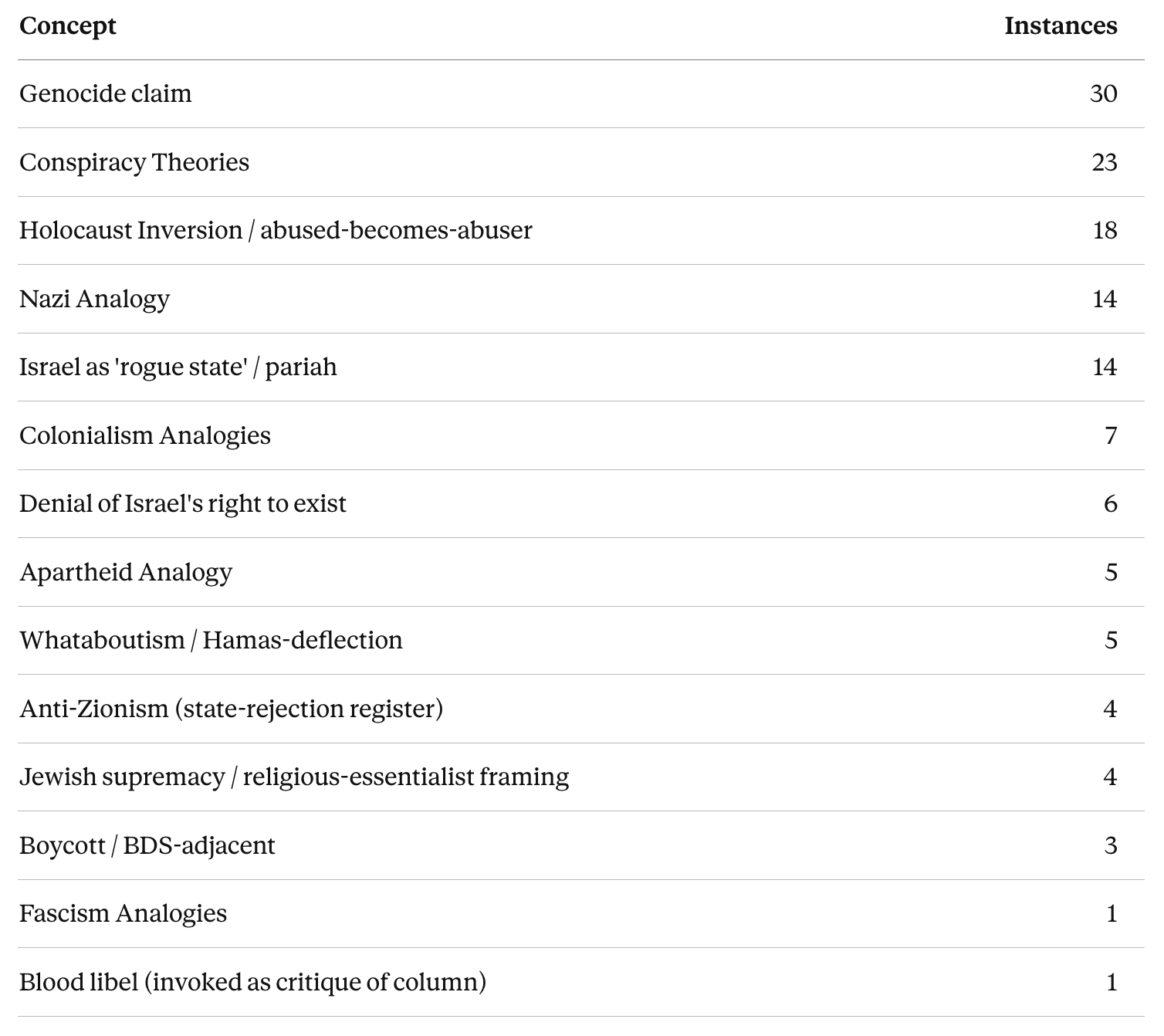
584 comments carry no concept. 91 carry one. 19 carry two. 2 carry three.
The top five concepts merit individual treatment.
15.1 Genocide claim (30 instances)
The most frequent concept in the corpus. The register is consistent: Israeli action against Palestinians characterized as genocide, genocidal, or as ethnic cleansing. Exemplars from the corpus: “It’s time for my fellow Jews to stand up to this genocide. … What Israel has done and is doing is a genocide. As Americans, we are funding this genocide”; “The sickness of genocide has dehumanized many Israelis”; “Modern Israel has never truly valued human life, the Nakba was planned from the 1890s … now through the Gazicide of the 2020s”; “I don’t know how humanity can move on with a reckoning for all involved in the genocide of the Palestinians”; “Bombing schools and hospitals along with sexual assaults is a Putin tactic he unashamedly admits as he says, ‘to break the will of the people.’” All 30 instances fall in Category C; the genocide framing is, in this thread, the diagnostic marker of escalation beyond the column.
15.2 Conspiracy Theories (23 instances)
A note on the operational threshold for this category. The DA Lexicon’s formal label for this concept is “Power/Conspiracy Narratives” — covering narratives of small-group power, lobby capture, and media-control attributions; the chapter uses “Conspiracy Theories” as the more widely-recognized term for the same operational category. Not all criticism of AIPAC, of campaign finance, or of organized political lobbying counts as Conspiracy Theories in the DA Lexicon sense. Generic criticism of lobby influence on US policy can be made, and routinely is made, in entirely non-antisemitic registers. The threshold for coding a comment under this concept is that the comment ascribes to a Jewish, Israeli, or Israel-aligned actor a degree of disproportionate, ethnicized, or covertly coordinated agency over institutions, governments, or media — the structural marker that distinguishes conspiracist antisemitism from ordinary institutional critique. The 23 instances counted here meet that threshold; comments criticizing AIPAC, lobbying, or campaign finance in registers that do not meet that threshold were not coded.
Within that filtered set, the structure of the 23 instances is consistent: a small but powerful Jewish or Israel-aligned lobby (AIPAC, “Zionist lobby,” “wealthy Zionists,” “the lobbies that have bought their vote,” “American Jewish organizational leadership”) is described as the mechanism by which US foreign policy is captured against the will of the American public. “There is silence from the US government because pro-Israel lobbies in the US have basically purchased that silence and support for Israel’s policies … with political donations.” “Wealthy Zionists, both Israeli and American, have had the political, economic, financial, and media power to condition Western governments and many of their citizens to believe that the Zionist way is crucially important.” “It is the no-criticism allowed supporters of Israel — Jewish AND gentile — who need to be held to account.” “[Ritchie] Torres who is more a spokesperson of Bibi than a US Representative.” 19 of the 23 instances appear in Category A — that is, in confirmation-of-Kristof comments, not in escalation comments. This is worth noting: the Conspiracy Theories register operates at the ordinary confirmation layer of this corpus, not as a marker of escalated discourse.
15.3 Holocaust Inversion (18 instances)
The trope: the historically persecuted Jewish people have, in the form of the Israeli state, become the persecutors, and now resemble or have become “the very thing they most despise.” “Israel is becoming the type of government that their ancestors left Europe to avoid.” “Israel, under Bibi, is the abused child who has grown up to become the abuser.” “Just as an abused child will often grow up to mistreat and torment children, so Israel, a country born out of abuse and cruelty, has emerged to be cruel and abusive itself.” “Their ‘Holocaust dividend’ has been depleted” — a particularly stark formulation in which Jewish historical persecution is treated as a moral credit-line Israel is described as having drawn down. 16 of the 18 instances appear in Category A — confirmation of the column without state-rejection escalation.
15.4 Nazi Analogy (14 instances)
The Israeli state, Israeli soldiers, or Israeli society compared explicitly to Nazi Germany. “The State of Israel dehumanizes Palestinians. The very same thing the State of Germany did to Jews in 1930s and 40s.” “Goering denied the gassing of Jews and Eichman wrote it off as accounting ledger entries.” “Hannah Arendt … concluded that evil does not swoop down in some vast, horrific, identifiable form. … Israel now embodies what she saw in Eichmann’s rationalizations.” “There were reports leaking out of Europe in the 1940’s of atrocities … All denied by the Nazi regime. Until it couldn’t be denied.” The DA Lexicon distinguishes Nazi Analogy from Fascism Analogies; in this corpus the former outnumbers the latter by 14 to 1, meaning that when commenters reach for an analogy to characterize Israeli state behavior, they reach for the specific historical case of the Holocaust-perpetrating regime, not for a generic political category. 13 of the 14 instances appear in Category A — operating, like Holocaust Inversion, at the confirmation layer of the thread rather than the escalation tail.
15.5 Israel as ‘rogue state’/pariah (14 instances)
“Israel is a rogue state.” “Time the US and the rest of the western world stopped supporting and funding this vile criminal regime.” “It is the country that is the problem. Its people widely participate in the horrors it inflicts. … Israel is an abomination.” All 14 instances are in Category C — the rogue-state framing is, in this corpus, definitionally escalation beyond the column.
15.6 Concepts at lower frequency
Colonialism Analogies (7 instances) characterize Israel as a settler-colonial project: “the Nakba was planned from the 1890s, initially implemented in the late 1940s, and has progressively continued on, now through the Gazicide of the 2020s”; “Israel that conquered and dispossessed the indigenous population of Palestine”; “it’s a pure shame that western countries keep protecting this colonial project”; “reminiscent of the attitudes of white populations toward the native peoples of the Western Hemisphere.” All 7 in Category C.
Denial of Israel’s right to exist (6 instances) is distinguishable from criticism of any particular Israeli government or policy. Six commenters cross the line explicitly. These six span an analytical range that is worth marking. At one end are bare anti-Zionist legitimacy-rejection formulations that reject Israel’s right to exist on principled grounds (whether religious-myth-based, settler-colonial, or generic-state-skeptical); at the other end is the explicit call for the removal of Israeli Jews from the territory. Both ends sit in Category C of the position coding, but they describe different end-states. The chapter notes the range; the count (6) holds. “Present-day Jewish Israelis have no intrinsic right to a homeland at the expense of Palestinians… And no amount of torture and dehumanization will give them that. The U.S. should immediately cease any and all support for Netanyahu’s and Ben-Gvir’s government.” “No country has a ‘right’ to exist and never has. Why do Americans think Israel has a right that nobody else has or ever had other than due to Israeli propaganda that nobody calls them out on.” “The existence of Israel is based on a biblical claim — myth — not reality, and does not have some inherent right to exist.” “How much longer can we shy from the conclusion that Israel must be defeated, and Israeli Jews removed and dispersed? We’re plainly bombing the wrong country.” “Moderate, admirable, secular Israels should emigrate and the US should take them in as refugees.” “Apartheid Israel is beyond the pale and should be dismantled.” The “removed and dispersed” formulation — the explicit call for Israeli Jews to be removed from the territory — is the most explicit eliminationist statement in the corpus; it appears, was published by NYT moderation, and drew no reply.
Apartheid Analogy (5), Anti-Zionism state-rejection register (4), Jewish supremacy/religious-essentialist framing (4), Boycott/BDS-adjacent calls (3) round out the Category C–clustering set.
Whataboutism/Hamas-deflection (5 instances) is the only concept-cluster appearing on the rejection side. “Where were you then, Mr. Kristof?” “Hamas did not allow the Red Cross to visit the hostages. How come no one seemed to care much about that?” “Hamas terrorists raping Gazan widows … Where’s Kristof on that one?” The whataboutism comments distribute across positions: 3 in A, 1 in C, 1 in E.
Blood libel (1 instance) appears once in the corpus — and only as a critique of the column’s dog-rape claim: “to write that systemic rape is part of the Israeli prison system for jailed Palestinians is a modern day form of blood libel.” The blood libel register is typically a marker of the discourse being analyzed; in this corpus, the only invocation of the term is as a critique of one of Kristof’s specific allegations.
16. Cross-tabulation: where do the concepts cluster on the position-coding?
This is the analytically load-bearing finding of the second main part.
Column legend: n = total instances of the concept in the corpus; A = Full confirmation; B = Confirmation with reservations; C = Escalation beyond column; D = Rejection on factual grounds; E = Rejection on framing grounds; X = Non-evaluative. Position categories are defined in §14.
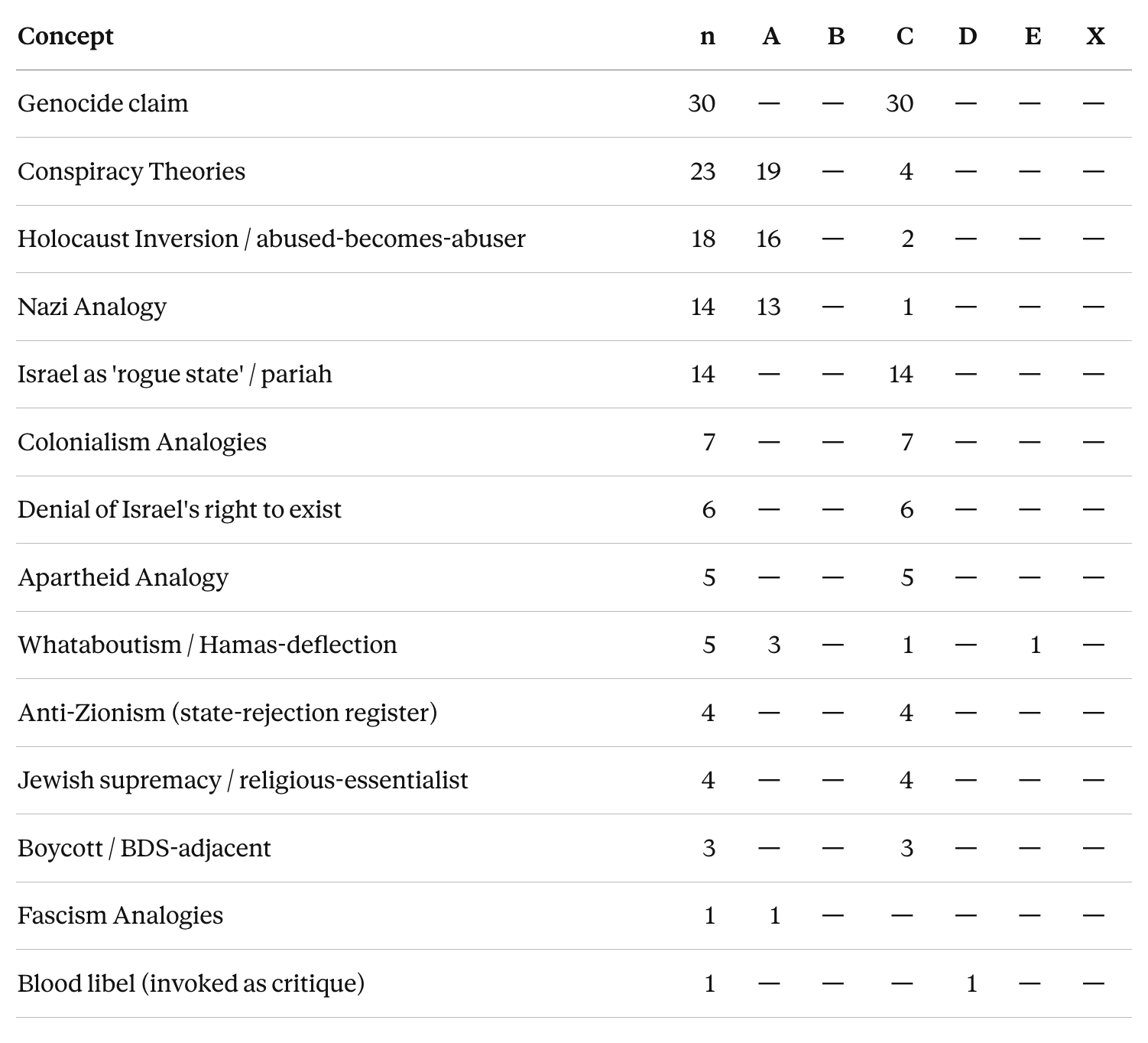
The distributional pattern shows two distinct clusters.
Cluster 1 — state-rejection concepts that cluster entirely in Category C. Genocide claim, Israel-as-rogue-state, Colonialism Analogies, Denial of Israel’s right to exist, Apartheid Analogy, Anti-Zionism, Jewish supremacy framing, Boycott/BDS: all 100% Category C. These concepts function by definition as escalation markers. Their presence in a comment denotes that the commenter has moved past the column’s claim 3 into a register of state-delegitimization or replacement.
Cluster 2 — inversion/comparison concepts that cluster heavily in Category A. Nazi Analogy: 93% in Category A. Holocaust Inversion: 89% in A. Conspiracy Theories: 83% in A. These concepts function as discursive registers that can be invoked without state-rejection. A commenter can compare Israeli prison guards to the Nazi regime, or characterize Israel as having “become what it sought to escape,” while staying within Kristof’s claim 3 and demanding policy reform rather than state dissolution.
This second cluster is the analytically important finding. The standard reading of moderated mainstream-press comment threads would predict that the antisemitism-related registers cluster only on the extreme escalation tail. The data from this corpus disconfirm that prediction. The inversive registers (Nazi Analogy, Holocaust Inversion, Conspiracy Theories) are operating in the ordinary confirmation register of the thread, embedded in comments whose explicit policy demand is the same as Kristof’s (cut aid, condition arms transfers, prosecute the perpetrators). These commenters are not the outliers in the thread. They are the modal reader.
Category B, the methodological-restraint position, is empty of these concepts. The pattern that holds: the antisemitic register is not a property of criticism of Israel. It is a property of how that criticism is structured and extended. Readers who confirm the abuse but flag the column’s inferential structure do not, in this corpus, reach for the registers that saturate Category A.
17. Synthesis: article, inferential architecture, afterlife
What the column documents
The May 11 column reports a pattern of sexual violence by Israeli prison guards, Shin Bet interrogators, soldiers, and settlers against Palestinian detainees and civilians. The reporting is well-sourced on the central question of whether such abuses occurred. The piece draws on 14 first-person interviews, supplementary interviews with family, lawyers, social workers, and investigators, the Sde Teiman indictments, B’Tselem’s case files, the Public Committee Against Torture in Israel’s complaint volume, Breaking the Silence testimony, and on-the-record acknowledgment from former and current Israeli officials. Reform-oriented Israeli analysts (Rettig Gur, Friedman, and Bashi inside the column itself) converge on the assessment that there is a serious pattern of unpunished misconduct under impunity. This chapter does not contest that assessment. Claim 1 (individual acts occurred) and Claim 2 (widespread, unpunished abuse) are substantially supported by the column’s sources and by independent corroboration.
The inferential architecture
Claim 3 (that the abuse constitutes “an organized state policy” and “standard operating procedure” of the Israeli state) is different in kind. It asserts design, not failure. The column’s sources do not support it. The UN report Kristof cites speaks of “implicit encouragement by the top civilian and military leadership.” Kristof drops the qualifier in his own framing voice. Sari Bashi tells him on the record: “I don’t see evidence that it has been ordered.” Olmert, after publication, issues a Free Press statement explicitly disclaiming the policy framing the column built around his words. The chapter has named six argumentative moves: qualifier-dropping, equivalence-by-presentation, selective hearing of named sources, symmetry as ontological claim, structural conditions framed as evidence of policy rather than as the alternative explanation, and institutional placement as authorization. These are the moves by which a competent columnist transforms a claim-2 evidentiary base into a published statement of claim 3. Each move is defensible in isolation. The methodological problem is what happens when they are deployed in combination on a high-salience charge against a state.
The comment-section afterlife
The dataset shows three patterns that turn out to be the chapter’s most substantive empirical findings.
First, the column’s claim 3 was taken up by some readers as authorization for further escalation. Once claim 3 is in the discursive record under the Times byline, 65 commenters (9.3%) appear to draw on it as authorization for moves Kristof himself does not make: the genocide characterization (30 instances), the rogue-state framing (14), the colonial-project framing (7), and in six cases the explicit denial of Israel’s right to exist. The column does not say these things. It does not need to. Its inferential structure permits readers who carry those framings into the thread to claim Times-byline support for them, and the post-publication discursive trace of the column is shaped accordingly. Bashi’s claim-2 disclaimer, the column’s most directly claim-2 line, is not visible in the comment-section uptake. The “organized state policy” formulation is.
Second, moderation filters the explicit registers but does not filter the coded ones, and the coded ones operate at the modal-reader layer. Explicit antisemitic registers (slur-level dehumanization, eliminationist call-and-response, explicit Holocaust denial) are largely absent from the NYT thread. The coded layer is present at meaningful frequency and largely uncontested in the comment thread itself. What is new in this corpus, and worth registering as a finding, is that several of these concepts (Nazi Analogy, Holocaust Inversion, Conspiracy Theories) operate in Category A. That is, in the modal confirmation register of the thread, not in the escalation tail. The discursive labor of moderation is in filtering registers that mark themselves as hateful at the surface. The registers that operate through historically-loaded analogy, structural framing, and group-attributed agency pass through and saturate the ordinary register of confirmation. This is a structural feature of moderated comment spaces, not a NYT-specific deficiency.
Third, the corpus does not match the framing that emerged in some post-publication reaction. The American Jewish Committee characterized the column as a “modern-day blood libel.” Cotler-Wunsh used the same register. Both framings carry an implicit claim about reception: that the column produces, at scale, antisemitic uptake of the kind the term blood libel historically denotes. The corpus does not bear that prediction out at the level of the Times-reader population. Explicit blood-libel-register material is absent from the comment thread. The term itself appears once, used by a commenter as a critique of one of Kristof’s specific allegations rather than as part of the discourse the column produces. What the corpus does show is something different and arguably more analytically interesting. The antisemitic registers most active in the thread (Nazi Analogy, Holocaust Inversion, Conspiracy Theories) saturate the modal confirmation layer of the readership, not an extremist tail. That is not the pattern an AJC-style framing would predict. It is the pattern a discourse-analytic framework would predict. Under conditions where explicit registers are filtered by moderation, the analytically significant uptake migrates into coded registers carried through historically-loaded analogy, structural framing, and group-attributed agency. The AJC framing locates the antisemitism in the column’s most sensational specific claims. The discourse-analytic framing locates it in the registers that pass moderation and saturate the ordinary reader’s response. The corpus, on the evidence available, supports the second account.
The joint finding
Taken together, the textual analysis and the comment-section data converge on a single structural point. Once the “organized state policy” framing and the October 7 symmetry frame enter the public record under the Times byline, those are the formulations the readership overwhelmingly retains and extends. The hedges and internal dissenting voices present inside the column (Bashi’s claim-2 disclaimer, Olmert’s Free Press clarification, Kristof’s own “no evidence that Israeli leaders order rapes” and “impossible to know how common sexual assaults against Palestinians are”) are not visible in the uptake. The discursive trace the column produces is shaped by its strongest formulations, not by its qualifications.
The diachronic frame from §12 adds a further layer to this finding. The discursive consequence of correction-asymmetry is not just that the original framing remains in circulation while the correction does not. It is that the uptake of the original framing, the comment-section register documented here, runs ahead of both the framing and the correction. The Kristof column has not been corrected. Olmert’s Free Press clarification appeared elsewhere. Bashi’s disclaimer is visible in the column for any reader who reaches it. The comment-section trace nonetheless shows that the column’s claim 3 is being metabolized at scale. 9.3% of unique commenters carry the argument further than the column itself goes. And the registers most active in the thread (Genocide claim, Conspiracy Theories, Holocaust Inversion, Nazi Analogy) saturate not just the escalation tail but the modal confirmation layer of the discourse the column has authorized.
On the evidence available in this case, the structural finding holds. High-impact framings about Israel and antisemitism, when published under mainstream-press institutional authority, are taken up not at the level of their hedges and qualifications but at the level of their strongest formulation. The discursive uptake reaches for the historically-loaded registers the framing makes available. The Times comment thread on this column is one such trace.
Conclusion
The chapter has examined a single opinion column and the comment thread that gathered beneath it. The conclusions worth carrying away from that single case are general only in the disciplined sense that the mechanisms identified in this case can in principle operate in other cases. Whether and how they do so is a question for further work.
The first general implication concerns the inferential structure of opinion journalism on high-salience topics. Reporting that documents individual abuses, however well-sourced, does not automatically license a published claim that those abuses are systemic, organized, or constitutive of the institution under scrutiny. The move from individual incident to systemic-crime allegation is a distinct inferential step. The six argumentative moves the chapter names (qualifier-dropping, equivalence-by-presentation, selective hearing of named sources, symmetry as ontological claim, structural conditions framed as evidence of policy rather than as the alternative explanation, and institutional placement as authorization) are not innovations of this particular column. They are recognizable techniques of opinion-journalistic argumentation, available across many topics and many columnists. What is worth examining is the conditions under which their deployment in combination, on a high-salience charge against a state, transforms documented misconduct into a claim about state design. And what editorial practices would distinguish a column that performs this transformation from one that does not.
A second implication concerns the empirical character of moderated mainstream-press comment spaces. The conventional reading of such spaces treats them as buffered against historically-loaded registers by editorial moderation. The corpus examined here is consistent with a different account. Moderation in such spaces effectively filters surface-explicit hate registers (slurs, eliminationist exhortations, explicit Holocaust denial). It is not designed to filter coded registers that operate through historically-loaded analogy, structural framing, and group-attributed agency. Under conditions where the explicit registers are filtered out, the analytically significant uptake of high-salience framings migrates into the coded registers that pass moderation. This feature is not particular to one publication or one moderation policy. It is a feature of moderated comment spaces as a class. Discourse-analytic work on such spaces would benefit from distinguishing what moderation removes from what moderation does not remove, and from treating the latter not as a residue but as the analytically meaningful layer.
The third implication is the one the chapter’s two halves jointly support, and it is the chapter’s central contribution. The framing operations identified in the deconstruction, the six moves catalogued in §4.5, do not operate only at the level of the printed page. The corpus examined here shows that under the institutional authority of a mainstream-press byline, those moves are followed downstream by a readership pattern with two features. First, the column’s strongest formulation (”organized state policy”) is retained and extended while the column’s qualifications and internal dissenting voices are not. Second, historically-loaded antisemitic registers (Nazi Analogy, Holocaust Inversion, Conspiracy Theories) cluster not in the extreme tail of the discourse but in its modal confirmation layer. On the evidence available in this case, the framing and the uptake are aligned in ways consistent with the framing having shaped or facilitated the uptake. The data show correlation, not causation. The alignment is itself the finding. It distinguishes the chapter from purely textual analyses of opinion journalism on one hand, and from purely empirical analyses of online discourse on the other. The combination is what the discourse-analytic method makes available, and what would be lost if either half were undertaken alone.
A fourth implication concerns the asymmetry between framing and correction in mainstream press institutions. An original framing reaches readers under prominent institutional authority; a correction reaches readers through a smaller, slower, or differently-routed channel. The original framing reaches readers at scale, and the correction documents that the framing did so. This asymmetry is not unique to the cases examined here. It is a feature of contemporary mainstream press operations under conditions of high audience-attention competition and rapid news cycles. What the chapter’s data add is that the uptake of the original framing, the readership trace it generates, can run ahead of both the framing and any subsequent correction. The discursive register the framing authorizes continues to operate in the public record after the framing itself has been qualified or walked back.
A fifth implication, more methodological than substantive, concerns evidentiary differentiation. The chapter has worked throughout to distinguish: (i) whether abuses occurred, (ii) whether they are widespread and unpunished, (iii) whether they constitute organized state policy, and (iv) whether comparing them to other phenomena collapses or preserves analytically relevant differences. These distinctions are not pedantic. They are the distinctions that the inferential moves catalogued in §4.5 work to elide. The capacity to keep them separate, in journalism, in policy discussion, and in the public record, is a precondition for serious engagement with the underlying issues. The chapter’s hope is that the framework it offers, narrow as it is, can be put to use in other cases where the same distinctions are at stake.
The chapter does not claim to have settled questions of editorial intent, institutional pattern, or downstream political consequence. It claims, more modestly, to have shown what a discourse-analytic examination of one column and its reception can produce: a named set of argumentative moves, an empirically-grounded account of what the readership did with the column’s framing, and a structural observation about the relationship between the two. Whether the methodology travels to other cases (other columns, other topics, other publications) is the question further work would address.