
The Rally and the Reception: How the Mamdani–AIPAC Controversy Propagated Across Instagram and YouTube

AddressHate Research Scholar at NYU’s Center for the Study of Antisemitism | PI, Decoding Hate | Research Advisor, AddressHate | Editor-in-Chief, Digital Hate Review
Executive Summary
On June 18, 2026, at Brooklyn’s Kings Theatre, New York City Mayor Zohran Mamdani gave a rally speech in which he described AIPAC — the American Israel Public Affairs Committee — as one of the “monsters” New Yorkers face. He accused the organization of moving “millions in dark money” toward “a single goal” of “turning us against one another,” and said AIPAC fears the end of “genocide and Netanyahu’s wars.” On June 22, at City Hall, he defended and extended that framing.
A substantive political critique of AIPAC’s spending and influence — no other lobby PAC was mentioned in the rally — is as legitimate as criticism of any other lobbying organization. However, this study examines something different: the specific phrases the mayor chose stand in the foreground, and what happened when audiences received them. The corpus comprises three strata of digital reception assembled in the five days following the rally: 15 supportive Instagram posts (N = 1,497 codable comments), 5 critical Instagram posts (N = 499 codable comments), and 4 mainstream-press YouTube threads (Forbes Breaking News, CNN, NBC New York, CBS New York; N = 400 codable comments). Total coded N = 2,396 across all three strata. The full reception corpus is coded against a published catalog of antisemitic discourse patterns developed over five years of empirical research and documented in Decoding Antisemitism (Becker et al., Springer Nature/Palgrave Macmillan, 2024).
Three findings stand out.
One: across 1,497 codable comments in 15 supportive Instagram posts, 75% took up or extended speech patterns that overlap with documented antisemitic discourse. Per-post combined rates ranged from 58% to 96%, with 22% deploying antisemitic patterns directly (compression from “AIPAC” to “Jews” as a group, claims about Jewish control of US politics, dehumanizing imagery with documented Nazi-era genealogies, blood-libel registers, conspiracy-network expansion) and a further 53% substantively endorsing or amplifying the post’s speech patterns without themselves adding directly antisemitic phrasing. The 75% measures the overall audience-response environment, not the share of comments that themselves activate antisemitic tropes; the 22% is that strict count. In threads critical of the mayor’s framing, the comparable combined rate was 1.4% — a 53-fold cross-stratum gap. The same rally language entered very different comment environments, depending on whether the post endorsed or criticized it.
Two: two of the mayor’s signature phrases propagated through pro-Mamdani comment threads on both Instagram and mainstream-press YouTube; the others did not. “Monsters” and “dark money” each generated extensive direct uptake: 23 and 22 direct-extension instances respectively across the five most-engaged supportive Instagram posts (N ≈ 500). Across the four mainstream-press YouTube threads (N = 400), “monsters” was reproduced about 30 times — roughly 22 extending the rally’s framing toward Jewish-associated targets, and about 8 redirected against Mamdani himself — while “dark money” generated 98 activations of the broader Power/influence framing. Audience commenters extended the predicates from AIPAC toward Jews and Israel as a group, including what this study treats as the corpus’s most consequential single activation: the two-word “Jewish playbook” compression that drops AIPAC entirely. Within this corpus, other phrases the mayor used — “single goal of turning us against one another,” “fear of peace” — produced no observed uptake across the supportive Instagram stratum, the critical Instagram stratum, or the mainstream-press YouTube stratum. The phrases that traveled were the ones that named a moral antagonist in absolute terms; the longer attributive phrases — describing actions or motivations — did not. Much of the audience-side reception therefore appears to build on his lexical material, even as commenters also draw on pre-existing framing repertoires.
Three: where mainstream-press accounts engaged the controversy on the platform, the reception was not moderating — it produced a markedly higher antisemitism-relevant activation rate than rates observed in comparable prior project studies. On Instagram, mainstream-press outlets produced almost no rally-related posts with meaningful audience engagement in the seven days following the rally; the Instagram reception ran almost entirely through partisan-advocacy accounts on either side. On YouTube, by contrast, four high-engagement mainstream-press threads (Forbes Breaking News, CNN, NBC New York, CBS New York; combined ~309K views; N = 400 codable comments (the first 100 visible comments per thread)) produced a combined antisemitism-relevant rate of approximately 80% — within the range of the supportive Instagram stratum (58–96%) — and a 42.5% explicit antisemitic-trope activation rate, approximately double the supportive Instagram rate (22%). No substantive anti-antisemitism counter-speech was observed across the 400 coded comments. The mainstream-press YouTube ecology around the Mamdani rally functioned not as a moderating third option but as a polarized middle: the antisemitism-relevant activation rate the supportive Instagram stratum produces in diffuse form appears concentrated and intensified in the coded mainstream-press YouTube threads. The platform-architectural observation about mainstream-press absence holds for Instagram; the cross-platform finding sharpens it: increased mainstream-press platform presence is not, by itself, the missing moderating force, because the mainstream-press comment ecology where it does engage propagates the same patterns.
The study makes no claim about the mayor’s intent — intent is not the question, and the framework does not require an answer to it. What the study claims is that the specific language chosen overlaps with patterns cataloged across a century of historical scholarship on antisemitism, that this language was received in measurable ways the study quantifies, and that the substantive political critique of AIPAC is available in language that does not overlap with these patterns. The specific phrases chosen — not the political criticism itself — were associated with measurable audience-side uptake of historically documented antisemitic discourse patterns. Those audience-side uptake patterns are what this study measures.
Implications for journalists, policymakers, and political actors
The specific phrases Mayor Mamdani used about AIPAC varied dramatically in how audiences took them up. "Monsters" and "dark money" — the two phrases with the longest historical genealogy of overlap with antisemitic tropes — were widely reproduced across all three reception strata, intensified and — in supportive and editorially neutral mainstream environments — frequently redirected from AIPAC to Jews as a group. The two phrases without that historical genealogy ("single goal of turning us against one another," "fear of peace") produced no observed uptake across N = 2,396 coded comments. These specific phrases — not the political critique itself — drove the high audience-side activation the study measured. The same critique of AIPAC could have been made in other words. Political actors choosing words about Jewish-associated institutions, journalists framing controversies of this kind, and platforms shaping reception environments should weigh not only what language is intended to mean but also which historical repertoires that language is likely to activate in the audiences that receive it.
Introduction
Political language does not stay on the stage where it is spoken. It travels into the audiences that receive it, the platforms that propagate it, the communities that contest it, and the broader digital discourse environment in which contemporary publics encounter one another. When that language works through demonization — by attributing to a particular group an essential malign quality, hidden coordinated agency, or destructive purpose — it can alter the discourse environment in ways that reduce democratic deliberation. These effects are structural and largely independent of the speaker’s intent.
Five features of these effects are relevant to the case this study examines. First, sustained demonization of a target community in mainstream political speech can contribute to the withdrawal of members of that community from public conversation through harassment, intimidation, and the normalization of hostile discourse. Second, demonization replaces argument with enemy-identification: the targeted group is no longer a political actor to be argued with but a malevolent collective to be defeated, neutralized, or expelled. Third, demonization paired with conspiracist explanation — visible institutions reframed as surface effects of hidden hostile agency — denies the legitimacy of disagreement and produces a permanent emergency frame in which exceptional measures against the imagined enemy are licensed. Fourth, essentializing enemy constructions corrode the democratic premise that political opponents are legitimate counterparts to be argued with rather than coordinated enemies to be defeated; these effects extend beyond the targeted community to the civic culture in which all political actors participate. Fifth, in some cases sustained online demonization has formed part of the discursive background to offline violence — including attacks in Pittsburgh (2018), Christchurch (2019), Buffalo (2022), and the Capital Jewish Museum in Washington (2025) — an observation that is contextual, not evidentiary: it does not establish a causal claim about the case examined here, but it explains why demonizing public language warrants careful analysis when it enters mainstream political speech.
This essay examines a focused instance: NYC Mayor Zohran Mamdani’s June 18, 2026 Kings Theatre rally and his June 22, 2026 City Hall press conference defending the rally’s framing. The substantive political question — what AIPAC does, how it spends, what positions it advocates, how it should be criticized — is a legitimate subject of democratic contestation. The discourse-analytic question is different: when criticism of AIPAC takes the specific phrasings the mayor used, what historical predicates do those phrasings activate, what tropes do they invite, what readings do they make available to audiences carrying the relevant repertoire, and how does the resulting discourse circulate in the publics that encounter it? These questions are testable, both through close reading of the speech and through empirical analysis of audience-side reception.
The contribution this research attempts is methodological as well as empirical. Read at the broadest level, this article is a case study in how codes and frames travel from authoritative speakers into online cultures of reception. Previous discourse-analytic work on antisemitism has primarily examined speakers' language — the predicates, frames, and tropes that appear in source texts. This study extends that apparatus to the audience side, tracing how historically loaded predicates are received, transformed, amplified, contested, and generalized across digital reception environments. The argument is not only that the rally’s language overlaps with documented antisemitic tropes at the textual level; it is also that this overlap is observable, at measurable rates and with documented bidirectional dynamics, in the reception that actually received the rally. The empirical center of this paper is the audience-side trace.
The case is also analytically distinctive at the level of topical choice: the rally foregrounded AIPAC’s federal-lobbying activity and the Israel–Hamas war — terrain on which a New York City mayor has no direct authority — rather than the housing, transit, and affordability policy questions that municipal office actually controls. Among the super PACs active in the June 2026 New York primaries, AIPAC is the only one named, elaborated, and made the rhetorical center of the speech. The mayor’s later defense — that he meant “super PACs at large” — does not change which organization the speech actually foregrounds. The choice to mobilize around a federal-lobbying organization widely perceived as Jewish-associated is itself a rhetorical move: it shifts the discursive ground from policy-lever questions to questions of moral antagonism on a highly emotionally charged topic, and the framing accomplishes that shift before the substantive critique of AIPAC’s spending or lobbying activity has been made.
What discourse analysis can do is identify what language draws on, what it can evoke, and how audiences read it. What it cannot do is determine what the speaker believes. This essay makes no claim about Mamdani’s intent. It claims that the language of the rally and the press conference overlaps with documented antisemitic tropes, that this overlap makes a group-level reading of the language available to audiences carrying the relevant historical repertoire regardless of speaker intent, and that the empirical reception corpus assembled in the days following the rally — coded across all three strata at total N = 2,396 codable comments — exhibits audience-side patterns consistent with this discourse-analytic reading.
The article proceeds in three parts. Section 1 reads the speech and its defense, identifying the specific phrases and framing moves that warrant attention and locating each within the documented tropes of the Decoding Antisemitism Lexicon. Section 2 turns to the empirical reception: a stratified sample of 24 posts and threads in the 5-day window following the rally (15 supportive Instagram posts, 5 critical Instagram anchor cases, and 4 mainstream-press YouTube threads from Forbes Breaking News, CNN, NBC New York, and CBS New York), with the first 100 visible comments per post or thread coded against the Lexicon’s categories and against counter-discourse escalation categories — 2,396 codable comments in total. Section 3 presents what the reception shows: how supportive audiences extended the framing, how critical audiences identified it, how cross-spectrum convergence emerged across otherwise-opposed political positions, what bidirectional vocabulary propagation across all three strata reveals about the rhetorical reach of the rally’s signature predicates, and what the platform-architectural environment within which the controversy propagated reveals about the contemporary digital discourse environment more broadly. The conclusion returns to the opening stakes: what political language of this kind does to the discourse environment that receives it, and what — narrowly but consequentially — follows from the diagnosis.
1. The Speech
1.1 The framework’s starting point
Decoding Antisemitism catalogs antisemitic concept-clusters across forty chapter-level categories, organized in five parts: Classic Antisemitism (chapters on Other/Foreign, Evil/The Devil, Blood Libel, Repulsiveness and Dehumanization, Immorality, Lie and Deceit, Vengefulness, Disloyalty, Blame for Antisemitism), Concepts of Power (Greed, Power, Conspiracy Theories, Disintegration, Self-victimization), Secondary Antisemitism (Rejection of Guilt, Holocaust Denial, etc.), Further Post-Holocaust Categories, and Israel-Related Antisemitism. When discussing the Power concept, the Lexicon is explicit on one point: lobbying is a lawful political process in modern democracies, and the work of Israeli lobby organizations is a matter of fact that does not in itself constitute antisemitism.
Critique of AIPAC is a legitimate political activity. The concern is that some phrases used in such critique have a long history in antisemitic discourse, where they attributed hidden power, division, or moral corruption to Jews as a group. These phrases developed historically as forms of group attribution, and they have appeared, across different periods and political settings, in traditions that helped justify exclusion, persecution, and violence against Jews.
When those phrases are used together and attached to a Jewish-associated institution, they can evoke those tropes in audiences (consciously or unconsciously) familiar with them. This is one way historical repertoires operate in public discourse. The audience does not perform a logical inference from “AIPAC bad” to “Jews bad.” The phrases already belong to a historical repertoire built around Jews as a group. Referring to an institution rather than a group does not necessarily prevent audiences from hearing those associations.
This is not a hypothetical concern. On the day of Mamdani’s rally, a federal grand jury in the Southern District of Florida indicted Forrest Kendall Pemberton for an alleged December 2024 mass-shooting plot targeting AIPAC employees at the organization’s Plantation, Florida office; two days earlier, federal authorities had announced charges against five men in a separate alleged accelerationist plot whose target list (per the FBI affidavit) included AIPAC-supported lawmakers. Both proceedings are allegations, not convictions, and they do not establish a causal link to any political speech. They establish only that violent threat environments around AIPAC are not hypothetical — a context in which public speech about the organization warrants particular analytical attention. The ADL’s Audit of Antisemitic Incidents 2025 and the corresponding ADL New York / New Jersey regional report recorded 1,160 antisemitic incidents in New York State (the highest of any state), with New York City accounting for 860 of those incidents and 85 of the state’s 90 antisemitic assaults.
Audiences process political references analogically. Historically loaded references bring broader associations and narratives into a discussion, even when those associations are not stated explicitly. What follows is a diagnosis of six recurring phrases and framing moves across the June 18 rally and the June 22 press conference.
1.2 The “monsters” predicate
Mamdani identifies AIPAC as one of the “monsters” New Yorkers face, in a passage framed by Antonio Gramsci’s line that “now is the time of monsters.” At the rally, the mayor’s own framing of the predicate is universalist — “these monsters take many forms today” — not NYC-specific; the closing reinforces it: “In the wealthiest city, in the wealthiest country in the history of the world, we need not live in fear of monsters any longer.” Pressed on the term in a press conference after the rally, the mayor reaffirmed it.
The phrase is dehumanizing in form. “Monster” is not a description of conduct or position; it is a category of being. Problematic activities of a lobby group can be criticized in the strongest terms, but the dehumanization of the people who constitute that lobby serves no intellectual or ethical purpose. The Lexicon’s Repulsiveness and Dehumanization chapter documents the antisemitic stereotype that depicts Jews as monstrous or subhuman, from medieval Christian iconography through twentieth-century propaganda. The Evil/The Devil chapter — whose sub-section on the depiction of Jews as “demonic or Satanic creatures” cross-references the dehumanization chapter — extends the same diagnosis. The concern is not the word alone. It is the combination of that predicate with a Jewish-associated target in a passage that also uses the phrases analyzed below.
1.3 The Gramsci frame
The rally opens its central passage with: “And we need that because, as Gramsci once wrote, ‘The old world is dying, and the new world struggles to be born. Now is the time of monsters.’” The press conference reaffirmed the citation under direct questioning.
The citation is not decorative. Gramsci wrote the Prison Notebooks under confinement by Mussolini’s regime; for audiences who carry that historical context, the citation can make available an interpretive frame in which the speaker occupies the anti-fascist position and the named opponents occupy the role of obstructing forces. The mayor did not say AIPAC is fascist. He did not say Israel is fascist. The diagnostic point is narrower: the framing makes that analogical reading available, and the substantive critique of AIPAC’s spending and lobbying does not require this scaffolding.
1.4 The “dark money” claim
The rally attributes to AIPAC the movement of “millions in dark money to accomplish a single goal.” The press conference elaborates: AIPAC “filters money that would have previously been directly from AIPAC now through other shell organizations whose identities of their contributors are only made clear after an election.”
A distinction is needed. AIPAC’s principal political vehicle, the United Democracy Project, files publicly with the Federal Election Commission and discloses its donors. Per FEC filings reported by CNN on June 22, 2026, UDP made two political contributions in May 2026 totaling over $600,000 to BOLD America, which has funded ads supporting Rep. Adriano Espaillat against Mamdani-backed challenger Darializa Avila Chevalier in New York’s 13th Congressional District. Applied to UDP itself, the term “dark money” — which has a specific meaning in U.S. campaign finance: money from donors whose identities are not disclosed — does not fit.
The press conference’s more elaborated claim is closer to the campaign finance record. Several partner and pop-up super PACs active in the same primary cycle, including groups recently created and reported alongside the broader pro-Israel super PAC ecosystem, are not required to disclose donors until after the June 23 primary. Investigative reporting has documented that pattern in detail. As a factual claim about parts of the broader architecture in which AIPAC’s allied money moves, the “shell organizations” elaboration is defensible.
The diagnostic concern is therefore narrower than a charge of factual error. It is that the phrase “AIPAC moves millions in dark money” collapses two distinguishable things: a disclosed super PAC (UDP), and a network of partner PACs whose disclosure timing is genuinely opaque. Collapsing them under a single label, attached to a Jewish-associated institution, renders the historical resonance of the term available — and risks importing it — beyond what the underlying campaign finance facts about AIPAC’s own spending arm carry. The image of concealed Jewish financial influence operating through opaque structures is a classic antisemitic frame, cataloged in the Lexicon’s Conspiracy Theories chapter as part of the world-domination sub-cluster and central to the Protocols of the Elders of Zion and to conspiracy narratives reproduced across the twentieth century. The political point about post-election disclosure can be made — and made forcefully — by naming the partner PACs whose timing actually fits the description, rather than by collapsing AIPAC’s disclosed spending into the same category.
This diagnostic reading is supported by the speaker’s own June 22 elaboration. Pressed at the press conference on the “dark money” phrasing, Mamdani explained: AIPAC defends the status quo “through dark money, by filtering money that would have previously been directly from AIPAC now through other shell organizations whose identities of their contributors are only made clear after an election” (official transcript, NYC Mayor’s Office, June 22, 2026). The phrasing is analytically revealing. “Shell organizations whose identities of contributors are only made clear after an election” is structurally an accurate description of the partner-PAC disclosure-timing pattern that the diagnostic above identifies as the legitimate object of post-election-disclosure critique. When pressed to defend the original framing, the explanation moves toward the analytically more precise concept — post-election-disclosure partner PACs — but does not perform the disaggregation between UDP and the partner-PAC network: the umbrella label “dark money” remains attached to AIPAC. The speaker’s elaboration is therefore not a contradiction of the diagnostic but a confirmation of it: the legitimate critique exists, can be made precisely, and is being made imprecisely in the original framing.
Rabbi Misha Shulman, who leads the progressive Brooklyn synagogue The New Shul and is a member of the progressive Israeli-American group Israelis For Peace, told the Jewish Telegraphic Agency on June 22, 2026 that the dark-money framing was more troubling to him than the “monsters” line itself. “For me, the question of dark money was the tougher knot,” he said, calling Mamdani’s remark a “tactical mistake.” “For a left-wing leader to use that phrase, and invite traditional antisemitism into this conversation in that way, was not smart” (Andrew Lapin, JTA, June 22, 2026). Shulman is a Mamdani supporter; the criticism comes from within the mayor’s progressive Jewish base, not from his political opposition.
Rep. Josh Gottheimer, a Jewish Democrat and critic of the mayor, named the content the phrases draw on directly: “’Monsters.’ ‘Dark money.’ A hidden hand ‘turning us against one another.’ Swap ‘AIPAC’ for ‘Jews’ and it’s the oldest antisemitic conspiracy theory in the books. That’s not criticizing a lobby. That’s laundering antisemitism from your podium as Mayor of a city with more than a million Jews.” His reaction matters not as proof of intent, but as evidence of how the phrases were heard by a Jewish public figure using a straightforward substitution test.
1.5 The “fear of peace” attribution
AIPAC is characterized in the rally as an organization “for whom the only thing more frightening than democracy being allowed to run its course is an end to the genocide in Netanyahu’s wars.”
The relevant Lexicon categories are Evil/The Devil and Vengefulness, with possible cross-activation of the Warmongering Conspiracy Theories sub-cluster within Conspiracy Theories. The Evil/The Devil chapter catalogs the attribution to Jewish actors of essential malicious nature — “the intent to commit evil for evil’s sake” as “the essential core of the individual or group as Jewish.” The Vengefulness chapter catalogs the supposed “irrational, misanthropic, egoistic drive to punish those perceived as having wronged them,” including “alleging aggressive or bloodthirsty behavior on the part of Jewish or Israeli figures” and “alleging Jews or Israelis take a particular sadistic pleasure in taking violent retaliatory action against opponents.” The Warmongering sub-cluster catalogs “the idea of Jews seeking to convince, coerce or bribe rulers of states into declarations of war.” All three chapters and sub-clusters draw the necessary distinction: such accusations are different from legitimate criticism of Israel’s foreign policy.
Substantive critique of AIPAC’s positions on the Israel-Hamas war is legitimate political activity. The attribution that AIPAC fears the end of war is structurally different. It does not describe a policy position; it ascribes an essential disposition. The predicate “fears peace” is closest in form to the Evil/The Devil cluster: it attributes not what AIPAC does (lobby for particular military policies) but what AIPAC is (an actor whose essence is to fear the end of war). The surrounding framing — “the genocide in Netanyahu’s wars” — can be read as adding a Vengefulness dimension: the wars are characterized as disproportionate retaliatory violence, and the wording invites a reading in which the named actor is positioned as wanting that violence sustained. This is a structural reading of the predicate, not an interpretation of any actual organizational goals; what the analysis identifies is what the wording makes available to audiences carrying the relevant repertoire. Whether the Warmongering sub-cluster also activates depends on whether audiences read the predicate as ascribing essential disposition (Evil) or hidden orchestration (Conspiracy Theories / Warmongering). Both readings are available; both are cataloged in the Lexicon as antisemitic tropes distinct from legitimate political criticism.
1.6 The “single goal” — Disintegration
The rally specifies AIPAC’s “single goal” as “to preserve their power, so that they can turn us against one another instead of turning our leaders toward the moral change we all know to be necessary.”
The relevant Lexicon category is Disintegration — the attribution of a tendency toward separation or destruction of a community, with the key identifying characteristic of provoking divisions, endangering social cohesion, or seeking to abolish desirable structures of life. The chapter traces this trope through European antisemitic discourse from the nineteenth century through Nazi propaganda to contemporary forms, including the “Great Replacement” narrative. The Conspiracy Theories chapter cross-references Disintegration through a “White Genocide / Disintegration Conspiracy Theories” sub-cluster, distinguished by attention to the means by which Jewish groups supposedly undermine the “foundational values” of the nation-state or civilization as such. What links these representations across the Lexicon’s chapters is the structural move of attributing to a Jewish actor an essential purpose of producing division.
The Disintegration concept is also the broader analytical category that grounds this essay’s opening claim. Language that endangers social cohesion, that provokes division, that attributes essential malign purpose to a community — this language works against the conditions of democratic discourse itself, regardless of which group is targeted or which political direction the speaker comes from. The antisemitism diagnosis in this case is the specific instance; the disintegration of democratic discourse is the broader phenomenon.
The Lexicon’s own non-antisemitic example shows the line clearly. “Netanyahu is a political troublemaker” is not antisemitic because the criticism is tied to his political actions, not to his Jewish identity. The difference is between attributing specific divisive actions in a specific context and attributing a single purpose of causing division.
The rally’s phrase is in the second category. It does not say AIPAC engages in divisive tactics in specific races. It says AIPAC’s single goal is “to turn us against one another.” The attribution describes not what AIPAC does, but what AIPAC is supposedly for.
1.7 The June 22 press conference
The City Hall press conference was the mayor’s deliberative response to criticism, not an extemporaneous rally line. It contained three further framing moves that warrant attention.
The scope expansion. AIPAC is said to have “fought any attempt to actually deliver safety to people not just in Palestine, but frankly through much of the region.” A single American lobbying organization is positioned as a causal force in regional insecurity across the Middle East. That is a very broad claim. The Lexicon’s Power chapter catalogs the attribution to Jewish actors of disproportionate, region-wide or world-wide causal power as a feature of the Jewish omnipotence stereotype. Whether that historical pattern applies in any given case depends on the specific attribution being made; the concern here is the structural form of the attribution.
The Gaza-to-New-York causal chain. The press conference opens with: “We’re talking about a status quo where children are being killed on a daily basis.” The argument begins with an emotionally salient image of suffering and ends with an attribution of responsibility to AIPAC — sustaining “a status quo that is quite literally starving people in this city, all in the name of sustaining something that we simply cannot defend any longer” — creating a causal chain that is asserted rather than explained. The Lexicon’s Power chapter notes that claims that Jews cause local hardship have been especially volatile in the historical record, because they translate abstract suspicion into immediate, locally felt grievance.
The complicity-naming move. The press conference closes: “I think that it is important that when we ask ourselves how such death and destruction is happening overseas, we also name those who allow it to take place.” The phrase “those who allow it” can reach beyond the named organization to the people who support it. This is not, in isolation, a distinct Lexicon category — extending political accountability from an institution to its members is a generic move in democratic discourse. But paired with the surrounding framing (the “single goal” attribution from the rally, the scope expansion to “much of the region,” the “starving people in this city” causal chain), the complicity-naming move contributes to the Disintegration attribution and to Power: it separates AIPAC and “those who allow it” from the broader American political community by attributing to them sustained malign purpose. The historical record shows that extending culpability from a named Jewish institution to its supporters has been a recurring step in the broadening and normalization of antisemitism. The key issue is not whether the mayor intended that extension. The key issue is that the wording, in combination with the surrounding predicates, makes it available.
One more note. Asked about the “monsters” term, the mayor said: “I used the term to describe all those who are preventing the birth of a new world, not solely AIPAC, but frankly super PACs at large.” That hedge helps him answer the charge of singling out AIPAC. But as noted in the opening of this section, AIPAC remains the only super PAC the rally and the press conference actually name, elaborate, and tie to regional insecurity and to starvation in New York. The hedge does not substantially alter the discourse-analytic reading developed here.
1.8 The contested Jewish reception
The most important evidence is not the phrases in isolation. It is how they were received.
Rabbi Jill Jacobs of T’ruah called the framing part of a “disturbing trend” of left-wing attacks on AIPAC, writing that the lobby “absolutely deserves to be criticized, sidelined, and rejected for its decades of negative influence on American foreign policy” — but “without dehumanizing language, and without hinting at a grand Jewish conspiracy” (Jacobs, Substack, June 22, 2026; quoted in Lapin/JTA). Rabbi Shulman’s concern about the dark-money framing, quoted above, is part of the same intra-progressive pushback. Neither voice comes from the mayor’s usual political opposition; both share substantial political ground with him on many other questions. Their concern matters because they read the language as going beyond ordinary policy criticism.
Rep. Gottheimer’s substitution test — swap ‘AIPAC’ for ‘Jews’ and it’s the oldest antisemitic conspiracy theory in the books — captures the same issue in plain language. That does not settle the argument by itself. But it shows that the discourse made a group-level reading available to Jewish audiences, including Jewish voices outside the mayor’s usual opposition.
This is the kind of ambiguity in which institutional critique can become available for broader group attribution: not because the speaker intends it, but because the wording allows that reading.
2. The Reception
2.1 From speaker to audience
Discourse analysis identifies what language can evoke in audiences. It does not, by itself, establish what audiences did evoke. The reading offered in Section 1 makes a structural claim — that the speech’s predicates overlap with documented antisemitic tropes and make a group-level reading available to audiences carrying the relevant historical repertoire. That claim is testable, and this section describes the empirical apparatus designed to test it.
Instagram and mainstream-press YouTube comment threads provide tractable test environments. Both are public, time-bounded, stratifiable by post stance and platform-architectural position, and large enough to support quantitative analysis of how predicate-clusters propagate across strata of the reception ecosystem. This study applies the Decoding Antisemitism / Decoding Hate coding methodology to both the rally speech and its reception. This section describes the corpus and the methodology and reports the coded findings across three strata: Instagram supportive (S), Instagram critical (K), and mainstream-press YouTube (M). Codable N = 2,396 across 24 posts and threads (1,497 supportive Instagram + 499 critical Instagram + 400 mainstream-press YouTube).
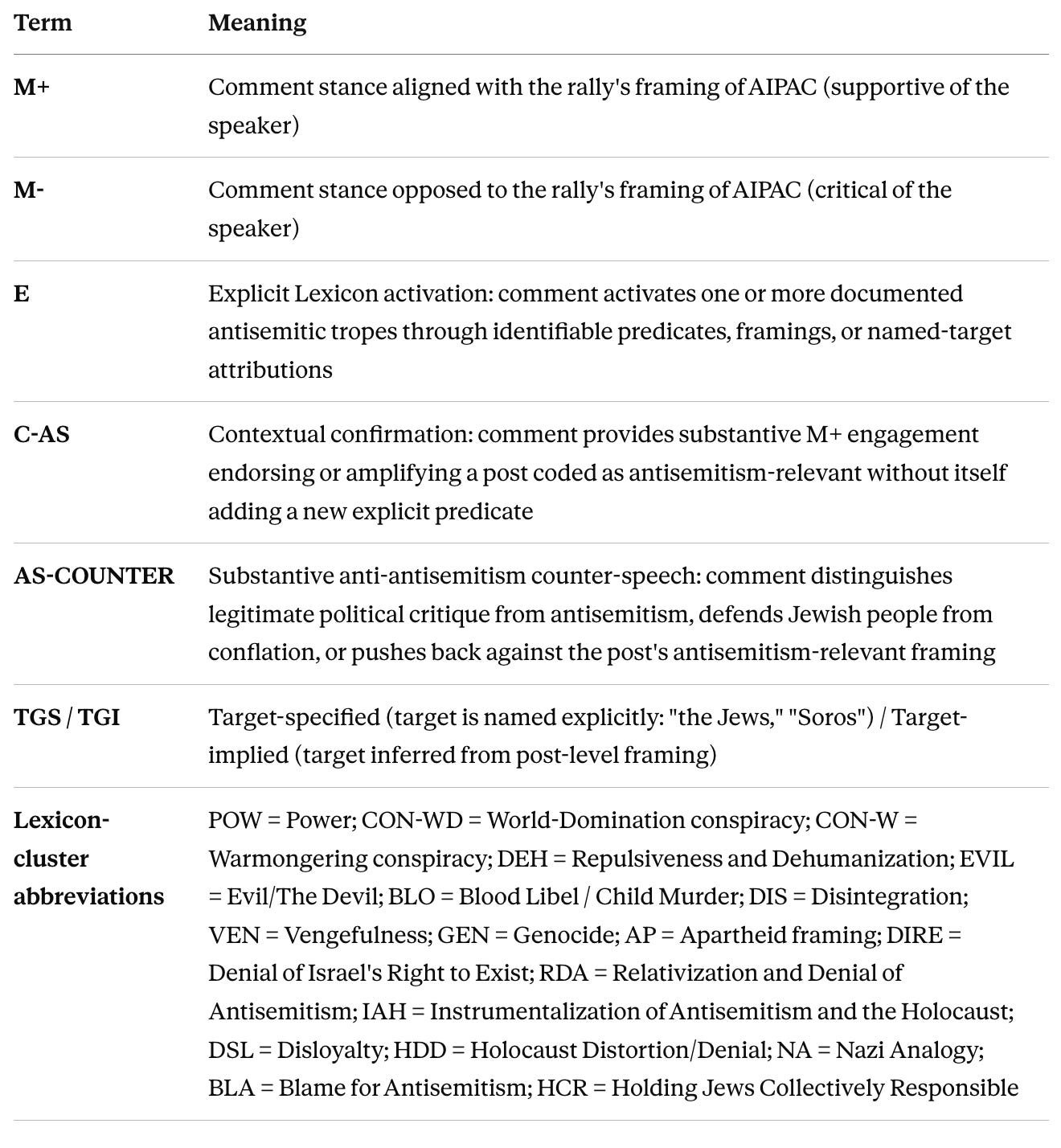
Notation used in this section
2.2 The Dataset
A qualitative reception pool of 38 Instagram posts plus 5 reference posts was assembled in the 5 days following the rally (17–23 June 2026). From this pool, a stratified sample of 20 posts was selected for formal coding: 15 supportive and 5 critical anchor cases. The critical stratum is structured around analytical anchors rather than engagement-proportional coverage; the resulting cross-stratum N-imbalance (1,497 supportive vs. 499 critical) is a feature of that design. A separate mainstream-press YouTube stratum (M) was assembled in parallel, covering all four mainstream-press YouTube videos covering the Mamdani-AIPAC controversy that generated substantial audience engagement (≥100 codable comments) within the same window. Codable N totals 2,396 (1,497 supportive Instagram + 499 critical Instagram + 400 mainstream-press YouTube).
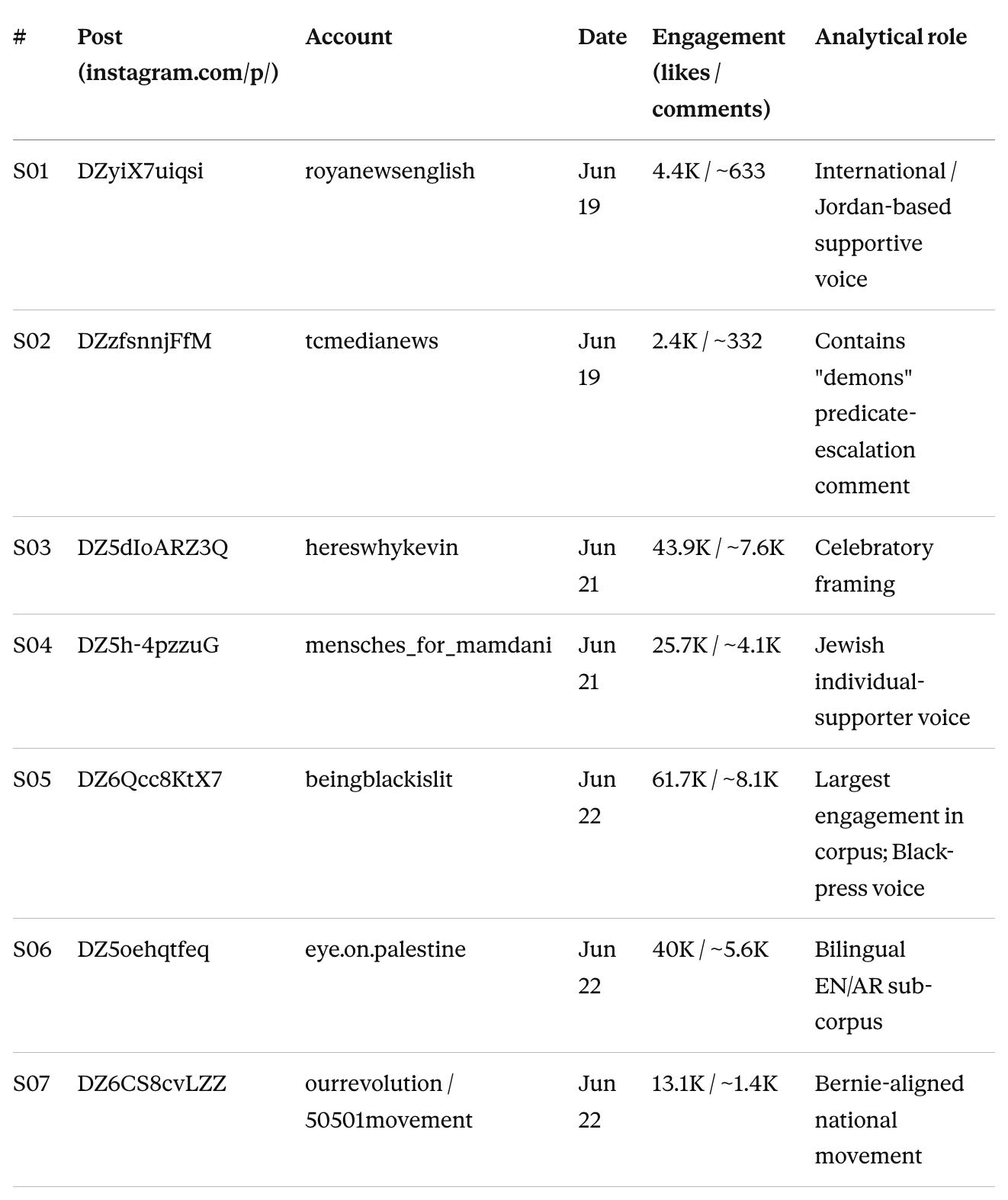
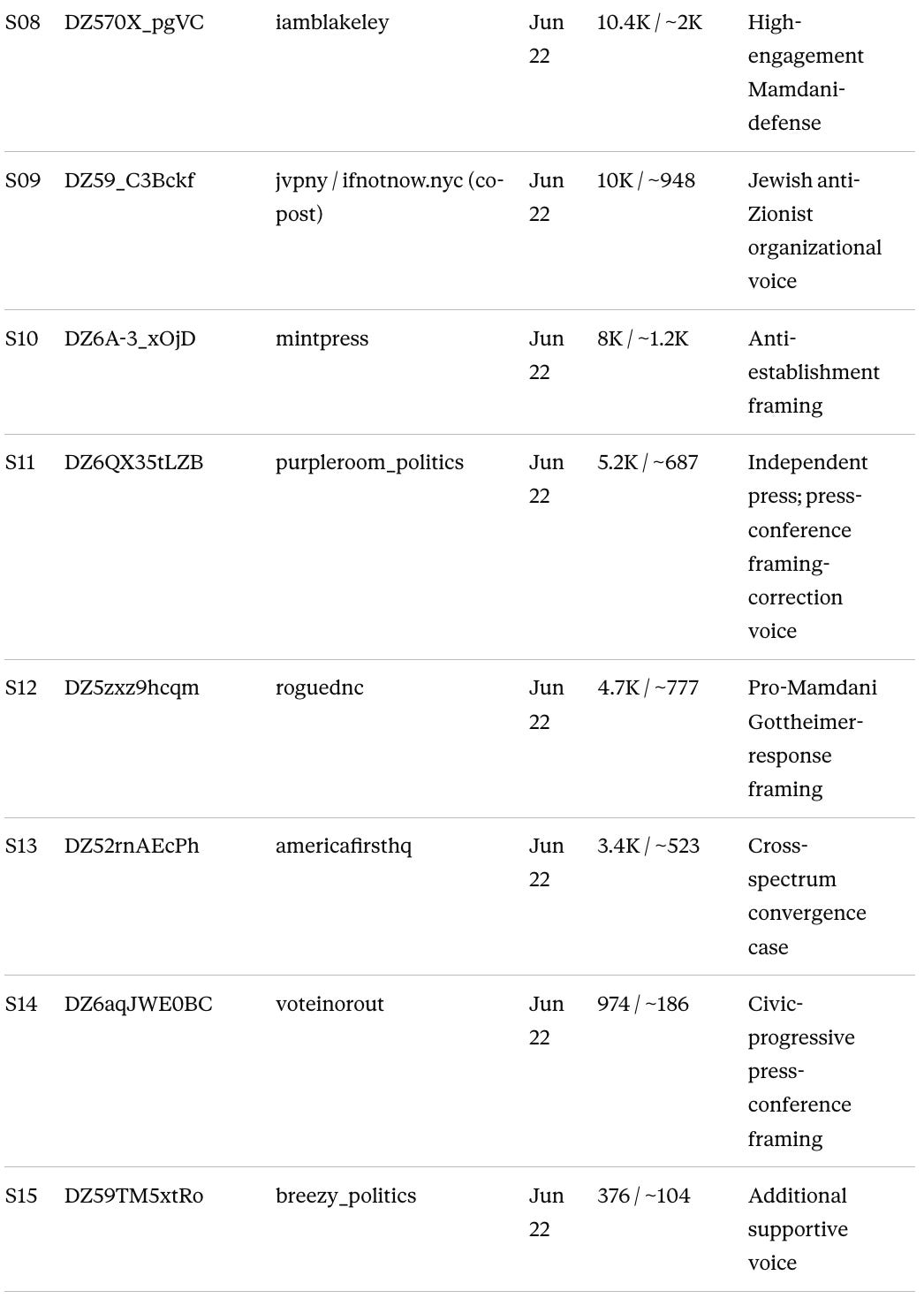
The 24 posts and threads in the coded stratum are listed below. URLs are abbreviated to the Instagram post short-code (full URLs in Appendix A).
Supportive Instagram posts (N = 15), chronological
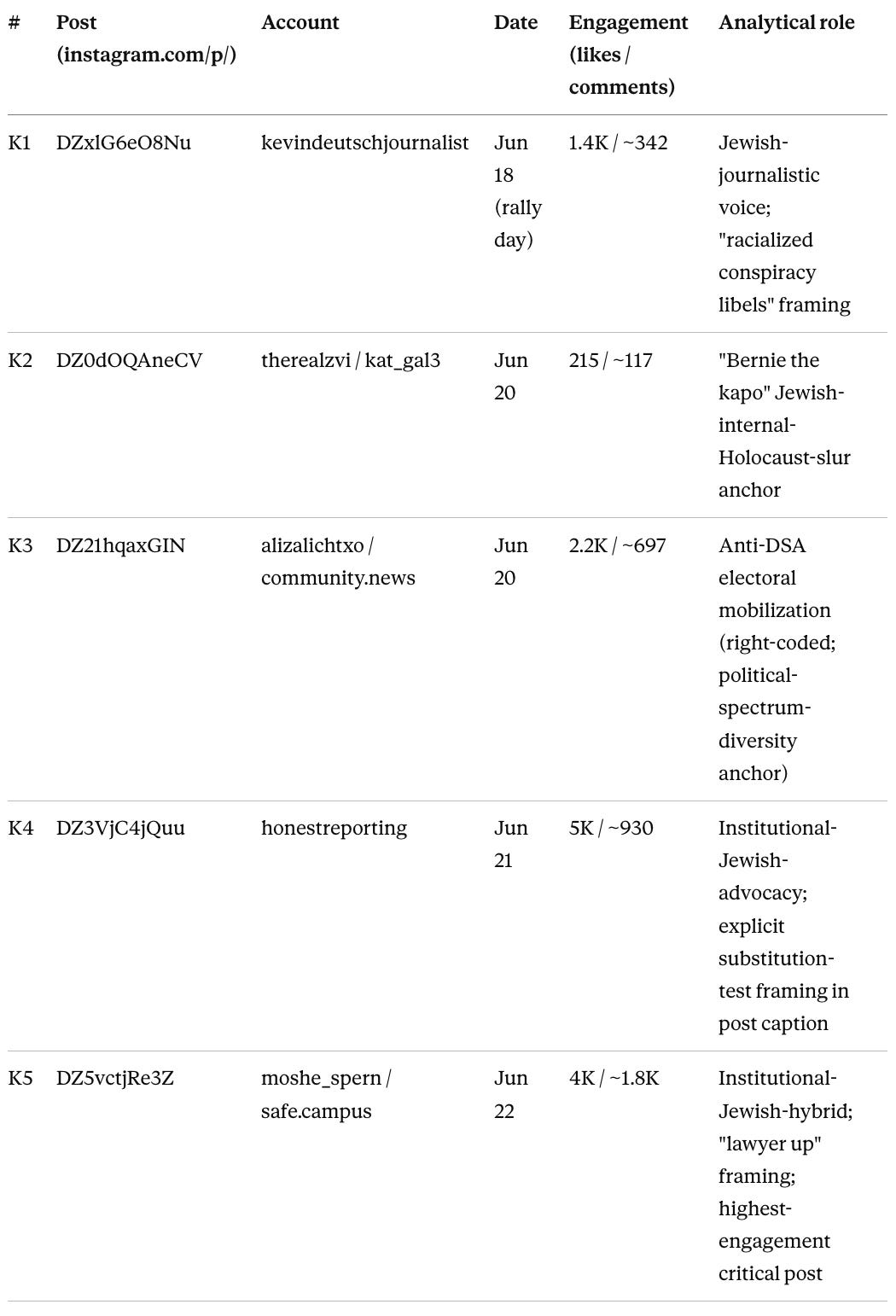
Critical Instagram posts (N = 5 coded anchor cases), chronological
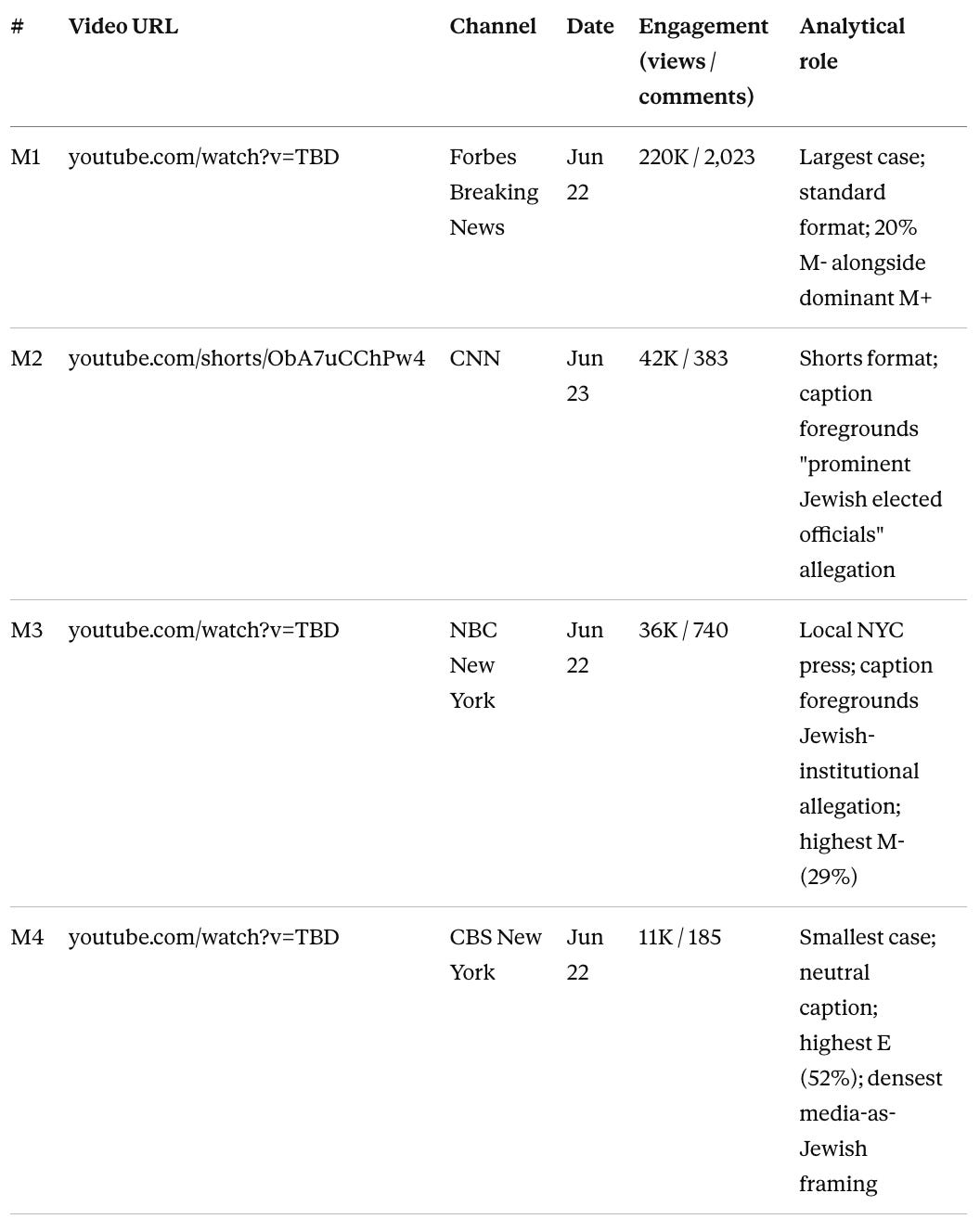
Mainstream-press YouTube threads (N = 4 coded anchor cases), chronological
2.3 The mainstream news absence in the Instagram corpus
A feasibility scan of high-engagement mainstream news Instagram accounts (Newsweek, NBC New York, CNN, AP, NYT, Gothamist) found that only Newsweek produced a substantive rally-related Instagram post with meaningful audience engagement in the 17–23 June window. The other mainstream news outlets either did not post on the rally or produced posts with very limited Instagram engagement, even where their broadcast or print coverage was substantial.
Whatever the explanation — Instagram strategy, audience behavior, or algorithmic curation — the observed reception of the Mamdani-AIPAC controversy on Instagram was almost entirely partisan-account-mediated. Audiences encountering the rally on Instagram were structurally exposed only to either supportive amplification of Mamdani’s framing or critical identification of it as antisemitic. The “third option” of measured news framing — which exists in the broadcast and print record — did not propagate to Instagram in significant volume. The polarization the Instagram corpus documents is therefore at least partly a function of platform architecture. The mainstream-press YouTube stratum (M1–M4) addresses the YouTube-side reception of the same controversy and is reported alongside the Instagram findings.
2.4 Methods
This study uses qualitative content analysis grounded in pragmalinguistic discourse analysis. The pragmalinguistic premise: meaning in political comment threads is not exhausted by what individual words denote in isolation. It is constructed at the level of predicates and framings — how speakers and commenters attribute properties, motives, agency, and identity through specific phrasing choices, lexical registers, and cross-linguistic equivalences. The analytical question is therefore not whether a given comment contains a “bad word” but whether the comment’s predicate-attribution operations align with documented tropes in antisemitic discourse.
The analytical instrument is the Decoding Antisemitism Lexicon (Becker et al., Springer Nature/Palgrave Macmillan, 2024) — the same reference framework introduced in Section 1 and used here to code audience comments. The Lexicon catalogs forty concept-clusters distinguishing the predicate-level operations of antisemitic discourse (Power, Repulsiveness and Dehumanization, Conspiracy Theories, Evil/The Devil, Disintegration, Blood Libel, Vengefulness, Relativization and Denial of Antisemitism, Instrumentalization of Antisemitism and the Holocaust, and others) from the surface vocabularies they recruit. The methodology has been applied across 300,000+ expert-annotated comments in the project’s prior research cycles.
For each post or thread, the first 100 visible comments are coded against this Lexicon-anchored codebook. The codebook combines primary codes for the antisemitism-relevant tropes with modifier codes (target-specified vs. target-implied; explicit vs. implicit; predicate-level vs. framing-level) and counter-discourse escalation codes (Holocaust analogy, deportation rhetoric, anti-Muslim ad hominem, identity-based slur, jurisdictional delegitimization). The codebook in full is provided in Appendix B.
The coding convention
Each comment in the coded stratum is assigned one of three antisemitism-relevant flags. The flag determines what the headline numbers mean, so the convention is reported here before the findings rather than as a footnote afterwards.
Explicit activation (E): the comment activates one or more Decoding Antisemitism Lexicon categories through identifiable predicates, framings, or named-target attributions. The Lexicon codes (Power, Conspiracy Theories, Repulsiveness and Dehumanization, etc.) are the diagnostic instrument; activation is determined by predicate, modifier (explicit/implicit, target-specified/target-implied), and framing operation.
Contextual confirmation (C-AS): the comment does not itself activate a Lexicon category, but it provides substantive M+ engagement that endorses, amplifies, or builds on the post-level framing of an antisemitism-relevant post. Pure affirmation (a “great job” or emoji response under a post coded as antisemitism-relevant) qualifies as contextual confirmation; substantive endorsement of the post’s specific framing does as well. The convention follows the discourse-analytic reasoning that audience-side reception of a post coded as antisemitism-relevant is itself a form of participation in the post’s discursive operation, even when the comment adds no new predicate.
Anti-antisemitism counter-speech (NO with AS-COUNTER tag): substantive M+ engagement that distinguishes legitimate political critique from antisemitism, defends Jewish people from conflation, or pushes back against the post’s antisemitism-relevant framing — even when the comment opens with affirmation. Under the refined convention, these are not counted as antisemitism-relevant.
The convention is consequential because it determines the denominator. A narrow E-only rate reports only comments that themselves activate a Lexicon cluster; a combined E+C-AS rate also counts substantive engagement with a post coded as antisemitism-relevant as participation in its discursive operation. Both numbers are defensible; they measure different things, and both are reported in the empirical findings below.
One further convention deserves brief notice. When an antisemitic predicate is deployed against an unnamed target in a comment thread whose post-level framing has positioned a particular group as the targeted out-group, the Lexicon code attaches to the implied target rather than to the surface text — but only when four criteria are jointly met: (a) the post-level target is explicit, (b) the comment appears in a sub-thread responding to that target or to a defender or critic of that target, (c) the predicate is historically and lexicographically mapped to the post’s target group within the Lexicon, and (d) no alternative target is more plausible. The four-criterion test confines the convention to comments where the inference is constrained by the discursive context.
2.5 Empirical findings
2.5.1 Supportive Instagram (N = 1,497 across 15 posts)
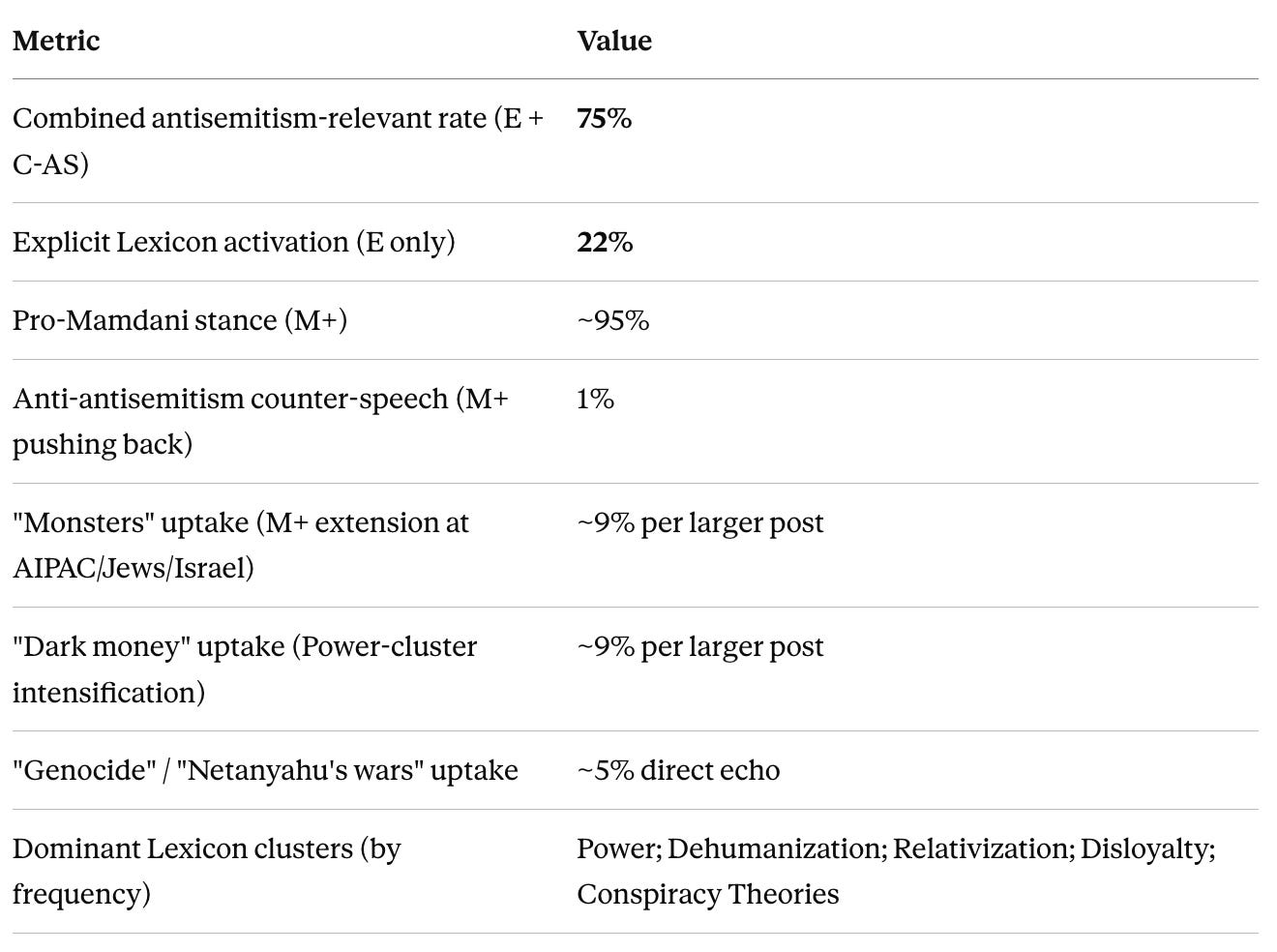
At a glance — Supportive Instagram (N = 1,497)
Audience uptake of Mamdani’s rhetoric.
Two of Mamdani’s signature phrases were widely taken up in the supportive Instagram stratum: “monsters” (≈23 observed direct-extension instances across S01–S05, N ≈ 500 codable comments) and “dark money” (≈22 instances). The “monsters” predicate was extended from AIPAC toward Israel, Israelis, Zionists, and Jews as a group, often through religious-evil escalation registers (demons, Satan, shaytan, Satanyahoo). The “dark money” predicate was intensified into “Jewish playbook” (S03 010-004 — the central compression from organization-level critique to Jewish-agency framing), “AIPAC mafia” (S02 031), “blood-stained shekels” (S01 030-001), and broader claims of Jewish/Israeli control of American politics. Two phrases Mamdani also used at the rally — “single goal of turning us against one another” (Disintegration) and “fear of peace” (Evil/Vengefulness) — produced no observed direct uptake across the same N ≈ 500. The pattern is selective: the phrases that named a moral antagonist in absolute terms propagated; the longer attributive phrases describing actions or motivations did not.
Overall rates.
Across the supportive Instagram stratum, the coded comments distribute as follows:
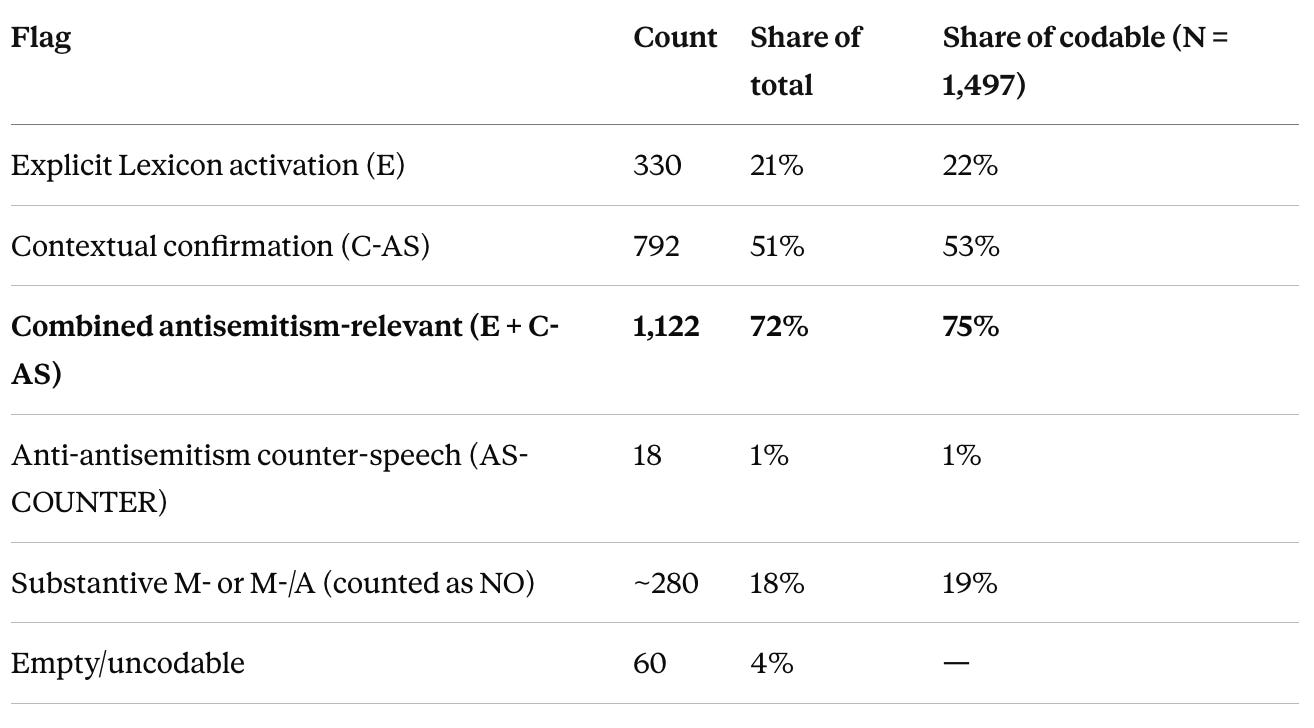
The most important figure for interpreting these findings is the 22% explicit Lexicon activation rate: this is the share of supportive Instagram comments that themselves activate one or more Lexicon categories under strict coding criteria, independent of the C-AS convention. The 53% contextual-confirmation rate measures substantive endorsement of a post coded as antisemitism-relevant, under the C-AS convention. The 75% combined rate measures the share of supportive Instagram comments that participate in the antisemitism-relevant reception ecology under the study’s coding convention. The 75% should not be glossed as “75% antisemitic comments”: it is a reception-level measure that includes substantive endorsement of antisemitism-communicating posts without independent predicate-activation. These figures should therefore be interpreted as follows: the 22% is the strictest measure, the 75% is the broadest reception-level measure, and the 53% is the convention-dependent middle term.
Per-post rates range from 58% (S02, S14) to 96% (S12), a 38-percentage-point spread that correlates with post-framing emphasis and the politically homogeneous composition of the comment audience. The five dominant Lexicon clusters across the stratum are, in order, Power, Repulsiveness and Dehumanization, Relativization and Denial of Antisemitism, Disloyalty/Jewish Loyalty, and Conspiracy Theories. Substantial secondary activations are documented for Genocide, Instrumentalization of Antisemitism and the Holocaust, Blood Libel/Child Murder, and Denial of Israel’s Right to Exist.
Five audience-side mechanisms.
Five distinct audience-side mechanisms account for the bulk of Lexicon activations in the supportive Instagram stratum. Each is illustrated below by representative examples drawn from the coded stratum; the full per-comment catalog is in the coding files. The mechanisms are ordered by analytical centrality rather than by frequency: the “Jewish playbook” compression (Mechanism 2) is the corpus’s most consequential single instance.
Mechanism 1 — Dehumanization through Nazi-era propaganda registers. Audience comments activate the Lexicon’s Repulsiveness and Dehumanization cluster through three lexical registers traceable to Nazi-era propaganda: parasite imagery, organized-crime imagery, and religious-evil escalation. The parasite register recurs across four posts in four lexical forms — parasite (S01), tick (S10), lice (S11), leech (S14) — with each form applied to Israel, to Zionists, or to a Jewish-coded political target. The religious-evil escalation appears most explicitly at S02 (“’monsters’ is too lenient of a term. I’d go with ‘demons’ instead”), with the Arabic-language shaytan and the Satanyahoo portmanteau (Satan + Netanyahu) showing that the same escalation pattern appears across languages. The organized-crime register surfaces as “biggest mob in the world” at S14, and the excrement register reaches its most explicit form at S15 014-005 against a named Jewish-religious target. Taken together, these examples suggest that the supportive Instagram stratum draws on several elements of the Lexicon’s cataloged dehumanization repertoire; Mamdani’s “monsters” baseline is intensified by audience-side registers without additional speaker prompting.
Mechanism 2 — Conspiracy-network expansion: the “Jewish playbook” compression. The Power and Conspiracy Theories clusters together constitute the densest activation register in the supportive Instagram stratum. Mamdani’s organization-level “dark money” framing is extended by audience comments in two structurally distinct directions. The first is broadening: AIPAC is retained as the named actor but the scope is expanded to claims of Jewish-American or Israeli control of US political institutions (“AIPAC controls both parties of Congress,” “93 of 100 senators are owned and funded by Israel”). The second is compression: AIPAC as the mediating organization-level frame is dropped entirely, and Jewish-agency is named directly without scaffolding. The corpus’s most consequential single audience-side activation is the two-word compression at S03 010-004: “Jewish playbook.” This comment performs three discursive operations in two words. AIPAC as the mediating frame is dropped. The Power cluster’s coordinated-strategic-agency predicate (”playbook”) is attached to “Jewish” as a group-level attribute. And the comment requires no contextual scaffolding — the commenter assumes the reader will track the implication. A single empirical instance can nevertheless be analytically central when its structure matches the mechanism predicted by the discourse-analytic framework — and when that structure is observable in two words.
The historical conspiracy compounds operate alongside the broadening and compression patterns. The JFK-AIPAC assassination conspiracy (”Kennedy tried that, months later he died”) is concentrated at S05 with the grammaticalized verb-form “JFK him” and recurs at S15 003-002 and at K3 005-001/005-009 — cross-stratum and bidirectional. The Rothschild-Balfour conspiracy appears at S09. The Jewish-Bolshevism trope (a canonical early-20th-century anti-Jewish conspiracy claim foundational to Nazi propaganda) appears at S15 033 in the formulation “a communist is calling out rich Jews who authored communism.” The synagogue of Satan + Khazar biblical-Christian-AS compound appears at S11 038, and the Chabad-Lubavitch three-branch deep-state framing at S14 002-002 positions a named Jewish religious movement as one of three globally-distributed power centers alongside the Vatican and the British Crown. The cross-stratum cross-direction sub-patterns documented for JFK-AIPAC and Soros confirm that these predicates are not specific to progressive-left politics; they are available across the political spectrum and the speaker’s political direction is not the operative mechanism.
A related single-post concentration at S14 frames Israel and AIPAC as a political-assassination apparatus — 6 explicit activations including “If anything happens to him for speaking the truth, we will know Israel is behind it” (007) and “I’m afraid that they might put a hit on him” (016) — anticipatory victim-blaming that pre-attributes any future violence against Mamdani to Israeli or Jewish agency. The same Conspiracy/Dehumanization apparatus accounts for both the cross-stratum diffusion of “Jewish playbook” and this single-post concentration.
Mechanism 3 — Blood Libel through child-harm essentialization. Comments that report wartime casualty figures are not coded under the Lexicon’s Blood Libel / Child Murder cluster; comments that essentialize, ritualize, depict child harm as a site of Jewish/Israeli sadism, or attribute Jewish/Israeli essence-based agency to child harm are. These cases are coded as Blood Libel only where the comment moves from casualty or atrocity allegation to essentialized, collective, or demonizing attribution. The conservative coding convention yields a small but documented set of activations. The cross-thread libel of famine spam pattern from a coordinated spam-account network deploys identical text across S04 and S06, attributing child-starvation to deliberate Israeli essence. The “Doctors find IDF sniper bullets in children’s heads” framing at S04 essentializes child harm as deliberate agency. The pedophile-predicate extension at S13 037 (“pdf file nation,” a homophone for pedo file) extends the Blood Libel register through cross-activation with Repulsiveness and Dehumanization and Evil/The Devil. The blood-libel cluster is the corpus’s highest-risk coding territory because casualty-reporting and blood-libel coding share surface features; the conservative convention is the codebook’s response.
Mechanism 4 — State-erasure slogans (bidirectional). The Denial of Israel’s Right to Exist cluster is activated by state-erasure slogans, most clearly MAKE ISRAEL PALESTINE AGAIN / MIPA. The codebook treats this cluster symmetrically: pro-Israel reversals in the qualitative pool (“Israel is Palestine, the name was stolen from the Jews”) perform the same formal operation in the opposite direction.
Mechanism 5 — Audience-side correction toward collective attribution. Even when the speaker exercises restraint in the direction of leader-specific framing — Mamdani’s deliberate choice of “Netanyahu’s wars” rather than “Israel’s wars” — audience-side discourse pulls the framing back toward collective-Israel or collective-Jewish attribution. The clearest case is S15 035: “israel’s wars not Netanyahu’s” — six words that replace the political-leader actor with collective-Israel attribution and activate the Holding Jews Collectively Responsible cluster. A related bidirectional case at S15 038 (“He is the monster in office to push his own radical agenda”) redirects Mamdani’s “monsters” predicate at Mamdani himself from an M- commenter, indicating that audience-side vocabulary propagation is not unidirectional. The mechanism provides empirical support for the audience-side availability claim of Section 1: speaker-side restraint is not preserved by audiences carrying the relevant historical repertoire.
Two meta-discursive sub-patterns warrant brief mention. Filter-evasion variants (israHELL, Isnotreal, Zio, zionazi, Hasbara bot, and approximately ten further forms) bypass Instagram moderation while still activating the underlying Repulsiveness and Dehumanization predicate; the pattern is platform-architectural rather than analytically new. More substantive is the post-Holocaust regulatory compound observed at S07: M+ users who raise antisemitism-structural concerns about Mamdani’s framing are met by other M+ users who deny the substance and impute bad-faith weaponization (a Relativization and Denial + Instrumentalization of Antisemitism and the Holocaust compound), and in one case M+ commentary frames AIPAC as “worse than Nazi Germany” while claiming the historical Nazis had a legitimate basis for their anger at German Jews — a Holocaust Distortion + Nazi Analogy + Blame for Antisemitism compound. The S07 006 sub-thread (fifteen reply comments, including a citation to Norman Cohn’s Warrant for Genocide) shows the regulatory function in extended form: scholarly anti-antisemitism counter-discourse exists within supportive Instagram threads, but it is actively contested from within.
2.5.2 Critical Instagram (N = 499 across 5 anchor cases)
At a glance: Critical Instagram (N = 499)
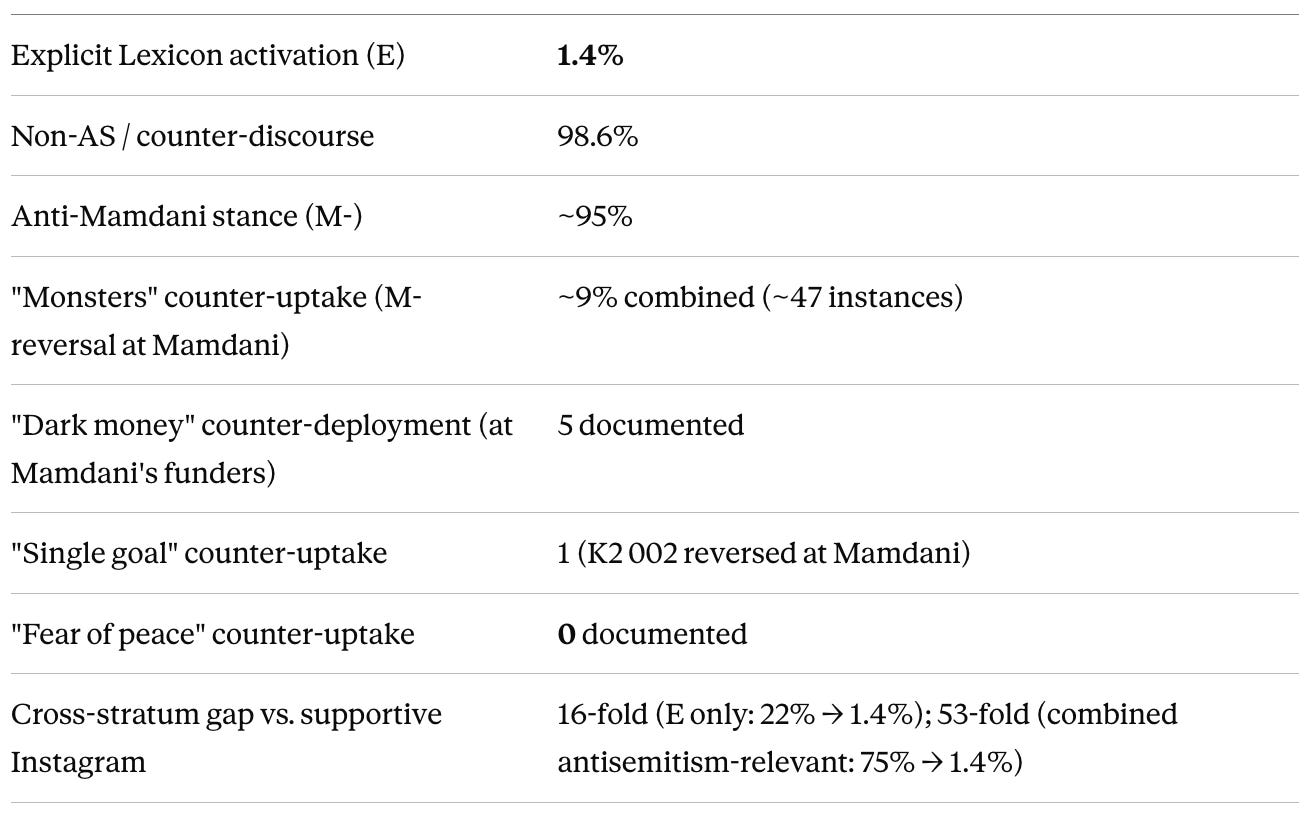
Audience uptake of Mamdani’s rhetoric.
Mamdani’s signature predicates also propagated in the critical Instagram stratum, but in reversed form: they were redirected at Mamdani himself. The “monster” predicate was taken up in counter-framing in approximately 47 instances across the five posts (~9% combined: K1 ~22%, K2 ~15%, K3 ~7%, K4 ~1%, K5 ~0%) in the form “He’s the monster,” “Mamdani is the monster of our times.” Beyond the simple counter-framing reversals, two of the critical-stratum’s most explicit cases identify the dehumanizing function of the “monster” predicate by naming its historical antecedents: K2 044 performs an audience-side substitution test in first-person (“As one of these ‘monsters’, I call out his blatant antisemitism!”), and K3 064 names historical antisemitic iconography directly (“the Judensau,” “Der Stürmer,” “1930s Germany”). The “dark money” predicate was redirected at Mamdani-funders (Qatari government, CAIR-affiliated PACs, DSA) in five M- counter-deployments across K3, K4, and K5. The bidirectional propagation finding is the central cross-stratum result on rhetorical uptake: appropriable predicates are appropriated by audiences on both sides — the supportive Instagram stratum extends them toward AIPAC and Jews as a group, the critical Instagram stratum reverses them at Mamdani. The two phrases that did not propagate in the supportive stratum — “single goal of turning us against one another” (Disintegration) and “fear of peace” (Evil/Vengefulness) — also show little to no M- counter-uptake here (1 observed instance of “single goal” counter-uptake at K2 002; zero for “fear of peace”).
Overall rates.
Across the five critical Instagram posts, the coded comments distribute as follows:
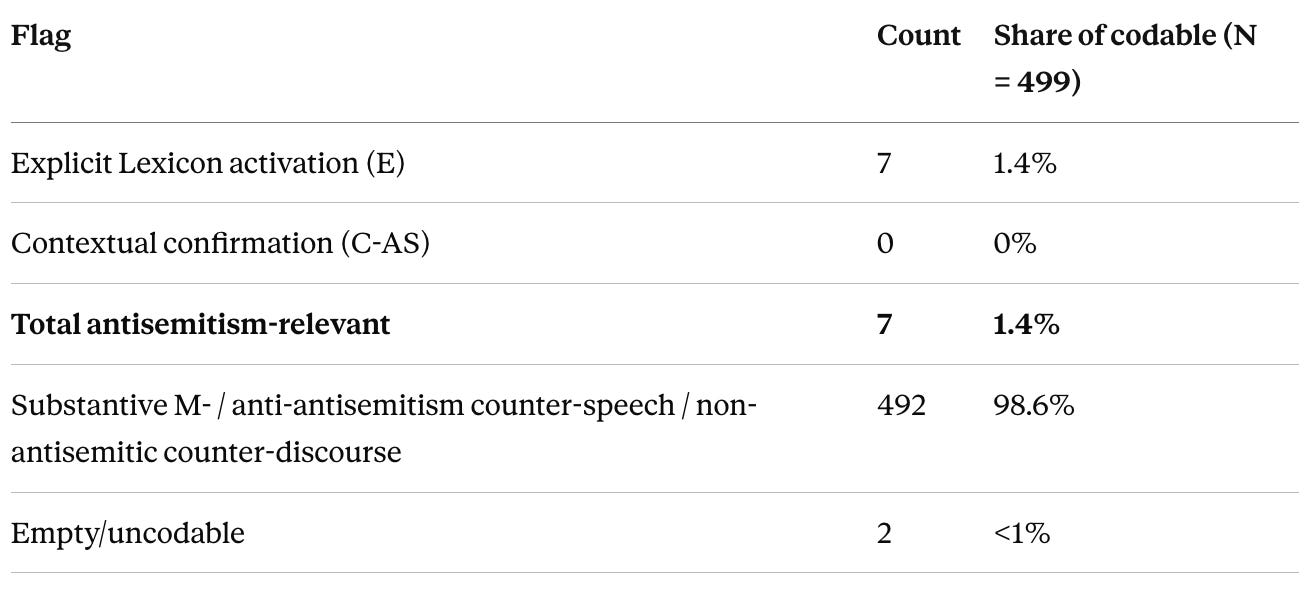
The 1.4% explicit Lexicon activation rate is approximately one-sixteenth of the supportive Instagram baseline (22%) — a 16-fold cross-stratum gap that holds across post-architectural diversity (Jewish-journalistic, Jewish-individual, institutional-Jewish-advocacy, right-coded mobilization, institutional-hybrid). All five posts produce E rates below 5%. The contextual confirmation category (C-AS) does not apply in critical post-ecologies: the post-level framing diagnoses antisemitism rather than activating it, so substantive M+ engagement endorsing the post-level framing is anti-antisemitism counter-speech rather than participation in an antisemitism-relevant discursive operation.
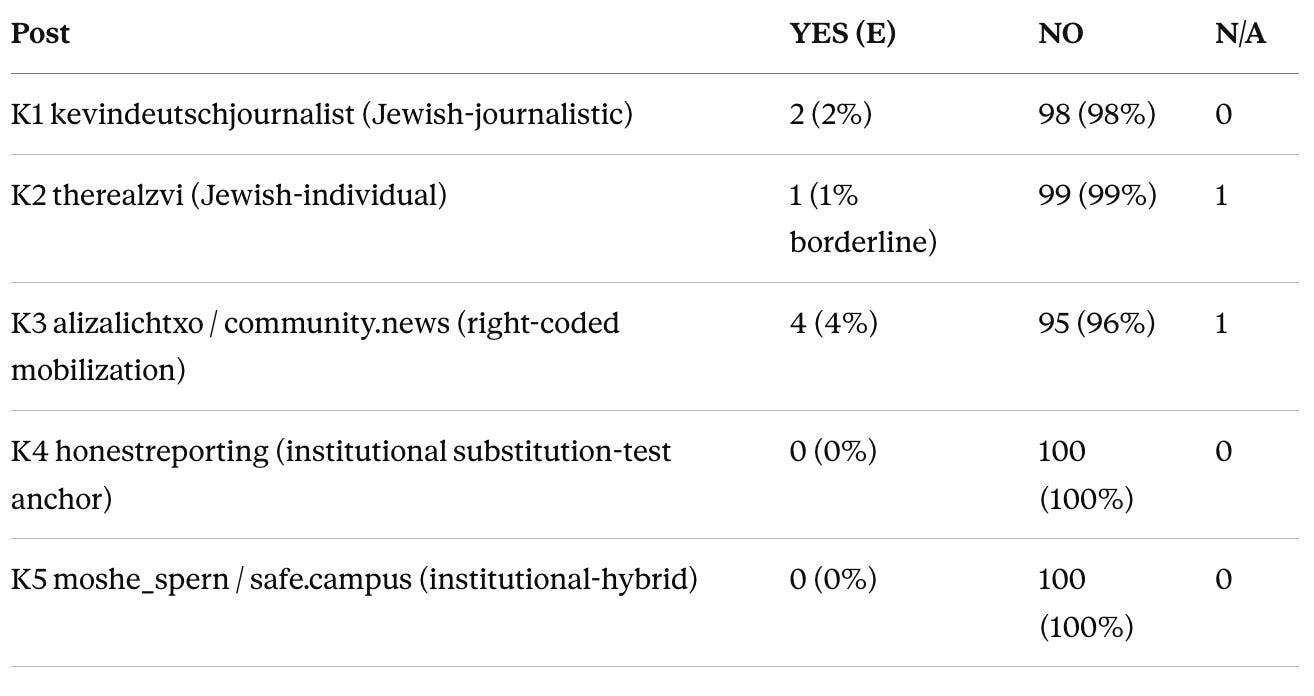
Audience-side dynamics.
The 98.6% NO share is not analytically empty. Critical comment ecologies escalate using historical-discursive vocabularies that do not activate Lexicon antisemitic predicates against Jews as a group: anti-Muslim and anti-immigrant attacks drawing on Mamdani’s Ugandan background (~10% of critical Instagram codable); Hitler-rhetoric and Holocaust-analogy positioning Mamdani as a contemporary perpetrator (~3%); Jewish-internal-Holocaust-slur compounds (Kapo, cattle car) applied to Jewish-progressive Mamdani-supporters like Bernie Sanders and Brad Lander (~2%); deportation and denaturalization rhetoric drawing on Mamdani’s Ugandan birthplace (~2%); religious-eliminationist framing (Amalekite, Yimach Shemo — ~1%). These vocabularies escalate against Mamdani personally rather than against Jews as a group; they are analytically distinct from the antisemitic tropes the supportive Instagram stratum activates.
Two cross-stratum cross-direction sub-patterns are worth noting alongside the main finding. The JFK-AIPAC assassination conspiracy and the Soros conspiracy both appear from M- direction in the critical Instagram stratum (K1, K2, K3) as well as from M+ direction in the supportive stratum (S05, S13, S15). The pattern documents that some Lexicon categories operate independently of post-stance direction: they activate where the historical-discursive material matches an audience-side repertoire, regardless of the political stance of the comment ecology.
In this corpus, the critical Instagram stratum is not where antisemitism-relevant activation is concentrated. Its 1.4% E rate is the cross-stratum benchmark against which the supportive Instagram stratum’s 22% and the mainstream-press YouTube stratum’s 42.5% acquire their analytical significance.
2.5.3 Mainstream-press YouTube (N = 400 across 4 threads)
The mainstream-press YouTube stratum shows the highest antisemitism-relevant activation rate documented in the present study. Two methodological observations frame the empirical findings below. First, the mainstream-press YouTube comment ecology around the Mamdani rally is not a moderating third reception environment but one characterized by comparatively high levels of antisemitism-relevant activation. Second, audience commenters reproduce Mamdani’s specific word choices — “monsters,” “dark money,” “genocide” — at high rates throughout the four threads.
At a glance — Mainstream-press YouTube (N = 400)
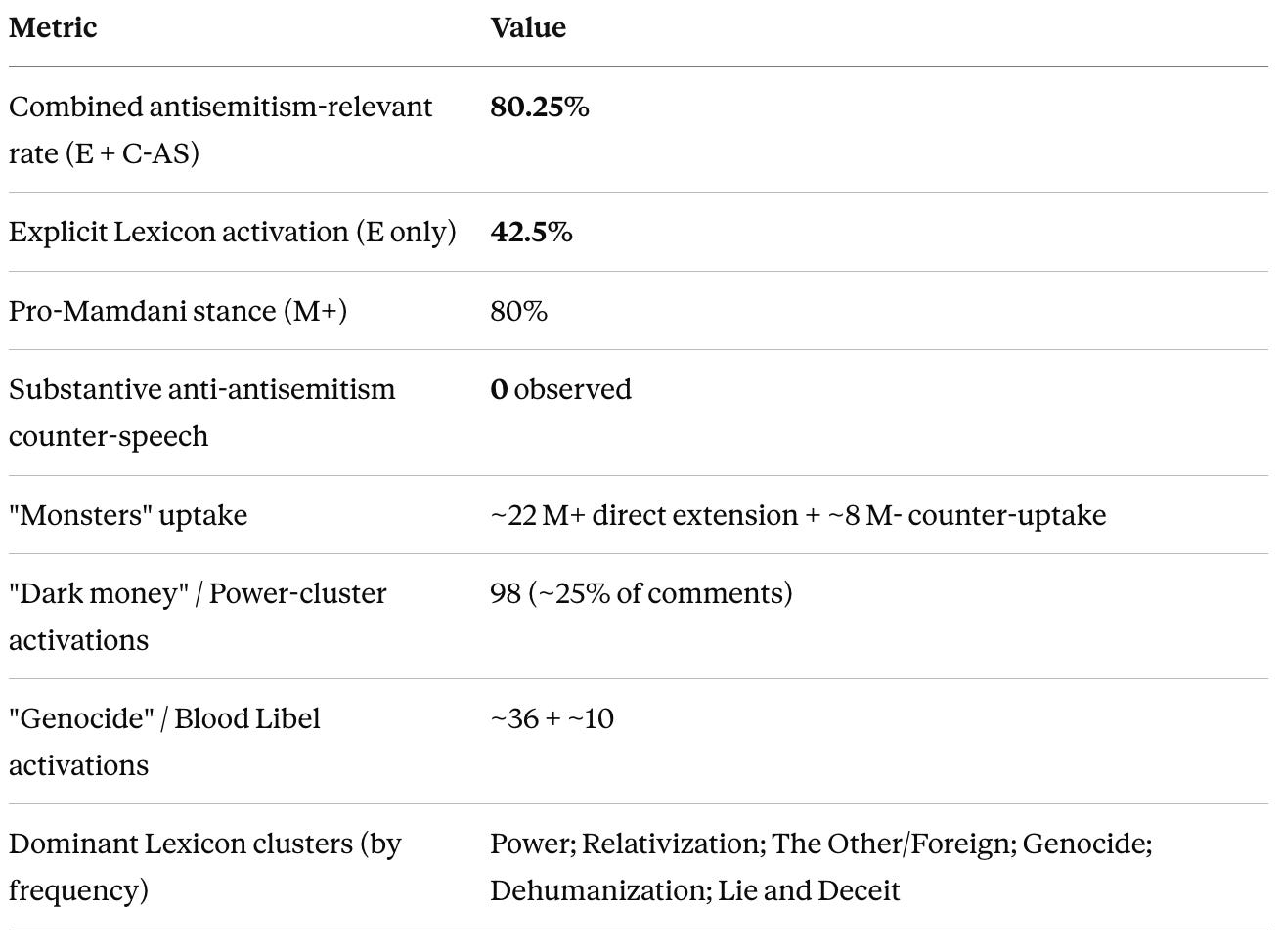
Audience uptake of Mamdani’s rhetoric.
Three of Mamdani’s signature phrases were widely taken up in the mainstream-press YouTube stratum. The “monsters” predicate produced approximately 22 M+ direct-extension instances and approximately 8 M- counter-uptake instances, extending from AIPAC toward Israelis, Jewish billionaires, and Jews as a group, often with escalation: “Anyone who supports Zionism-infected genocidal, ethnic cleansing, expansionist Israel is a monster” (M3 014 — extends the predicate to Israel-as-state with a DEH “infected” + GEN + COL compound); “Stop questioning the people who condemn a genocide and start questioning and attacking those who support a genocide like THE DEVIL MONSTOR AIPAC” (M1 0035 — adds EVIL escalation); “AIPAC is a monster. Unfortunately, it’s not the fun kind that breathes fire and fights robots. It’s the kind that shows up in a suit and funds genocide with American tax dollars” (M4 069 — adds POW + GEN); “Apologize? These demons don’t get phase” (M3 069 — religious-evil escalation). The “dark money” / Power-cluster framework propagated as 98 POW activations across N = 400 (~25% of comments), extending to Jewish billionaires, Jewish media, and Israeli foreign-influence framings: “Foreign lobbies don’t belong in politics, and AIPAC is probably the worst offender” (M1 0014 / M2 007 — same commenter cross-posting); “AIPAC has overthrown the American government, anyone supportive of the organization is treasonous” (M3 004 — CON-WD + DSL); “a lot of the billionaires who buy the politicians who fund Israel’s atrocities happen to be Jewish” (M3 063 — Jewish-billionaires TGS); “FINALLY, someone has the balls to call AIPAC the genocidal bankroll murders they are” (M1 0049, 1,655 likes — DEH + GEN + POW compound). The “genocide” / “children being killed” framework produced approximately 36 GEN + 10 BLO activations across the stratum; “21,000 children bomb to death. That’s antisemitism? Isn’t that the truth?” (M4 048 — GEN + BLO + RDA compound); “AIPAC is genocide” (M4 015 — direct predicate-attribution); “We have a media that is accepting the genocide so naturally they’re accepting of child molestation and sex trafficking” (M3 086 — GEN + BLO compound). The two phrases Mamdani also used at the rally — “single goal of turning us against one another” (Disintegration) and “fear of peace” (Evil/Vengefulness) — produced no observed uptake across N = 400. The selective-uptake pattern is now supported across N = 2,396 total codable comments combining all three reception strata: Mamdani’s signature phrases that named a moral antagonist in absolute terms (”monsters”) or alleged corrupt political power (”dark money”) were widely reproduced across every reception environment, while his longer attributive phrases describing actions or motivations produced no observed direct uptake anywhere in the coded corpus.
Overall rates.
Across the four mainstream-press YouTube threads (Forbes Breaking News, CNN, NBC New York, CBS New York; 309K total views; 3,331 total comments; first 100 coded per thread), the coded comments distribute as follows:
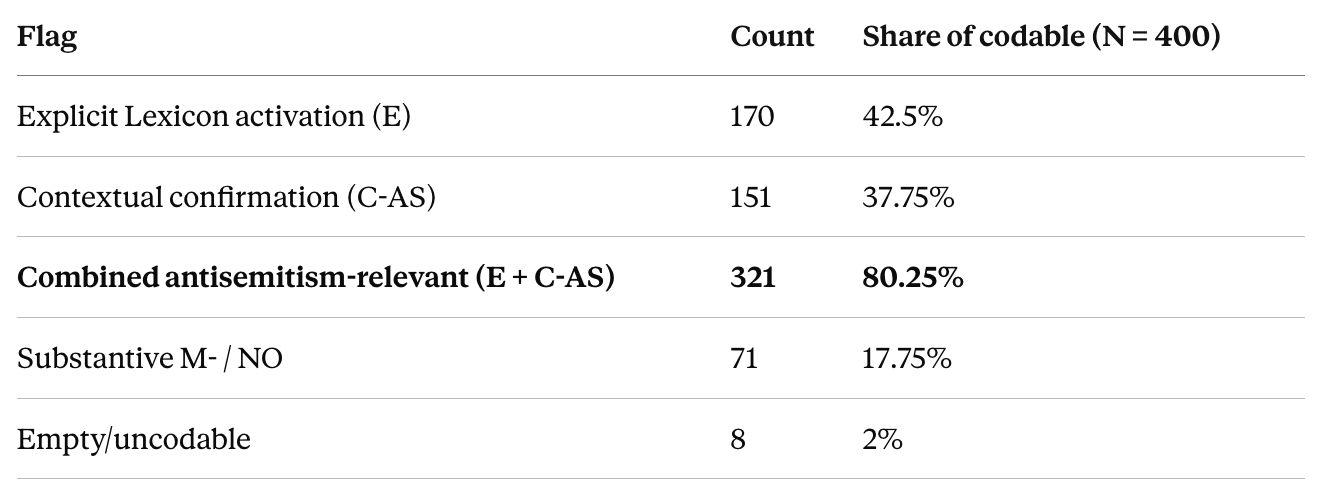
Across 400 mainstream-press YouTube comments, 321 (80.25%) participated in the antisemitism-relevant reception ecology. Of these, 170 (42.5%) deployed Lexicon predicates explicitly; 151 (37.75%) endorsed or amplified the post’s framing without independently activating predicates. Per-thread distribution:
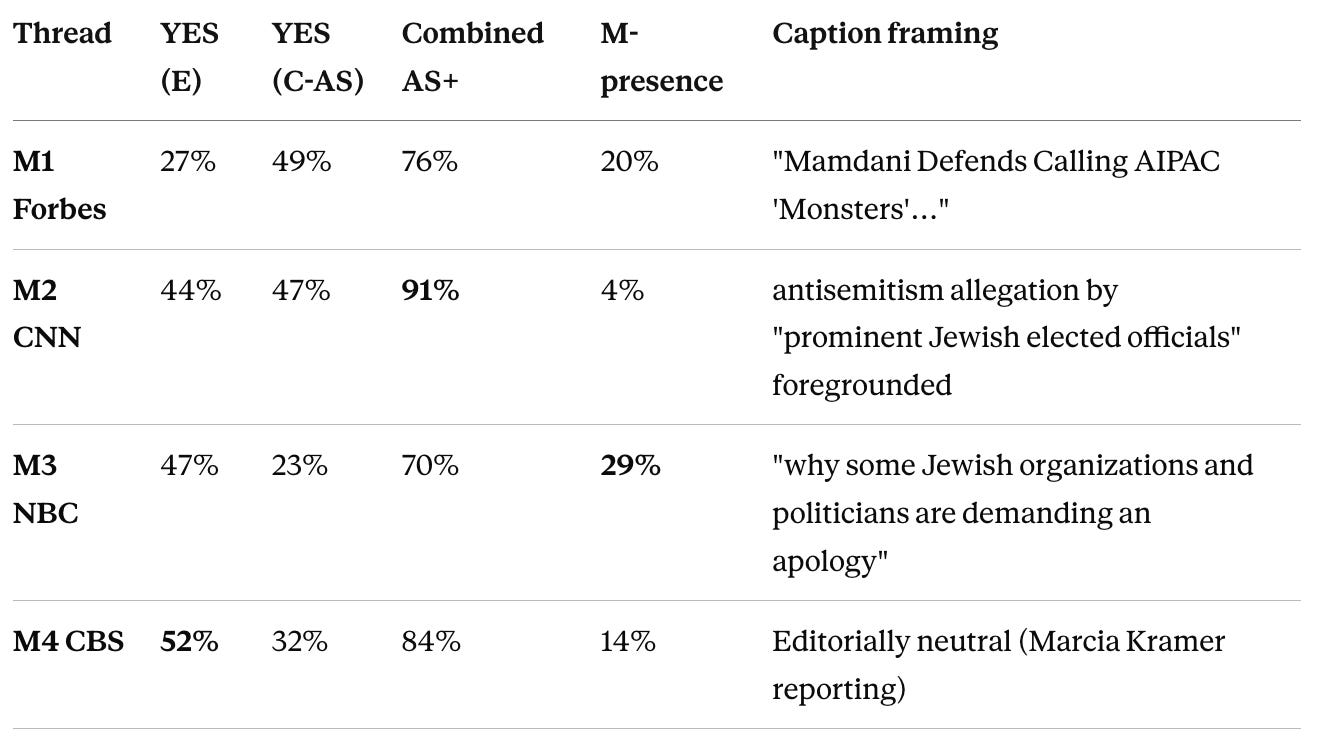
The thread with the highest antisemitism-confirming rate (M2 CNN, 91%) and the thread with the lowest (M3 NBC, 70%) both fall within the supportive Instagram stratum’s range (58–96%). Mainstream-press YouTube does not function as a moderating reception environment for this controversy. Substantive AS-COUNTER comments across N = 400: zero. No comment substantively rejected the antisemitism-relevant framework; comments that questioned individual predicates (e.g., dehumanizing language) while confirming the broader conspiracy framing were coded as confirmation (YES C-AS), not as substantive AS-COUNTER.
The cluster-activation density across N = 400 follows the same hierarchy observed in the supportive Instagram stratum: POW (98 activations, ~25% of comments), RDA (46), OF (~38), GEN (~36), DEH (~33), LIE (~23). Because comments may activate multiple tropes simultaneously, cluster frequencies exceed the number of coded comments. The “AIPAC = corrupt political power” framing is the structural anchor of the mainstream-press YouTube reception.
Audience-side dynamics.
The mainstream-press YouTube stratum exhibits a polarization spectrum from M2 CNN (4% M-) to M3 NBC (29% M-) — but the polarization does not produce moderation. Smaller-engagement threads concentrate M+ antisemitism-relevant activation; larger-engagement and Jewish-institutional-foregrounded captions attract more substantive M- voices alongside the dominant M+ reception. The M- pushback does not move the reception toward measured news framing: it produces direct M- antisemitism allegation against Mamdani alongside the dominant M+ antisemitism-confirming reception. The mainstream-press YouTube stratum is, in this sense, the polarized middle, not a moderating one.
Three further sub-patterns warrant brief mention. Cross-direction M- antisemitism activations — antisemitic predicates deployed against Mamdani and Jews from M- direction — appear at M3 074 (Soros + Nazi-analogy compound) and M3 085 (anti-Jewish economic-flight framing); Lexicon predicates activate from both M+ and M- direction across all three reception strata. The Khazar-identity-denial framework propagates at 5 activations (M1 0060, M1 0071, M3 021, M3 099, M4 011) — the typical form: “Jews aren’t really Semites, they’re European converts — so anti-Zionism cannot be antisemitism” — and notably does not appear in the supportive Instagram stratum. Named-Jewish-individual target-specification escalates by thread, correlating with caption framing: M3 NBC (Jewish-institutional caption) activates ADL, Gottheimer, Schumer, Jeffries, “Jewish billionaires,” “Jewish media,” and “Golem newscasters” as named targets; M4 CBS activates Bari Weiss, the Ellison family (Paramount-CBS ownership), and Marcia Kramer; M2 CNN and M1 Forbes show minimal named-target activation by comparison.
2.6 Audience uptake of Mamdani’s rhetoric across all three strata
A coded measurement of speaker-language uptake — how often the specific phrases Mamdani used at the rally and the press conference reoccur in audience comment threads, and how those phrases propagate — provides a way of empirically grounding the discourse-analytic reading from Section 1. The reading there identifies six recurring phrases and framing moves and maps each to one or more Lexicon categories. The empirical question is whether those phrases are picked up and extended by audiences in the reception, or whether they remain speaker-bound.
Coded data across all 24 posts and threads in the corpus (N = 2,396 codable comments combining 1,497 supportive Instagram + 499 critical Instagram + 400 mainstream-press YouTube) supports the selective-uptake hypothesis across all three strata. The two phrases Mamdani emphasized most heavily at the rally — “monsters” and “dark money” — propagate in all three reception environments, in both M+ and M- direction. The two phrases this essay identifies as antisemitism-relevant in concept but not in vocabulary-matching form — the “single goal” / Disintegration framing and the “fear of peace” / Evil/Vengefulness framing — show no observed direct uptake in any of the three strata.
The per-stratum speaker-language uptake findings are reported in the three subsections above. The cross-stratum summary below captures the bidirectional pattern across all three reception strata:
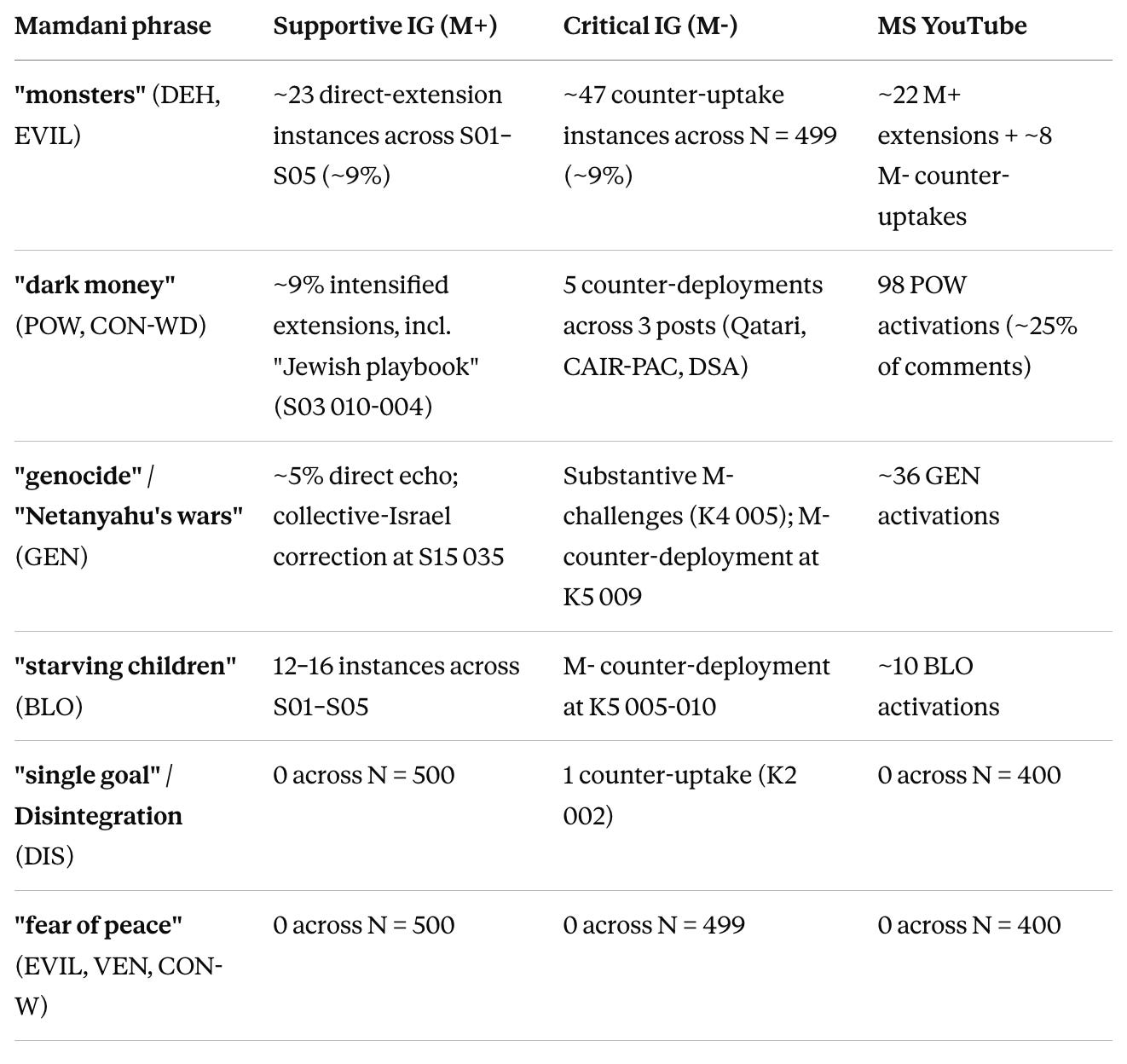
Two cross-direction sub-patterns are documented across the Instagram strata: the JFK-AIPAC conspiracy framework (S05 concentrated cluster, S15 003-002; K3 005 M+ within critical thread) and the Soros conspiracy framework (S13 within politically-diverse M- ecosystem; K1 022-001, K2 030, K3 006-001 from M- direction). The mainstream-press YouTube stratum adds the Khazar-identity-denial framework (5 activations across M1, M3, M4) as a further cross-stratum sub-pattern absent from the supportive Instagram stratum.
2.7 The main tropes in the comment sections
This subsection synthesizes the audience-side activations across all three strata by predicate-cluster, distinguishing dominant clusters, clusters with near-zero uptake, and counter-discourse registers.
Power and Conspiracy Theories together constitute the densest activation register across all three strata: 50+ explicit activations in the supportive Instagram stratum and 98 Power-cluster activations in the mainstream-press YouTube stratum (~25% of comments). Audience extensions take three documented forms: broadening from organization-level critique to claims of Jewish-American or Israeli control of US institutions; compression from organization-level framing to direct Jewish-agency framing (the “Jewish playbook” anchor at S03 010-004); and named-Jewish-individual target-specification (Schneerson, Chabad, Tisch, Rothschild, Soros, Brad Lander). Repulsiveness and Dehumanization is the corpus’s second-most-activated cluster, with parasite imagery (parasite S01, tick S10, lice S11, leech S14), organized-crime imagery, and religious-evil escalation (demons / Satan / shaytan / Satanyahoo) operating across languages. Two conspiracy frameworks — Soros and JFK-AIPAC — appear in both supportive and critical strata, indicating that some antisemitic predicates activate independently of the audience’s political stance toward Mamdani.
Two of the speaker’s predicates that Section 1 identifies as antisemitism-relevant produce near-zero audience-side direct echo. The Disintegration cluster activated by Mamdani’s “single goal of turning us against one another” receives one observed counter-uptake (K2 002 reverses it at Mamdani) and otherwise no propagation across all three strata. The Evil/Vengefulness “fear of peace” predicate receives zero observed uptake anywhere in the coded corpus. The Evil/Devil cluster does activate strongly through the religious-evil escalation of “monsters,” but not through “fear of peace” itself — the predicate that would have carried the cluster propagates only through a different speaker-side phrase. These are among the corpus’s clearest cases of selective uptake.
The critical Instagram stratum documents counter-discourse escalation registers that are analytically distinct from Lexicon antisemitic trope activation. The anti-Muslim register appears in approximately 52 instances across the five critical posts (~10% of critical-stratum codable), spanning Mamdani-as-foreign-Muslim-infiltrator framings, CAIR / Muslim Brotherhood conspiracy framings, and anti-Arab racial slurs, with deportation and denaturalization rhetoric in approximately 10 further instances drawing on Mamdani’s Ugandan birthplace. The Holocaust analogy register, prominent in the critical stratum, deploys Nazi-equation against Mamdani (K4 009’s “Sounded better in the original German” at 313 likes), Jewish-internal-Holocaust-slur compounds against Jewish-Mamdani-supporters (11 cases across K1 and K2), and religious-eliminationist designations (Amalekite, Yimach Shemo). A jurisdictional delegitimization frame (”the mayor of NYC shouldn’t be talking about Israel”) appears across both Instagram strata, and the Knicks-jersey appropriation reading appears at K4 010 and K3 059 as a recurring critical-stratum sub-pattern. The coding convention treats these registers as analytically distinct from antisemitic-trope activation: the Jewish-safety concern about Mamdani’s language and the anti-immigrant rhetoric mobilized in defense of it are different objects, and they can co-occur without being the same.
A move that recurs across strata without forming its own Lexicon cluster is complicity-naming: in the supportive Instagram stratum, Mamdani’s “those who allow it” framing extends into calls for investigation, prosecution, and removal of “those who support AIPAC,” “the Jewish lobby,” “the Zionist infiltration”; in the critical Instagram stratum, the inverse move extends culpability from Mamdani to his supporters (K3 065) and to his immediate family (K2 003 sub-thread; K5 008-007, 010-011). The move contributes to Disintegration and Power attributions in combination with surrounding predicates but is not a standalone cluster.
3. What the evidence shows
The reception analysis across all three strata (N = 2,396 codable comments across 24 posts and threads: 1,497 supportive Instagram + 499 critical Instagram + 400 mainstream-press YouTube) supports the patterns anticipated by the discourse-analytic reading in Section 1 and surfaces several cross-stratum sub-patterns that warrant separate documentation.
First, the audience-side availability claim from Section 1 receives empirical support across all three strata, with an unevenness that is itself analytically important. Explicit Lexicon activation rates run from 1.4% (critical Instagram) to 22% (supportive Instagram) to 42.5% (mainstream-press YouTube). The 16-fold cross-stratum gap between critical and supportive Instagram holds across post-architectural diversity — Jewish-journalistic, Jewish-individual, institutional-Jewish-advocacy, right-coded mobilization, institutional-hybrid critical posts — indicating that these high activation rates are post-stance-dependent. The mainstream-press YouTube rate of 42.5% (combined 80.25%) falls within the supportive Instagram per-post range but with a doubled explicit activation rate. The speaker's vocabulary appears to have supplied some of the lexical material through which antisemitism-relevant framings entered each reception ecology, even as commenters also drew on pre-existing framing repertoires.
Second, the diagnostic operations that this essay performs in Section 1 are independently performed by audience-side commenters in the critical Instagram stratum. At least seven specific instances are documented across the critical stratum, covering the substitution test, the trope identification, the historical-genealogy mapping (with one commenter at K3 022 invoking Mein Kampf and The Protocols of the Elders of Zion as predicate sources), the Weimar / 1930s-Germany historical analogy, the linguistic-manipulation diagnostic, the downstream-effects argument, and the predicates-to-offline-violence framing (referencing the Montreal incident at K5 016). The framework’s diagnostic operations are not unique academic constructions; they are also how critical audiences themselves read political language of this kind.
Third, the bidirectional propagation of Mamdani’s signature predicates — and the selective-uptake pattern that accompanies it — is the corpus’s strongest single empirical finding on rhetorical uptake. The “monsters” predicate was widely reproduced in M+ direct-extension form in the supportive Instagram stratum (~9% per larger post), as M- counter-framing in the critical Instagram stratum (~9% combined, ~47 instances), and in both directions in the mainstream-press YouTube stratum (~22 M+ extensions + ~8 M- counter-uptakes). The “dark money” predicate was reproduced as M+ intensified extension in the supportive Instagram stratum (with the analytically central two-word “Jewish playbook” compression at S03 010-004), as M- counter-deployment in the critical Instagram stratum (five Qatari/CAIR-PAC/DSA counter-deployments across three posts), and as M+ Power-cluster intensification in the mainstream-press YouTube stratum (98 activations, ~25% of comments). The rally’s signature predicates were taken up by audiences on every reception side: audiences are not passive recipients of speaker framing — they appropriate the framing and redirect it. Both phrases Mamdani also used at the rally — “single goal of turning us against one another” and “fear of peace” — produced no observed uptake across N = 2,396 codable comments anywhere in the corpus. The observed reception patterns are consistent with the selective-uptake hypothesis across all three strata: appropriable predicates are appropriated by audiences on every side; non-appropriable predicates show no observed uptake in either direction.
Fourth, the predicate-clusters at issue are not specific to progressive-left politics but are available across the political spectrum. The cross-stratum cross-direction sub-patterns documented for the JFK-AIPAC and Soros conspiracy frameworks — appearing in both supportive and critical strata — make this visible empirically. S13 (a right-coded supportive account) and K3 (a right-coded critical account) both attract cross-spectrum conspiracy activations. The implications are analytically important: the predicates themselves, not the speaker’s political direction, are the operative mechanism. The same predicate-availability cuts across the Jewish-internal contestation visible in the corpus, in which Jewish accounts on both sides of the controversy mobilize Jewish identity as the authority-anchor for opposite analytical positions — a feature of the discourse environment that the framework navigates by anchoring the diagnosis in specific predicate-clusters with documented historical genealogies, rather than in claims about who counts as a legitimate Jewish voice.
Fifth, the platform-architectural observation about mainstream news framing is double-sided. Mamdani’s rally generated extensive broadcast and print coverage, much of it analytically careful and much of it engaging the substantive predicate-level questions this article addresses. That coverage did not propagate to Instagram in meaningful volume — audiences receiving the rally on Instagram encountered it almost entirely through partisan-advocacy accounts on either side, without the moderating presence of mainstream news framing. Where mainstream-press coverage did propagate on YouTube, however, the comment ecology did not function as a moderating reception environment: no substantive anti-antisemitism counter-speech was observed across the 400 coded comments, and the combined antisemitism-relevant rate of 80.25% sat within the supportive Instagram range while the explicit activation rate doubled it. What the platform-architectural finding collectively shows is that the digital reception environment around an authoritative political speech is not organized as a moderator-and-partisans triad. The moderator role does not exist in the comment ecologies observed; the partisan modes operate at higher intensities precisely where audience volume is highest; and where mainstream-press coverage attracts the largest audiences, the comment ecology amplifies rather than tempers the antisemitism-relevant framings the rally activated.
Conclusion
This study began with a question about political language and digital discourse. Using the Mamdani rally as a case study, it asked how political language employing demonization and hidden-agency framings is received in contemporary digital discourse environments. Bringing together the discourse-analytic reading in Section 1 and the reception analysis across three coded strata (N = 2,396), the study offers an empirical answer to that question.
The discourse-analytic reading establishes that six recurring phrases and framing moves across the rally and the press conference overlap with documented antisemitic tropes cataloged in the Decoding Antisemitism Lexicon. The reading does not assess speaker intent. It identifies what the language draws on, what it makes available to audiences carrying the relevant historical repertoire, and which Lexicon chapters the predicates engage.
The reception analysis across all three strata shows that the audience-side dynamics this reading predicts are present at measurable rates, with a methodologically robust cross-stratum gap: 22% explicit Lexicon activation in the supportive Instagram stratum (N = 1,497), 1.4% in the critical Instagram stratum (N = 499), 42.5% in the mainstream-press YouTube stratum (N = 400), and 16-fold cross-stratum gaps holding across post-architectural diversity. Section 2’s empirical findings report the cluster-by-cluster results; this conclusion will not repeat them.
Several audience-side mechanisms illustrate these dynamics. Organization-level criticism was sometimes compressed into direct attributions to Jews as a group; leader-specific references were broadened toward collective attributions; and comments raising concerns about antisemitism were themselves contested through denial and instrumentalization framings. These mechanisms illustrate how audience reception can transform speaker-level formulations into broader historical repertoires.
The corpus’s central empirical finding on rhetorical uptake is the bidirectional propagation of Mamdani’s signature predicates across all three strata: “monsters” and “dark money” propagate as M+ direct-extension in the supportive Instagram stratum (toward AIPAC, Jews, and Israel), as M- counter-uptake in the critical Instagram stratum (toward Mamdani himself), and in both M+ and M- directions across the mainstream-press YouTube stratum. The audience-side reception is not passive; audiences appropriate the framing and redirect it. A second cross-stratum finding concerns audience-side performance of the framework’s diagnostic operations: at least seven observed instances across the critical Instagram stratum show audience commenters performing the substitution test, the historical-genealogy mapping, the Weimar / 1930s-Germany analogy, and the downstream-effects argument in their own vocabulary. The reception patterns are consistent with the framework’s expectations not only at the predicate level but also at the diagnostic-operation level.
More broadly, the findings demonstrate that political rhetoric does not remain at the level of the original speaker. It becomes raw material for audiences, who selectively intensify the predicates that resonate with pre-existing historical repertoires. The historical resonance of political language therefore cannot be assessed solely at the level of speaker intention or textual interpretation. It must also be evaluated through the patterns of audience reception that the language generates.
What the analysis cannot do is determine the mayor’s intent. What it can do is identify the structural features of the language and the discursive effect of its reception. The claim is narrow: the substantive political critique of AIPAC’s spending and lobbying activity is available without phrases that overlap with antisemitic tropes. The choice to use those phrases rather than alternatives that do not carry the historical resonance is a rhetorical choice with documented consequences for the reception environment.
The broader frame returns. Political language that works through demonization and hidden-agency framings raises the risk of fragmenting the discourse public along the dividing line the language draws. The Mamdani case is one focused instance. The political critique that prompted these phrases is available without them.
The central finding of this study is not simply that some audience comments were antisemitism-relevant; it is that particular rhetorical predicates proved highly portable across discourse environments. The phrases “monsters” and “dark money” were repeatedly extracted from the original speech, intensified, generalized beyond AIPAC to Jews as a group in many supportive comments, and reproduced across both partisan and mainstream-platform reception environments. Other phrases from the same speech showed virtually no uptake. Political rhetoric therefore does not diffuse uniformly: audiences selectively amplify the predicates that best fit pre-existing historical repertoires, and reception analysis makes those dynamics empirically observable.
The broader methodological claim the case is meant to demonstrate is transferable. What this study describes — the path from speaker to platform to audience appropriation to cross-platform propagation — is a model of rhetorical diffusion, applicable beyond the specific case examined here. At its broadest, the article is a case study in how codes and frames travel from authoritative speakers into online cultures of reception. Political rhetoric can be analyzed at the level of audience reception by tracing how audiences actually receive, transform, amplify, contest, and generalize it across the discourse environments that propagate it. Speakers do not control the predicate-clusters their language may activate. Audiences bring historically conditioned repertoires that can engage with those predicates independently of speaker intent, while platforms shape which framings circulate and which do not. These audience-side traces are observable, codable, and methodologically tractable.
Extending discourse analysis from source texts to reception ecologies therefore produces a different kind of empirical evidence. Rather than relying on close reading alone, it becomes possible to observe how historically resonant predicates are propagated, transformed, generalized, and contested across large-scale digital reception environments — as the bidirectional propagation of “monsters” and “dark money” across this corpus, the 16-fold cross-stratum gap in explicit Lexicon activation (supportive Instagram 22% vs. critical Instagram 1.4%), and the audience-side performance of the framework’s diagnostic operations each illustrate. The case is local. The method is not.
References
Anti-Defamation League. (2026). Audit of Antisemitic Incidents 2025. Released 6 May 2026. https://www.adl.org/resources/report/audit-antisemitic-incidents-2025.
Anti-Defamation League, New York / New Jersey Regional Office. (2026). New York Leads the Nation in Antisemitism, Again, Even as Incidents Fall Nearly 20% in 2025. Released 6 May 2026. https://nynj.adl.org/resources/report/new-york-leads-nation-antisemitism-again-even-incidents-fall-nearly-20-2025.
Becker, M. J., Troschke, H., Bolton, M., & Chapelan, A. (eds.) (2024). Decoding Antisemitism: A Guide to Identifying Antisemitism Online. Palgrave Macmillan / Springer Nature. https://link.springer.com/book/10.1007/978-3-031-49238-9.
CNN. (2026, June 22). Mamdani defends criticism of AIPAC after being accused of antisemitism. CNN Politics. Published 4:15 PM ET. https://www.cnn.com/2026/06/22/politics/mamdani-aipac-new-york-primaries.
Cohn, N. (1967). Warrant for Genocide: The Myth of the Jewish World Conspiracy and the Protocols of the Elders of Zion. Harper & Row.
Federal Election Commission. (2026, May–June). United Democracy Project (UDP) committee filings. FEC Committee ID C00799031. https://www.fec.gov/data/committee/C00799031/ — reported in CNN coverage (cited above).
Jacobs, J. (2026, June 22). On AIPAC and Bogeymen. Substack.
Lapin, A. (2026, June 22). Some of Mamdani’s Jewish allies criticize his use of ‘monsters’ to describe AIPAC. Jewish Telegraphic Agency / New York Jewish Week. https://www.jta.org/2026/06/22/ny/some-of-mamdanis-jewish-allies-criticize-his-use-of-monsters-to-describe-aipac.
Times of Israel staff. (2026, June 22). Some Jewish allies of Mamdani denounce his use of 'monsters' to describe AIPAC. The Times of Israel. https://www.timesofisrael.com/some-jewish-allies-of-mamdani-denounce-his-use-of-monsters-to-describe-aipac/.
U.S. Department of Justice / FBI. (2026, June 16). Criminal complaint unsealed in connection with alleged plot against UFC Freedom 250 event at the White House, charging Tycen Proper, Bryan Omar Roa, Michael Alan Thomas, Daniel Eskridge, and Abraham Hermosillo Alvarez. FBI Director Kash Patel announcement.
U.S. Department of Justice, Civil Rights Division. (2026, June 18). Federal grand jury indictment in United States v. Forrest Kendall Pemberton, Southern District of Florida. Criminal complaint and indictment documents; DOJ Civil Rights Division X announcement, 18 June 2026.