
Antisemitism in Real Time, Part IV: “A Fake Feud” YouTube Reactions to the Trump–Iran Deal and the Trump–Netanyahu Rift

AddressHate Research Scholar at NYU’s Center for the Study of Antisemitism | Lead, Decoding Antisemitism — PI, Decoding Hate | Research Advisor, AddressHate | Editor-in-Chief, Digital Hate Review

Previously in this series:
Part I — Antisemitism in Real Time, Part I: U.S. YouTube Reactions to Israel’s Strike on Iran (June 2025)
Part II — Antisemitism in Real Time, Part II: U.S. YouTube Reactions to Iran’s Retaliatory Strike on Israel (June 2025)
Part III — Antisemitism in Real Time, Part III: “Israel Made America Do It” — YouTube Reactions to the US–Israel Campaign Against Iran (March 2026)
Executive Summary
On June 14–15, 2026, the United States and Iran announced an initial agreement after more than three months of war, signed by President Trump on June 17. Israel was not a party to the agreement, and Israeli reactions ranged from cautious skepticism to outright opposition. The announcement also exposed visible tensions between Trump and Netanyahu, including Trump’s public criticism of Israeli strikes in Beirut that he said risked the deal. The agreement’s stability came into question in the days that followed.
This article asks how YouTube comment sections under U.S. news coverage of these events respond, and what happens to the antisemitic discursive register documented in Parts I–III when the political conditions that underpinned Part III’s interpretation had substantially changed.
For several weeks in mid-June 2026, the specific condition of U.S.–Israeli co-belligerence — which Part III argued was responsible for the subordination register — no longer held: Trump signed a deal Israel publicly opposed, exposing visible tension in the U.S.–Israel relationship. Part IV tests how the register responds across three temporal phases — Phase A (rift buildup, May 20 – June 10), Phase B (deal-period rupture, June 12 – June 16), and Phase C (post-signing destabilization, June 17 – June 21, 2026) — sampling the same eight outlets as Parts I and III (CNN, MS NOW [formerly MSNBC, rebranded November 2025], NBC, CBS, ABC, AP, Fox News, Forbes Breaking News) with 4,598 coded comments across 23 threads.
The register does not disappear under apparent contradiction; it reorganizes. The base “Trump-is-Bibi’s-puppet” register stays roughly flat per thread across all three phases. What grows most sharply is the blackmail and hidden-control sub-form, in which Trump’s compliance with Israeli interests is explained not by overt political alliance but by Mossad’s covert leverage. The clearest single instance, from an MS NOW comment section, is the article’s title quote:
“A fake feud. We wouldn’t be in Iran in the first place if Netanyahu didn’t own Trump.” (MS NOW T2 #0016)
A real Trump–Netanyahu rupture — Trump publicly criticizing Netanyahu over the Beirut strikes, Vance rebuking the Israeli Cabinet on NBC — is neutralized by declaring the rupture itself fake. The findings identify a mechanism through which this conspiracist register remains stable despite contradictory evidence: rather than abandoning the parent narrative, speakers replace one explanatory sub-form with another that better accommodates the new political reality while preserving the underlying interpretive structure. This article terms the mechanism compositional mutation.
Scale and design. Part IV analyzes 4,598 coded comments across 23 YouTube threads — considerably larger than the previous studies — and tracks the same eight outlets across three successive political phases. A second finding emerges from the design: observed antisemitism density is strongly constrained by video framing (more Netanyahu-focused → more antisemitism), with outlet-audience composition modulating density inside that constraint.
Parts I–III asked how antisemitism shows up during Israel-related wars. Part IV asks whether it survives apparent contradiction, and finds that it does not collapse — it mutates.
Introduction
On June 14, 2026, after more than three months of war that began with the joint U.S.–Israeli Operation Epic Fury on February 28, the United States and Iran announced an initial agreement to end the conflict and reopen the Strait of Hormuz. Mediated by Qatar and Pakistan, the memorandum of understanding was signed in person by President Trump at a state dinner at the Palace of Versailles on June 17 following the G7 summit in Évian-les-Bains, France, and signed remotely by Iranian President Masoud Pezeshkian; the document was finalized in both English and Farsi at Iran’s insistence. Follow-up technical talks scheduled for Bürgenstock, Switzerland on June 19 were postponed after Iran demanded guarantees that Israel would cease its operations in Lebanon. The memorandum extends the Iran ceasefire to Lebanon, though Israeli officials have stated that Israel reserves the right to continue operating against Hezbollah and will not withdraw from the southern Lebanon security zone. Israel was not a party to the agreement and was not directly involved in the negotiations.
Netanyahu’s first public response, delivered at a press conference in Jerusalem on June 15, was measured: he acknowledged that, with Trump, “many times we see eye to eye, and there are also cases in which we see less eye to eye”, while making clear that Israel does not intend to withdraw from southern Lebanon, Gaza, or Syria. Israeli opposition figures and former senior security officials were considerably sharper: Yair Lapid said Netanyahu “can no longer fix” the situation and committed to defeating him at the upcoming election; Yair Golan and former Prime Minister Ehud Barak framed the agreement as a strategic failure attributable to Netanyahu’s leadership. The U.S.–Israel relationship surrounding the announcement was visibly strained: Trump publicly criticized Netanyahu over Israeli strikes in Beirut, which he said risked the deal. Vice President Vance, defending the deal, rebuked Israeli cabinet officials who had criticized it, saying he “might not be attacking the only powerful ally” Israel has “anywhere left in the entire world.”
This article examines what happens to the antisemitic discursive register documented in Parts I–III of the Antisemitism in Real Time series under the materially changed political condition this episode represents. The empirical material consists of YouTube comment sections under U.S. mainstream-news coverage of the deal, sampled across three phases of the surrounding Trump–Netanyahu rift. The specific question is whether the subordination frame documented in Part III — discourse portraying American political agency as covertly controlled by Israel or Jewish interests — changes when the political configuration that prompted its consolidation in Part III no longer holds.
Two findings structure the analysis. First, the subordination frame does not disappear — it reorganizes. The base subordination idiom (dog/master, puppet, owns-the-party) declines as a share of the Power and Conspiracy register while the blackmail and hidden-control sub-form rises from approximately 18 % to approximately 57 % of all Power-and-Conspiracy content across the three phases. Second, observed antisemitism density across the 23-thread corpus is strongly constrained by how directly the video centers the Trump–Netanyahu confrontation versus the Iran-deal mechanics, with outlet-audience composition modulating density inside that constraint. The first finding bears on the trajectory of one discursive register under empirical contradiction; the second, on how density figures should be read in cross-platform and cross-period comparison.
This article is the fourth installment in the Antisemitism in Real Time series, which tracks how antisemitic discourse is activated by geopolitical events and adapts to them as they unfold in YouTube comment sections beneath major U.S. news coverage. Across all four installments, the same protocol and analytical instrument are applied; Parts I, III, and IV sample the same eight outlets.
Part IV differs from the prior installments in one substantive respect: its triggering event is diplomatic rather than military. Comment-section dynamics in response to a settlement need not mirror dynamics in response to strikes or escalation, and raw rate comparisons between Parts I–III and Part IV accordingly require interpretive care.
The Four-Study Arc: Testing a Structural Claim
The first three installments produced a cumulative argument: the antisemitic register does not simply recur across events — it adapts to them. Part I documented predominantly religious and demonological registers. Part II documented a pivot toward emotional celebration of Israeli suffering. Part III documented the emergence of a consolidated subordination frame and advanced a conditional claim: when the United States became a full participant in a war publicly framed as aimed at regime change alongside Israel, conspiratorial discourse about Jewish control of American foreign policy acquired what Part III called a political scaffold. Part IV makes that claim testable: if the scaffold changes substantially, the discourse should change in one of three ways:
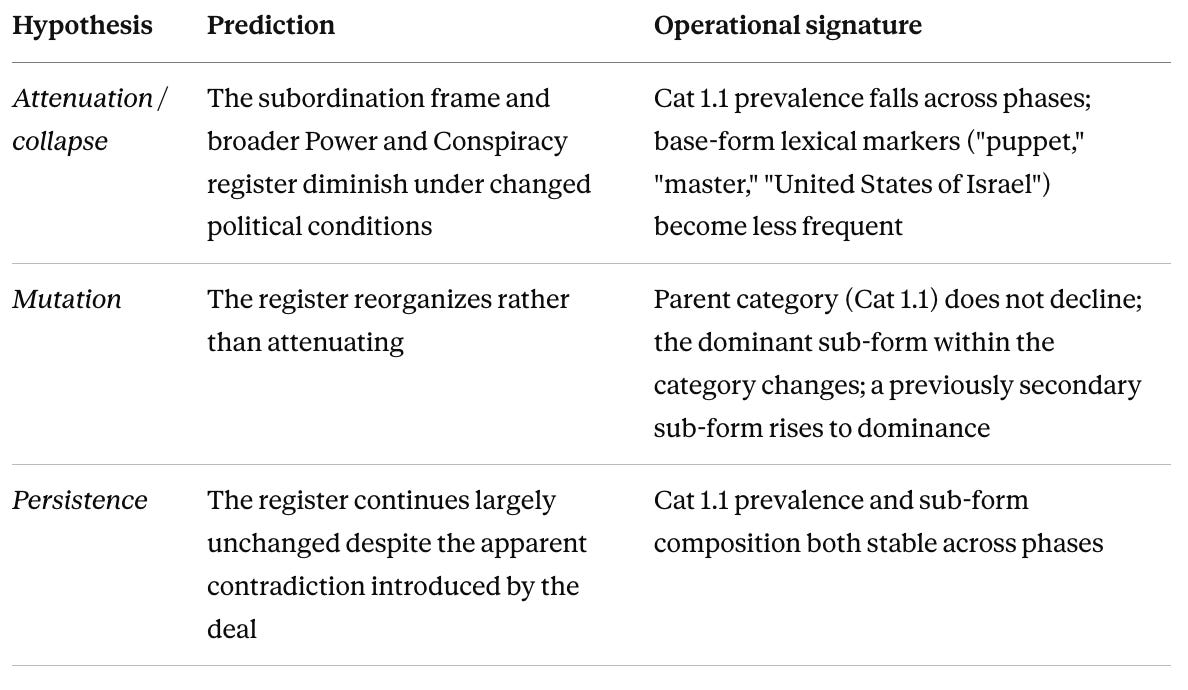
The three outcomes are not mutually exclusive; persistence and mutation in particular can co-occur, with the parent category persisting while the dominant sub-form changes. The analytical task is to identify which patterns predominate at which outlets, and across which subtypes of antisemitic language.
The hypotheses can also be read as a specific test case for a broader question about conspiracist discourse. When political events appear to contradict the core claim of a conspiracy theory, what happens to the theory? Does the framework collapse, attenuate, or absorb the contradiction by reinterpreting it within its own terms? The literature on conspiracy belief — going back to Festinger, Riecken, and Schachter’s When Prophecy Fails (1956), and continuing through Barkun’s A Culture of Conspiracy (2003) on the epistemic structure of conspiracist worldviews — suggests the third outcome, but the mechanism has typically been documented in cult or fringe settings rather than in mainstream-news comment sections at scale. The Part IV corpus, where the political condition Part III treated as causal no longer holds, is a test case for whether the mechanism operates in a mainstream venue.
A second analytical question concerns the stability of cross-ideological symmetry. Part III’s most striking finding on this axis was the convergence between CNN and Fox News — opposite ends of the political spectrum producing near-identical rates (21 % and 20 %). The Trump–Iran deal places particular strain on this symmetry on the right, where the America-First wing should welcome a deal that ends U.S. involvement while the pro-Israel right faces a bind between defending Trump and defending Netanyahu. Whether the Fox News comment section continues to track CNN’s antisemitic content rate, or whether the two diverge, is an empirical question this study is positioned to answer.
A narrower follow-on question concerns the Trumpstein thread documented in Part III — the suffix-Jewification of Trump’s name within a cross-platform conspiratorial formation linking the U.S. war alongside Israel to the alleged suppression of Epstein-related files said to be controlled by Jewish elites (the broader online suffix-Jewification pattern is documented in Becker 2024). In the Part III corpus, the Trumpstein formation depended on the Trump administration actively prosecuting the war alongside Israel; the deal removes that political fact. Whether the thread attenuates, mutates, or persists is the narrower empirical sub-question this study addresses alongside the main hypotheses.
Dataset & Methodology
Corpus overview
The Part IV corpus comprises comments drawn from 8 U.S. news outlets across three analytically distinct phases of the Trump–Netanyahu rift: Phase A (rift buildup, May 20 – June 10), Phase B (deal-period rupture, June 12 – June 16), and Phase C (post-signing destabilization, June 17 – June 21, 2026). Each phase corresponds to a discursive event window in which the rift and the deal pass through a distinct political condition; the cross-phase comparison enables the three-hypothesis test set out in the Four-Study Arc section above.
Within each phase, each outlet is represented by exactly one thread — the single video in that outlet × phase cell with the strongest combination of engagement and rift-centrality. This one-video-per-cell selection rule produces a corpus of 23 videos across 24 outlet × phase cells, with one structural cell absence (CBS Phase B) and one documented sub-threshold inclusion (NBC Phase A, at 198 comments). The coded sample applies the Parts I–III standard of 200 comments per outlet, but per phase rather than pooled across phases, enabling per-outlet per-phase comparison. The total coded sample is 4,598 comments (200 × 22 filled cells at threshold + 198 from the NBC Phase A sub-threshold cell).
Outlet selection follows Parts I and III: the same eight outlets are sampled in this study.
Operational definition of rift-centrality
The one-video-per-cell rule invokes “rift-centrality” as a selection axis alongside engagement. To prevent the term from functioning as post-hoc justification, the study operationalizes it through an explicit six-criterion definition applied uniformly to the candidate corpus.
A video qualifies as rift-central if its title, description, or primary news hook explicitly references at least one of: (1) Trump–Netanyahu disagreement, (2) Israel as non-party to the deal, (3) Israeli strikes threatening the deal, (4) U.S. administration criticism of Israeli officials, (5) Lebanon–Hezbollah as deal-violation site, (6) phase-anchor deal-events (signing, Strait of Hormuz closures and reopenings, postponement of follow-up talks).
A single match qualifies a thread as rift-central. Criteria 1–4 target the bilateral relationship directly; Criterion 5 captures Lebanon–Hezbollah as a specific deal-violation vector; Criterion 6 captures phase-anchor deal-events. Selection follows a two-stage rule: threads are first filtered for rift-centrality and the 200-comment engagement minimum, then the selected thread combines strongest engagement with the most directly bilateral criterion match. The criteria were specified before final thread selection and applied uniformly to the candidate corpus. Of the 23 selected threads, all 23 satisfy at least one criterion, with three within-criterion deviations at ABC Phase A, Fox News Phase B, and AP Phase C.
Video framing-position framework
Within the rift-centrality criteria, threads are further classified along a five-point framing-position axis that captures how directly the video centers the Trump–Netanyahu confrontation versus the Iran-deal mechanics:
Position 1 — Direct Netanyahu-focused (e.g., “Netanyahu will do whatever I want him to do,” “Israel defies demand from Trump”).
Position 2 — Israel-as-deal-breaker or deal-survival-conditional-on-Israel.
Position 3 — Trump or VP versus Netanyahu confrontation (e.g., “Vance issues blunt message to Israeli Cabinet”).
Position 4 — Deal mechanics with Israel as secondary actor (e.g., both-sides stop-shooting framings).
Position 5 — Iran-deal-with-Netanyahu-minimal (e.g., Strait of Hormuz closure as primary focus).
Framing-position serves as the study’s principal structural variable in the Section 5.D quantitative apparatus and provides the analytical bridge between news production and comment-section discourse. Analysis of the sampled threads indicates that, in this corpus, framing-position substantially constrains observed antisemitism density, with outlet-audience composition operating as a second-order modulator inside that constraint.
The five-position scale is derived inductively from the 23 selected threads themselves. The first sweep across the candidate corpus identified the visible spectrum of video framings — direct Netanyahu-focused content at one end, Iran-deal-with-Netanyahu-minimal content at the other — and the intermediate positions were operationalized to capture the structurally distinct mid-range types observed: Israel-as-deal-breaker (Position 2), Trump or VP versus Netanyahu confrontation (Position 3), and deal-mechanics-with-Israel-secondary (Position 4). Five positions represented the smallest number of categories that preserved the empirically distinct framing types observed across the candidate corpus without collapsing conceptually different news framings. The scale’s discriminating power was therefore developed against the same corpus on which it is reported; this is acknowledged as a methodological constraint, and the regression line in Figure D2 is presented as descriptive of this corpus rather than as a generalization beyond it.
Coding decisions on framing-position were made by the PI on the basis of each video’s title, framing, and opening content. Boundary cases — particularly at the Position 2 / Position 3 split, where a video may mention Netanyahu without foregrounding the Trump/VP confrontation — were reviewed twice. Formal inter-coder reliability has not been computed for Part IV and is flagged here as a methodological limitation.
Corpus structure at a glance
The 24 outlet × phase cells of the Part IV corpus are structured as follows:
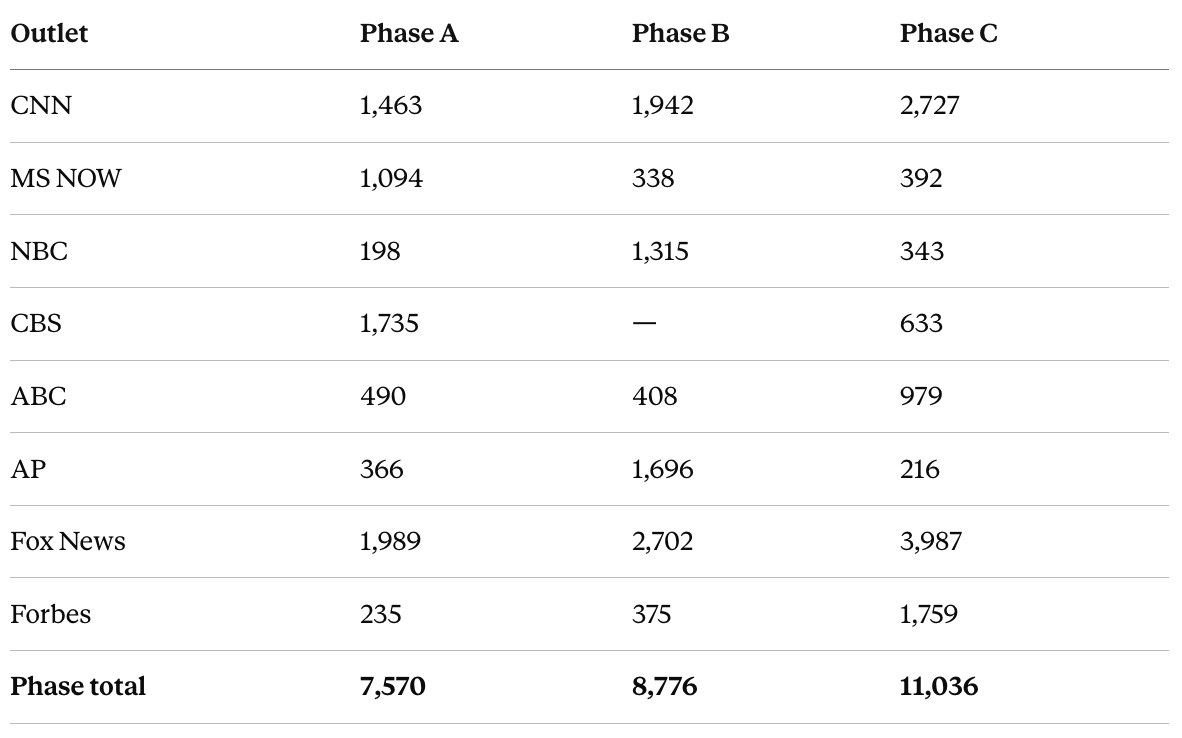
Legend: — = structural absence (CBS Phase B, no in-period video met the rift-centrality criterion). The NBC Phase A cell (198 comments) is a documented sub-threshold inclusion. Corpus total: 27,382 comments across 23 selected threads in 8 outlets.
Sampling procedure
The sampling target follows Parts I and III, with one design difference: 200 comments per outlet per phase, rather than 200 per outlet pooled across the study. For each filled outlet × phase cell, the first 200 comments of the selected thread are imported chronologically into the analytical software. Within each thread, top-level comments and replies are counted equally as discrete comments, in the order YouTube presents them when sorted chronologically. This research line treats antisemitic discourse as a relational and sequential phenomenon in which comments respond to, escalate, qualify, or contest one another; for a design focused on these dynamics, chronological sampling is preferable to random or interval-based sampling.
Five-week window: justification
Parts I, II, and III each sampled discrete events within tight 24- to 72-hour windows. The Trump–Iran deal did not arrive as a discrete event but as the culmination of a multi-event diplomatic rift spanning approximately five weeks, from Trump’s May 20 claim that Netanyahu “will do whatever I want him to do” through Iran’s June 20 closure of the Strait of Hormuz. Testing whether the subordination frame documented in Part III attenuates, mutates, or persists requires comments from across this entire rift rather than from any single moment, because the frame’s grammar may transform across the buildup, deal-announcement, and post-signing periods.
Annotation protocol
Annotation follows the linguistic and multimodal close-reading protocol used in Parts I, II, and III, supplemented by sequence and relational analysis, and guided throughout by the Decoding Antisemitism (DA) Lexicon (Becker et al. 2024).
The DA Lexicon’s analytical inventory is carried forward without modification. The Part III five-category structure (Power and Conspiracy Narratives; Demonology and Dehumanization; Schadenfreude, Death Wishes, and Glorification of Violence; Nazi Analogy; Classic Financial and Resource Exploitation Tropes) plus two Part IV additions (Denial of Israel’s Legitimacy; Discursive Strategies) supplies the coding spine. The final qualitative organization — five sections in Section 5.B plus a separate Discourse Dynamics section — reflects the cross-phase observations rather than the initial coding spine; the relationship between the two structures is set out in the Section 5.B opening, which maps each section to its Lexicon source and notes where the Part IV reorganization sits relative to the Part III coding categories. Whether and to what extent these categories actually dominate the Part IV corpus is an empirical question, not a methodological commitment.
Coding workflow
Comments were imported into the analytical software and annotated by trained team annotators using the DA Lexicon as the operational codebook. Each coding decision was reviewed by the Principal Investigator (PI); disagreements between annotator and PI were adjudicated against the DA Lexicon’s defined criteria for each sub-register, and the resolution was recorded for codebook calibration. Where a comment’s coding turned on a contextual reading not directly resolvable by lexical criteria — for example, irony readings or indirect-activation readings in which the antisemitic content depends on the surrounding thread context rather than on the comment’s surface text — the coding decision was made by the PI on a per-comment basis.
Category boundaries within Section 5.B carried recurring adjudication patterns rather than one-off difficulties. Three are worth naming because each affects multiple comments. The Power-and-Conspiracy / Financial boundary concerns AIPAC and donor-network framings, which can read primarily as control-mechanism (Cat 1) or primarily as financial-extraction stereotype (Cat 5); the operational rule applied here is that comments framing Jewish money as the mechanism of policy capture code under Cat 1, while comments framing the financial register as the content of the stereotype code under Cat 5. The Demonology / Financial boundary concerns parasite metaphors, which can function dehumanizingly (Cat 2) or as financial-extraction stereotype (Cat 5); the boundary is determined by the surrounding content (see Section 5.B.5 disambiguation paragraph). The Dual-Loyalty / Legitimacy-Denial boundary concerns “Jews-belong-elsewhere” framings, which can function as essentialized exclusion (Cat 2, Lexicon 1.8 Disloyalty) or as a denial-of-sovereignty argument applied to Israel (Cat 4, Lexicon 5.7 Denial of Right to Exist); comments framing the predicate as a character claim about Jews code under Cat 2, while comments framing it as a sovereignty argument code under Cat 4.
Sampling rationale and scope
The choice of YouTube comment sections as the data source is continuous with Parts I–III of this series and reflects three properties of the platform: its position as a mass-readership engagement venue under mainstream-news content, its hosting of long-form threaded discussion that enables observation of reply-context dynamics, and the public availability of comment text without authentication. The eight outlets selected — CNN, MS NOW, NBC, CBS, ABC, AP, Fox News, Forbes Breaking News — preserve cross-Part comparability and span the visible spectrum of U.S. mainstream news positioning: three centrist legacy networks (NBC, CBS, ABC), one wire service (AP), two left-leaning outlets (CNN, MS NOW), and two right-leaning outlets (Fox News, Forbes Breaking News). The 200-comments-per-outlet-per-phase target is calibrated to the corpus density observed in Parts I and III; beyond roughly the first 200 comments of a thread, the marginal register-content yield declines and the additional comments are dominated by reaction-emoji and short rejoinder content.
These choices carry limitations that should be flagged before the empirical sections. Formal inter-annotator reliability statistics across the team were not computed for Part IV and are flagged here as a methodological limitation; the Part V design will incorporate explicit inter-annotator reliability calculation per sub-section of Section 5.B. YouTube comment sections are not representative of antisemitic discourse on social media as a whole; the audience is self-selected to interact with mainstream-news content and differs from message-board, X/Twitter, or TikTok populations. The English-language restriction limits the corpus to one linguistic community of antisemitic discourse, and the registers documented in non-English contexts may differ from those reported here. The 200-comment threshold is a sampling-economy choice rather than a representativeness claim; on threads where the antisemitic register concentrates in the first 50 comments, the threshold captures the bulk of the register, whereas on threads where the register diffuses across the first 500, the threshold may understate it. These limitations bear on how the article’s findings should be read: as descriptive of this corpus and the conditions it samples, rather than as generalizations to the broader landscape of antisemitic online discourse.
Summary of Comment Patterns by Outlet
The corpus comprises 4,598 user comments across 23 selected threads in 8 outlets across three temporal phases. The per-thread density of antisemitism-coded content is reported in the table below; the three substantive findings that emerge from the cross-phase comparison are summarized in plain prose immediately after. The full quantitative apparatus — figures, regression statistics, two-stage determination evidence, per-phase compositional table — appears in Section 5.D Quantitative apparatus, after the qualitative chapter, for readers who want the technical grounding.
Cross-phase density
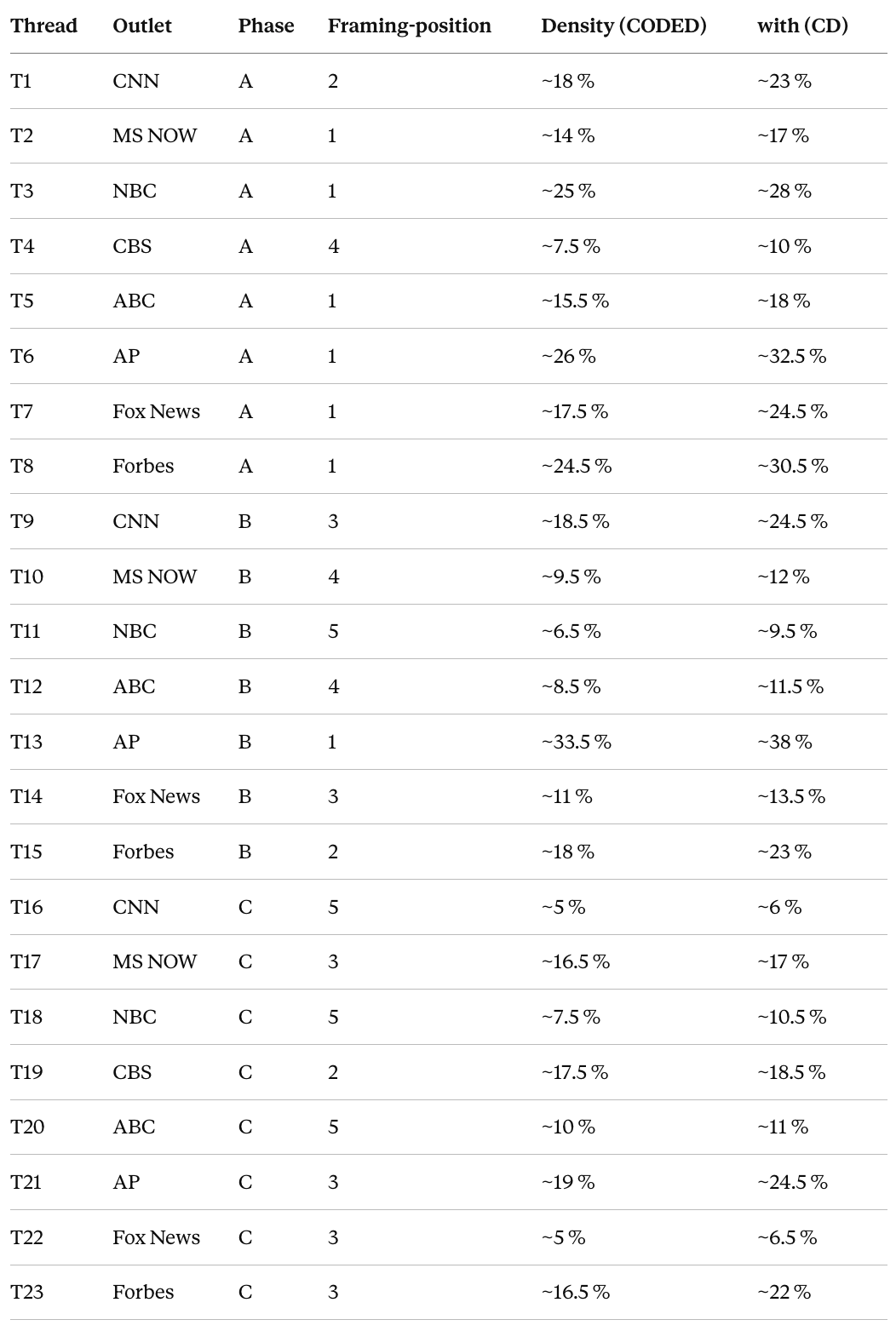
The two density columns report the same threads under two coding standards used throughout the AiRT series: the explicit count includes only comments that meet the DA Lexicon’s strict coding criteria on the comment’s surface text; the context-dependent count additionally includes comments whose antisemitic reading depends on the surrounding thread context (irony, indirect activation, reply-context disambiguation). The narrative analysis below uses the explicit count as the conservative reference figure; the context-dependent figures are reported for transparency.
What the corpus shows
The headline numbers, read naively, would mislead. On their own, the raw percentages suggest that antisemitism simply faded once Trump and Netanyahu appeared to split. Phase C — the post-signing period in which Trump publicly broke with Netanyahu — produces a lower peak density (19 % at AP T21) than Phase A (26 % at AP T6) or Phase B (33.5 % at AP T13). On its face, this looks like attenuation: the political conditions shifted, the antisemitic register quieted. That interpretation is incomplete, for two reasons. Attenuation is visible in the raw numbers; what cannot be inferred directly from those numbers is that the antisemitism register itself attenuated, because the framing-position mix of the news cycle also changed.
The first is that the three phases are not sampled at comparable video framings. Phase A and Phase B both contained “direct Netanyahu-focused” videos — the framing class that produces the corpus’s highest densities. The Phase C news cycle (June 17–21) did not produce videos in that class; coverage shifted to “Trump-vs-Netanyahu” or “Iran-deal-with-Netanyahu-minimal” framings, which produce lower densities by structural design across all three phases. The density numbers cannot be read as straightforward attenuation, because the news cycle’s framing mix also changed. (The full framing-position regression and its statistical apparatus are in Section 5.D.)
The second is the substantive Phase C finding, which is the article’s central result: what changed at Phase C is not the amount of antisemitism but the dominant sub-form within the subordination register. This compositional finding is methodologically distinct from the raw-density question disqualified above: the comparison here is within Cat 1.1 — base-form versus blackmail sub-form — rather than across thread-level antisemitism densities, so it is not subject to the same framing-position confound that disqualifies the cross-density comparison. The base “Trump-is-Bibi’s-puppet” register stays roughly flat per thread across all three phases. The proportion of comments expressing the blackmail and hidden-control sub-form rises markedly across the three phases — Mossad has Epstein files on Trump, “Trumpstein,” golem-Trump, “Bibi has Trump by the curlies,” Israel-first / Epstein-administration. This sub-form rises from approximately 1.2 instances per thread in Phase A to approximately 5.4 in Phase C, with Forbes T23 alone containing 13 instances in a single 200-comment sample. Its share of all subordination-register content rises from approximately 18 % in Phase A to approximately 57 % in Phase C: by the post-signing window, the blackmail sub-form produces more than half of all subordination-frame content. Under the changed political conditions — Trump signing a deal Israel publicly opposes, Vance rebuking the Israeli Cabinet on NBC — the within-frame composition shifts toward a sub-form that can absorb apparent counter-evidence. Among the three hypotheses set out in the Four-Study Arc section, the Phase C composition is most consistent with mutation over attenuation or stable persistence.
Two further cross-phase observations The outlet-audience composition produces large variation in density at the same framing-position throughout the corpus — Fox News and Forbes Breaking News stay quieter under the same framing than AP, ABC, and MS NOW. The methodological implication: no single “X % of comments are antisemitic” number is meaningfully interpretable for cross-period or cross-platform comparison without specifying outlet and framing. Separately, the religious antijudaism register (Christ-killer, Jews-as-usurers, Jews-threaten-Christians) and the Nazi analogy — concentrated at right-leaning outlets in Phase A — recede in Phase B and re-surface at higher cross-outlet concentration in Phase C, accompanied by new lexical-allusion vehicles entering the selected mainstream-news YouTube comment sections (yarmulke-coded allusions, neo-Nazi numeric codes in usernames, Holocaust-denial book recommendations).
The qualitative material that grounds these claims — the actual comment text, organized by register — is the subject of Section 5.B below, which is where the article’s evidentiary weight sits.
Breaking Down the Predominant Concepts of Antisemitism in YouTube Responses
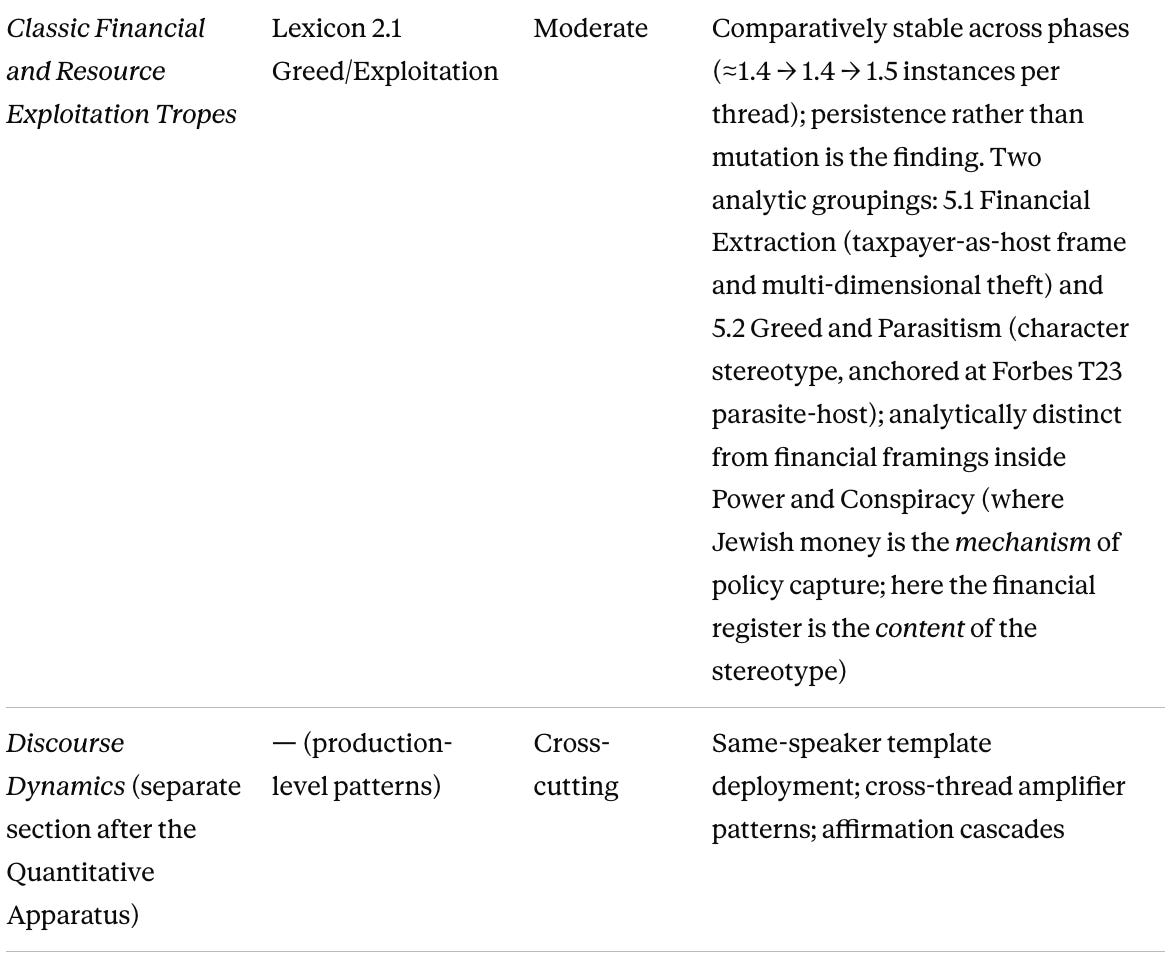
The qualitative analysis of the 23-thread corpus organizes the findings into five sections aligned with the DA Lexicon’s analytical architecture: 1 Classic Antisemitism, 2 Concepts of Power, 5 Attacks on Israel’s Legitimacy, 6 Aggressive Speech Acts, and 2.1 Greed/Exploitation. The register coded as Lexicon 3 Secondary Antisemitism in the prior installments — the treatment of antisemitism accusations themselves as bad-faith manipulation deployed by Jewish actors to silence criticism, here termed antisemitism-instrumentalization — is incorporated under Section 5.B.2 (sub-section 2.7) because it applies the same deceit stereotype to claims of antisemitism. A separate Discourse Dynamics section, placed after the Quantitative Apparatus, treats the production-level patterns through which these registers circulate — same-speaker template deployment, cross-thread amplifier patterns, affirmation cascades — at a different analytical level than the content-register sections.
Empirical volume distribution The five Section 5.B sections are not equal in size; the separate Discourse Dynamics section is included in the final row for completeness. Approximate proportions across the corpus:
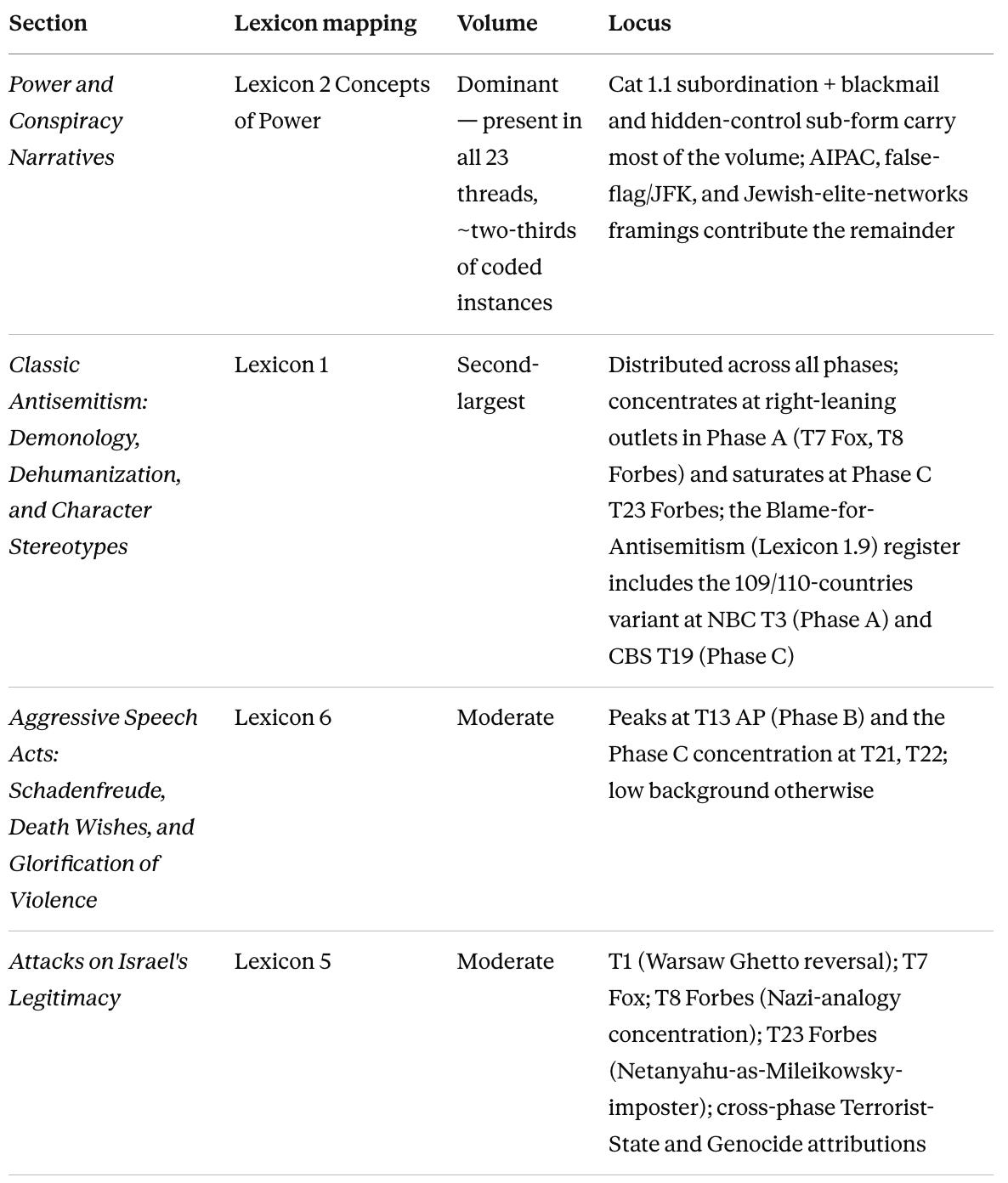
Relationship to the Part III five-category structure
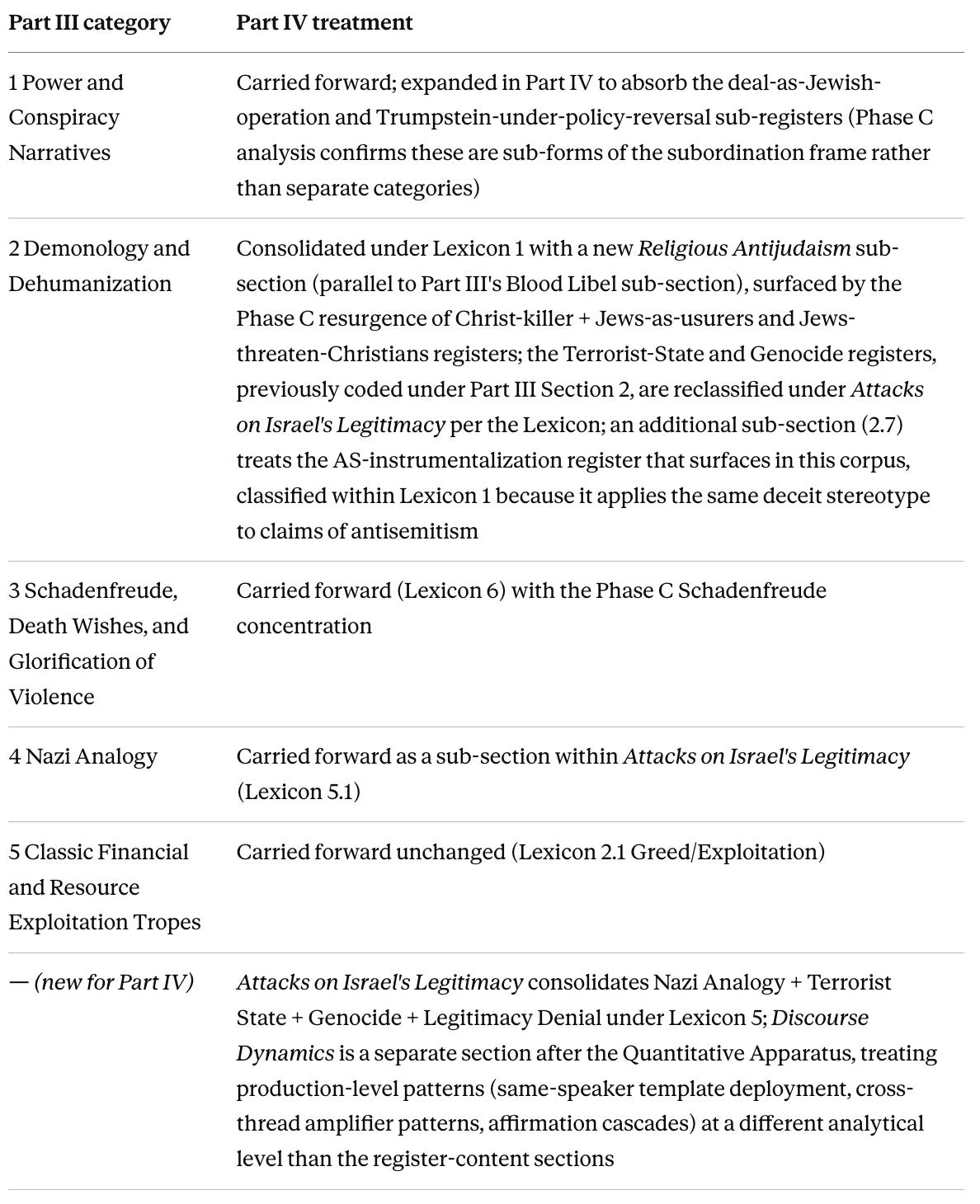
Each section below is illustrated with representative items from across the three phases. The cross-phase trajectory of each unit is flagged where present. A separate Section 5.C addresses forms of rejection that are not antisemitism — the boundary cases that the conservative-coding standard excludes.
1. Power and Conspiracy Narratives
Power and Conspiracy Narratives constitute the dominant antisemitic register across all 23 threads of the Part IV corpus, accounting for roughly two-thirds of coded instances. As Part III documented in March 2026, when the geopolitical configuration places the United States in a posture of cooperation or co-action with Israel, the discourse that emerges in mainstream-news comment sections is overwhelmingly conspiratorial rather than religious or affective. Part IV asks whether this register weakens when the configuration changes. It does not. Its internal composition changes instead.
The central organizing formation across all three phase windows remains the subordination frame — discourse rendering the United States as Israel’s instrument, the U.S. president as Netanyahu’s functionary, and the U.S. military as a mercenary force deployed in Jewish interests. What distinguishes the present corpus from Part III is not the persistence of this frame but the shift in its internal composition. The base subordination idiom — the dog/master, puppet, and ownership metaphors that dominated Part III’s documentation — holds steady in per-thread frequency across all three phases (≈5.8 → 5.1 → 4.1 instances per thread), with only a modest decline. What grows most sharply is a related sub-form, blackmail and hidden-control, in which Trump’s compliance with Israeli interests is explained not by overt political alliance but by Mossad’s covert leverage. The sub-form’s share of total Power and Conspiracy content rises from approximately 18 % in Phase A to approximately 57 % in Phase C: by the post-signing window, it produces more than half of all subordination-frame content.
The register also contains two adjacent sub-registers operating within the same conspiracy logic: a False-Flag / JFK-Precedent formation positioning Trump or American interests as the target of Jewish or Israeli action rather than its agent, and a Jewish Elite Networks formation naming Rothschild finance, Chabad-Lubavitch leadership, and adjacent elite actors as controlling forces.
Subordination The base subordination idiom — Israel-controls-America in the dog/master, puppet, owns-the-party, dictate-US-policy, tail-wagging-the-dog form — is documented across all 23 threads. Nine representative instances, drawn from across the corpus to span outlet, phase, and metaphor sub-class:
“Bibi owns Trump it’s clear.” (CNN T1 #0015)
“Dump is Israel’s personal dog!” (CNN T1 #0047)
“BiBi has a short leash on Trump!” (Fox T7 #0009)
“Mileikowsky is Trump’s daddy.” (ABC T5 #027-17)
“He is Israels puppet. PUPPET PRESIDENT” (CBS T4 #0014-13)
“Israel is entirely in control of US domestic and foreign policy. As well as our military.” (CNN T1 #0035-23)
“AIPAC has captured America.” (ABC T5 #011; 204 likes)
“The biggest enemy for America is Netanyahu. He has dog walked America to 3 wars: One with Iraq, and twice with Iran.” (NBC T3 #041)
“Trump writes Netanyahu strongly worded check” (Forbes T23 #053)
NBC T3 #041 supplies the canonical compression — America as the dog being walked through three wars on a leash held by Netanyahu personally. The ABC T5 #011 “AIPAC has captured America” comment works the same Subordination register through a different mechanism: institutional proxy rather than personal submission, with AIPAC as the named conduit through which Jewish capture of US policy is alleged to operate. The Forbes T23 #053 “strongly worded check” comment is the corpus’s clearest ridicule-class instance: rather than asserting Israeli control through metaphor, the comment mocks Trump’s ineffectuality against Netanyahu via the “strongly worded letter” trope, with the check substitution converting Trump’s response into transparently inadequate payment. The mockery presupposes the subordination — only a subordinate would reduce its protest to a check — and works the register from the inverse angle. T6 AP shows the strongest single-thread base-form saturation in the corpus (~26 %) under the “Netanyahu will do whatever I want him to do” video framing — Trump’s May 20 assertion of dominance over Netanyahu. Rather than aligning with Trump’s framing, the comment section overwhelmingly reverses it — Netanyahu controls Trump, not the other way around — across six metaphor classes in a single 200-comment sample (master, puppet, canine, sexualized-submission, daddy, owned-and-controlled), including a multi-presidential-orchestration variant absent in Phases A T1 and T2. The thread is the Phase A precursor of the mutation pattern that develops at Phase C: even direct counter-evidence to the subordination claim is reframed as confirmation of it. The full inventory spans six metaphor sub-classes: canine, puppet, ownership, parent/child, ridicule, and sexual-domination.
Blackmail and Hidden Control The defining feature of the hidden-control sub-form is that observable political disagreement is reinterpreted as evidence of deeper covert coordination. The political proposition “Trump is influenced by Israel” is routine political analysis; what makes the Phase C material antisemitic is the mechanism speakers reach for to re-narrate the relationship under the changed political conditions:
“A fake feud. We wouldn’t be in Iran in the first place if Netanyahu didn’t own Trump.” (MS NOW T2 #0016)
“Trump is blackmailed by Israel over the Epstein files.” (Fox T22 #0012-1)
“Ireasl [sic] said to Trump do it, or we will release the sick PDF video of you” (Forbes T23 #0051-2)
“Donald Judas Trump eventually betrays everyone” (Forbes T23 #005)
“Golem Trump, turned on its creator” (Forbes T23 #006)
The MS NOW T2 #0016 “fake feud” comment is the article’s title quote and the corpus’s most compressed instance of the mutation: a real Trump–Netanyahu rupture — public criticism, Cabinet rebuke, Lebanon refusal — dissolved by declaring the rupture itself fake, with the hidden-control premise (Netanyahu owns Trump) preserved through the dissolution. The Fox T22 “blackmailed over the Epstein files” comment is the lexically explicit categorical attribution of the mechanism. The Forbes T23 PDF-video and the two adjacent Forbes T23 cultural-vocabulary comments — “Donald Judas Trump” and “Golem Trump, turned on its creator,” posted as #005 and #006 in the same thread — frame the Trump–Netanyahu rift through name-vocabulary drawn from religious antijudaism (Judas the betrayer-disciple; golem the creature-of-its-creator). In context, both comments contribute to the hidden-control narrative by treating Trump’s apparent break with Netanyahu as a betrayal or malfunction inside an assumed prior relationship of control — the Judas-betrayer trope frames the rupture as collaborator-betrayal internal to a Jewish-patron relationship, the Golem-turned-on-its-creator trope as creature-turn internal to a Jewish-creator relationship. Both convert apparent counter-evidence into further evidence of the framework’s core premise.
The blackmail and hidden-control sub-form appears as Phase A precursors at CNN T1, Fox T7, NBC T3, and Forbes T8; Phase B Trumpstein instances at ABC T12; and Phase C instances at Fox T22, CBS T19, and Forbes T23.
The sub-form grows from approximately 1.2 instances per thread in Phase A to approximately 5.4 in Phase C — a roughly 4.5× increase. The Trumpstein thread documented in Part III does not attenuate under policy reversal; its within-frame composition shifts toward the blackmail-leverage sub-form that can absorb the political contradiction. The headline share-shift (18 % → 57 %) is documented in the Section 5.D Phase C compositional table.
False-Flag and JFK-Precedent Conspiratorial framings positioning Trump or American interests as the target of Jewish or Israeli action — a related but inverse variant of the subordination frame, operating within the same conspiracy register. The Phase C T21 AP comment is the corpus’s lexically explicit realization:
“False flag attack by Israel incoming” (AP T21 #106)
The comment activates the broader register in which Israeli covert action is expected when U.S. policy diverges from Israeli interests. In this corpus, the JFK register functions as the paradigm case: a president who diverged from Israeli interests and was punished by Mossad-orchestrated assassination. Trump’s current divergence — signing a deal Israel publicly opposes — invites the inference that the same sequence is now in motion, with the false-flag prediction at T21 #106 operating as the anticipatory move that places the predicted operation in continuity with the JFK precedent. The register also operates in elaborated forms across the corpus, with the JFK and October-7 precedents made fully explicit:
“They’re going to false flag nuke an American city and blame it on Iran to drum up war support.” (ABC T5 #012-2)
“You mean the attack Israel knew about, had ties to, provided material support, and chose not to warn its own people” (ABC T20 #027-05)
“Only Kennedy did not cooperate with Jews and Israel, so they killed him.” (MS NOW T2 #0021-04)
The JFK precedent (MS NOW T2) and the October-7-as-false-flag attribution (ABC T20, framing the October 7 attack as one Israel “knew about, had ties to, provided material support”) share a structural feature with the T21 “false flag attack by Israel incoming” prediction: all three treat documented or anticipated violence against Jewish, Israeli, or American actors as evidence of Jewish-orchestrated cover, with the violence itself reframed as an Israeli operation. The corpus contains five instances of the register across three Phase C threads (T19, T21, T23) plus a Phase A precursor at T2.
Jewish Elite Networks The classical conspiracy register naming Jewish or Jewish-associated elite networks as the controlling force behind Israeli or U.S. policy. The register appears in three recurrent forms in this corpus: (1) historical-elite-conspiracy framings naming Rothschild finance and Chabad-Lubavitch leadership; (2) named-billionaire and institutional-listing framings naming Miriam Adelson, Larry Ellison, AIPAC, ADL, and adjacent entities; and (3) interlocutor-directed accusations that apply the same control-through-Jewish-money logic to comment-section opponents themselves.
“Isreal [sic] has been owned by the Rothschild’s since 1917 through the signing of the Balfour declaration” (AP T13 #0010-18)
“Kushner and Bibi are both beholden to Chabad Lubavitch.” (AP T6 #017-3)
The T13 AP Rothschilds-1917 comment is the most lexically explicit Rothschilds-controls-Israel claim in the corpus and supplies the Phase B anchor for this sub-register. T6 AP supplies the Phase A Chabad-Lubavitch sub-register, with the Phase C continuation at T23 Forbes. A more inferential variant of the register — in which the conspiratorial implication is carried by the structural juxtaposition of Jewish names without explicit “Jewish networks” naming — also appears in the Phase C corpus, notably CBS T19 #014-5 (juxtaposing Jeffrey Epstein and the current US Commerce Secretary as long-term neighbors).
The register also surfaces in named-billionaire and institutional-listing variants. A Phase A CNN T1 instance personalizes the framework through a single named Jewish billionaire framed as Trump’s financial controller:
“There’s NO way Trump is going to jeopardize his ATM Miriam Adelson. He knows if he let Israel fall that evil woman will shut off the money stream.” (CNN T1 #0035-46)
“ATM” reduces a named Jewish person to a financial instrument; “money stream” frames political support as transactional cash-flow; “evil woman” essentializes the personal-character predicate. The construction sits within the Jewish Elite Networks register — a named Jewish actor as the controlling force behind Trump — rather than within the cross-phase taxpayer-extraction register treated at Section 5.B.5. The same speaker carries the “USA keeps footing the bill” framing elsewhere in the same thread, producing both the institutional-extraction and the named-billionaire variants within a single thread of approximately 200 comments.
A Phase A T3 NBC instance supplies a compressed list of named Jewish-funding institutions and individuals:
“Pro Israel pro Trump rightwing Israel government lobbies like AIPAC, ADL, AI, Crypto, Miriam Adelson, Larry Ellison funded pro Israel corporate moderate Democrats” (NBC T3 #036)
Here the speaker invokes the institutional-Jewish-funding-controls-politics register by listing AIPAC (lobby), ADL (advocacy), AI (industry sector), crypto (industry sector), two named individuals (Adelson, Ellison), and naming the political-actor-category being controlled (corporate moderate Democrats). ADL appears here not in its institutional capacity — it is a civil rights organization, not a funding body — but as a Jewish-associated organization that the speaker recruits into the financial-control frame alongside actual lobbying and donor entities; the comment’s persuasive structure depends on the reader not distinguishing among the entities listed. The construction is methodologically distinctive — naming-density itself becomes the persuasive vehicle, on the implicit premise that the list’s length is its argument.
The register also operates at the level of discourse interlocutors rather than at the level of state policy, applying the same control-through-Jewish-money logic to comment-section opponents themselves. The “shekelstein” coinage at MS NOW T2 #0014-13 (“Says the shekelstein... you get those illegal shekels from tel aviv”) applies the Trumpstein “-stein” suffix (documented in the Blackmail and Hidden Control sub-section earlier) to the interlocutor and pairs it with a categorical Israeli-payment claim. “ZIONIST BOT” (Fox T22 #0004-3, recurrent label) functions in the same way through a different lexical vehicle. Both register-instances belong analytically with the Power and Conspiracy register — Jewish money as the imputed mechanism through which dissent is bought — rather than with the financial-exploitation stereotypes treated in Section 5.B.5.
2. Classic Antisemitism: Demonology, Dehumanization, and Character Stereotypes
Consolidates the Part III Demonology and Dehumanization material under the DA Lexicon’s 1 Classic Antisemitism architecture, with sub-sections following the Lexicon’s own sub-categories. The Terrorist-State and Genocide registers that were grouped under Part III 2 are reclassified under Attacks on Israel’s Legitimacy (Section 5.B.4) per the Lexicon 5 architecture, where they sit more naturally with Nazi Analogy and Legitimacy Denial.
Three cross-phase developments distinguish the Part IV corpus from Part III. First, dual-loyalty / Jews-belong-elsewhere exclusion appears at sufficient cross-thread density to warrant explicit treatment. Second, the religious antijudaism register (Christ-killer + Jews-as-usurers + Jews-threaten-Christians) resurges in concentrated form at Phase C. Third, the AS-instrumentalization register surfaces at sufficient cross-phase density to warrant explicit treatment at 2.7, classified under Lexicon 1 because it applies the same deceit stereotype to claims of antisemitism.
2.1 Evil
The sub-section corresponds to DA Lexicon 1.2 Evil/The Devil. Israel or Jews framed as ontologically evil. The sub-register operates both at the level of the state (Israel-as-categorical-evil) and at the level of Jews as a collective (Jews-as-categorical-agent of obstruction or threat), with the corpus instances concentrating at the state level, and the collective-Jews framing surfacing in the MS NOW T10 instance below:
“Israel is THE evil that brings death and destruction to west Asia. It must be stopped before it will bring the same to the rest of the world” (ABC T20 #0037)
“Israel will be what brings the world to its knees” (ABC T5 #008-03)
“a threat to everyone in the world really. Because Israel is” (Fox T22 #0008-20)
“biggest threat to humanity than anything Iran wants to do” (Forbes T23 #0013-14)
“the entire gdp is propped up by endless war and conflict and occupation their stock market booming because all the defense industries is just more proof that the country is done for the second they stop killing their neighbors” (CBS T19 #005-17)
“Israel will not stop. Israel can’t stop. Wake up people. There will be no ceasefire. For Israel has spoken” (Forbes T23 #0026)
“Jews will never allow peace” (MS NOW T10 #031)
Categorical attribution of evil to Israel — the shift from “Israel pursues X policy” to “Israel IS evil / threat” — is the coded element within this register when embedded in the broader antisemitic predicates documented across this and the surrounding sub-sections; bounded political criticism of specific actions sits outside coding (see Section 5.C). CBS T19 supplies the analytically richest evil-essentialization sub-variant of the register: Israel is framed as a state that cannot exist except by killing its neighbors — “the country is done for the second they stop.” Economic prosperity and ontological violence are made co-extensive. The Forbes T23 “Israel has spoken” sequence performs the operation through a different mechanism: the four-clause incantatory structure (”will not stop / can’t stop / no ceasefire / has spoken”) elevates a state to the grammatical position of a sovereign-religious-actor whose word is law, with violence as its constitutive expression. The MS NOW T10 #031 “Jews will never allow peace” instance is the corpus’s collective-Jews variant — categorical predicate attributed not to Israel-as-state but to Jews-as-collective — and also activates the obstruction/control register at Section 5.B.1; the comment is preserved under Lexicon 1.2 here because the collective-essentialization carries the predicate.
2.2 Repulsiveness and Dehumanization
The Lexicon 1.4 dehumanization register in this corpus surfaces through vermin/extermination-coded imagery and through the parasite-host trope, the latter straddling Lexicon 1.4 (vermin-register) and Section 5.B.5 (financial-extractor-coded) depending on imposed-character context:
“isreal is literally nothing but a cockaroach without American support” (Forbes T23 #0051-1)
“Their biggest problem are themselves. They don’t care about doing what God has commanded them. Having those filthy parades in Jerusalem, and then the rumors, making dogs rape captives. They are wicked! They should really believe in God, and in Jesus Christ the Messiah, so that they will be well. If they don’t, they will never be well.” (Forbes T23 #0031)
“Israel has no support anymore. They are only relevant bc they leach off the U.S.” (ABC T5 #016-2)
The T23 #0051-1 cockroach instance carries the classical vermin-trope: “cockroach” is a compact vermin-dehumanization label deployed against Israel-as-state, and its appearance in a mainstream-news YouTube comment section is one of the cross-platform migration markers documented in this study. The T23 #0031 instance compresses three Lexicon 1.4 sub-registers — moral-condemnation (”They are wicked”), bodily-repulsion (”filthy parades”), and animalized sexual-violence imagery (”making dogs rape captives”) — into a single comment, concentrating the dehumanization through accumulated lexical density rather than through a single sustained metaphor; the Christian-supremacist coda (”believe in God, and in Jesus Christ the Messiah”) activates the religious antijudaism register at 2.3. The ABC T5 #016-2 leach/parasite predicate operates in Lexicon 1.4 dehumanization-coded mode (parasitism as character-essentialization, vermin-coded register) and continues the Part III pattern: the Part III Zionist-rats and parasite-as-character registers both recur in the Part IV corpus. The same predicate also activates the financial-extraction trope treated at Section 5.B.5; the boundary placement here reflects the dehumanizing vermin-register lexicalization (”leech”) as the surface marker, with the financial relation framed as its content. The corpus’s most lexically explicit parasite-host instance — Forbes T23 #024-05 “Israel is a parasite, a parasite who has the audacity of thinking that the host is indebted to them” — operates in financial-extractor mode and is treated at Section 5.B.5 (Parasite-Host) accordingly.
2.3 Religious Antijudaism
The sub-section covers the Christ-killer, Jews-as-usurers, Jews-threaten-Christians, and goyim-as-cattle sub-registers. The term religious antijudaism is used here to refer to the Christian-theological anti-Jewish tradition — predominantly medieval-European in origin — that frames Jews as deicidal, usurious, and a threat to Christian civilization. The category sits within Lexicon 1.5 Immorality, which also covers modern character-morality attributions; in this corpus, the Lexicon 1.5 instances concentrate at the theological end of the spectrum. As with Part III’s Blood Libel sub-section, this material is a secondary Phase C finding rather than the primary one (the Cat 1.1 mutation treated in Section 5.B.1). It warrants explicit treatment because Phase C surfaces these registers in concentrated form for the first time across the four-study series, but the analytical center of gravity of the article remains the conspiracy mutation, not the religious antijudaism resurgence.
The T23 Forbes thread carries the most explicit single instance:
“WAKE UP CHRISTIANS YOU DISHONOR YOUR SAVIOR BY SUPPORTING ISRAEL. CHRIST WAS CRUSIFIED BECAUSE HE SPOKE OUT AGAINST THE JEWISH PRACTICES OF USERY AND PROFITEERING IN GODS NAME.” (Forbes T23 #0042)
The comment combines two foundational Christian anti-Jewish motifs: the deicide accusation and the usury stereotype.
The register is not a Phase C novelty. Three Phase A instances anchor it across both right-leaning and centrist outlets and across both Christian and Islamic religious framings:
“the most bitter enemies of God Almighty, they are the Jews, the killers of prophets and messengers, and those who distort the words of the Torah. They are the most bitter enemies of both Christianity and Islam.” (CNN T1 #0021)
“Why do you support murdering children? Are you a Ba’al worshipper?” (AP T6 #015-4)
“Read the TALMUD and see what they actually think of non-jews, and what they’re supposed to do to them. That is their book of laws. They have everybody brainwashed” (Forbes T8 #107-3)
The CNN T1 instance is the corpus’s lexically densest religious-antijudaism statement, compressing three registers into a single comment: killers-of-prophets (a deicide-adjacent variant that travels beyond Christianity), Torah-distortion, and a dual-religion enemy-framing — Jews as enemies of Christianity and Islam, both named. The comment validates the umbrella term religious antijudaism by surfacing the Islamic-religious variant of the frame alongside the Christian one. The AP T6 Ba’al-worshipper accusation operates at a centrist outlet through transferred-worship logic: support for Israel is reframed as idolatry, with the supporter assigned the false-god-worship predicate by association. The Forbes T8 Talmud-anti-gentile instance is the cross-phase predecessor of the T23 #116 goyim-as-cattle trope — both attribute to the Talmud the claim that Jewish religious teaching sanctions contempt for non-Jews, and both circulate as cross-platform migration markers from white-nationalist vocabulary into mainstream comment sections. The Forbes T8 thread also carries a god-of-Israel-as-Baal accusation at #084 (”The god of Israel is baal”) and an anti-Christian-Israel framing at #066-2 (”Israel killing christians in Lebanon... destroy statues of Jesus”), confirming the right-leaning Forbes concentration of the theological register in Phase A.
The Jews-threaten-Christians register concentrates in Phase C through a single speaker’s three-template deployment in T22:
“Ben Shapiro is a threat to American Christian peaceful values, USA would be better off if he fled to Tel Aviv instead of Tennessee” (Fox T22 #0004-3)
The same speaker posts two further variants in T22 — one substituting “Israel” for “Tel Aviv” and “Nashville” for “Tennessee,” a third with a “Zionist Bot” opener — both treated as instances of same-speaker template deployment in Section 5.E. The register also surfaces at T23 #0031 (”they don’t follow what God commanded them, they should believe in Jesus”), combining Christian-supremacist framing with the wicked-Jew character essentialization above.
The “goyim-as-cattle” trope — an antisemitic attribution to the Talmud holding that Jewish religious teaching itself sanctions contempt for non-Jews, a misrepresentation of certain Talmudic passages with long-standing currency in white-nationalist message-board vocabulary — surfaces in the Phase C corpus through ironic ventriloquism:
“Cloooowwn..mid term panadering to the goyims..headless cattle” (Forbes T23 #116)
Here the speaker attributes the statement to an imagined Jewish voice rather than asserting it directly, positioning themself as critically reporting on a presumed Jewish view of non-Jews (”goyims..headless cattle”). The discursive structure is parallel to the stereotype-confirmation register at CBS T19 #007-16: an antisemitic claim is asserted not as the speaker’s own belief but as an empirically verified description of Jewish thought. Both forms operate by reframing antisemitic content as observation rather than accusation. The trope’s appearance at a mainstream-news YouTube comment section is one of the cross-platform migration markers documented in this study.
Together with the Disloyalty and Non-Belonging register at 2.5 and the eliminationist 109/110-countries variant at 2.6, the religious antijudaism resurgence at Phase C constitutes a complete classical Christian-anti-Jewish framework: Jews threaten Christians + Jews betray Christ + Jews don’t belong here + Jews see non-Jews as cattle. Whether this resurgence is specific to the Trump–Iran deal context or reflects a broader pattern is a question for subsequent studies.
2.4 Lie and Deceit
“Lol if only Israel didnt lie to Trump had him thinking he could take Iran like Venezuela” (ABC T20 #0042-4)
“Netanyahu sabotaging the person who started a war for him is the most Israel-like thing I’ve seen” (CBS T19 #007, 125 likes)
“Israelsucker. Ben Shitpiro is lying...AGAIN. If the US isn’t bending over backwards for Israel, the tiny hats claim its failure. Its good for everyone, but Israel is a untrustworthy lying LACKEY and they should be treated as such” (Fox T22 #0008-12)
“😂😂 they love to play into the stereotypes” (CBS T19 #007-16)
The essentialization is the coded element: deceitfulness is framed as essentially-Israeli, not as Netanyahu’s tactical choice. The comparative “most Israel-like thing I’ve seen” presupposes a baseline of Israel-typical deceit, and 125 likes on the CBS T19 comment — second-highest engagement in the thread — mark the formulation as canonical rather than marginal. The Fox T22 comment fuses three antisemitic moves in a single sentence: “untrustworthy lying LACKEY” essentializes deceit as Israeli character; “tiny hats” supplies a yarmulke-coded reference to Jews (cross-outlet companion to CBS T19’s “small hats”); and “bending over backwards for Israel” supplies the power-control framing. The reply “they love to play into the stereotypes” closes the loop — an antisemitic stereotype is treated as empirically confirmed by Israeli behavior. The distinctive move here is not the deployment of a stereotype but the citation of one as vindicated. In this thread context, the ratified stereotype reads as deceit — that is what the news story is about — but the wording “stereotypes” is open: the same construction can activate any of the classical AS character-stereotypes (greed, dual-loyalty, control) depending on framing. The same register surfaces cross-thread at MS NOW T17 (”reinforce all the stereotypes they insist are false”), confirming the move’s stability.
2.5 Disloyalty and Non-Belonging
“we need to distance ourselves from that dump. All the special people here need to go over there and fight, if it is something they believe in so much” (Forbes T23 #011)
“Shapiro is a traitor who isn’t even Israel first, he is Israel ONLY” (Fox T22 #0004)
“USA would be better off if [Ben Shapiro] fled to Tel Aviv instead of Tennessee” (Fox T22 #0004-3) [keving5711 template, deployed 3× in T22]
“Special people” in the Forbes T23 #011 instance functions as a coded reference to American Jews; the imperative to “go over there and fight” activates the classic dual-loyalty exclusion frame — Jews-belong-elsewhere coupled with the demand that Jewish Americans prove their commitment by relocating to Israel. In this corpus the Lexicon 1.8 register concentrates around two foci — Ben Shapiro as the named-public-figure case and the Forbes T23 “special people” framing — rather than appearing as a broad cross-outlet pattern.
Dual-loyalty assigned to Jewish public figures is the Lexicon 1.8 register treated here; the discursive complement — Hasbara-accusation against discourse interlocutors — sits under the control-through-money logic at Section 5.B.1 (Hasbara Accusation and the Shekel-Payment Slur).
2.6 Blame for Antisemitism
Antisemitism framed as the natural consequence of essentialized Jewish or Israeli action — antisemitism is Jews’ own fault — paired with the complementary register in which Jews are framed as falsely claiming victimhood to evade responsibility for their own behavior:
“’It’s never our own fault’ -small hats” (CBS T19 #012-1)
“that’s what happens when you steal peoples land and terrorize the native population” (CBS T19 #027-20)
The CBS T19 #012-1 “small hats” comment supplies the corpus’s clearest Lexicon 1.9 instance: “small hats” is a coded reference to kippot or yarmulkes — i.e., to Jews — that has migrated from white-nationalist message-board vocabulary into mainstream YouTube comment sections, and the construction ironically attributes to “small hats” the self-exculpating utterance “It’s never our own fault,” with the irony inverting the attribution: the self-exculpation is framed as the lie. The key discursive move is the reframing of Jewish victimhood as manipulative self-exculpation. The CBS T19 #027-20 “steal peoples land” comment carries the paired deserves-the-hate move within the same thread context — antisemitism reframed as deserved consequence of essentialized Israeli action; the comment falls within Lexicon 1.9 because of the surrounding thread’s broader essentialization of Israel rather than the bounded political claim about land alone. Both moves sit within the same Lexicon 1.9 category: the first reframes Jewish victimhood claims as manipulative, the second converts antisemitism into deserved consequence. The same logic overlaps with the AS-instrumentalization register at 2.7, where the same stereotype operates through accusations of Jewish bad-faith deployment of victimhood claims.
The 109/110-countries variant. The variant is not merely legitimacy denial; it explains persecution as deserved. The most heavily-loaded form of the Blame-for-Antisemitism register in the corpus — the antisemitic claim that Jews have been expelled from 109 countries, combined with an invitation for the US, or in T19’s variant for Israel itself, to join the expulsion list:
“America becomes the 110th” (NBC T3 #073 — Phase A first instance)
“So Israel attacked itself to keep the war going.. Big surprise. Let’s make it 110 countries” (CBS T19 #012, 70 likes)
The Blame-for-AS premise (Lexicon 1.9) is the coded element: the historical claim that Jews have been expelled from 109 countries frames the recurrence of Jewish persecution as Jews’ own deserved consequence — if 109 polities expelled the same population, the speaker invites the inference that the cause is inherent to the expelled. The Phase A NBC T3 instance applies the trope to the United States as the next country to expel its Jews; the Phase C CBS T19 instance applies the same arithmetic to Israel itself, framing Israel-as-state as the 110th eliminationist target. Both versions are coded at the highest severity level. The Phase C variant is more pointed because it pairs the expulsion-arithmetic with a false-flag accusation in the same comment (”Israel attacked itself”): Israel is essentialized as a state that fabricates its own attacks, then proposed as the next entry in the expulsion list. The “make it 110” move converts the Blame-for-AS premise into a call to action that crosses into Section 5.B.4 (4.4 Legitimacy and Indigeneity Denial) and Section 5.B.3 (Aggressive Speech Acts), but the primary code remains Lexicon 1.9 — without the sole-blame premise, the call would not carry its eliminationist force.
2.7 Instrumentalization of Antisemitism
The register is a specific application of the deceit-stereotype documented at 2.4: speakers position themselves as critics of an allegedly improper use of antisemitism-as-shield, framing Jewish actors’ invocation of antisemitism as bad-faith manipulation. It is treated within Lexicon 1 Classic Antisemitism because it applies the same deceit stereotype to the antisemitism-accusation itself. The placement is a classificatory adjustment for Part IV — reflecting the empirical fact that the corpus’s instances operate through the deceit-stereotype mechanism — rather than a rejection of the Lexicon 3 secondary-antisemitism reading carried in the prior installments.
“ungrateful Zionists… using the excuse of being in danger of survival to do the killings” (Forbes T23 #0039)
“ahh yes, the victim excuse for bad behavior. They’ve cried that tired script to the world for a few thousand years too many” (ABC T20 #0026-8)
“What will those POOR Professional Victims Here in the US and those in Isreal [sic] do without MAGAS TEMU president” (Forbes T23 #017)
The strategy frames antisemitism itself as an instrument Jewish actors deploy in bad faith to silence criticism — part of the antisemitic registers, not a counter to them. The Phase C ABC T20 variant adds historical essentialization — 'few thousand years too many' — that converts the antisemitism-shield critique into a victim-blaming claim with millennia-scale duration. The Forbes T23 “Professional Victims” instance applies the same predicate to U.S.-and-Israeli Jews collectively, framing organized Jewish self-defense as a professional category. (Note: the surrounding “TEMU president” phrasing — TEMU being the Chinese discount-retail platform known for cheap knockoffs — is anti-Trump rather than antisemitic; the coded register is the “Professional Victims” predicate.) The ABC T20 speaker also surfaces at Phase B MS NOW T17 carrying the same stereotype-reinforce register, an instance of the cross-thread author pattern documented in Section 5.E.
3. Aggressive Speech Acts: Schadenfreude, Death Wishes, and Glorification of Violence
The Aggressive Speech Acts register in this corpus concentrates in two distinct conditions. The first is the perceived Israeli defeat at the immediate post-signing window (Phase C T22 Fox, T21 AP), where speakers celebrate Trump’s apparent break with Netanyahu as Israeli defeat and call for that defeat to be extended. The second is the Phase B density peak at T13 AP, where the deal-announcement itself generates the register alongside the broader Power and Conspiracy register. The cross-phase pattern carries forward Part III 3 in conceptual treatment and expands it with the Phase C Schadenfreude concentration absent in the prior installments.
The three sub-registers below operate at different temporal positions relative to the act of harm — Schadenfreude celebrates a loss that has occurred, Death Wishes call for one that has not, and the boundary between them is structurally important because it tracks the target of aggression. The Phase A and Phase B instances concentrate on Israel-as-state (a defeat in war, the loss of a particular leader, the collapse of a policy); the Phase C instances expand the target to Israel-as-collective-existence (”Erase Israel off the map”) and, at the eliminationist edge, to Jews-as-population (the 109/110-countries register treated at Section 5.B.2 2.6). The examples below suggest a cross-phase target expansion: from defeat or loss, toward eliminationist fantasies of Israel’s collective existence.
Schadenfreude
Distinct from death-wish: schadenfreude celebrates an already-occurring loss, while the death-wish register calls for a future one:
“HERES ISRAEL’S NEW FLAG. 🏳️” (Fox T22 #0015-04)
The T22 Fox News white-flag comment is the most schematically compressed instance in the corpus: a single image — Israel’s new flag — and a white-flag emoji do the entire framing work. The username under which the comment is posted contains “1488,” the explicit neo-Nazi numeric self-identification (14 = the fourteen-word slogan; 88 = HH, Heil Hitler), pairing the schadenfreude register with overt extremist signaling. The mainstream-news YouTube comment section here carries content originating in white-nationalist message-board vocabulary.
Death Wishes
Calls for future destruction of Israel or Israelis. Phase A T2 supplies the first corpus instance — a mutual-destruction wish framed as gratification:
“Wouldn’t it be absolutely delicious if Israel and Murka went to war - against each other - and ended up destroying each other.” (MS NOW T2 #0010)
“Murka” is a mocking phonetic rendering of “America” — dismissive where “’Merica” is affectionate; the construction frames mutual annihilation between Israel and the United States as a desired outcome. Phase B at CNN T9:
“If America wants to end hostilities for good and save some taxpayer money they should bomb Israel!” (CNN T9 #0005)
Phase C contains the most explicit eliminationist instances:
“Erase Israel off the map 🎉🎉🎉🎉” (AP T21 #049)
“Zoomers will nuke Israel” (AP T21 #013-3)
These extend the Part III “I wish Israel to turn to glass” formulation. Two cross-phase shifts are visible. First, the target expands: Phase A’s MS NOW T2 instance imagines reciprocal destruction of Israel and the United States, retaining symmetry between belligerents; the Phase B CNN instance directs U.S. weapons at Israel; the Phase C AP instances move to elimination of Israel as a state (”erase…off the map”) with no reciprocal harm to the U.S. proposed. Second, the affect-marking shifts: Phase A frames the death-wish as gratification (”absolutely delicious”); Phase C pairs it with celebration emojis (🎉🎉🎉🎉), fusing the call for destruction with schadenfreude-style affirmation. The celebration-emoji modifier converts what is structurally a future-oriented wish into something closer to a present-tense cheer — collapsing the temporal distance between Schadenfreude and Death Wishes that the sub-section headers preserve. At Phase C the two registers begin to behave as one.
The glorification-of-violence sub-register sits at the boundary with death-wishes — Forbes T23 #0007 “Only military force will stop these Israeli war criminals” frames future force against Israelis as the necessary instrument rather than as a wish-fulfillment, paired with the T8 Forbes Phase A nuclear-destruction-affirmation pair (#028 + #054-6) — and is treated here as a variant of the death-wish register operating at one register-step further toward instrumentalization. The instrumentalization move is the third position on the same target-expansion vector: from celebration of a past loss, to wish for a future one, to designation of the means by which the future loss should be brought about.
4. Attacks on Israel’s Legitimacy
Legitimacy attacks remained a stable component of the corpus but shifted internally across phases. Nazi analogies concentrated in Phase A under Israel-strikes-civilians framings; legitimacy-denial expanded in Phase C through authenticity, expansionism, and right-to-exist registers. This section consolidates the Part III 4 Nazi Analogy category with the cross-phase legitimacy-denial registers documented across the Part IV corpus, under the DA Lexicon’s 5 Attacks on Israel’s Legitimacy architecture. The four sub-sections correspond to Lexicon 5.1 (Nazi Analogy), 5.4 (Terrorist State), 5.5 (Genocide), and 5.7/5.9 (Denial of Right to Exist + Sole Guilt). The Terrorist-State and Genocide sub-sections move here from their previous treatment under Part III 2 Demonology: both registers operate at Lexicon 5 (Israel-as-illegitimate-state) rather than at Lexicon 1 (Jews-as-ontologically-evil), and the reclassification reflects the analytical distinction between essentialization-of-Jews-as-people and essentialization-of-Israel-as-state.
4.1 Nazi Analogy
The sub-section carries forward Part III 4 unchanged in conceptual treatment. Israel-as-Nazi, Netanyahu-as-Hitler, Holocaust inversion. Analytically distinct from religious antijudaism (Section 5.B.2, 2.3 Religious Antijudaism) — operates by reversing Holocaust victim/perpetrator roles rather than by invoking medieval Christian theology — and treated as Cat 4 in the DA Lexicon, its own category.
Phase A surfaces the register most elaborately at T1 CNN and T8 Forbes:
“Two decades ago the leader of Jewish fighters in the Warsaw Ghetto wrote a letter to Palestinian fighters and activists supporting their fight against oppression — a fight similar to the one Jewish fighters in the Warsaw Ghetto fought against imperialist Nazi invaders/occupiers/oppressors.” (CNN T1 #0035-10)
“Israel’s casus belli is Germany’s. Their methods of waging war is identical” (Forbes T8 #035-5)
The Warsaw Ghetto reversal performs the inversion at maximum historical resonance: Jewish resistance fighters from the most iconic site of anti-Nazi resistance are appropriated to authorize the framing of Israelis as Nazi-equivalent occupiers, with a real or claimed letter invoked to confer historical authority on the inversion rather than asserting the inversion directly. The Forbes T8 instance performs the equation more directly. T7 Fox supplies the broader Phase A right-leaning Cat 4 grouping; T8 Forbes alone supplies five Cat 4 instances in a single thread, consistent with the higher Nazi-analogy concentration at right-leaning outlets observed in Part III. Phase B carries the register in moderate concentration; Phase C does not produce a comparable concentration. The multi-tyrant equivalence at T23 Forbes (Mao, Stalin, Idi Amin) operates as broad authoritarian-lineage delegitimization rather than as Holocaust inversion, and is treated in Section 5.B.4 4.4 (Legitimacy and Indigeneity Denial) where its Mileikowsky-anchored delegitimization frame belongs.
The cross-phase distribution suggests the Nazi analogy attaches to moments of perceived Israeli moral failure (Phase A: Israel-strikes-civilians-in-Lebanon framing) more than to the moment of U.S.–Israel friction itself. Phase B’s relative rarity of the register and Phase C’s absence of a concentration-anchoring instance support this reading: the deal-period rupture itself does not activate the inversion frame.
4.2 Terrorist State
The Terrorist-State register attributes to Israel as a whole the ontological status of a terrorist entity — distinct from the allegation that specific Israeli operations constitute terrorism.
“Israel is the gold standard if terrorism...they literally invented it” (Fox T7 #0117)
“Israel is a far right terrorist regime no different than Iran. They’ve killed tens of thousands of their own people and are now invading a sovereign nation in Lebanon.” (CNN T1 #0046)
Categorical attribution of terror-state status to Israel as a whole. The two Phase A instances operate through different rhetorical moves: Fox T7 #0117 makes the origin-essentialization move — Israel as the historical author of terrorism as a concept (”they literally invented it”) — while CNN T1 #0046 makes the categorical-equation move that places Israel within the same ontological category as the U.S. State Department’s designated state sponsor of terrorism (”no different than Iran”). The two registers regularly co-occur with the ontological-evil register treated in Section 5.B.2 (2.1 Evil) and contribute jointly to the Section 5.B thread densities reported in Figure D4.
4.3 Genocide
“We pay for Israel’s weapons to commit genocide” (Forbes T23 #0029-1)
The corpus contains fewer instances of the categorical Genocide register than of the Nazi Analogy or Legitimacy Denial sub-sections; the analysis below treats the most lexically explicit instance and the coding boundary that distinguishes the antisemitic predicate from policy critique. What makes the move antisemitic, rather than policy critique, is the categorical predicate — Israel-as-genocide-state rather than Israeli-policy-X-causes-civilian-harm. The Forbes instance does this directly: Israel is the entity committing genocide, and the construction places U.S. funding in grammatical proximity to the genocide predicate (”we pay for Israel’s weapons to commit”). The cross-register coupling — Genocide predicate plus Cat 5 financial-extraction — supplies the essentializing force that elevates the term above policy-critique. Genocide allegations are not coded as antisemitic merely because they use the term; they enter coding only when embedded in categorical essentialization, sole-guilt attribution, demonology, or another antisemitic predicate. A comment that argues Israeli military conduct in Lebanon amounts to genocide on the basis of specific civilian-casualty figures, international-law definitions, or documented policy, and that does not impose an essentializing character claim on Israel or Jews, falls outside coding (see Section 5.C). The boundary is methodologically important.
4.4 Legitimacy and Indigeneity Denial
The common denominator across this sub-section is not that all comments deny Israel’s existence in the same way, but that each weakens Israel’s claim to sovereign legitimacy: by portraying it as inherently cursed, expansionist, inauthentic, non-indigenous, or too recent to count as fully sovereign. The four sub-registers below — Right-to-Exist Denial, Greater Israel / Expansionist Conspiracy, Authenticity and Indigeneity Denial, and Temporal-Recency Delegitimization — each carry one of these moves.
Right-to-Exist Denial
“Israel having nuclear weapons is disastrous. Infact the country itself is a curse to humanity” (MS NOW T2 #0007-02)
Greater Israel / Expansionist Conspiracy
“Israel using terrorism as excuse to grab more and more land... Greater Israel project. Syria. Lebanon. Palestine” (Forbes T15 #004-08)
Phase A T3 NBC first surfaces this sub-register at four instances in a single thread; recurs at T13 AP (Greater-Israel + Chabad-Trump + Euphrates/Nile flag-conspiracy bundle) and T15 Forbes (BDS-context). The “Nile to the Euphrates” framing continues Part III’s documented instance at Forbes (”they want the Nile to the Euphrates”), now elaborated across phases as a delegitimization register in its own right.
Authenticity and Indigeneity Denial
“BiBi is American he is not from Israel not even his real name” (CNN T1 #0019-2)
“Mileikowsky is Trump’s daddy” (ABC T5 #027-17)
“He sits alongside Mao, Idi Amin, Joseph Stalin and Benjamin Mileikowsky the Polish citizen who now rules Israel” (Forbes T23 #0015-24)
T23 Forbes uses Netanyahu’s original Polish family name to frame Netanyahu as a non-Israeli imposter ruling Israel, with the surrounding authoritarian-lineage construction (Mao, Stalin, Idi Amin) placing Netanyahu within a broader category of illegitimate rulers. The Mileikowsky move reactivates the Netanyahu-impersonation and Netanyahu-body-double formations documented at T9 and T13 in Phase B. T5 ABC Phase A supplies the earliest instance of the Mileikowsky pre-Hebraization name-recovery variant — deploying an Ashkenazi origin-name as a marker of non-indigenous Jewish identity, which then grounds the delegitimization of Jewish sovereignty. This sub-register also draws on the discredited Khazar theory documented in Part III at AP (”KHAZARIAN MAFIA BIG BO$$ BATTLE”) — both perform the move of denying Jewish indigeneity to delegitimize Jewish sovereignty.
Temporal-Recency Delegitimization
Phase C T23 Forbes surfaces a sub-register that operates not by denying Jewish historical presence (the Khazar move) but by framing Israel’s 1948 statehood as too recent to ground full sovereign standing:
“1948 isn’t that long ago. Someone just got too big for their britches” (Forbes T23 #038-1)
The argument structure — Israel-only-since-1948, therefore Israel is not yet entitled to act as a full sovereign — is paired with the idiomatic “too big for their britches,” which frames the state as an arrogant child overstepping its position. The combined move converts a contested historical claim about state legitimacy into a character description: Israel as a recently-formed entity behaving above its station. The register sits at the boundary with Section 5.B.2 character-essentialization and is coded here for its primary delegitimization work.
5. Classic Financial and Resource Exploitation Tropes
Unlike every other major register documented in Part IV, financial stereotypes exhibit structural stability across the three phases. The conspiracy register mutates substantially after the Trump–Netanyahu rupture (see Section 5.B.1); the financial register remains stable, reproducing longstanding antisemitic narratives of extraction, dependency, and parasitism with little internal innovation. The persistence is itself the finding: Classic Financial density sits roughly flat across phases (approximately 1.4 instances per thread in Phase A, 1.4 in Phase B, and 1.5 in Phase C, per Figure D4) while every other register category changes in density or internal composition under the changed political conditions.
The material moves between two levels of abstraction. The first — Financial Extraction — explains political relations through a moral economy of one-sided dependence: taxpayer-as-host, Israeli action as the perpetually extractive agent, Israeli theft as ongoing and multi-dimensional. The second — Greed and Parasitism — transforms that relationship into a Jewish or Israeli character trait, essentializing Israel or Jews as constitutively greedy, parasitic, or oriented toward consumption of others. Two cross-section boundaries apply throughout: comments framing Jewish money or Jewish-elite networks as the mechanism of U.S.-policy capture are treated under Power and Conspiracy at Section 5.B.1 (Jewish Elite Networks), and the parasite-as-dehumanization variant is treated under Section 5.B.2.
5.1 Financial Extraction
The extraction register constructs a moral economy: America produces, Israel consumes; America sacrifices, Israel profits; America is the host, Israel is the dependent. The register is not bounded by any particular budget item, allocation, or appropriation. It recodes the entire fiscal relationship as essentialized one-way drain. The categorical framing — Israel as the perpetually extractive agent, the American taxpayer as the perpetually drained host — is what makes the construction antisemitic rather than ordinary fiscal critique. The corpus’s most cross-phase-stable sub-register names the American taxpayer as the financial host of Israeli action:
“Netanyahu will not allow peace to happen. USA keep footing the bill.” (CNN T1 #0035)
“All paid for with our tax dollars. Don’t be a sheep your whole life.” (CNN T1 #0015-22)
“The bill for US taxpayers is $2 to $3 billion dollars per day for war, but $0 dollars are available for tuition-free college in America.” (CNN T1 #0035-45)
“Israel still has nuclear weapons and continues sucks [sic] our tax dollars. That is a daily loss.” (NBC T16 #027-1)
“Cut off Israel we don’t want any relationship with them give us our tax money back” (Forbes T15 #036)
A Phase B Forbes T15 variant extends the same categorical framing to perpetuity:
“Israel will never be able to repay us for their forever holy war that they constantly drag us into” (Forbes T15 #036-03)
“Forever holy war” recodes the financial relationship as a religious-historical predicate (Israel’s wars are essentially perpetual, essentially theological), and “never be able to repay” forecloses the possibility of resolution. The operative move is not the financial imbalance itself but its representation as permanent and inherent: in this construction Israel cannot stop extracting and cannot reciprocate, because extraction is presented as Israel’s permanent defining relationship to the United States.
The extraction logic extends from financial to multi-dimensional when the same categorical structure is applied across domains simultaneously:
“how much more land lives and money must they steal” (MS NOW T2 #0025-2)
The three-term enumeration — land, lives, money — collapses territorial, human, and financial harm into a single categorical predicate of Israeli essential character. The “how much more” framing presupposes the extraction has been ongoing and quantifiable, grounding the categorical claim in an implied empirical baseline. The triadic structure also merges three otherwise distinct registers into a single essentializing predicate: the financial term (”money”) is flanked and authorized by the more affect-laden terms (”land,” “lives”), so that the financial-extraction claim acquires the moral weight of the territorial and human-harm claims it travels with.
5.2 Greed and Parasitism
Where Financial Extraction frames a relationship, the character-stereotype register frames a property: Israel as essentially greedy, essentially parasitic, essentially constituted by consumption of others. The Part III “bleed you of resources to the tune of billions annually” and “stir up forever wars for your children” formulations recur as continuing cross-phase registers, and the comparative-affluence frame appears across multiple outlets in Part IV with little variation in the underlying move from its Part III instances:
“We’re just Israel’s final round of Squid Game” (CNN T9 #0003-22)
“Isreal is A very wealthy country the American people struggle to even buy groceries” (Forbes T23 #0029)
The Squid Game framing positions American taxpayers as expendable contestants playing for Israel’s benefit; the wealthy-vs-struggling framing performs the classical greed-attribution by contrasting Israeli affluence with American hardship as if the two were causally linked. Both share the structural move that distinguishes the character-stereotype from the extraction register proper: the comment does not describe an action Israel performs but a quality Israel possesses.
The parasite-host register supplies the corpus’s most fully elaborated character-stereotype:
“Israel is a parasite, a parasite who has the audacity of thinking that the host is indebted to them” (Forbes T23 #024-05)
The trope unifies three operations the surrounding registers perform separately. The parasite feeds on the host (extraction); the parasite cannot survive without the host (dependency); the parasite demands gratitude from the host (inversion) — with the audacity-modifier marking the inversion as itself a further offense. The repetition (”a parasite, a parasite”) shifts the figure from analogy to constitutive identity, completing the logic of the moral economy of Section 5.1: the host has obligations to the parasite, the parasite has none to the host, and the parasite demands gratitude on top.
The parasite metaphor straddles the boundary between Section 5.B.2 (where it functions dehumanizingly, as in Part III’s pairing of “parasites” with “rats”) and Section 5.B.5 (where it functions as a financial-extraction stereotype). The boundary is determined by the surrounding content: where the imposed character is vermin-coded, the instance enters Section 5.B.2; where the imposed character is financial-extractor-coded, the instance enters Section 5.B.5. T23 #024-05 reads as financial-extractor and is treated here.
Forms of Rejection That Are Not Antisemitism
A substantial share of comments rejected U.S. support for Israel, criticized Netanyahu, or advocated ending the alliance without recruiting antisemitic discourse. Because the present study examines antisemitic discourse rather than anti-Israel sentiment per se, these comments were excluded. In several cases, individual lexical items or formulations closely resembled those found in coded antisemitic discourse. In isolation, these formulations might have suggested an antisemitic reading; in context, the comments lacked the essentializing, conspiratorial, or delegitimizing predicates required for coding. The distinction is methodologically important: coding is driven by the overall discursive construction of the statement rather than by individual words or by the political position expressed.
The distinction is not always clear at the level of individual comments. Three recurring threshold patterns in the corpus warrant explicit discussion.
Political criticism and legitimacy denial. The first concerns the line between political rejection of U.S.–Israel alignment and delegitimization of Israel as a state. The ABC T20 corpus contains the following America-First cut-ties comment, coded at Section 5.B.4 4.4 (Legitimacy and Indigeneity Denial) and Section 5.B.1 (Subordination):
“Tucker said it best. Israel is a Junior Partner while Iran is a real country” (ABC T20 #0008)
The comment illustrates how an apparently boilerplate cut-ties citation can carry coded register without using any of the standard antisemitism vocabulary. The predicate “Iran is a real country” presupposes that Israel is not a real country — the comparative structure makes the delegitimizing claim only by implication. “Junior Partner” performs the subordination move from the inverse angle: Israel as a state lacking standing or sovereignty — a framing with antecedents in U.S. foreign-policy discourse, where Israel has long been characterized variously as a strategic asset or client state of the U.S. in the region. The comment is included in coding not because it advocates ending the alliance — that position is bounded — but because the framing of why recruits a denial-of-Israeli-legitimacy register and a subordination register in the same sentence. The coding decision turns on whether the speaker frames Israel as politically inadvisable to support (bounded) or as denying Israel’s legitimacy as a sovereign state (coded).
Personification metaphors. The second concerns personification metaphors applied to Israel within cut-ties discourse. Personification metaphors constituted a recurring source of coding uncertainty in this corpus; the following cases are preserved here for transparency about the boundary-coding decisions.
“Anyways you supporting isreal is like a woman laying down with addicts” (ABC T20 #0026-5)
“Israel is the girlfriend who walks into a bar, picks a fight with the locals, and then expect her boyfriend to come and save her” (ABC T20 #091)
“Israel-as-addict” imposes a character profile of Israel as drug-dependent, unreliable, and draining of its supporters — a personification that activates immorality and unreliability registers against personified Israel. The “girlfriend-who-walks-into-a-bar” template casts Israel as habitually quarrelsome, hypocritical (picks the fight then demands rescue), and parasitically dependent on the U.S. boyfriend — activating character-essentialization and dependency registers. The mechanism is the same as the Tucker-citation Junior-Partner case above: ostensibly bounded framing recruits an essentializing portrait to do the explanatory work. The threshold question for each individual case is whether the imposed character is a generic political-relationship characterization (bounded) or a categorical claim about what Israel is (coded).
The personification register is itself further bisected by a verbal-framing distinction that produces opposite coding outcomes. The girlfriend and addict instances impose character-by-nature predicates on Israel — Israel is habitually quarrelsome and demanding, is essentially dependent and draining — and are coded. The following CNN T9 instance reads differently and falls on the non-coded side of the boundary:
“Israel is the drunk friend that talks shit & drags you into bar fights repeatedly & then runs out the back door while you take the punches. At a certain point you realize your friend is the problem” (CNN T9 #0006-20)
The structure is moment-of-recognition rather than essentialization. “At a certain point you realize” is the operative verbal frame: the speaker narrates their own change of view about a specific relationship rather than asserting a timeless character predicate. The bar-fight content is concrete and situational, naming a pattern observable in the current U.S.-Israel configuration rather than a metaphysical claim about Israel-as-state. The construction is also non-generalizing — “you realize your friend is the problem” identifies a particular relationship that has gone wrong, not a categorical attribute Israel possesses prior to and apart from the relationship. The contrast with the T20 girlfriend and addict instances is the contrast between specific-pattern recognition and categorical character claim, and T9 #0006-20 is preserved on the non-coded side of that boundary.
Targeted personal criticism of Netanyahu. The third concerns criticism directed at Netanyahu as a specific named political figure — his policy advocacy, his record, his manner — rather than at Israel as a state or Jews as a collective. The corpus contains many comments that criticize Netanyahu sharply without crossing into coded territory; the boundary turns on whether the target of the predicate is the individual political actor or a collective referent his name is being used to reach. Three instances illustrate the non-coded side.
“Netanyahu has been venomous for 30 years. Finally, his only ally has had enough” (Forbes T23 #0037-1)
The framing is transactional. “Venomous” attaches to Netanyahu as a personal-character predicate but stays at the level of the individual politician’s conduct over his political career; “his only ally has had enough” describes the state of one specific alliance after a long pattern of strain. There is no categorical predicate about Israel as a state, no collective claim about Jews, and no orchestration mechanism. The comment is a bounded cut-ties characterization of a particular political relationship between a U.S. administration and an individual Israeli prime minister.
“Netanyahu has been trying to convince American presidents to destroy Iran for him for the last 20 years. He just found one dumb enough to actually do it in Trump” (CBS T11 #0011-16)
The comment describes Netanyahu’s twenty-year advocacy for confrontation with Iran — a documented feature of his political record — and attributes the deal’s outcome to Trump’s particular decision-making. The framing is biographical-political: Netanyahu has, in fact, argued for U.S. military action against Iran across multiple administrations, and the comment names this as the kind of pressure an allied leader exerts through ordinary diplomatic channels. The threshold here is not the twenty-year claim itself, which is historically grounded, but whether the speaker frames Netanyahu’s advocacy as bounded political pressure or as evidence of a covert multi-presidential orchestration. The CODED parallel at NBC T3 #091 (”Ben pitched the same war to bush Obama and Biden”) and the same orchestration register at Forbes T8 #002 perform the second move; CBS T11 #0011-16 does not — the predicate stays attached to Netanyahu’s known foreign-policy position and stops short of the orchestration mechanism that would activate the conspiracy register.
“The Nutty Yahoo has promoted a lot of US aggression over the last few decades” (Forbes T8 #002)
Name-mockery directed at Netanyahu through phonetic distortion. “Nutty Yahoo” targets the individual political figure — registering as personal ridicule rather than as a claim about Jews or Israel collectively. The contrast with adjacent name-distortion variants is informative: “Satanyahu” substitutes a demonological vehicle (satan) for “Netan-” and codes accordingly under Lexicon 1.2 because the substitution does the demonization work directly on the name; “Nutty Yahoo” performs no such substitution and stays at the level of comic distortion attaching to a named political actor. The boundary turns on what the wordplay substitutes in. Where the substitution recruits a categorical register (demonological, vermin-coded, financial-extractor), the name-distortion codes; where it operates as personal ridicule of a specific political figure, it stays bounded.
Across the corpus, the distinction is not between criticism and support for Israel, but between criticism that remains politically bounded and criticism that recruits classical antisemitic frames to explain that political position. Part IV does not treat the political rejection of U.S.–Israel alignment as antisemitic per se; the analytical interest is the share of the rejection-discourse that recruits antisemitism registers to do the explanatory work.
Quantitative Apparatus
The analyses below are descriptive of this 23-thread corpus. They identify structured associations inside the sampled material; they are not presented as population-level estimates for YouTube, U.S. news audiences, or online antisemitism as a whole.
Overview diagrams
The four diagrams below visualize the per-thread density distribution, the framing-position correlation, the within-Power-and-Conspiracy sub-form shift documented in Section 5.B.1, and the register-class composition by phase.
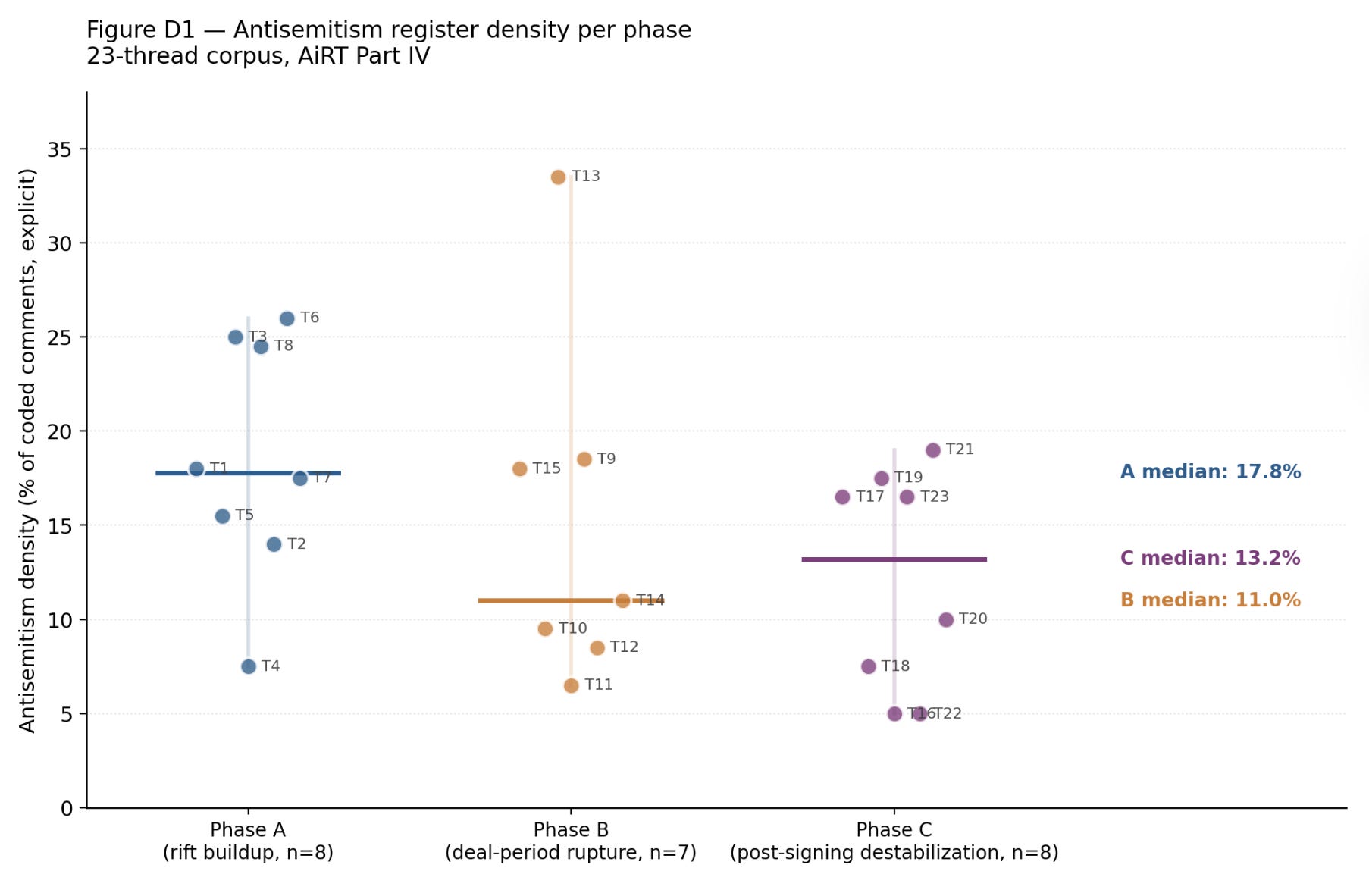
Figure D1 — Antisemitism register density per phase. Strip plot of all 23 threads grouped by phase, each thread labeled, with median line and min–max whiskers per phase. Phase A median 17.8 %; Phase B median 11.0 %; Phase C median 13.2 %. Phase A’s distribution shows two concentrations — a high cluster at 24–26 % (T3 NBC, T6 AP, T8 Forbes) and a lower cluster at 14–18 % (four threads) — with T4 CBS isolated at 7.5 %. Phase B contains the corpus density maximum (T13 AP at 33.5 %) but its median is pulled down by the four Position 4–5 threads. Phase C is the tightest distribution and contains no Position 1 threads
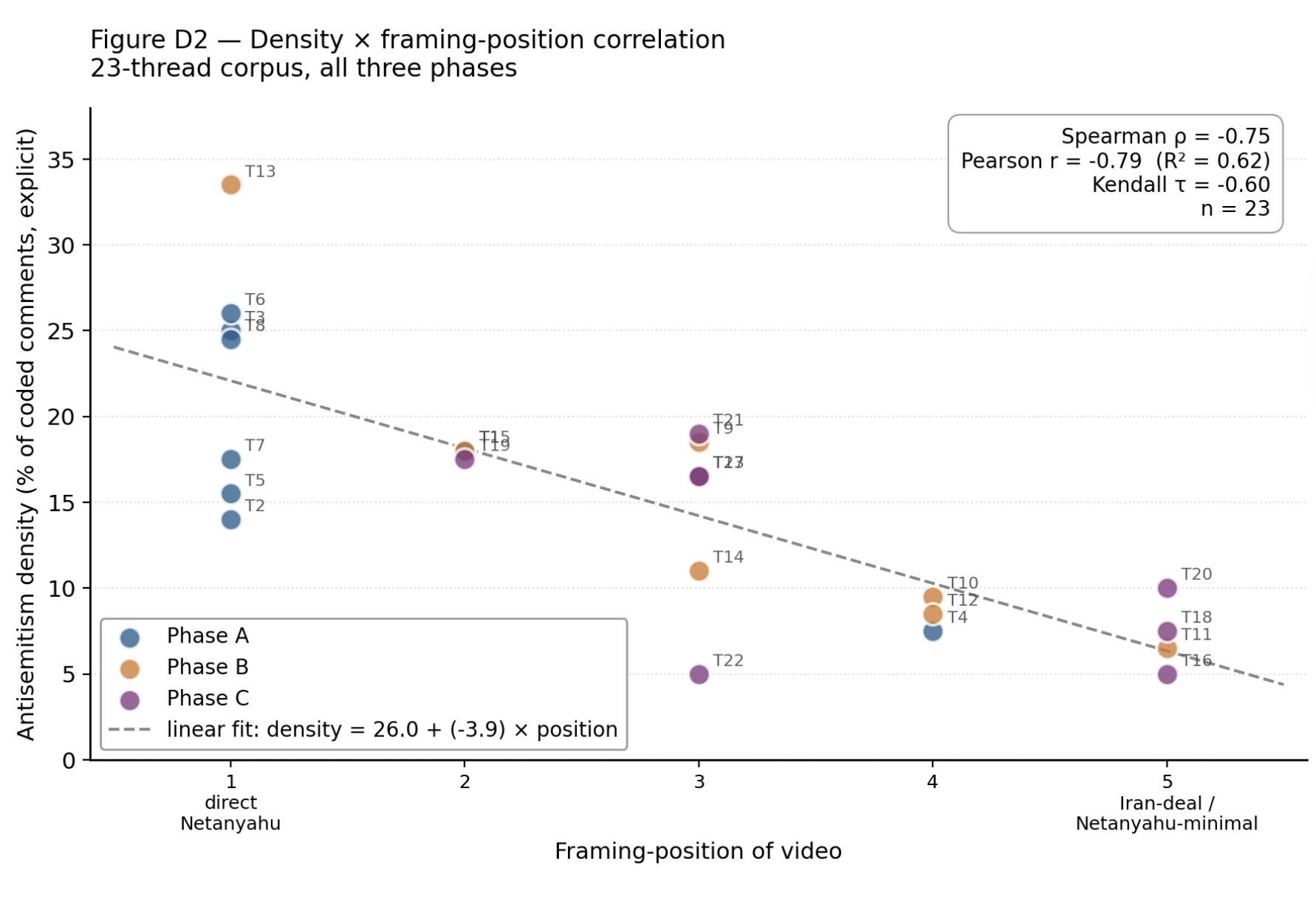
Figure D2 — Density × framing-position correlation. Scatter of all 23 threads with linear fit and phase markers. The rank-order association between framing-position and density is strong and negative in this corpus: Spearman ρ = −0.75 (p < 0.001, n = 23); as descriptive shorthand, the Pearson correlation is r = −0.79 (R² = 0.62) and Kendall τ = −0.60 (p < 0.001). Because framing-position is ordinal, the Pearson correlation is reported descriptively and the rank-order association is the primary statistic. The linear fit suggests density falls by approximately 3.9 percentage points per step on the framing-position axis (1 = direct Netanyahu-focused → 5 = Iran-deal-with-Netanyahu-minimal); the relationship holds across all three phases — Phase A, B, and C dots distribute along the same trend line.
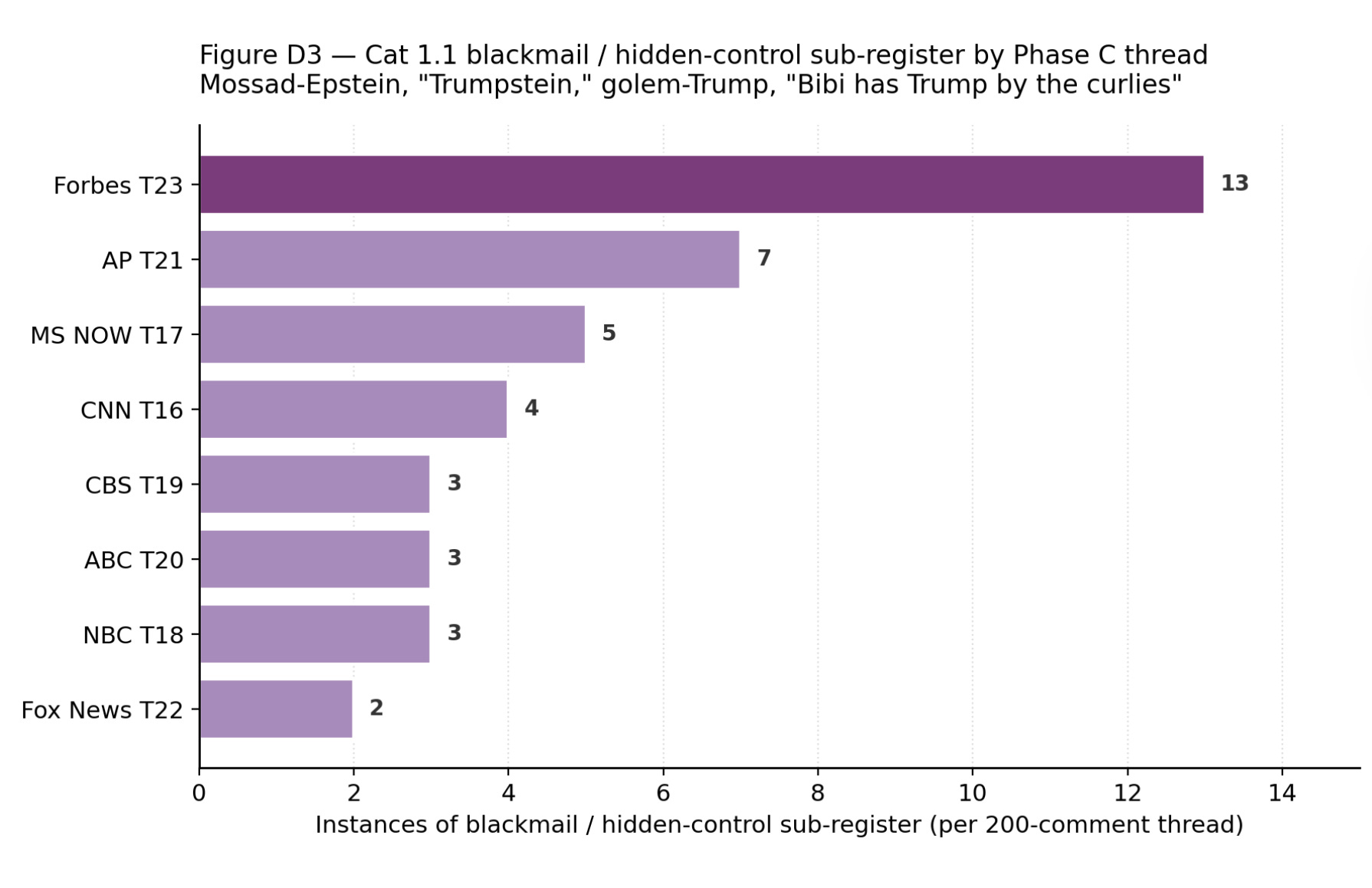
Figure D3 — Cat 1.1 blackmail / hidden-control sub-register by Phase C thread. Horizontal bar showing per-thread counts of the sub-register across all eight Phase C threads. Forbes T23 dominates (13 instances); AP T21 (7) and MS NOW T17 (5) follow; Fox News T22, CNN T16, NBC T18, and ABC T20 sit at the floor (2–4 instances). This is the visual record of the within-Power-and-Conspiracy shift toward the blackmail / hidden-control sub-form documented in Section 5.B.1.
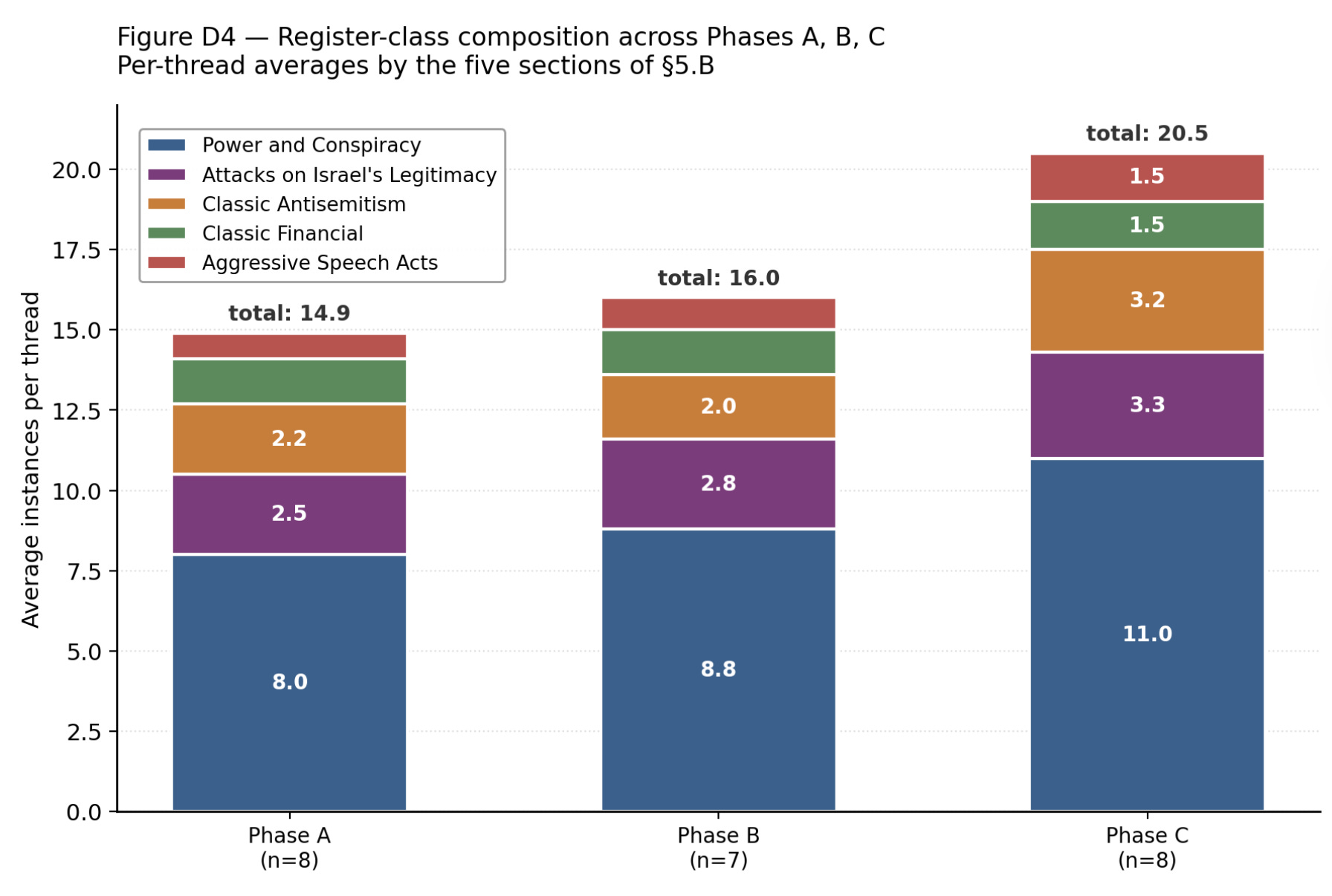
Figure D4 — Register-class composition across Phases A, B, C. Stacked bar showing approximate per-thread averages (n = 8, 7, 8 threads) by the five sections of Section 5.B. Power and Conspiracy is the dominant category across all three phases (≈8.0 → 8.8 → 11.0 instances per thread). Classic Antisemitism (Section 5.B.2: Demonology, Dehumanization, and Character Stereotypes, including 2.7 Instrumentalization of Antisemitism) is stable in Phases A and B (≈2.2 → 2.0) and rises in Phase C (≈3.2), driven by the religious anti-Judaism resurgence, the dual-loyalty / Jews-belong-elsewhere register, and the antisemitism-instrumentalization register at 2.7. Attacks on Israel’s Legitimacy — combining Nazi Analogy, Terrorist State, Genocide, and Legitimacy Denial — peaks in Phase C (≈3.3 per thread) under post-signing Israel-keeps-killing framings. Classic Financial sits roughly flat across phases (≈1.4 → 1.4 → 1.5). Aggressive Speech Acts is a smaller category that shows Phase C concentration.
Two-stage determination of antisemitism density
The framing-position of the video structures the opportunity for register activation, with the outlet-audience composition determining the actual density inside that structural condition. Two natural-experiment pieces of evidence support the model.
Controlled framing. T18 NBC and T20 ABC cover the identical Strait-of-Hormuz blockade event under identical Position-5 framing; densities converge within ~2.5 percentage points (7.5 % vs 10 %). The pair suggests that comparable framing can produce comparable density.
Residual outlet effect. Phase C samples four threads at Position 3 (Trump/VP-vs-Netanyahu confrontation) across four different outlets (MS NOW, AP, Fox News, Forbes); densities range from 5 % at Fox News to 19 % at AP — a ~3.8× spread within one framing-position. Phase A at Position 1 (the most direct Netanyahu-focused framing, sampled across six outlets — T2, T3, T5, T6, T7, T8) shows a similar pattern: density runs from 14 % at MS NOW to 26 % at AP, a ~1.9× spread within one framing-position.
The magnitude of the outlet variation suggests that hate-speech measurement studies aggregating across outlets without holding framing constant — or across framings without holding outlet constant — should be interpreted with caution when used for cross-platform or cross-period comparison.
The Phase C compositional shift
The within-Cat 1.1 composition shifts as follows across the three phases:
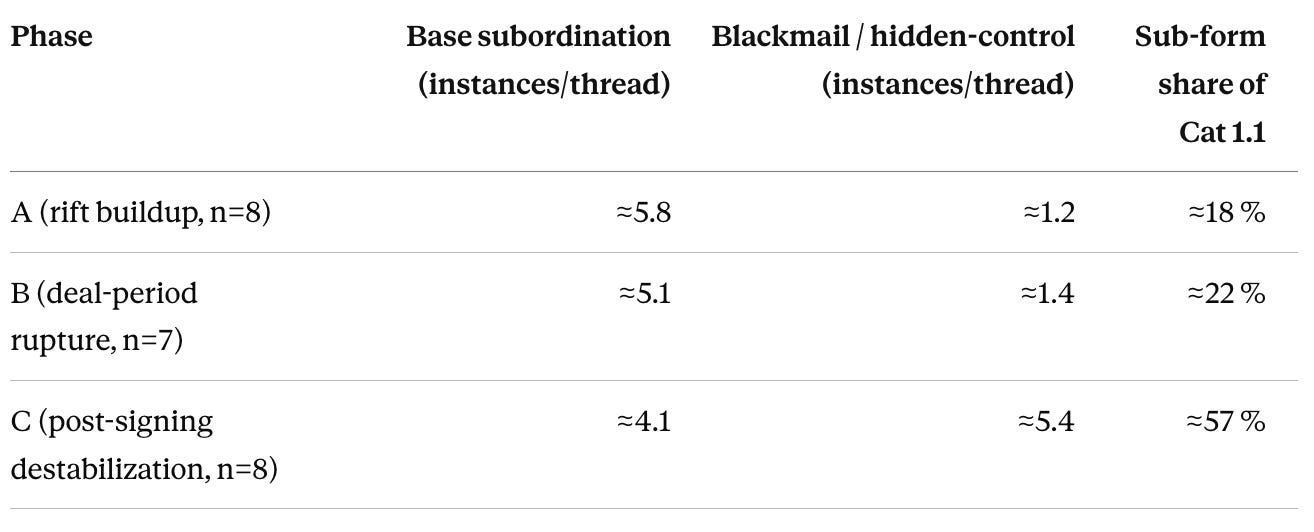
The base subordination form (dog/master, puppet, owns-the-party) declines slightly per thread across the three phases. The blackmail / hidden-control sub-form (Mossad-Epstein, Trumpstein, golem-Trump, “Bibi has Trump by the curlies,” Israel-first / Epstein-administration) grows from approximately 1.2 to approximately 5.4 instances per thread between Phase A and Phase C — roughly a 4.5× increase — with Forbes T23 alone containing 13 instances in a single 200-comment sample. The sub-form’s share of total Cat 1.1 volume rises from approximately 18 % in Phase A to approximately 57 % in Phase C: by Phase C, the sub-form is producing more than half of all Cat 1.1 coded content. Persistence and mutation are not exclusive — the base form persists alongside the sub-form’s growth — and the qualification is preserved in the Conclusion.
The Phase C density-peak diagnostic
The headline numbers show Phase C as the lowest-peak phase: density tops out at 19 % (T21 AP) versus 33.5 % (T13 AP) in Phase B and 26 % (T6 AP) in Phase A. Read naively, this would suggest the antisemitism register attenuated under the changed political conditions — but that interpretation is not supported by the data. Phase A and Phase B both contain Position 1 threads (direct Netanyahu-focused framings), which produce the corpus’s highest densities; Phase C contains none, with its dominant framing at Position 3 (Trump/VP-vs-Netanyahu confrontation) and four threads at Position 5 (Iran-deal-with-Netanyahu-minimal). Extrapolating from Figure D2 would place a hypothetical Phase C Position 1 thread in the 20–24 % range, comparable to Phase A and B Position 1 outcomes — but this remains an extrapolation, since Phase C contains no Position 1 cases. The Phase C dataset does not contain the evidence to test the attenuation hypothesis at Position 1, because the June 17–21 news cycle did not produce direct-Netanyahu-focused videos.
Discourse Dynamics
The preceding sections treat what antisemitic content appears in the corpus and at what density. This section treats a different analytical level: how that content circulates — the production-level patterns by which a single comment becomes a multi-comment thread, by which a single speaker reaches an audience, and by which one register migrates across outlets. These are not antisemitic concepts in themselves; they are properties of the discourse-production environment that shape how the registers documented in Section 5.B reach readers. Three recurring patterns are visible in the corpus.
Affirmation Cascade Same-thread audience extension of a coded framing through compressed affirmation replies. The reply does not independently restate the antisemitic register but carries the parent’s framing into compressed content:
“Israel? Absolutely agree” (Forbes T23 #029-2) [reply to a coded Israel-as-evil framing]
“Yeah, America don’t have friends” (CNN T16 #0013-1) [in reply to a coded subordination-frame parent]
The pattern is sequence-dependent and only becomes visible because chronological sampling preserves parent–reply relationships. Affirmation cascades function as low-cost endorsement signals: the reply commits the speaker to the parent’s framing without the rhetorical labor of restating it, and makes the parent-comment framing appear more broadly endorsed to subsequent readers.
Same-Speaker Templates A single speaker deploys an identical antisemitism template across multiple top-level comments in one thread to maximize visibility. T22 Fox News supplies the corpus-strongest instance — one speaker (@keving5711) deploys the Jews-threaten-Christians template three times in the same thread, replying to three different top-level comments:
“Ben Shapiro is a threat to American Christian peaceful values, USA would be better off if he fled to Tel Aviv instead of Tennessee” (Fox T22 #0004-3)
“Ben Shapiro is a threat to American Christian peaceful values, USA would be better off if he fled to Israel instead of Nashville” (Fox T22 #0008-01)
“Zionist Bot. Ben Shapiro is a threat to American Christian values, America would be better off if he fled to Israel instead of Nashville” (Fox T22 #0009-3)
The template-deployment pattern is telling because it indicates the speaker treats the comment-section infrastructure as a broadcast medium: replying to three different top-level comments with the same template maximizes the framing’s reach across the thread.
Cross-Thread Amplifiers A single speaker appears across multiple threads in the corpus carrying the same register — for example, one speaker appears at MS NOW T17 and at ABC T20 carrying the antisemitism-instrumentalization register treated at Section 5.B.2 (2.7) (different threads, different outlets, same coded content). Speaker identity across threads is established via the stable YouTube channel handle attached to each comment, which persists across comment sections regardless of video or outlet. The amplifier pattern is distinct from intra-thread template deployment: the speaker is moving between videos, not within a single comment section. The pattern’s visibility depends on cross-thread author tracking that single-thread studies cannot perform; it is one of the methodological yields of the per-phase per-outlet sampling design used in Part IV.
The three patterns are mutually reinforcing. Affirmation cascades extend a coded framing inside one comment thread; same-speaker templates extend it inside one comment section across multiple parent-comments; cross-thread amplifiers extend it across the outlet boundary. Together they constitute the production-level architecture by which the registers documented in Section 5.B circulate, and they belong to the study of discourse-production rather than to the study of antisemitism content per se.
Conclusion
The three-hypothesis test set out in the Four-Study Arc section produces a clear empirical answer: the mutation hypothesis is supported, with two qualifications.
The mutation finding. Of the three hypotheses set out in the Four-Study Arc section, the Phase C composition is most consistent with mutation over attenuation or stable persistence. Under the changed political conditions — Trump signing a deal Israel publicly opposes, Vance publicly rebuking the Israeli Cabinet, Netanyahu refusing to withdraw from southern Lebanon — the subordination frame documented in Part III does not attenuate. Its internal composition shifts within the Power and Conspiracy register, with the dominant sub-form moving from the base subordination idiom (dog/master, puppet, owns-the-party) toward a blackmail and hidden-control sub-form built around Mossad-Epstein blackmail, Trumpstein, golem-Trump, “Bibi has Trump by the curlies,” and Israel-first / Epstein-administration framings. The blackmail sub-form grows from approximately 1.2 instances per thread in Phase A to approximately 5.4 in Phase C, and its share of total Cat 1.1 volume rises from approximately 18 % to approximately 57 % across the three phases (Section 5.D table). Forbes T23 alone contains 13 instances in a single 200-comment sample. The pattern is consistent with the conspiratorial framework absorbing apparent counter-evidence through internal recomposition rather than collapsing under it; whether this reflects individual speakers adapting their framing, a change in which speakers are most active, or differences in the framing-position mix across the three phases, the dataset cannot directly distinguish. Persistence and mutation are not exclusive — the base form persists alongside the sub-form’s growth — and the central evidentiary support for mutation is therefore the within-Cat 1.1 compositional shift, not a wholesale replacement of one register by another.
First qualification: density does not spike. The raw density numbers do not show Phase C as the densest phase — the corpus maximum sits at T13 AP in Phase B (33.5 %), and Phase C tops out at 19 %. This is explained by the framing-position mix of the Phase C news cycle (no direct Netanyahu-focused videos were available in the June 17–21 window), not attenuation of the antisemitism register itself. The regression line in Figure D2 predicts that a Position 1 thread at Phase C would have produced density in the 20–24 % range — comparable to Phase A and Phase B Position 1 outcomes. The mutation hypothesis is therefore supported on compositional grounds, not volumetric ones.
Second qualification: religious antijudaism resurges. Alongside the mutation finding in the Power and Conspiracy register, Phase C surfaces a concentrated resurgence of the religious antijudaism register (Christ-killer + Jews-as-usurers, anti-Christian framings, Jews-threaten-Christians) and a continued presence of the Nazi analogy at right-leaning outlets. These were latent in Phase A at Forbes and Fox News and re-surface at higher cross-outlet concentration in Phase C, accompanied by new lexical-allusion vehicles entering the selected mainstream-news YouTube comment sections — yarmulke-coded allusions (”tiny hats,” “small hats”), neo-Nazi numeric codes in usernames (1488), and Holocaust-denial book recommendations.
A second finding: the two-stage determination of antisemitism density. One broader methodological contribution of this study is the two-stage determination model. In this corpus, video framing strongly constrains observed antisemitism density (Spearman ρ = −0.75, Pearson r = −0.79 as descriptive shorthand, across the full 23-thread corpus). Outlet-audience composition modulates density inside that constraint by approximately 3.8× at the same framing-position. The methodological implication: any antisemitism density figure reported without outlet specification, or without framing-position specification, is not meaningfully interpretable for cross-platform or cross-period comparison. Hate-speech measurement studies that aggregate across outlets without holding framing constant — or across framings without holding outlet constant — produce numbers that cannot reliably support cross-platform or cross-period claims. The two-stage model is a minimal correction; richer models would add speaker-demographic and platform-affordance terms, and the generalizability of the framing-position–density relationship beyond this 23-thread corpus is itself an empirical question for future studies.
On the cross-ideological symmetry question. Part III’s striking CNN–Fox News convergence (21 % vs 20 %) does not survive into Part IV. Across the 23 Part IV threads, Fox News produces 5–17.5 % density depending on framing-position and phase; CNN produces 5–18.5 %. The two outlets remain in the same density band, but the tight one-percentage-point convergence appears to have been specific to the period when the U.S. was actively fighting alongside Israel. The Phase C divergence — Fox News at 5 % under the Shapiro “DISASTER” framing (T22), CNN at 5 % under the Trump-responds-to-GOP-backlash framing (T16) — is consistent with a right-wing audience navigating competing commitments between America-First and pro-Israel positions: the America-First base welcomes the deal while the pro-Israel base struggles to defend both Trump and Netanyahu. The pattern visible in the data is that the right-wing comment population redirects its register-production toward the blackmail and hidden-control sub-form (Trumpstein, Epstein-administration) and toward the religious antijudaism register (T22 anti-Christian template, T23 Christ-killer + usurer) rather than toward base-form subordination. The outlet distribution of the base form in this corpus skews to CNN, MS NOW, AP, and ABC; the Phase C right-leaning audiences appear to favor the conspiratorial and theological registers over the base subordination idiom, an observation that warrants further testing on a larger right-wing sample.
On the Trumpstein thread under policy reversal. The Trumpstein thread does not attenuate. The Trump-applied form consolidates at Phase B T12 ABC and saturates at Phase C across T16, T19, T22, and T23, paired with golem-Trump and “Donald Judas Trump” variants. The conspiracy thread is more autonomous from immediate political reality than Part III’s argument allowed for, but the autonomy is bounded: the thread deepens by attaching itself to the deal as a new occasion for hidden-control narration (Mossad-Epstein blackmail explains why Trump signed it, Netanyahu-manipulated-Trump explains why he is now publicly criticizing Israel, the Epstein-administration framing explains everything else). The persistence and the mutation hypotheses are not exclusive; the Trumpstein thread evidences both.
The broader pattern: conspiracist discourse under empirical contradiction. The mutation finding has a counterpart in the wider literature on conspiracy belief. Festinger, Riecken, and Schachter (When Prophecy Fails, 1956) documented that the members of a UFO group whose explicit prediction of world-destruction was empirically falsified did not abandon their framework; they reinterpreted the falsification as further evidence of the framework’s truth. Barkun’s A Culture of Conspiracy (2003) supplies the complementary structural account: conspiracism operates as an epistemic system in which appearances are presumptively deceptive, hidden connections are foundational, and accidents are excluded by definition — premises that make the reinterpretation of contradiction not an ad hoc rescue but a native move within the framework. The general property — that conspiratorial explanatory systems can absorb apparent empirical contradiction by reinterpreting the contradictory event within the framework’s own terms — is well-established in the broader conspiracy-belief literature as a structural feature of the genre rather than an idiosyncratic finding.
What the literature has documented less often is the discursive mechanism through which that persistence unfolds inside mainstream public communication. Part IV contributes a documented within-case observation of the mechanism operating at scale in a non-cult, mainstream-news comment-section setting. The empirical material is a 4,598-comment corpus across 23 threads in eight outlets, tracking a single conspiratorial framework — Jewish or Israeli control of U.S. foreign policy — across a political condition that on its face contradicts the framework’s core claim. The observed pattern is consistent with the mechanism the broader literature predicts: the framework does not collapse, it shifts toward a sub-form that absorbs the contradictory evidence. The blackmail and hidden-control sub-form converts Trump’s public break with Netanyahu into evidence of Mossad’s leverage over Trump rather than disconfirmation of Israeli control; the “fake feud” framing converts the visible rupture into staged performance preserving the hidden coordination underneath. Each is an instance of the same operation — apparent counter-evidence reinterpreted as further confirmation of hidden coordination.
The mechanism identified here may extend beyond antisemitic discourse. Comparable compositional mutation could plausibly occur in other conspiratorial frameworks — including anti-vaccine narratives, Great Replacement discourse, anti-Muslim conspiracy narratives, and QAnon — but establishing this requires separate corpora and domain-specific codebooks. Whether compositional mutation is a general property of conspiracist discourse remains an open empirical question.
The contribution to the antisemitism-research field specifically is a documented instance of the mechanism operating in a contemporary mainstream-news venue rather than a fringe one. The 23-thread corpus is not representative of antisemitic discourse on social media as a whole — that limitation is flagged in the Sampling rationale section — but it does establish that the mutation pattern is observable in the same outlets, in the same comment-section environment, in which the prior installments documented the base register. Under conditions that on their face contradicted the register’s core claim, the register did not move to a more extreme venue. It stayed where it was and adapted.
Implications for the broader field. Three implications follow from the corpus. First, hate-speech measurement reports that do not specify outlet and framing should be read with caution; the underlying numbers cannot be compared across studies that do not control for these variables. Second, the antisemitism register documented in this series is event-conditioned in the sense Part III argued, but the event-conditioning is more flexible than a simple political-fact-causes-register model allows: under the changed political conditions, the register’s composition shifts within itself rather than collapsing. Third, the religious antijudaism register — the medieval Christian-anti-Jewish theology that the prior installments tracked as recessive in mainstream U.S. comment sections — re-surfaces under conditions of perceived Israeli moral failure, with new lexical-allusion vehicles entering the corpus. The recession was conditional, not stable.
References
Barkun, M. (2003). A culture of conspiracy: Apocalyptic visions in contemporary America. University of California Press.
Becker, M. J. (2024). Jordan Peterson and conservative antisemitism online: The dethroning of an intellectual icon following his interview with Netanyahu. In M. J. Becker, L. Ascone, K. Placzynta, & C. Vincent (Eds.), Antisemitism in online communication: Transdisciplinary approaches to hate speech in the twenty-first century (pp. 47–74). Open Book Publishers. https://doi.org/10.11647/OBP.0406.02
Becker, M. J. (2025a). Antisemitism in real time, Part I: U.S. YouTube reactions to Israel’s strike on Iran. Decoding Antisemitism. https://decodingantisemitism.substack.com/p/antisemitism-in-real-time-us-youtube
Becker, M. J. (2025b). Antisemitism in real time, Part II: U.S. YouTube reactions to Iran’s retaliatory strike on Israel. Decoding Antisemitism. https://decodingantisemitism.substack.com/p/from-retaliation-to-rhetoric-digital
Becker, M. J. (2026). Antisemitism in real time, Part III: “Israel Made America Do It” — YouTube reactions to the US–Israel campaign against Iran. Decoding Hate, NYU Center for the Study of Antisemitism. https://decodingantisemitism.substack.com/p/antisemitism-in-real-time-part-iii
Becker, M. J., Troschke, H., Bolton, M., & Chapelan, A. (Eds.). (2024). Decoding antisemitism: A guide to identifying antisemitism online. Palgrave Macmillan. https://link.springer.com/book/9783031492372
Festinger, L., Riecken, H. W., & Schachter, S. (1956). When prophecy fails: A social and psychological study of a modern group that predicted the destruction of the world. University of Minnesota Press.
This article is Part IV of the Antisemitism in Real Time series. Parts I and II were conducted under the Decoding Antisemitism project (TU Berlin, HTW Berlin, King’s College London; June 2025). Part III marked the continuation of this work under Decoding Hate, the expanded research hub at NYU’s Center for the Study of Antisemitism. Part IV continues under Decoding Hate. All four parts draw on the Decoding Antisemitism Lexicon.