
Catchy Hatred: YouTube Reactions to Kanye West's "Heil Hitler"
Sympathetic Amplification: Host Framing and Audience Response Across Ten YouTube Threads

By Matthias J. Becker, PhD, Isabelle Deutsch, and Jameson Verser
Matthias J. Becker — AddressHate Research Scholar at NYU’s Center for the Study of Antisemitism | Lead, Decoding Antisemitism — PI, Decoding Hate | Research Advisor, AddressHate | Editor-in-Chief, Digital Hate Review
Isabelle (Izzy) Deutsch
Jameson Verser — Decoding Hate Researcher, NYU’s Center for the Study of Antisemitism

Executive Summary
In May 2025, Kanye West released “Heil Hitler,” a song whose title, lyrics, and music video explicitly draw on Nazi symbolism, archival Hitler audio, and antisemitic conspiracy narratives. Major streaming platforms removed the song within days, but it continued to circulate widely on YouTube through news coverage and reaction videos. This secondary circulation makes the case particularly well suited for examining how explicitly antisemitic content is framed, propagated, and recontextualized within platform discourse. The study also explores how the song’s openly antisemitic rhetoric is taken up across different online environments, and which forms of endorsement, rejection, elaboration, and normalization emerge in audience responses.
This study analyzes 1,000 comments from ten YouTube videos posted across the first ten days after release. All threads examined engage the same song; what varies is the communicative context created by different hosts — adversarial hosts who condemn the song (e.g., Piers Morgan), right-leaning commentators, progressive hosts, reaction-creators, and independent commentators. The corpus also includes an instance of sympathetic amplification (Joe Rogan), in which the host repeats or normalizes central interpretive framings of the song on camera. One pre-release comparator YouTube thread is retained as immediate context. All comments were coded using a structured antisemitism lexicon and a three-annotator consensus process.
Four findings stand out.
First, antisemitic communication appears in substantial volume across every host condition examined. Across the corpus, 26.0% of all coded comments contain one or more antisemitic elements; per-thread rates range from 12% to 46%. Antisemitic content does not concentrate only in unambiguously extremist spaces but also surfaces in comparatively mainstream YouTube formats.
Second, host condition shapes the communicative norms of a thread. The phenomenon of sympathetic amplification makes this especially visible. We define sympathetic amplification as an on-camera move in which a host treats the song’s overt Nazi references and conspiracy-ideological message as plausible, treats its removal from platforms as confirmation of that message, endorses substantive claims of the song, or expressly praises its message. Under this definition, sympathetic amplification does not simply increase antisemitic content; in this corpus, it changes the character of the discussion itself. Host condition shapes what we call audience permission structures — the communicative norms of a thread: which statements are treated as self-evident, which draw pushback, and which forms of antisemitic articulation appear as legitimate. Under adversarial hosts, commenters attack the host and defend the song. Under sympathetic hosts, they extend the song’s framings, confirm antisemitic tropes, and normalize their open articulation. At the same time, the Joe Rogan thread produces the corpus’s densest substantively engaged counter-speech, indicating that sympathetic amplification mobilizes both endorsement and heightened public pushback.
Third, and most striking: even a pop song whose Nazi reference could hardly be more explicit does not, in the YouTube discussions examined here, meet with widespread rejection. Across every host condition, the corpus surfaces substantial endorsement, further development of antisemitic narratives, and — at a density we have not observed in prior studies in this research line — open affirmation of the Nazi reference itself. The extraordinary explicitness of the song does not produce correspondingly strong social sanction; instead, it opens a form of antisemitic follow-on communication that extends beyond the reproduction of classic antisemitic conspiracy narratives. Substantive counter-speech, by contrast, accounts for only 3.2% of coded entries corpus-wide (32 of 1,000), with one thread containing none at all.
Fourth, the results suggest that the societal opportunity structures for antisemitic communication have shifted in recent years. What now proves resonant is no longer only coded or indirect antisemitic material. Even openly Nazi-referential communication can, in broader digital publics, meet with endorsement, applause, and discursive further development. That these dynamics appear not only in unambiguously extremist spaces but also in comparatively mainstream YouTube formats is among the study’s most notable findings. The present case therefore documents not only the reception of one song. It also points to a broader shift in the conditions under which antisemitic communication circulates in digital space, acquires public traction, and seeps into online discourse more widely.
Introduction
Public communication about identifiable social groups does not remain on the stage where it is first articulated. It circulates through digital platforms, is amplified by news organizations, commented on by influencers, and further developed thousands of times in online discussion spaces. In this process, statements are not simply repeated. They are affirmed, contested, intensified, reinterpreted, and endowed with new meanings. Particularly within digital publics, the societal significance of public communication therefore arises not only from the original speaker but also from the secondary discourse that the speaker’s statements generate.
This dynamic becomes especially consequential when public communication operates through demonization. We use this term to describe representations that attribute to an identifiable group an essential malevolence, hidden coordinated power, or destructive collective purpose. Such narratives do more than shape perceptions of the targeted group. They alter the communicative conditions under which public discourse unfolds. Political disagreement gives way to enemy identification; complex social developments are reduced to conspiratorial explanations; and democratic conflict increasingly comes to be framed as a struggle against a supposedly existential adversary. These effects are structural: they obtain regardless of the speaker’s intentions or declared political commitments.
The consequences extend well beyond the targeted group itself. Demonizing communication can contribute to intimidation and withdrawal from public discourse, normalize hostility toward minority communities, and gradually shift the boundaries of what becomes publicly acceptable. Particularly significant is the trivialization of historical atrocity through popular culture. When Nazi symbolism, Holocaust references, or Hitler imagery become components of mass entertainment, the question is no longer merely how widely such content circulates, but how digital publics respond to it. What is ultimately eroded is not only recognition of the historical crime itself, but also the mutual recognition upon which democratic public life and social cohesion depend.
The present study examines precisely this question. It does not attempt to infer Kanye West’s intentions; discourse analysis cannot establish what a speaker ultimately believes. Instead, it investigates the communicative consequences of the song and asks how its openly antisemitic and Nazi-referential message is received, interpreted, contested, elaborated, and normalized across different digital publics.
The analytical significance of this case lies in the communicative object itself. Prior studies in this research program have examined audience responses to coded, indirect, or ambiguously-signalled forms of antisemitic discourse embedded in political speeches, media commentary, interviews, and public debate. Here, by contrast, the communicative object is a song built around explicit Nazi references. “Heil Hitler” combines antisemitic conspiracy narratives with Nazi symbolism in a form whose explicitness can scarcely be exceeded. The central question is therefore no longer whether audiences recognize antisemitism when it is communicated indirectly, but how digital publics respond when antisemitic and Nazi-referential communication requires no interpretation at all.
The case is analytically unusual for another reason. Although major streaming platforms removed the song within days of its release, it continued to circulate widely through YouTube news coverage, commentary programs, podcasts, and reaction videos. As a result, the same communicative object repeatedly entered different interpretive environments, where hosts condemned, defended, normalized, or contextualized it in markedly different ways. That trajectory extended well beyond the initial release window. By April 2026, the artist now known as Ye was on a stadium comeback tour. The album “Bully” debuted at No. 2 on the Billboard 200 in late March, and two SoFi Stadium shows sold out in early April. Days later, the United Kingdom denied him entry and the Wireless Festival he was set to headline was cancelled. A CNN feature on 13 April 2026 described the moment as a “dichotomy of a star both banned and celebrated” (Respers France 2026). The precondition for the tour was a January 2026 full-page Wall Street Journal advertisement headlined “To Those I’ve Hurt,” in which West apologized for prior antisemitic remarks and attributed them to an undiagnosed brain injury and untreated bipolar type-1 disorder — “I am not a Nazi or an antisemite,” he wrote, “I love Jewish people.”
Alongside that contrition, the audience-facing circulation of the earlier content has continued. Days before the WSJ apology, video circulated of far-right figures — Nick Fuentes, Sneako, Andrew Tate, Myron Gaines — singing along to “Heil Hitler” at the Miami Beach nightclub Vendôme, drawing condemnation from the venue, the mayor, and the Auschwitz Jewish Center Foundation. This article documents one stage of that trajectory: the YouTube comment discourse the song generated when it was released a year earlier. The May 2025 release itself sits within a three-year trajectory of antisemitic content from Kanye West, from the “death con 3 on JEWISH PEOPLE” tweet of October 2022 through the May 2025 song release, as traced by the Blue Square Alliance Against Hate’s Command Center.
The variation was substantial. Some commentators treated the song as indefensible antisemitic provocation; others framed it as taboo-breaking or as evidence of censorship. In one of the JRE clips analyzed for this study, Rogan describes the song as “kind of catchy” and articulates a framework in which platform removal functions as confirmation of the conspiracy the song articulates: “If you ban it, then people want to hear it more… and then it kind of supports what he says, which is that there’s this concerted effort, if you talk about Jewish people, that they’re going to remove you from everything” (Gilson 2025a). Piers Morgan condemns the song on-camera as “indefensible” in two of the threads analyzed here. Outside the present corpus, Russell Brand defends the song as artistic provocation and calls West “uncancellable” (Gilson 2025b). This variation creates an unusually favorable setting for discourse analysis: the object of discussion remains largely constant while the surrounding context changes.
To examine these dynamics, the study analyzes 1,000 comments posted beneath ten YouTube videos discussing the song during the first ten days following its release. The central question is what role host framing plays once the communicative object itself is already maximally explicit. Rather than asking only whether antisemitic responses occur, the analysis examines how different communicative environments influence which forms of audience participation become plausible, legitimate, or socially expected. Under what conditions do users defend the song, attack its critics, elaborate its conspiracy narratives, reject them, or openly affirm its explicit Nazi references? Addressing these questions allows the study to move beyond measuring the prevalence of antisemitic discourse toward identifying the communicative mechanisms through which explicitly antisemitic messages acquire legitimacy, become normalized, and are further developed within contemporary digital publics.
Contribution
The study makes three contributions:
To our knowledge, it provides the first cross-comparison of audience responses to a song built around explicit Nazi references across multiple YouTube host conditions.
It introduces audience permission structures as a discourse-analytic construct operationalized from comment data.
It identifies explicit Affirmation of Antisemitism as a distinct response register — surfacing at densities not documented in prior speaker-driven studies of coded antisemitic discourse in this research line.
The Track and the Artist
The Track
“Heil Hitler” is a single song, not an album. It was released on 8 May 2025 via West’s X (formerly Twitter) account as the intended third single from his then-forthcoming studio album CUCK, a project that later leaked and was scrapped. The song is written by Dave Blunts, produced by Quadwoofer and Sheffmade, and features additional vocals from West’s group The Hooligans. Unlike the speaker-driven cases examined previously in this research line, the song’s Nazi referent is explicit rather than coded. The title is the Nazi salute in its original German; the song incorporates archival Hitler audio from a 1935 speech; the lyric articulates a standard set of antisemitic conspiracy claims (Jewish institutional control, banking conspiracy, persecution-of-the-truth-teller framing) within a verse-and-chorus pop structure designed for circulation; and the accompanying music video depicts a warehouse of Black men in militaristic formation, draped in animal skins and mouthing the chorus alongside The Hooligans. The Nazi reference operates at the surface of the song’s title, audio, lyrics, and visuals, rather than requiring interpretive reconstruction.
The song was removed from major streaming platforms (YouTube, Spotify, Apple Music, SoundCloud) and is banned in Germany under §86a StGB, but remained accessible on X and Meta-owned platforms during the May 2025 reception window this corpus documents. West released two variants that month: an instrumental version on 14 May 2025 (“The Heil Symphony,” later renamed “Hit Symphony”) and a partially censored gospel-themed rewrite on 31 May 2025 (“Hallelujah”) that replaced the chorus’s Nazi salute with the title word. After meeting Orthodox rabbi Yoshiyahu Yosef Pinto in November 2025 and apologizing, West’s company YZY began issuing copyright strikes against reuploads of the original song. The January 2026 Vendôme nightclub incident discussed in the Introduction is one documented instance of the song’s circulation continuing well beyond the May 2025 window this corpus samples.
The song’s methodological significance is its boundedness: a single object, under five minutes long, encountered as the same lyrical-musical-visual referent across every host context in the corpus. All ten videos are organized around this same referential object, though they engage it differently: some play extended clips, some quote excerpts, some summarize, and some show the music video, with on-screen attention ranging from seconds to minutes. The song is therefore stable across the corpus in a sense not available to speaker-driven studies that rely on distributed, multi-segment discourse; the host-framing variable captures the differences in how the videos present, quote, and contextualize it.
The Artist
Kanye West is one of the most-followed cultural producers of the past two decades. The 2025 release is not his first antisemitic episode; the 2022 cycle — including the “death con 3 on JEWISH PEOPLE” tweet, the Alex Jones interview, and the “I like Hitler” remarks — had already established an audience familiar with and engaged by his antisemitic content. Those 2022 statements were widely treated by platforms, advertisers, and commentators as a public scandal: brand partnerships dissolved, accounts were suspended, and mainstream commentary largely converged on condemnation. The 2025 release drew similarly intensive institutional criticism — streaming platforms removed the song within days, public condemnation was widespread, and the WSJ apology in January 2026 acknowledges the trajectory of fallout. What differs between the two cycles is less the volume of friction than its form of circulation. In 2022, condemnation occupied the discursive foreground; in 2025, the explicit Nazi reference circulated alongside condemnation through reaction-and-commentary content on YouTube, where extended host engagement and audience comments engaged the song directly across multiple host conditions. The three-year trajectory is part of what the case documents.
Dataset
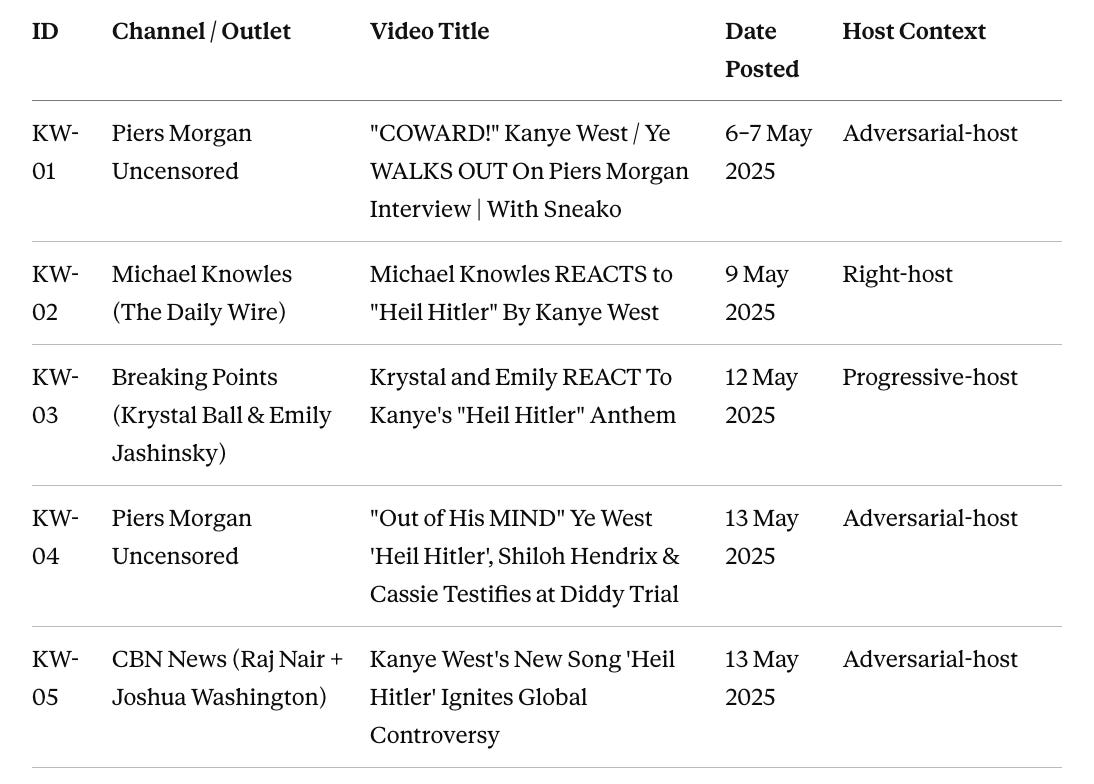
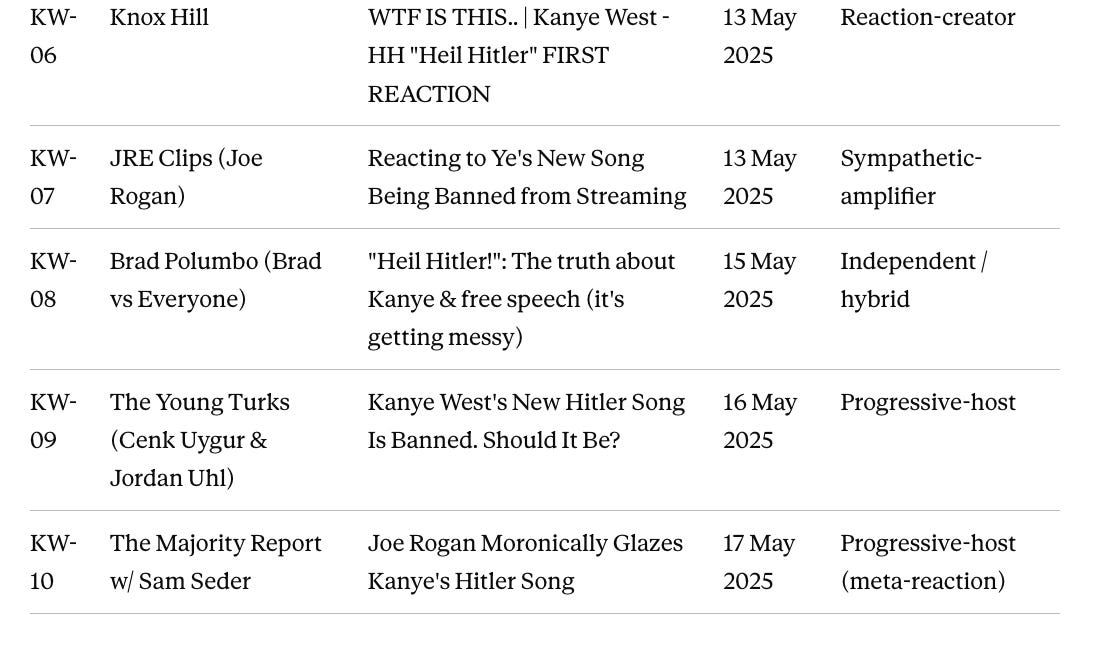
The corpus comprises 1,000 user-generated comments from ten YouTube videos around the “Heil Hitler” release, spanning roughly ten days (9–17 May 2025), plus one near-predecessor video (KW-01, 6–7 May 2025) retained as immediate context. The first 100 chronologically ordered comments per video form the per-thread sample; top-level comments and reply comments are coded and counted the same way, with reply chains preserved for sequence and relational analysis. Spam and duplicates were excluded.
The corpus listing below is ordered chronologically by date posted. Each entry is tagged with its host-context type, since the analysis turns on host framing variation. In plain terms: we classify each video by how the host frames the song on camera — condemning it, defending it, reacting to it, or treating it as proof of a conspiracy. The host conditions are operationalized as follows:
Adversarial-host. The host explicitly condemns the song and rejects its claims. The song is treated as content to be opposed, not engaged on its merits.
Progressive-host. Left-leaning political commentary that condemns the song but situates it within a broader political-cultural critique.
Right-host. Conservative political commentary; positioning toward the song ranges within the right-political spectrum from condemnation to defense.
Independent / hybrid. Centrist or politically heterogeneous commentary; evaluation not anchored to a primary partisan position.
Reaction-creator. Single-creator reaction content; primary mode is real-time response rather than political-editorial framing.
Sympathetic-amplifier. The host repeats, legitimizes, or normalizes one or more of the song’s central framings during on-camera commentary. The category is operationalized as a decision rule: a host is coded as sympathetic-amplifier when at least one of the following criteria is met on camera. (i) The host treats the song’s conspiracy claim as plausible or worth taking seriously, rather than dismissing it. (ii) The host treats the song’s removal, demonetization, or other moderation outcome as confirmation of the conspiracy the song articulates. (iii) The host endorses a substantive factual premise of the song (e.g., that a particular industry or institution is controlled by Jewish actors). (iv) The host explicitly praises the song’s message or its rhetorical effectiveness in a way not separated from the song’s antisemitic content. Aesthetic praise alone (e.g., “the beat is good”) does not satisfy the criterion unless accompanied by engagement with the song’s substantive claims; condemnation of the song’s content while expressing curiosity or amusement does not satisfy the criterion. The criteria are intended to distinguish hosts whose on-camera articulation supplies discursive material the audience can pick up (Rogan’s articulation of (i) and (ii) above) from hosts whose framing remains evaluatively external to the song even when politically sympathetic to West more generally (e.g., Knowles, who is coded as right-host rather than sympathetic-amplifier because his on-camera articulation does not meet any of (i)–(iv)).
Sympathetic-ambiguous. Host positioning is favorable to the song but qualified — favorable evaluation with conditionality that reads as rhetorical hedge rather than substantive constraint. The category is retained for analytical scope: it has no instances in the present ten-video corpus, but is preserved in the typology because the distinction between sympathetic-amplifier and sympathetic-ambiguous remains analytically operative for future cases and for comparison with prior research-line studies in which such hosts appear.
The Adversarial-host and Progressive-host categories above admit substantive sub-types that emerged inductively from the data rather than being specified a priori, and are tracked in the results below as data-driven refinements of the base typology. Adversarial-secular (KW-01, KW-04) and Adversarial-religious (KW-05) distinguish two grounds of adversarial framing observed in the corpus: secular-liberal condemnation (Morgan) and Christian-conservative condemnation (CBN News), each of which surfaces a partly different audience-permission-structure. Meta-progressive (KW-10) was induced from KW-10 specifically: Seder critiques Rogan’s reception of the song rather than commenting on the song directly, producing a distinctive argument about antisemitism rather than articulation of it register. The Meta-progressive subtype is therefore a category generated by the empirical material rather than imposed on it, and it does not currently extend beyond the single thread that motivated it. Whether it generalizes to other meta-discursive progressive cases is a question for future corpora. These sub-types are reported where they bear on the results; the base typology above remains the analytical frame.
Taken together, the typology contains six base host families (Adversarial-host, Right-host, Progressive-host, Reaction-creator, Sympathetic-amplifier, Independent/hybrid), with two of those families sub-divided into observed variants from the corpus (Adversarial → secular vs religious; Progressive → standard vs meta-progressive). This produces eight observable host conditions instantiated in the corpus: Adversarial-secular, Adversarial-religious, Right-host, Progressive-host, Reaction-creator, Sympathetic-amplifier, Independent/hybrid, and Meta-progressive. Sympathetic-ambiguous is preserved in the base typology for future cases but has no instances in the present ten-video corpus. The cross-thread results table below uses the eight-condition vocabulary.
KW-01 (Piers Morgan walk-out) is included as a near-predecessor to the song’s release: the interview was recorded on 6 May 2025, two days before the 8 May release, and addresses Kanye West’s antisemitic record in general rather than the “Heil Hitler” song specifically. It is retained in the corpus as immediate context for the song’s reception environment and as one half of the Morgan host-framing pair (with KW-04, the Piers Morgan Panel discussion of the song itself). Its inclusion is flagged here so that readers can weight its analytical contribution accordingly.
Chronological Corpus Listing
Research Design
Method
Analysis followed the principles of qualitative content analysis, with native-speaker coders applying linguistic and multimodal close reading supplemented by sequence and relational analysis where comments form part of reply chains. Coding combined deductive categories from the Decoding Antisemitism Lexicon (Becker et al. 2024) — 40 antisemitic concepts organized across categories including Otherness, Moral/Supernatural Defamation, Dehumanization/Blood Libel, Deceit/Blame, Power/Conspiracy/Economic Domination, Victimhood Inversion, Holocaust & Memory Politics, Israel-Related antisemitism, and Aggressive Speech Acts — with inductive coding of formations specific to the Kanye West case. The Lexicon accounts for dog whistles, sarcasm, irony, visual and emoji-based signaling, and inversion structures.
In plain terms: every comment was read and coded against a structured antisemitism framework covering conspiracy claims, direct Nazi references, Holocaust distortion, Israel-related abuse, and direct threats — with three annotators coding independently and resolving disagreements through discussion until they reached consensus.
Two case-specific coding decisions bear noting. First, comments endorsing the song or the artist on the basis of the song's antisemitic content (e.g., “hail ye,” “I stand with Ye!”) are coded as Affirmation of Antisemitism (C4-3) with a secondary Conspiracy code (C2-3) where the endorsement is framed in terms of “they're hiding the truth” reasoning. Second, comments directed at the hosts — most prominently Piers Morgan as “Mossad asset,” “puppet for Israel,” “koshervative” — are coded under Conspiracy (C2-3) when they invoke puppet-family logic (asset, puppet, agent, pawn, stooge, payroll, controlled-by, on-behalf-of), per the team's standing puppet-rule. The rule fires only on the commenter's own on-behalf claims: quoted or mocked puppet-constructions do not trigger C2-3. Power (C2-2) is reserved for bare-influence claims that do not invoke string-puller logic (e.g., “Zionist megaphone”).
The study applies the same annotation protocol and counting unit as prior pieces in this research line.
Coding Protocol
The unit of analysis is the YouTube comment, whether top-level or a reply. The first 100 chronologically ordered comments per video form the per-thread sample; top-level comments and reply comments are coded and counted the same way. Comments were excluded if they contained no semantic content (empty, single emoji, single character), if their language fell outside the coder team’s working competence and machine translation did not yield a stable reading, if they addressed a topic unrelated to the song in a multi-topic video, or if they were clear duplicates.
All comments were independently coded by three annotators (Becker, Deutsch, Verser), who resolved disagreements in adjudication sessions until they reached consensus. The coding scheme is the Decoding Antisemitism Lexicon (Becker et al. 2024) — 40 concepts plus sub-registers and multimodal signals — supplemented by a small set of corpus-specific standing rules, such as treating puppet-family metaphors as Conspiracy rather than Power and coding aesthetic praise of “Heil Hitler” as Affirmation absent explicit distancing. These rules and their full rationale are documented in the Standing Coding Rules appendix. The per-thread rates and concept-frequency counts in this essay reflect the post-adjudication consensus.
Analytical Categories
The six-category schema below adapts the Decoding Antisemitism Lexicon and the Temple Israel framework to the distinctive features of this case — specifically, a song built around explicit Nazi references and an Affirmation register that prior speaker-driven cases did not surface at comparable density. Categories are ordered by their empirical density in this corpus.
Affirmation of Antisemitism. This category captures direct endorsement of the song’s Nazi reference and Hitler-rehabilitation content, including explicit slogans, salute language, and “Hail Ye”-style praise. In this corpus we also group certain Otherness, Deceit, and Historical-Precedent moves (for example the “109 countries” trope or theological delegitimization) under Affirmation when they function as scaffolding for explicit endorsement rather than as standalone themes.
Taboo and Self-Victimization. This category covers “you can’t criticize them” narratives, persecution-of-the-truth-teller framing, and cancellation-as-evidence inversions, along with Relativization moves that defend antisemitic content as free speech, mere aesthetics, or misunderstood provocation.
Power and Conspiracy Narratives. This category combines Power claims (that Jewish actors control media, politics, finance, or public opinion) with Conspiracy claims about hidden coordinated action behind specific events, including host-as-puppet recoding, historical-event revisionism, and “AshkeNazi”-style Hitler rehabilitation. Power and Conspiracy are separate Lexicon codes, but in this corpus they sit on the same terrain — “they run things” and “they orchestrated this event” — and are therefore presented together.
Threats and Calls for Retaliation. This category includes eliminationist content, Holocaust-completion language, threats against specific targets, and Blame-for-Antisemitism moves that attribute responsibility for antisemitism to its victims.
Israel-Related Antisemitism. This category covers Nazi and fascism analogies applied to Israel, Blood-Libel projections onto Israeli military forces, instrumentalization of antisemitism and the Holocaust as deflection from the song’s content, and Gaza/genocide framings used to reorder discursive priority.
Holocaust Distortion and Denial. This category captures numerical revision (for example “6 million” vs “271k” substitutions), false-equivalence framings, and denial of the Holocaust’s historical scale. It is conceptually distinct from Affirmation: Affirmation endorses the Nazi reference itself, whereas Holocaust Distortion contests the historical record of Nazi violence. The two can dual-code (for example in Hitler-rehabilitation comments) but function as separate discursive moves.
A Schadenfreude / Sarcasm register operates across the corpus but in this case functions principally as affective cover for the Affirmation register (e.g., “I did Nazi that coming”); where this dual-coding is operative, the comment is coded under Affirmation of Antisemitism and contributes to the antisemitism rate through that route (per the humor-as-affirmation rule; see Standing Coding Rules appendix).
These categories structure the empirical chapter that follows; detailed sub-registers (e.g., Affirmation A1–A4) and illustrative comments are discussed there rather than in this section.
Three-Phase Circulation Model
The analysis maps onto the three-phase circulation model developed in prior pieces in this research line (Becker, Beacken, and Sabra 2026): the song, held constant across the corpus; host framing, varied across the ten videos from adversarial (Morgan, CBN News) to sympathetic-amplifier (Rogan); and the audience response in the comment sections. Compared to prior speaker-driven studies that examined coded antisemitic discourse, the Kanye West design varies host framing while holding the discursive object constant in a form built around explicit Nazi references.
Key Terms
Five terms carry the analytical weight in this article. Each is defined here and used consistently below.
Discursive object. The content the audience is responding to. In this corpus, the discursive object is the song “Heil Hitler” — held constant across the ten threads (except KW-01, where the song had not yet been released and West’s general antisemitic record served as the discursive object instead).
Host framing. How the host on camera positions the discursive object — condemning it, defending it, playing it, quoting it, contextualizing it, or treating it as evidence of a broader claim. Host framing is a variable, coded per video.
Host condition. The typological category into which a host framing falls — adversarial-secular, right-host, progressive-host, reaction-creator, sympathetic-amplifier, hybrid, meta-progressive, or the Adversarial-religious sub-type induced from KW-05. Host framing is what a specific host does; host condition is the class to which their framing belongs.
Sympathetic amplification. A specific type of host framing in which the host, on camera, treats the discursive object’s claim as plausible, treats institutional response to it as confirmation of that claim, endorses a substantive premise of the object, or praises its content. The KW-07 (Joe Rogan) thread is the corpus’s single sympathetic-amplifier instance.
Permission structure. The set of discursive moves that commenters in a given thread treat as ordinary, uncontroversial, and not requiring defense against pushback. Permission structures are inferred from what circulates without friction, what draws counter-articulation, and what is marked as transgressive within the comments themselves. They are an analytical abstraction, not an independently observable variable.
Two adjacent terms recur in the article and are used in more specific senses. Response register refers to a discursive mode audiences activate — Affirmation, Taboo, Conspiracy, Relativization, and so on — rather than to individual codings. Discursive scaffolding refers specifically to how one register (e.g., Taboo) creates the terrain on which another register (e.g., Conspiracy elaboration) operates.
Empirical Findings
Results
Quantitative Overview
The corpus comprises 1,000 audience comments coded across ten YouTube threads (KW-01 through KW-10) covering eight distinct outlets across the first ten days after the song’s 8 May 2025 release. All ten threads were independently coded by three annotators (Becker, Deutsch, Verser) and adjudicated to team consensus; per-thread antisemitism rates, counter-speech counts, and dominant conceptual registers are summarized below.
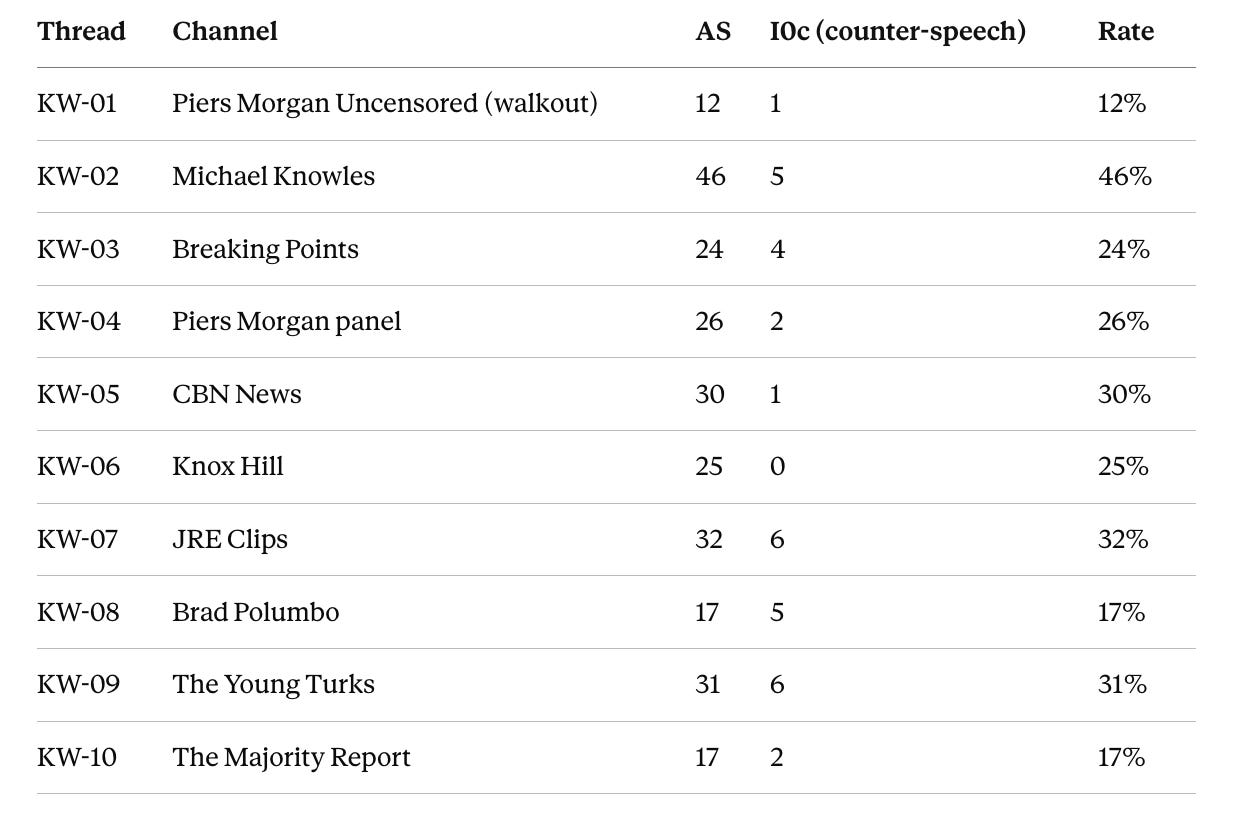
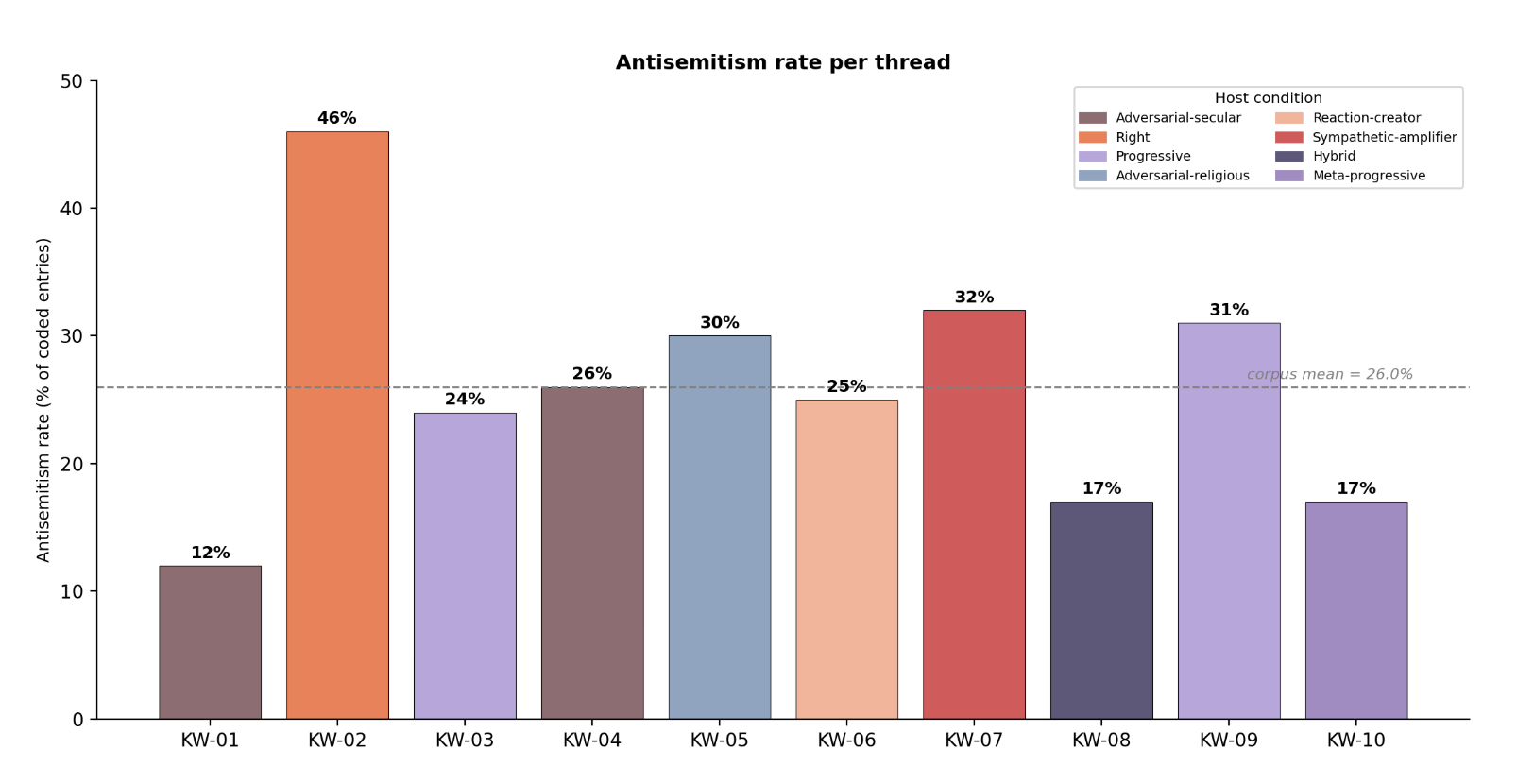
Figure 1. Antisemitism rate across the ten threads. Bars are colored by host-condition typology; the dashed line marks the corpus mean (26%).
Three patterns visible at the cross-thread level shape the qualitative findings that follow.
First, the host-condition gradient that a simple version of the audience-permission-structures argument would predict — adversarial low, sympathetic high — does not appear cleanly in the rates: the right-host thread KW-02 tops the corpus at 46%, above the sympathetic-amplifier thread KW-07 at 32%, progressive threads sit at 24% (KW-03) and 31% (KW-09), the adversarial-secular pair KW-01 (12%) and KW-04 (26%) span the corpus’s floor-to-middle range, and the hybrid and meta-progressive threads (KW-08, KW-10) sit at 17%. Host condition is associated with which registers commenters activate, but it does not map linearly onto total antisemitism density. In this corpus, host condition mainly affects the mode of audience response — what kinds of moves surface — rather than the overall volume of antisemitic material. Notably, the corpus minimum (KW-01, 12%) is the one thread in which the song is not yet the discursive object — a point developed under Finding 1.
Second, the song-release variable produces the clearest within-corpus signal. The KW-01 (pre-release, 12%) versus KW-04 (post-release, 26%) comparison — same host, same adversarial framing, same channel environment, a 14-point shift — shows the strongest within-host association between introduction of the song and a change in audience discourse. This is not a controlled isolation: the discursive object shifts (West’s antisemitism in general vs the “Heil Hitler” song), timing differs, and the broader public discourse moves across the seven days between threads. The 14-point shift is nonetheless the largest within-host change in the corpus and coincides, under constant adversarial framing, with Affirmation content that the pre-release thread does not surface.
Third, counter-speech is unevenly distributed across host conditions. KW-07 and KW-09 each contain 6 of the corpus’s 32 counter-speech codings — but the two sixes differ qualitatively. KW-07’s counter-speech engages the antisemitism register substantively (naming moderation logic, rebutting conspiracy elaboration), giving the sympathetic-amplifier condition a 32% antisemitism rate alongside the corpus’s densest engaged counter-speech. KW-09’s counter-speech consists predominantly of explicit pro-ban stances toward the song, coded as counter-speech under the standing rule that an explicit pro-ban position on openly Nazi-referential content constitutes rejection of it (see Standing Coding Rules appendix). By contrast, the reaction-creator thread (KW-06) contains no counter-speech at all — the corpus’s only such thread — and the adversarial-religious thread (KW-05) contains a single instance. Where counter-speech does appear, it tends to coincide either with a substantive antisemitism register the audience can engage directly (as in KW-07’s conspiracy elaborations) or with explicit antisemitism-defending clusters that invite rebuttal (for example, KW-02’s Nazi-endorsement comments and the humor-as-affirmation and Blame-for-Antisemitism clusters in KW-08, KW-03, and KW-09).
Concept Distributions
The cross-thread concept-frequency matrix shows which of the Lexicon’s concept codes appear in which threads. The compressed view below covers the twelve codes with the highest corpus-wide frequencies; the full matrix, including rare-incidence codes, appears in the supplementary appendix at the end of this piece for readers who want the complete distribution. Each code is named in plain language alongside its Lexicon identifier so the matrix reads independently of the technical apparatus.
Cross-thread concept-frequency matrix (top 12 codes by corpus total)
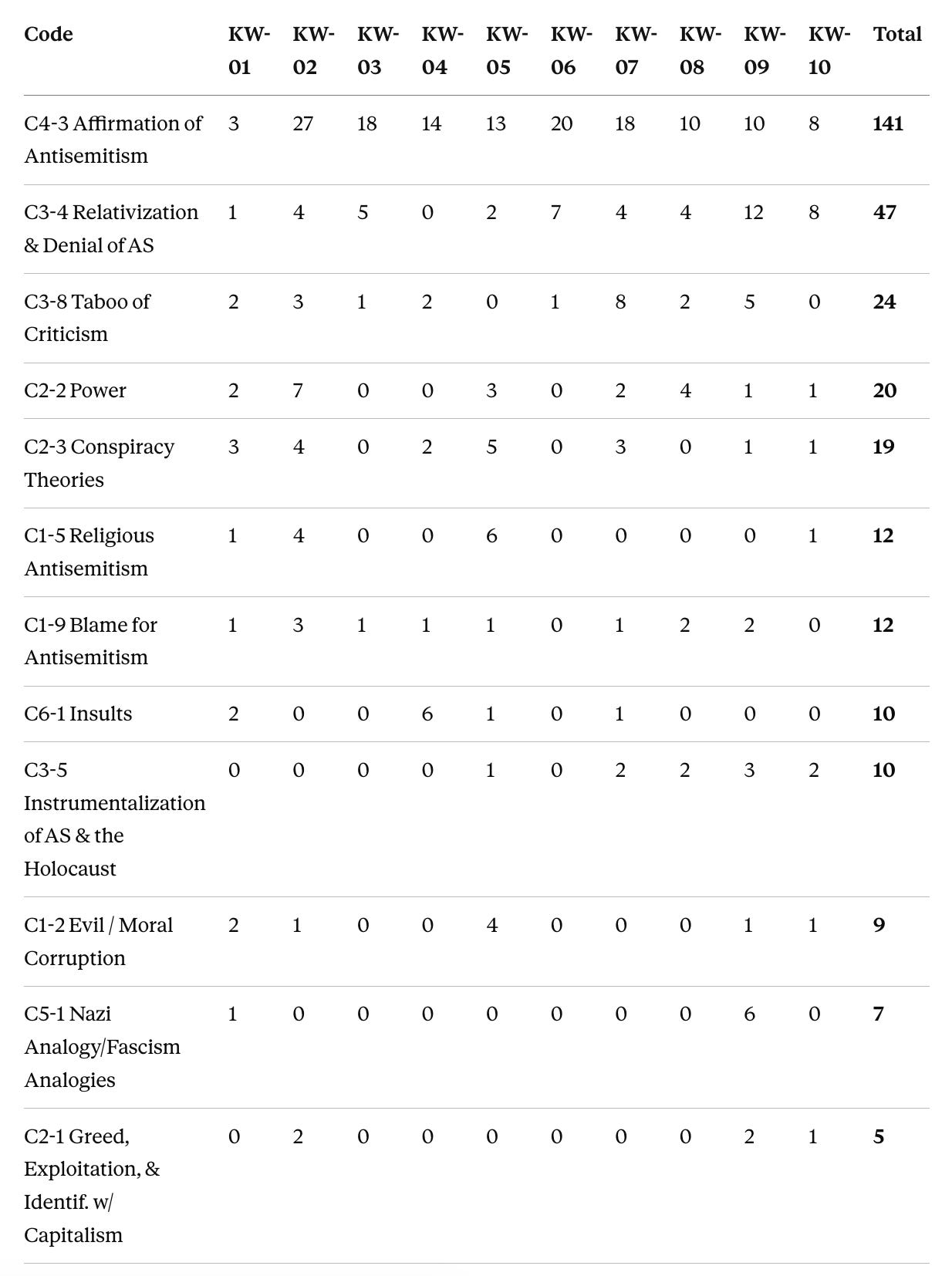
The matrix surfaces three patterns: (1) Affirmation (C4-3) is the corpus’s modal concept code with 141 codings, and operates at substantial density across every thread in the corpus — with the highest concentrations in KW-02 (27) and KW-06 (20), and the lowest in KW-01 (3, the pre-release thread where the song is not yet the discursive object); (2) Relativization (C3-4, 47 codings — the corpus’s clear second register, reflecting the widened Relativization standard and the anti-ban coding rule documented in the appendix), Taboo (C3-8), Conspiracy (C2-3), and Power (C2-2) form a secondary cluster that operates at moderate density across host conditions, with Religious Antisemitism (C1-5) concentrating in KW-05; (3) the Israel-related family (C5-1) concentrates in KW-09 and is thin elsewhere — the Israel-related register is strongly host-condition-dependent in this corpus.
*KW-04 records 0 Power (C2-2) and 2 Conspiracy (C2-3) codes against 6 Insults (C6-1) — the highest Insults count in the corpus — plus the corpus’s only 2 Threats (C6-2) codings — consistent with a shift in host-attack registers between KW-01 and KW-04. In KW-01 (pre-release), hostility toward Piers Morgan runs through puppet-family constructions that code as Conspiracy or Power; in KW-04 (post-release), structured ideological host-attack thins and hostility operates instead through a slur-and-threat register (documented in the KW-04 per-outlet summary and in §4 below), while the Affirmation slot (14 C4-3) carries the structured ideological engagement. The KW-01 → KW-04 shift is thus not simply additive (host-attack plus Affirmation) but a redistribution of audience hostility across registers once the song becomes the primary discursive object.
Audience Permission Structures: A Working Definition
The three findings below use audience permission structures in a specific, discourse-analytic sense: the set of discursive moves that commenters in a given thread treat as ordinary and uncontroversial — moves that are not actively defended, hedged against pushback, or marked as transgressive in the comments themselves. This is a description of the discursive environment, not of individual cognition: permission structures are an analytical abstraction inferred from recurring interactional patterns, based on which moves surface, which draw counter-articulation, and which circulate without friction. When we speak of host conditions “being associated with” or “shaping” a permission structure, the claim is about the comment environment audiences encounter, not about their internal sense of license; references to moves “being available” or “surfacing” likewise refer to what the thread actually contains.
One epistemological clarification is worth stating explicitly. Audience permission structures is an analytical abstraction inferred from recurring interactional regularities in the comment corpus — patterns of what circulates without friction, what draws counter-articulation, what is marked as transgressive — rather than an independently observable variable. The risk of circularity — the construct being inferred from comments and then used to explain those same comments — is mitigated by the cross-thread comparison structure: a permission-structure claim predicts which moves should and should not circulate under a given host condition, and that prediction can be checked against the corpus. The Morgan within-host comparison (KW-01 vs KW-04) is one instance of that structure.
The inference rule is worth stating in one place. A discursive move is coded as available under a given permission structure when it satisfies at least three of the following five markers: (i) it circulates at meaningful frequency in the thread (not a single isolated comment); (ii) it appears in interactional uptake — subsequent commenters treat it as ordinary and build on it rather than mark it as transgressive; (iii) it draws proportionally little or no counter-articulation from other commenters; (iv) it is not prefaced with justification, hedging, or in-comment defense against anticipated pushback; and (v) it operates alongside compatible moves in the same thread as an organized register rather than as an isolated occurrence. Moves that fail multiple markers — surfacing but drawing counter-speech, or appearing only under hedge structures — are coded as present but not available. This distinction matters because permission structures are not read from frequency alone: a register with three occurrences that circulates without friction is more diagnostic of what the thread makes available than a register with ten occurrences all met by counter-articulation.
Two patterns organize the three findings below. The first concerns volume and effect: sympathetic amplification does not simply increase antisemitic volume but alters the discursive object commenters engage and the operations they perform on it. The second concerns the register the song’s explicit Nazi reference makes available: Affirmation of Antisemitism appears here at densities the research line’s prior speaker-driven studies did not document — a within-case pattern in which the song’s explicit Nazi content, more than sympathetic amplification alone, appears to account for the surface presence of this register. The corpus’s cleanest within-host test of these patterns is the two-thread Morgan comparison (KW-01 pre-release vs. KW-04 post-release), developed under Finding 1 below, where the same host under the same adversarial framing engages the audience under two different discursive objects.
The Analytical Role of Each Thread
Before turning to the findings, it is worth stating what each of the ten threads contributes to the analysis. The corpus is not ten instances of the same observation. It is a structured comparison in which each thread performs distinct analytical work, with the ten together supplying the variation the three findings rest on.
The Morgan pair (KW-01, KW-04) is the corpus’s controlled within-host comparison. Same host, same adversarial framing, same channel environment, seven days apart, with only the discursive object varying (Kanye West’s antisemitism in general in KW-01; the “Heil Hitler” song specifically in KW-04). The pair isolates the effect of the song’s discursive presence from the effect of host condition, and supplies the strongest within-corpus association between the song’s introduction and a change in audience discourse (Finding 1).
The right-host, progressive-host, and adversarial-religious threads (KW-02, KW-03, KW-05, KW-09) vary host condition across the corpus’s central ideological range while holding the song constant as discursive object. These threads test whether host condition shapes the mode of audience response — which registers surface as available — independently of overall antisemitism density. KW-02 (Michael Knowles, right-host) produces the corpus’s highest density (46%) but through Affirmation-dominant uptake; KW-09 (Young Turks, progressive-host) produces the corpus’s third-highest density (31%) with distinctive Israel-comparison and Blame-for-Antisemitism registers absent elsewhere, alongside a Relativization cluster that is the corpus’s densest. KW-05 (CBN News, adversarial-religious) surfaces the Religious Antisemitism register at concentrations no other thread produces.
The sympathetic-amplifier thread (KW-07, Joe Rogan) is the corpus’s single instance of the host condition in which the host, on camera, articulates a framework in which the song’s platform removal confirms the conspiracy the song articulates. It supplies the primary case for Finding 2 (conspiracy elaboration under sympathetic-amplifier framing) and contains the corpus’s densest engaged counter-speech (6 I0c, tied in count with KW-09 but distinct in kind — see the third pattern above) alongside its second-highest antisemitism density — the empirical basis for the refinement that sympathetic amplification appears to make space for audience engagement with the antisemitism register in both directions.
The reaction-creator thread (KW-06) and the hybrid thread (KW-08, Brad Polumbo) test what happens under host conditions that do not fit the adversarial / sympathetic-amplifier axis directly. KW-06 supplies a reference case in which host reaction operates without extended commentary; KW-08 supplies the corpus’s clearest case of the humor-as-affirmation register, where entertainment framing operates as indirect endorsement via trivialization.
The meta-progressive thread (KW-10, Sam Seder) occupies a distinctive position: the host critiques Rogan’s reception of the song rather than the song directly, placing the audience response at one remove from the discursive object. The thread supplies a co-dominant Affirmation/Relativization profile unique in the corpus (8 C4-3 tying 8 C3-4) and its clearest illustration of how meta-discursive framing produces argument about antisemitism rather than uniform articulation of it.
Together the ten threads perform three analytical operations. The Morgan pair isolates the discursive-object variable within-host. The four ideological-variation threads plus the sympathetic-amplifier thread isolate the host-condition variable across the corpus’s central range. The reaction-creator, hybrid, and meta-progressive threads supply reference cases against which the central-range findings can be calibrated. Each thread contributes distinct analytical material; the variation across the ten is the corpus’s design, not its noise.
Finding 1 — Host recoding under adversarial framing
The Piers Morgan threads (KW-01, KW-04) furnish the corpus’s primary case of audience response under sustained adversarial host framing. Morgan condemns the song on camera, identifies its content as antisemitic, and challenges West (and West’s sympathetic interlocutor Sneako) directly. The audience response is consistent with a structural recoding of Morgan himself as Mossad-controlled, with the conspiracy claim articulated as defense of the song against the host. Comments treat Morgan as “Mossad asset,” “puppet for Israel,” “koshervative,” and “Jew worshipper” — formulations directed at the host rather than at the song. Where comments do engage the song’s content, they typically do so to argue that Morgan’s hostility to it confirms his subordination to the system the song names.
The structural significance: adversarial host framing in this corpus does not function as suppression of audience uptake. It redirects audience attention from the song to the host, while the conspiracy framework the song articulates is preserved intact and reactivated as defense against the host’s adversarial position. The pattern is consistent with a framing-dependence mechanism noted in prior work in this research line: adversarial framing functions as suppression only when the audience grants the framer legitimacy in the first place. Where that legitimacy is denied — as it is in this corpus for Morgan — adversarial framing provides additional evidence absorbed into the conspiracy framework rather than functioning as challenge to it.
The two Morgan threads in the corpus permit a within-host comparison that bears on the audience-permission-structures argument. KW-01 (6–7 May 2025) is the pre-release Sneako walkout interview; the song had not yet been released, and the discussion concerns Kanye West’s general antisemitism rather than the song specifically. KW-04 (13 May 2025) is the post-release panel discussion in which the song itself is the subject of the segment. The host is the same, the host’s adversarial framing is the same, the political positioning is the same, and the channel environment is the same (both videos are Piers Morgan Uncensored uploads). The audience composition across the two threads cannot be verified from comment data alone — channel-overlap inference is plausible but not directly demonstrated. The discourse profiles diverge meaningfully. KW-01 is dominated by host-attack content, with commenters treating Morgan as proxy for the system the broader Kanye discourse names; Affirmation of the song’s Nazi reference is thin (3 C4-3 instances) because the song is not the discursive object. KW-04 retains the host-attack register but adds substantial Affirmation content — comments engaging the song directly (“Its a banger though,” “the greatest statement of freedom of speech ever,” “The noticing continues. Thank you, Kanye!”) coexist with the Morgan-as-Zionist-asset construction (14 C4-3 instances). The observable discourse pattern under the same adversarial host condition shifts from host-attack-dominant to host-attack-plus-Affirmation when the song enters the discourse environment. The song’s discursive presence is associated with what commenters articulate under the host’s framing, even when that framing remains constant. This is consistent with the broader argument that audience permission structures depend on the interaction between host condition and discursive object, not on host condition alone.
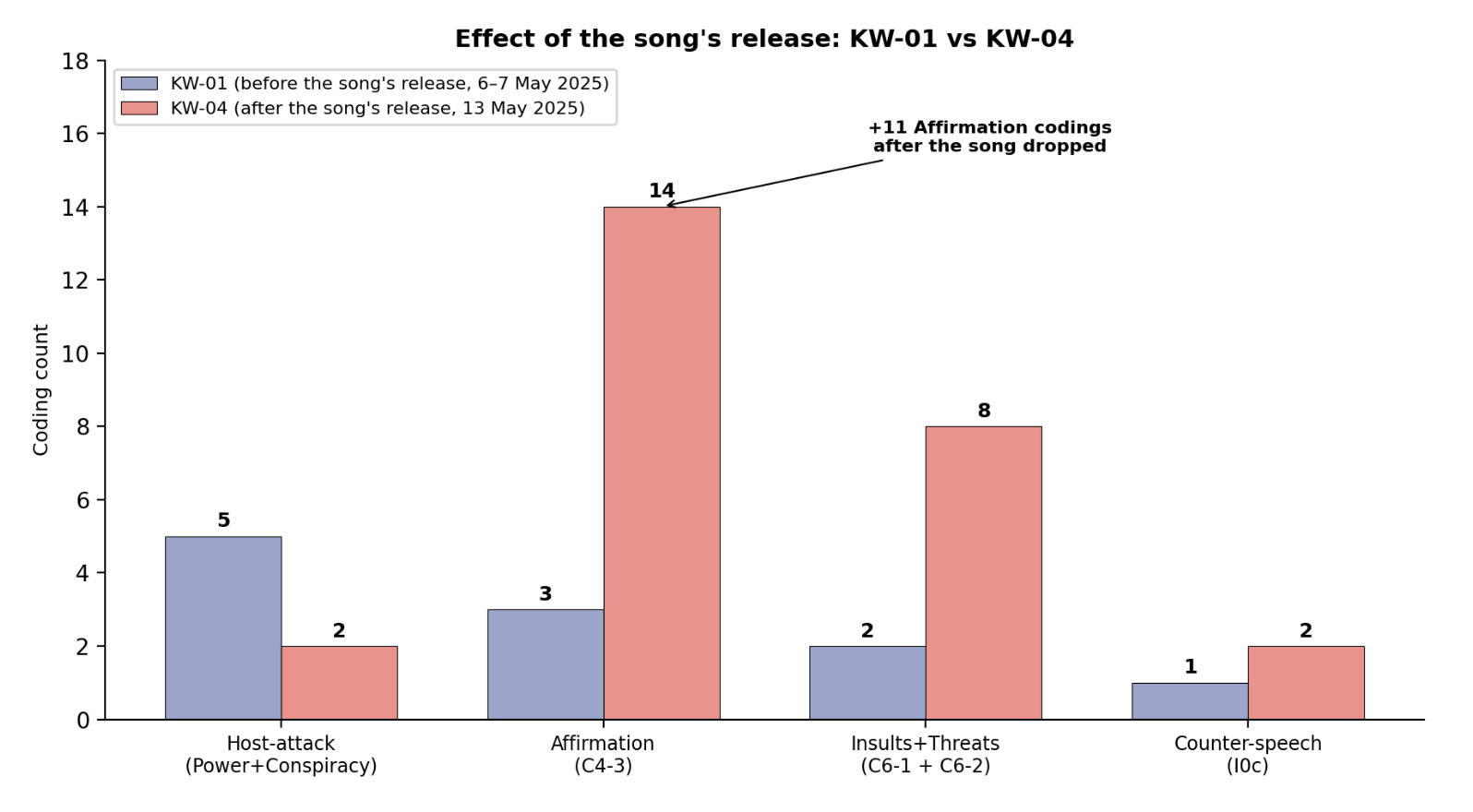
Figure 2. Effect of the song’s release — KW-01 vs KW-04. Same host (Morgan), same adversarial framing, before vs after the song’s release. Counts here are at the coding level. Affirmation codings increase from 3 (KW-01) to 14 (KW-04) — an eleven-coding rise once the song is the discursive object. Host-attack content persists across both threads but redistributes across registers: KW-01’s structured puppet-family constructions (5 Conspiracy/Power codings) give way in KW-04 to a slur-and-threat register (6 Insults + 2 Threats codings against 2 Conspiracy and 0 Power). Other categories of antisemitic coding and counter-speech remain comparable. The eleven-coding Affirmation shift is the strongest within-host association between the song’s introduction into the discussion and a change in audience discourse the corpus contains; it is not a controlled isolation of the song variable alone, since topic, week, guests, media coverage, discursive object, and comment population all shift between the two threads (see discussion in the second pattern, above, and in Limitations).
Finding 2 — Conspiracy elaboration under sympathetic-amplifier framing
The Joe Rogan thread (KW-07) furnishes the corpus’s primary case of audience response under sympathetic-amplifier framing. Rogan describes the song as “kind of catchy,” articulates the “you can’t criticize them” framework on camera, and treats the platform removal of the song as confirmation of the conspiracy the song articulates. Where the Morgan threads produced host-attack uptake, the Rogan thread produces a register in which the host drops out of audience commentary almost entirely. Audience comments elaborate the conspiracy framework directly, building out the media-control, banking-control, and “they run everything” registers Rogan introduces. The Taboo / “you can’t criticize them” formulation operates in this thread as discursive scaffolding for the audience’s conspiracy elaboration — consistent with the pattern of host articulation and audience elaboration moving in the same direction, without the redirection-to-host-attack visible in the adversarial threads. The pattern is consistent with prior observations of the JRE audience under different speaker conditions: a parallel discourse-analytic study of the Rogan / Murray / Smith episode of April 2025 documented that comment sections under Rogan’s framing converge on dismissal of credentialed counter-positioning and elaborate the conspiracy register rather than challenging it, with antisemitic content present in roughly a third of the analyzed sample (Becker and Sabra 2025).
A refinement worth flagging from the empirical pattern in KW-07. The scaffolding the host’s framing provides does not produce uniform audience uptake of the kind documented under right-host or progressive-host conditions, where commenters converge on a single discursive register (Affirmation in those cases). Instead, KW-07 commenters produce both substantial conspiracy-elaboration of the host’s framing and substantial direct counter-articulation challenging it.
Under Comment 19 alone — the audience comment treating Kanye as proving who can’t be criticized — the reply chain contains roughly four substantive antisemitism articulations of the media-control / Israel-criticism / Jewish-ownership-of-media register alongside multiple direct counter-articulations operating in two modes. Some engage the antisemitic content itself: one identifying the antisemitism as echoed genocide, one quoting the Heil Hitler refrain to challenge the framing that it constitutes criticism, one naming Kanye as actively Nazi-aligned, one rejecting the conflation of Hitler-praise with Israel-criticism, one quoting the antisemitic chorus to dismantle the Taboo framing. Others engage the antisemitism-protective argument structures Rogan advances: countering the Taboo claim via empirical counter-example, countering the hate-speech-as-free-speech framework that protects the song’s circulation, and countering the Taboo claim’s logical form via reductio.
Counter-speech in KW-07 ties with KW-09 for the corpus’s highest count (6 each), and constitutes the corpus’s densest substantively engaged counter-speech — KW-09’s count is carried largely by explicit pro-ban stances coded I0c under the standing rule, whereas KW-07’s engages the conspiracy elaboration directly. This coexists with the corpus’s second-highest conspiracy-elaboration density. The sympathetic-amplifier host condition appears to make space for audience engagement with the antisemitism register in both directions — elaboration and challenge — rather than producing the Affirmation-monoculture KW-03 exhibits or the host-attack redirection KW-01 and KW-04 exhibit. The scaffolding claim holds in the sense that the host’s articulation of “you can’t criticize them” produces an audience discourse that engages the substantive antisemitism register directly. Whether that engagement produces elaboration or counter-articulation appears to depend on the individual audience member’s prior position rather than on the host’s framing alone.
The Rogan thread supports the more precise formulation of the central finding: sympathetic amplification appears to reshape what the audience does with the song (elaborate it, extend it, challenge it, integrate it with adjacent conspiracy material) rather than how much of it the audience produces. The host-condition pattern visible in Figure 1 is consistent with the volume-versus-mode distinction: KW-07 (32%) and KW-02 (46%) both surface high antisemitism densities under structurally different host conditions — right-host with no audible host conspiracy framing versus sympathetic-amplifier with such framing on-camera. The two threads differ substantially in what the audience does with that rate — KW-02 concentrates in Affirmation (C4-3 ×27), KW-07 in Affirmation (C4-3 ×18) combined with Taboo (C3-8 ×8) and Conspiracy (C2-3 ×3). Comparable-high antisemitism density across differing concept distributions is the simplest visible form of the article’s central claim.
Finding 3 — Affirmation of Antisemitism as a corpus-distinctive register
Across the corpus — with the highest density in KW-02 (right-host, 27 instances of C4-3) and KW-06 (reaction-creator, 20 instances), followed by KW-03 and KW-07 (18 each) — commenters produce a register of direct endorsement of the song’s explicit Nazi reference. Formulations such as “hail ye,” “Yedolf turning up the gas,” and “I did Nazi that coming” do not operate through the plausible-deniability scaffolding that characterized comparable content in event-conditioned corpora (e.g., the Temple Israel “elbows to the temple” register) or the coded scaffolding that characterized comparable content in prior speaker-driven studies in this research line. The concept-frequency heatmap (the Supplementary Appendix’s Figure) makes the corpus’s modal pattern visible at a single glance: Affirmation (C4-3) is the only code that operates at moderate-to-high density across every thread in the corpus. The cross-thread comparison (Figure 1) underscores the pattern’s host-condition reach — Affirmation surfaces across right, progressive, adversarial-religious, reaction, sympathetic-amplifier, hybrid, and meta-progressive conditions alike, with the lowest density in the pre-release KW-01 thread (where the song is not yet the discursive object).
The pattern is consistent with the possibility that the song’s explicit Nazi reference reduces the discursive labor of coding endorsement: where the song already names the Nazi reference, commenters do not need to construct plausible-deniability scaffolding to endorse it, and the Affirmation register operates openly. The category architecture of digital antisemitism, on this reading, is not exhausted by the conspiracy-cluster registers that have dominated prior speaker-driven studies; a song built around explicit Nazi references can be associated with an additional register — direct Affirmation of its content — that coded discourse did not surface at comparable density in the cases we have on record. The relationship to host framing is worth flagging: Affirmation appears across the corpus, with the densest instances in KW-02 (right-host) and KW-06 (reaction-creator), and the lowest post-release density in KW-10 (meta-progressive, 8). The corpus contains only one sympathetic-amplifier thread, so claims about that condition’s relationship to Affirmation density rest on a single observation; the pattern that Affirmation is widely distributed across host conditions and concentrated in some of them is more robustly supported.
Summary of Comment Patterns by Outlet
The cross-thread table above gives the headline counts. The per-outlet summaries below describe the distinctive empirical signature of each thread — what register dominated, what sub-register patterns surfaced, where the thread diverges from the corpus norm. Comment IDs identify a comment’s position within a thread: single numbers refer to top-level position (e.g., Comment 4), hyphenated IDs to position within a reply chain (e.g., Comment 17-02). All comments — top-level and reply — are counted equally in the per-thread antisemitism rate.
KW-01 — Piers Morgan Uncensored (Morgan + Sneako, walk-out): antisemitism rate 12% (100 entries). Predates the song release (6–7 May 2025); addresses Kanye West’s general antisemitic record rather than “Heil Hitler” specifically. Dominant register: host-attack recoding Morgan as Mossad/AIPAC/Zionist proxy — codes primarily as Conspiracy (C2-3) under the puppet-family rule (asset, puppet, stooge, payroll formulations), with Power (C2-2) reserved for bare-influence claims like “Zionist megaphone” and unnamed-controller constructions (“the Powers that be… can make or break you overnight”). Affirmation of Antisemitism appears thinly (3 instances). Netanyahu-comparison jabs at the host without puppet lexicon or a Jewish collective referent (“Piers is netanyahoo light”) code I0 per the final calibration. The corpus’s only thread where host-attack dominates over song-engagement — and, at 12%, the corpus floor.
KW-02 — Michael Knowles (The Daily Wire): antisemitism rate 46% (100 entries). Earliest verified primary reaction in the corpus (9 May 2025, day after song release). Dominant register: Affirmation of Antisemitism (27 instances of C4-3), including the “NHH” / “N**s Heil Hitler” salute formula and the “I now love Kanye” positive-alignment sub-register. The corpus’s highest antisemitism density.
KW-03 — Breaking Points (Krystal Ball & Emily Jashinsky): antisemitism rate 24% (100 entries). Affirmation-monolithic profile — of the 25 concept codings in the thread, 18 are C4-3 (72%), almost all aesthetic praise of the song without distancing (A4 sub-register); the remainder concentrate in Relativization (5 C3-4). Host visibility in comments near-absent. Notable as the corpus’s first progressive-host thread; antisemitism density is comparable to right-host and adversarial-religious conditions, undermining the predicted host-condition gradient. Four counter-speech codings.
KW-04 — Piers Morgan Uncensored Panel: antisemitism rate 26% (100 entries). Same host, framing, and channel environment as KW-01, but post-song-release. The KW-01 → KW-04 shift involves a register redistribution: structured-ideology host-attack thins (puppet-family Conspiracy/Power codings drop), while substantial Affirmation surfaces (14 C4-3 codings — “Its a banger though,” “the greatest statement of freedom of speech ever,” “The noticing continues. Thank you, Kanye!”). Host-attack routes through the slur-and-threat register in the corpus’s densest threat sub-thread, producing the corpus’s highest C6-1 (Insults) count, its only C6-2 (Threats) codings — including the weapon-emoji threat and the death-wish location solicitation — and its first explicit incitement cluster. Also notable: the corpus’s most sophisticated Holocaust-denial construction (Comment 4, the 6 million / 271k numerical substitution).
KW-05 — CBN News (Raj Nair + Joshua Washington): antisemitism rate 30% (100 entries). Faith-context outlet (CBN = Christian Broadcasting Network); the guest, Joshua Washington, directs the Institute for Black Solidarity with Israel. Distinctive register: religiously-grounded antisemitism through Christian theology, including the Christian-Zionist inversion cluster, supersessionism (both the “synagogue of Satan” variant and the chosen-people-inversion / scriptural-imposture variant), conversionist antijudaism, deicide-inversion, and Christian-historic-antisemitism-as-heritage. The corpus’s densest Religious Antisemitism concentration (6 C1-5 codings) and the most conceptually diverse thread (13 distinct concept codes). One counter-speech coding (Comment 25-4, “Jesus was Jewish though,” rebutting the antijudaic “noticer” frame of its parent).
KW-06 — Knox Hill: antisemitism rate 25% (100 entries). Reaction-creator host providing critical-aesthetic engagement with the song. Host visibility in comments near-absent — the discourse stays on the song rather than recoding the host. Dominant registers: Affirmation (20 C4-3 codings, primarily aesthetic praise of the song, the corpus’s second-highest Affirmation count) and a substantial Relativization cluster (7 C3-4 codings) elaborating minimization and free-speech defenses around the platform’s failure to remove the song. Zero counter-speech — the corpus’s only thread with none.
KW-07 — JRE Clips (Joe Rogan): antisemitism rate 32% (100 entries). Second-highest density in the corpus, after KW-02. Distinctive registers: a platform-removal-as-confirmation conspiracy cluster (the “jewtoob” framing — Comments 17-02, 17-25, 19-027); an explicit Affirmation register (18 C4-3 codings, including “NHH”-formula and numerological-decoding constructions); a substantial Taboo cluster (8 C3-8 codings); an Instrumentalization register (Comment 17-32, “oi vey!” as mock-performance of Jewish complaint, I1a + C3-5); and 6 I0c codings — the corpus’s densest substantively engaged counter-speech — operating in two modes: direct engagement with antisemitic content, and engagement with antisemitism-protective argument structures. The sympathetic-amplifier condition appears to make space for engagement in both directions rather than producing uniform Affirmation.
KW-08 — Brad Polumbo (Brad vs Everyone): antisemitism rate 17% (100 entries; tied with KW-10 as the lowest post-release density in the corpus — the overall corpus floor is the pre-release KW-01 at 12%). Conservative-critical / hybrid condition: Polumbo defends free speech while explicitly naming Kanye’s content as antisemitic. Distinctive registers: the corpus’s largest humor-as-affirmation cluster — anchored by Comment 9 (”I’m Jewish and Kanye’s crash out is just hilarious... beat at the end honestly goes hard if you ignore the blatant antisemitism”) with its Confirmation chain (9-01, 9-02, 9-14) — where entertainment framing operates as indirect Affirmation via trivialization; a thin aesthetic-praise cluster (3 pure C4-3 codings: 1-4, 6-2, 13); a Power-Media + Blame-for-AS cluster (Comment 16 “jew music moguls,” Comment 29-8 “Jewish record executives profit off the plight of impoverished Black Americans” — the latter triple-coded C4-3 + C1-9 + C2-2); and Instrumentalization via a villain-comparison chain (Comments 21-05 / 21-06, juice-box 🧃 letter-substitution). Notable single cases: Comment 18-4 “271k at most” (the cross-thread Holocaust-distortion register, also KW-04 Comment 4) and Comment 18-5 (Neturei Karta weaponization register). Substantial counter-speech (5 I0c codings): Comment 18 offers the corpus’s most substantive counter-speech articulation, and the Comment 9 chain contains the corpus’s rare interactional case where humor-as-affirmation and counter-speech (9-06, 9-08, 9-10) occur in direct dialogue.
KW-09 — The Young Turks (Cenk Uygur & Jordan Uhl): antisemitism rate 31% (100 entries). Third-densest in the corpus, after KW-02 and KW-07 — and within one point of KW-07. Progressive-host condition, but the audience profile diverges from KW-03’s monolithic A4-aesthetic pattern. Distinctive registers: the corpus’s densest Israel-comparison cluster (6 C5-1 Nazi Analogy codings + 3 C3-5 Instrumentalization); the corpus’s densest Relativization cluster (12 C3-4 codings, carried substantially by anti-ban stances coded under the standing anti-ban rule) running in parallel with direct Affirmation (10 C4-3); the Jewish-music-industry-profits trope (Comments 3-2, 5-2, same user); the corpus’s first clean manufactured-hate-crimes register (Comment 31); the first visual-identity-marker euphemism (Comment 3-5, “the little hats”). The most conceptually diverse progressive-host thread in the corpus. Six counter-speech codings — predominantly explicit pro-ban stances coded I0c under the standing rule.
KW-10 — The Majority Report (Sam Seder): antisemitism rate 17% (100 entries; tied with KW-08 as the lowest post-release density). Meta-progressive condition — the host critiques Joe Rogan’s defense of the song (KW-07) rather than the song itself, positioning the audience response at one remove. Distinctive registers: a dense Relativization cluster (8 C3-4 codings, tying Affirmation and giving KW-10 a co-dominant Affirmation/Relativization profile unique in the corpus — Kanye-as-edgy-trolling, mental-illness, Israel-comparison, free-speech defense, sports-analogy minimization, Jewish-Nazi-collaborator tropes); the corpus’s most multi-concept antisemitic construction (Comment 7-030, supersessionism + Greed + Power + Evil, with the supersessionist frame carrying Religious Antisemitism); the first active Nazi-revisionist propaganda recommendation (Comment 7-052, “Europa the Final Battle”); the first esoteric antisemitism-conspiracy reference (Comment 7-062, anti-Frankist); the most explicit Blood-Libel-projected-onto-Israel construction (Comment 7-005); and substantial political-positioning argument in the 85-reply mega-thread under Comment 7. Direct Affirmation at 8 C4-3 codings — consistent with meta-discursive framing producing argument about antisemitism rather than uniform articulation of it. Two counter-speech codings, including the mega-anchor Comment 7 itself (“According to right wingers, even if you make a song glorifying Hitler, that still somehow doesn’t make you a Nazi” — I0c, 834 likes, 85 replies), whose counter-speech status frames the entire dominant reply chain.
1. Affirmation of Antisemitism
This is the response register that distinguishes the Kanye West corpus most sharply from the research line’s prior speaker-driven studies. The Affirmation register is treated here as a hierarchy of four sub-registers rather than a single category. The distinction matters because the sub-registers carry different evidential weight: a comment endorsing Hitler directly is analytically distinct from a comment making a pun about Nazism, even though both circulate the Nazi referent. Coders distinguish among:
A1. Direct ideological endorsement. Explicit endorsement of the Nazi reference itself, with the Nazi content as the endorsed object: “Hail Hitler,” “Hitler was right,” “based,” and similar. Coded as Affirmation only when the Nazi referent is the substantive endorsed content, not a generic edginess marker.
A2. Positive alignment with the song’s framing. Endorsement of Kanye West’s framing of his grievance as containing legitimate substance, including the conspiracy claim the song articulates: “He’s calling out your bosses,” “109 countries btw,” “they don’t understand the things I say.” The alignment is with the song’s discursive content rather than with Nazi ideology per se; the two converge in this case because the song’s framing is itself the Nazi referent.
A3. Humorous normalization. Antisemitic content delivered through wordplay, puns, or irony whose humorous frame is built on the antisemitic referent rather than against it: “I did Nazi that coming,” “Yedolf turning up the gas,” “Karaoke night will never be the same.” Coded as Affirmation when the joke’s structure requires the antisemitic content to function — the antisemitic referent is the punch line’s load-bearing element, not its target.
A4. Aesthetic endorsement linked to Nazi content. Praise of the song’s musical or production qualities (“that beat is truly undeniable,” “the song slaps,” “Ye cooked”) delivered in commentary contexts where the song’s title, lyric, and visual content are the explicit Nazi reference. A4 is the most interpretively demanding sub-register, and the coding rule reflects a corpus-specific judgment. For songs in which the antisemitic content lives in subtext rather than in the title and chorus, the strict default would be to hold ambiguous aesthetic praise for second-coder review. For “Heil Hitler” the strict default is loosened, because the song’s title and chorus are the Nazi referent: positive aesthetic engagement with the song is not reliably separable from positive engagement with the Nazi referent it names without an explicit distancing move in this artifact-specific context. The coding rule is therefore: aesthetic praise of the song was treated as A4 unless an explicit distancing move was present in the comment itself — formulations like “I wish the lyrics were changed”, “shame about the message”, “despite the content”, or an irony marker that distances the speaker from the Nazi referent specifically. Distancing must appear within the comment; subsequent self-disavowals in reply chains do not retroactively change a coded A4 instance. Comments that praise the music while making the lyrics the punchline of irony are coded A3 (humorous normalization) rather than A4. The distinction between A4 and A2 (Positive alignment) is whether the comment articulates substantive alignment with the song’s framing: “This song goes so hard” is A4 (aesthetic only); “He’s calling out your bosses, song slaps” is A2 (aesthetic plus framing alignment).
The section’s analytical claim — that a song built around explicit Nazi references activates registers that coded discourse did not activate at comparable density in the cases we have on record — anchors the corpus’s contribution to the coded/explicit distinction. The hierarchy above is also the article’s primary methodological refinement: prior research-line studies treated Affirmation as a single category, but the Kanye West corpus surfaces enough sub-register variation to warrant the four-level decomposition.
The clearest A1 case in the corpus is KW-07 Comment 17-30:
“NHH = 1488 because N is the 14th letter” (KW-07 Comment 17-30)
The construction articulates Direct Ideological Endorsement through numerological decoding: the commenter spells out, for other readers, how the “NHH” abbreviation circulating across multiple threads (N****s Heil Hitler) maps onto the white-supremacist numerological signature 1488 (the Fourteen Words plus “HH” — Heil Hitler — as the eighth letter doubled). The comment does not merely deploy the dog whistle; it teaches it, functioning as in-thread decryption service for the white-supremacist vocabulary the song’s audience is circulating. The comment codes as I1b + C4-3 (Affirmation, A1 sub-register) — contextual rather than co-textual, since the 1488 signifier requires world knowledge to interpret.
Christian-historic-antisemitism-as-heritage surfaces in KW-05 Comment 25-1:
“To be a true Christian is to be ‘antisemitic’. Man up and be like your glorious ancestors.” (KW-05 Comment 25-1)
The construction — posted by an account whose handle carries the 1488 numerological signature — frames antisemitism as constitutive of authentic Christian identity and invokes “glorious ancestors” as the tradition to be inherited. Coded as I1 + C4-3 (Affirmation) + C1-5 (Religious Antisemitism). This is the corpus’s clearest case of historical-precedent-as-justification: historic Christian antisemitism is presented not as a cautionary example but as an ancestral standard the commenter urges others to live up to.
The corpus also surfaces adjacent historical-precedent and relativization registers that interact with Affirmation but are conceptually wider. One such register is expulsion-as-evidence: claims that historical expulsions of Jews from “109 countries” prove the validity of contemporary antisemitism. In prior coded-discourse studies these arguments primarily scaffold conspiracy narratives; in this corpus they more often push toward direct Affirmation of historical anti-Jewish violence, consistent with the explicit-supply pattern noted across the article.
Supersessionist Christian antisemitism concentrates in KW-05 and KW-10 and operates as a theological variant of this historical-precedent register. The most compressed case is KW-05 Comment 5-1 — “Amen — Revelation 2. 9” — which invokes the “synagogue of Satan” verse as assent to a parent comment’s warning that God will “get [Kanye’s] attention,” and codes as I1b + C1-5 (Religious Antisemitism). The blood-curse variant appears in KW-02 Comment 4-21, which cites the Pilate blood-on-their-hands passage and “a certain synagogue of a certain red feller,” coding as I1b + C1-5 + C2-3 (the covert-agent construction carrying the Conspiracy code). Conversionist antijudaism appears in KW-05 Comment 24 — “needa bring the jews to jesus” — coded I1 + C1-5. A structurally distinct KW-05 case is Comment 15-1, which weaponizes the chosen-people frame against contemporary Jews: scripture is invoked to affirm biblical Israel’s special status, then reversed to strip current Jews of that status. The move is imposture — contemporary Jews cast as counterfeits — and codes with the hidden-identity logic structurally parallel to the puppet-family constructions. A more elaborated version appears in KW-10 Comment 7-030, which layers supersessionism, Greed, Power, and Evil across a single block of text (coded I1b + C2-1 + C2-2 + C1-2 + C1-5, with the supersessionist framing carrying the Religious Antisemitism coding). Across these comments, supersessionism functions as the master frame: historical, economic, and identity-based grievances are presented as evidence for a Christian-theological claim about Jews, rather than as standalone complaints.
An adjacent register operates through name-fusion. KW-01 Comment 5 fuses “Satan” and “Netanyahu” into:
“Satanyahu” (KW-01 Comment 5)
attaching the Devil-attribution register directly to the sitting Israeli prime minister. The construction codes as I1b + C1-2 (Evil / Moral Corruption, via the Satan-identification — contextual rather than co-textual, since the pun requires recognizing the Netanyahu reference) + C1-9 (Blame for Antisemitism, via the surrounding argumentative structure) + C5-5 (Genocide, via the wider argumentative context in which the name-fusion is deployed). The construction is analytically distinctive because it compresses a triple attribution — demonization, blame-shifting, and genocide-framing — into a single lexical device. The name-fusion register echoes historically documented antisemitic constructions (e.g., “Zio-nazi,” “Rothschild-vermin”) but adapts them to a contemporary head-of-state target, illustrating how digital vocabulary generates compact vehicles for legacy antisemitic frames.
The corpus also surfaces a Nazi-vocabulary redeployment register in KW-06 Comment 11-11, where the term “untermensch” — the National Socialist designation for dehumanized populations — is turned on the commenter’s interlocutor: “How do you like your state forced vaxx undermench?” The redeployment sits inside a construction that simultaneously minimizes Nazism itself (“Adolf was a sad loser on meth that lost. Its the least dangerous ideology around today, the one that’s actually dangerous is mainstream democrat globalist communism”). The comment codes as I1b + C4-3 (Affirmation, via the minimization-of-Nazism move) + C3-4 (Relativization & Denial of Antisemitism). The register is analytically notable for its double operation: Nazi persecution vocabulary is kept in active circulation as an insult resource, while Nazi ideology is simultaneously reframed as the least dangerous option on the contemporary political menu. A contrasting deployment of the same term appears in KW-04 Comment 4-5, where “untermensch” is used in counter-speech — reminding a Kanye defender that “Hitler would view you also as untermensch” (coded I0c) — demonstrating that Nazi-historical vocabulary circulates in this corpus in both affirming and counter-speech modalities.
A cross-thread Christianized-Heil register surfaces in KW-02 and KW-05, in which the Nazi salute is fused with Christian affirmation formulas:
“Christ is Lord! HH” (KW-02 Comment 1-6) “Hail Christ Jesus 💪.. MAGA 🇺🇸🏁” (KW-05 Comment 20)
The first attaches the “HH” (Heil Hitler) abbreviation directly to a Christological credo; the second fuses the salute formula with a Christian invocation and a contemporary political slogan. Both comments code as I1a + C4-3 (Affirmation) with the Christianized framing carrying an additional Religious Antisemitism (C1-5) coding in the KW-02 case where the “HH” + Christological pairing operates as a substantive theological claim rather than a bare adjacency. The pair is analytically distinctive because it illustrates how the salute formula circulates in the corpus not as a standalone Nazi reference but as a modular element that combines with adjacent identity-marking vocabulary — Christian, political, aesthetic — depending on the discursive environment. Its appearance in a right-host (KW-02) and an adversarial-religious (KW-05) thread suggests that the Christianized-Heil register operates as a cross-condition identifier of a specific fused ideological position rather than as a host-condition-dependent register.
The corpus surfaces a distinctive humor-as-affirmation register whose paradigmatic case is KW-08 Comment 9:
“I’m Jewish and Kanye’s crash out is just hilarious (Edit: I’ve never heard the whole song the beat at the end honestly goes hard if you ignore the blatant antisemitism).” (KW-08 Comment 9)
The comment codes as I1a + C4-3 (Affirmation) + C3-4 (Relativization) — dual-coded because the entertainment-framing and the aside-from-content bracketing operate simultaneously. The commenter’s Jewish self-identification does not neutralize the trivialization move; if anything, it authorizes an “even Jews find it funny” trivialization for other commenters in the reply chain. Confirmation comments in the reply chain endorse the “don’t take it seriously” framing:
“lol love this. People really shouldn’t take everything to heart so deeply...” (KW-08 Comment 9-01) “He is truly comedy material to laugh at!” (KW-08 Comment 9-02) “there is no such thing as bad publicity” (KW-08 Comment 9-14)
Comment 9-03 illustrates the register’s operation even in comments that register concern about the song’s spread:
“It’d be a whole lot funnier if I didn’t look at the comment sections... teenagers being introduced and AGREEING with it” (KW-08 Comment 9-03)
The “funnier” framing performs the trivialization that the concern nominally opposes. The register is analytically important because it operates independently of aesthetic-praise or ideological-endorsement modes: humor as such becomes the vehicle by which antisemitic content is normalized in the commenting environment.
The Comment 9 chain also surfaces the corpus’s clearest interactional case of humor-as-affirmation and counter-speech in direct dialogue. The same reply chain contains three counter-speech comments — 9-06, 9-08, 9-10 — that push back against Comment 9-05’s “he wants you to get mad” trivialization framing, naming the harm concretely (a cited 400% increase in hate crimes; “actual people at the end of his shock trick”). No other thread in the corpus shows this pattern of concentrated humor-as-affirmation and concentrated counter-speech coexisting within a single reply chain. The finding is worth flagging as an empirical instance of the audience-permission-structures argument: the same discursive space, under the same host framing, can host both the trivialization register and the counter-speech register in dialogue.
The most analytically dense Blame-for-Antisemitism case in the corpus is KW-08 Comment 29-8:
“He’s already said in an interview he’s doing it because he feels Jewish record executives profit off the plight of impoverished Black Americans. Also because he feels they’re fucking with him... few Jewish individuals in the industry that openly threatened him with black mail... So I don’t really blame him for being mad.” (KW-08 Comment 29-8)
The comment codes as I1a + C4-3 (Affirmation) + C1-9 (Blame for Antisemitism) + C2-2 (Power) — triple-coded because it simultaneously (a) endorses Kanye’s antisemitic content by justifying it as reactive, (b) attributes responsibility for that content to Jewish media control, and (c) invokes the Power register through the “record executives” framing. The case is important because it articulates the “they made him do it” logic as a coherent argument rather than as a slogan — the commenter constructs a full justification narrative that ends with an explicit exculpation (”I don’t really blame him for being mad”). The construction is a compressed instance of the broader Blame-for-Antisemitism register that surfaces across multiple threads in the corpus.
2. Taboo and Self-Victimization
Taboo and self-victimization is the register that operates as the discursive scaffolding through which the sympathetic-amplifier effect functions. Four sub-registers organize the corpus’s Taboo content: the “you can’t criticize them” framework as Rogan articulates it on the podcast and the audience picks it up; the cancellation-as-evidence inversion (platform removal reframed as the cause rather than the effect of the song’s circulation); the persecution-of-the-truth-teller framing applied to Kanye West himself; and the personal-experience-of-moderation sub-register, in which commenters cite their own account suspensions as confirmation of the conspiracy framework. Commenters frequently interpret platform-moderation responses as confirmation of that framework when the responses arrive without an accompanying account of why the content meets the moderation threshold — an observation the Conclusion develops further.
The Taboo register in this corpus is structurally inseparable from the Conspiracy register documented under §3 — the corpus’s clearest Taboo cases pull double duty as Conspiracy cases:
“U really think jewtoob would let him type that?” (KW-07 Comment 17-02) “the song has been removed from every mainstream platform... they often get accused of controlling media. Logic dummy.” (KW-07 Comment 19-027)
The first articulates Taboo through the “letting” construction (someone is permitted or not permitted to speak) and Conspiracy through the “jewtoob” identification of who is doing the permitting (I1b + C2-3 + C3-8). The second articulates Taboo through the platform-removal anchor and Conspiracy through the elaboration that follows. The dual-coding is the analytical point: in this corpus, the Taboo register predominantly serves as the entry-point for Conspiracy elaboration rather than as a stand-alone discursive move.
The cancellation-as-evidence inversion appears in compressed form as a recurring formula across multiple threads:
“the more they ban it the more people listen” “this only makes it bigger”
and the recurring inversion in which platform-moderation actions are reframed as marketing rather than moderation. The construction codes as I1b + C3-8 (Taboo) where the implicit Jewish-control identification is the discursive context, and as I1a + C3-8 where the construction names “they” directly. The structural feature worth noting: counter-speech directed at this register rarely redirects the discussion away from the Taboo framing in the corpus. Among the corpus’s counter-speech (I0c) codings, the ones that engage the cancellation-as-evidence formula directly (KW-08 Comment 18, KW-07 Comments 14, 19-005) are themselves treated by subsequent responders as further evidence of the Taboo claim — the counter-speech move is recoded by the comment ecosystem as part of the silencing it tries to challenge.
The highest-engagement Taboo anchor in the corpus is KW-07 Comment 19 — “He’s proving a point. He’s showing who you can’t criticize. That’s who’s in charge.” — which received approximately 5,024 likes and generated a multi-comment counter-speech (I0c) reply cluster. The comment codes as I1a + C3-8 (Taboo of Criticism) and articulates the who-you-can’t-criticize framing in compact form. The interactional structure around it is analytically distinctive: rather than the more common pattern in which counter-speech is met with reaffirmation of the Taboo claim, the reply chain under Comment 19 sustains consecutive counter-speech comments that name the moderation logic directly and reject the removal-as-evidence inference. The cluster is analytically important for two reasons. First, it demonstrates that concentrated counter-speech engagement is empirically possible against a high-engagement Taboo anchor under sympathetic-amplifier conditions — the register is not immune to sustained pushback. Second, it illustrates the specific discursive circumstance under which pushback holds: where the counter-speech names the moderation rationale rather than only denying the removal-as-evidence claim, the reply chain sustains rather than collapses. The counter-speech that succeeds is register-naming rather than assertion-denying — consistent with the pattern documented earlier in the “noticing”-pair analysis.
3. Power and Conspiracy Narratives
The initial expectation from prior pieces in this research line was that Power and Conspiracy together would form the dominant antisemitic register in the corpus. The matrix surfaces a different pattern: Affirmation (C4-3, 141 codings) is modal; Power (C2-2, 20) and Conspiracy (C2-3, 19) operate as a secondary cluster.
Power and Conspiracy nonetheless remain the register through which the Morgan–Rogan contrast operates, and are presented first here because the audience-facing logic that connects them — “they run things” and “they orchestrated this specific event” — sits on the same conceptual terrain.
This section covers two operationally distinct but conceptually adjacent codes in the Decoding Antisemitism Lexicon: Power and Subordination claims (C2-2 — background influence and control as stated fact) and Conspiracy Theories (C2-3 — hidden coordinated action behind specific events). The Lexicon treats them as separate codes; this article presents them together because the audience-facing logic links them.
Sub-registers under Power observed in the corpus: dog-whistle and orthographic substitution; the “Zionist megaphone” / media-influence register (most densely in the Joe Rogan thread, where the song’s removal from streaming platforms is treated as evidence of Jewish media influence — note that control claims here, where they invoke string-pulling logic, sit under Conspiracy below); generalized claims of Jewish influence over institutions without specific hidden-coordinator agency.
Sub-registers under Conspiracy observed in the corpus: host-attack formulations that frame the host as a puppet/asset/agent of a hidden controlling body (the puppet metaphor, with its inherent string-puller logic, codes as Conspiracy — most densely in the Piers Morgan threads, where Morgan is recoded as “Mossad asset,” “AIPAC puppet,” and “Zionist agent”); the USA-as-puppet-state framing (same puppet logic at the state level) and the AIPAC-capture / Jewish-state-capture register (capture implies covert seizure of institutions by hidden coordinated agency); historical-event conspiracy framings (JFK, Lavon Affair, USS Liberty, dancing Israelis); and deep-state and institutional-conspiracy elaborations. The “AshkeNazi Zionist pawn” Hitler-rehabilitation revisionism is treated separately under §1 (Affirmation), since its central move is Hitler-rehabilitation rather than conspiracy proper.
The relationship between the two registers in this corpus: the Power register supplies the meta-frame (Jews/Israel/Zionists as influential and controlling) under which specific Conspiracy claims about individual events or actors are organized — per the hierarchical multi-target organization principle established in prior work in this research line.
The clearest sympathetic-amplifier elaboration in the corpus appears in KW-07 (Rogan), where commenters articulate the Conspiracy register through the song’s removal from streaming platforms. The anchor, Comment 19 (“He’s proving a point. He’s showing who you can’t criticize. That’s who’s in charge.”), frames the removal as demonstration; the elaboration arrives in the reply chain:
“use logic dumbass. The song has been removed from every mainstream platform. Who did Hitler hate the most? They often get accused of controlling media. Logic dummy.” (KW-07 Comment 19-027)
The construction is a chain — platform removal → identification of who removed it → confirmation that they control media — in which each step is presented as inferential follow-through rather than ideological articulation. The anchor codes as I1a + C3-8 (Taboo of Criticism); the reply’s elaboration carries the Conspiracy content. The Comment 19 chain represents the cleanest case of the Taboo-to-Conspiracy bridge the article’s broader argument identifies: platform moderation becomes confirmation of the conspiracy frame precisely because the moderation arrives without an accompanying account of why the content meets the threshold.
Adjacent in KW-07 is the “jewtoob” construction:
“U really think jewtoob would let him type that?” (KW-07 Comment 17-02) “Jew toob? 😂” (KW-07 Comment 17-25)
The construction names YouTube through a Jewish-portmanteau that articulates platform ownership as a fact-claim about Jewish influence. Comment 17-02 codes as I1b + C2-3 (Conspiracy Theories) + C3-8 (Taboo) — the “would let him” construction invokes the hidden-permitter logic; Comment 17-25, appearing later in the same thread, codes as I1a + C2-2 (Power) — the bare portmanteau restates the ownership claim without the string-puller machinery. The same word does different work depending on where it sits in the elaboration sequence: the pairing surfaces how a single coined term carries either the full Conspiracy construction or its residual Power claim depending on the surrounding syntax.
The corpus’s most efficient global-Conspiracy formulation is KW-05 Comment 25-2:
“He’s just acutely aware of international jewery...” (KW-05 Comment 25-2)
The construction codes as I1 + C4-3 (Affirmation, endorsing Kanye’s “awareness”) + C2-3 (Conspiracy, “international jewery” invokes the trans-national-Jewish-coordination architecture). One twelve-word comment performs both endorsement of the song’s framing and full-scale global-conspiracy elaboration.
A note on register visibility. The “noticing” construction — coded euphemism for identifying (alleged) Jewish influence, widely circulating in alt-right and reactionary discourse — appears in the corpus in both endorsement and counter-speech modalities. Its endorsement form surfaces in KW-04:
“The noticing continues. Thank you, Kanye!” (KW-04 Comment 15)
where the register is affirmed positively as identification with Kanye’s discourse. Its counter-speech form surfaces in KW-03 Comment 33-10:
“More like ‘I can notice patterns and will ensure there is a world left for my grandchildren’” (KW-03 Comment 33-10)
where the commenter mockingly ventriloquizes both the “noticing” frame and the Great Replacement / demographic-threat frame (”a world left for my grandchildren”) as a substitute-quotation offered in response to a parent comment characterizing the song as alt-right pipeline content. The KW-03 case codes as I0c (counter-speech); the KW-04 case codes as I1a + C4-3 (Affirmation) + C2-3 (Conspiracy Theories) — co-textual, since the thread supplies the “noticing” anchor, and dual-coded because the formulation simultaneously thanks Kanye for the identification and invokes the coded conspiracy frame. The pair is analytically distinctive because it demonstrates that the same coded formation circulates across host conditions in different discursive positions — as sincere affirmation in the adversarial-secular thread (KW-04, where Morgan condemns the song and the audience defends it) and as ventriloquized target in the progressive-host thread (KW-03, where the host condemns the song and the audience-side counter-speech mocks the coded scaffolding). Some commenters, in other words, recognize the pipeline’s coded markers well enough to articulate them from the outside as objects of critique — a form of register-naming counter-speech distinct from direct content-challenge. That the same construction shifts sign under different host conditions, without changing its lexical form, is consistent with the broader argument that audience permission structures affect not just what content commenters produce but which stance they take toward circulating antisemitic vocabulary they can be assumed to recognize. A related instance worth noting for the cross-thread reach of the register: KW-05 Comment 25-3 (“in fact, you could say jesus himself was a bit of a ‘noticer’ too 🤔”) extends the coded term into the theological frame, coded I1b + C4-3 + C1-5 (Religious Antisemitism).
The corpus also surfaces a distinctive manufactured-hate-crimes construction in KW-09 Comment 31:
“More manufactured Jewish hate crimes to pass more Antisemitic laws.” (KW-09 Comment 31)
The structure inverts the standard moderation narrative — antisemitic incidents are reframed as Jewish self-staging to legislate against critics — and codes as I1a + C2-3 (Conspiracy Theories) + C3-5 (Instrumentalization of Antisemitism). This register matters because it pre-empts one likely counter-speech move — the move that the existence of antisemitism could be used to challenge the conspiracy framing — by claiming the incidents themselves are coordinated.
4. Threats and Calls for Retaliation
Eliminationist content directed at Jewish targets, individual and collective — including Holocaust-completion language, target-individual threats with direct combat-game-register address, and the corpus-distinctive dynamic flagged in the team’s adjudication in which commenters call each other “Jew” as a pejorative when one disagrees with another’s pro-West stance, performing Jewish identity as the discursive marker of opposition to the song and completing the inversion through which the comment ecosystem frames defense of the song as defense of truth.
The corpus’s densest threat cluster is in KW-04, in a sub-thread where the reply-target’s channel handle itself signals a kill-the-target framing. The cluster contains an escalation pattern across six replies:
“Jew” — deployed as slur to a Jewish-coded interlocutor (KW-04 Comment 9-5) “Jew” / “jewy” — slur escalation (KW-04 Comments 10-02 / 10-04) “OK rabbi” — substitution-slur (KW-04 Comment 10-06) “me too Jew. Me too. 🔫“ — slur + gun emoji (KW-04 Comment 10-08) “Jew send location” — meme-formula threat (KW-04 Comment 10-09)
The cluster shows the in-thread acceleration from slur-as-insult to slur-paired-with-violence-emoji to explicit hunt-for-target threat. The progression matters because each step is locally legible — the slur is the slur, the gun emoji is the gun emoji, the “send location” phrase is the “send location” phrase — but the cumulative thread carries the escalation that no single comment articulates. The cluster codes through C6-1 (Insults) for the slur-deployment and C6-2 (Threats) for the violence content: Comment 10-08 codes as I1a + C6-1 + C6-2 + MMD (the first-person adoption of “can’t wait to meet one of you,” addressed to a Jewish-coded target and fused with the weapon emoji, constitutes an implied threat rather than abstract violence endorsement), and Comment 10-09 as I1a + C6-1 + C6-2 (Threats, death wish — the location solicitation downstream of the weapon-emoji threat). KW-04’s documented absence from the Power (C2-2) and Conspiracy (C2-3) registers suggests the thread’s host-attack continuation operates through the slur-and-threat register rather than the structured-ideology registers KW-01 supplied.
The Jew-as-pejorative-marker dynamic surfaces also in KW-07 (Rogan), where commenters use “Jew” to mark other commenters’ disagreement with the pro-West / pro-Rogan position — performing Jewish identity as the discursive position of opposition to the song. The construction is structurally distinct from the KW-04 cluster because it does not require its target to be Jewish-coded; it simply marks the target’s discursive opposition through Jewish-coding. Coded as I1a + C6-1, plus the inversion-completion the register performs: defense of the song is reframed as defense of truth against a Jewish-coded opposition that the comment ecosystem has just generated through the labeling act itself.
5. Israel-Related Antisemitism
The register operating principally as deflection — moving the discursive object from the song’s explicit Nazi content to Israel/Palestine framings. Under the progressive-host condition in particular, Israel-related framings become one of the principal discursive routes through which the explicit Nazi referent is displaced: the permission structure makes Israel-criticism content available as a frame the audience can pick up, and the song’s Nazi content recedes from the discursive object. The corpus surfaces Gaza-genocide deflection formulations alongside moves in which commenters acknowledge the antisemitism category but reorder its priority relative to other framings.
The corpus’s most consequential Israel-related construction is KW-10 Comment 7-005, which projects Blood Libel — the medieval Christian charge that Jews ritually murder children for religious purposes — onto Israeli military forces. Coded as I1b + C1-3 (Blood Libel) + C3-5 (Instrumentalization of Antisemitism & the Holocaust). The interest is the route of transmission: Blood Libel is a Christian-historical antisemitic register that, in this corpus, surfaces only in Israel-comparison contexts, suggesting that the Israel/Palestine framing supplies a contemporary scaffold for circulating historic antisemitic content that would otherwise be too explicitly identifiable as antisemitism. The Blood Libel content is delivered through Israel-as-perpetrator narrative rather than through Jews-as-perpetrator narrative, which permits its circulation in spaces where the explicit Christian-historical framing would be foreclosed.
KW-09 (The Young Turks) carries the corpus’s densest Israel-comparison cluster. The relevant codings include I0 (legitimate criticism of Israeli policy), I1b + C5-1 (Nazi-analogy applied to Israel as collective antisemitism), and I1a + C3-5 (Instrumentalization of Antisemitism through Israel-criticism deflection). The internal distinction matters because the three modes do different work: legitimate Israeli-policy criticism is not antisemitism and does not enter the antisemitism count; Nazi-analogy applied to Israel slides into antisemitism through the Jewish-collective-as-Nazi claim; and the Instrumentalization-through-Israel-deflection move — typically:
“why do we have to talk about Kanye when Israel is committing genocide” (KW-09, recurring formulation)
— functions to reorder discursive priority rather than to articulate antisemitism directly. KW-09’s distinctive concentration of these registers (the thread carries the corpus’s only multi-instance C5-1 cluster) reflects the progressive-host condition’s audience-permission-structure for Israel-criticism content, which absorbs both legitimate criticism and antisemitic material under shared discursive surface.
6. Holocaust Distortion and Denial
Where Affirmation of Antisemitism endorses the Nazi reference itself, Holocaust Distortion and Denial operates on the historical record of Nazi violence: contesting death tolls, offering false equivalences, or redistributing responsibility for the Holocaust. The two registers can dual-code in the same comment — Hitler-rehabilitation constructions in particular typically carry both — but they are analytically distinct discursive moves. The Holocaust Distortion register operates at substantially lower corpus density than Affirmation (C3-3 surfaces in only a few threads), but the constructions it produces are often the corpus’s most sophisticated in their argumentative machinery. Two sub-registers organize the corpus’s Holocaust Distortion content:
Hitler rehabilitation. Favorable historical comparisons framing Hitler as a competent national leader rather than a genocidaire; “AshkeNazi Zionist pawn” revisionism in which Hitler is reframed as a Jewish agent and therefore not a legitimate object of antisemitism critique.
Holocaust distortion through false-equivalence. Structural arguments that admiration of Hitler is no different in kind from religious worship or from praise of other historical figures, deployed to claim parity between the song’s content and routine speech.
Holocaust distortion through numerical revision appears as a distinct sub-register, identifiable through a recurring numerical marker. A brief gloss for readers outside Holocaust-distortion literature: 6 million is the widely-accepted scholarly and memorial figure for Jews murdered in the Holocaust, established through forensic, archival, and demographic research compiled in the postwar period and now standard in Holocaust historiography. Within the Holocaust-denial and white-supremacist online ecosystem, 6 million functions as the targeted figure — the number “deniers” claim to disprove or revise downward. The counter-figure 271,000 (often abbreviated 271k) circulates in revisionist literature as a substitute count derived from selective readings of Wehrmacht statistical documents (most prominently the Korherr Report) interpreted against the historical consensus. When 271k appears in proximity to 6 million in online comment registers, the construction operates as a coded denial speech act: the writer is articulating Holocaust-revisionist content through a numerical-substitution dog whistle that codes as innocuous to readers outside the ecosystem and as full denial to readers inside it. The construction is a recurrent pattern in online Holocaust-denial discourse — a coded form that reads as arithmetic to outside readers while functioning as denial inside the ecosystem.
The most sophisticated Hitler-rehabilitation case is KW-05 Comment 11-3:
“You mean the Austrian Painter that enacted Animal Rights Laws, anti-child labor laws and worked almost his whole life for the prosperity of the German people and succeeded in reaching almost full employment at a time America was in the grips of the Great Depression?” (KW-05 Comment 11-3)
an accomplishment-listing register that recodes Hitler as a competent national leader rather than a genocidaire, delivered through the “Austrian Painter” euphemism that itself circulates as a coded Hitler reference. Coded as I1a + C4-3 (Affirmation). The construction is the prototype of historical-rehabilitation through selective-accomplishment listing — the Holocaust is absent from the list precisely because it is what the construction is rehabilitating around. Where rehabilitation-by-accomplishment codes as Affirmation, the corpus’s numerical-revision constructions (KW-04 Comment 4; KW-08 Comment 18-4, both I1b + C3-3) carry the Holocaust Distortion code proper: the two registers work the same rehabilitative terrain from different directions.
The corpus’s only multi-trope Affirmation construction with full Holocaust-distortion machinery is KW-05 Comment 9-07, a 120-word comment articulating four antisemitism registers simultaneously:
“the exaggerated tales of suffrage” (KW-05 Comment 9-07, excerpt)
The comment articulates Holocaust distortion (the excerpt above), Lie/Deceit about Holocaust narratives, Power (Zionist influence on US policy), and Instrumentalization. It requires contextual reading throughout (I1b ideation) and codes with the full four-concept set (C3-3 + C1-6 + C2-2 + C3-5). The interest is structural — at the comment’s length and density, the construction approaches the form of essayistic antisemitic commentary rather than reaction-text, signaling that some YouTube commenters use the comment space as an extended-prose vehicle for antisemitic discourse rather than reactive engagement.
A cross-thread 271k Holocaust-distortion register circulates in the corpus as a compressed numerical-substitution device. The construction operates by displacing the widely cited “6 million” figure for Jewish victims of the Holocaust with the number “271k” — a formulation drawn from Holocaust-denial literature that argues (falsely) for radically lower death tolls. The construction surfaces in KW-04 Comment 4 (the panel-thread post-release) and in KW-08 Comment 18-4 (Brad Polumbo’s hybrid-critical thread), where it is deployed inline in response to Comment 18’s quotation of the antisemitic slogan “6 million was not enough.” Both comments code as I1b + C3-3 (Holocaust Distortion & Denial). The register is analytically distinctive because it operates through a single number rather than through explicit denial rhetoric: the numerical substitution carries the denial while the surrounding text remains ostensibly conversational, making the construction difficult to moderate at the platform level. Its cross-thread circulation — appearing in adversarial-secular and hybrid-critical conditions alike — suggests that Holocaust-denial numerical dog whistles are becoming a portable vocabulary that migrates independently of host framing.
The corpus’s most direct Nazi-propaganda recommendation is KW-10 Comment 7-052:
“Go watch Europa the final battle.” (KW-10 Comment 7-052, from a longer comment that opens “The word antisemitic means nothing… you are brainwashed into what you currently think.”)
The reference is to a 2017 Holocaust-revisionist documentary that circulates in white-supremacist online discourse as a primary Holocaust-denial vehicle. The comment codes as I1b + C3-4 (Relativization & Denial of Antisemitism, via “the word antisemitic means nothing”) + C4-3 (Affirmation) + C2-3 (Conspiracy Theories, via the brainwashing frame). Notable because it is the first instance in the corpus of active Nazi-revisionist propaganda recommendation — the comment goes beyond circulating antisemitic content and directs other commenters to additional Holocaust-denial material as if to a reading list. The recommendation register surfaces in KW-10 (Sam Seder, meta-progressive condition), suggesting that even under conditions strongly hostile to antisemitism, the comment-space functions as a discovery channel for white-supremacist material.
Comparative Observations
The corpus intersects with prior work in this research line on two structural points, both worth flagging briefly.
First, on cross-study observation: the prior Bilzerian study (Becker 2026c) documented audience uptake of a coded speaker-driven mode in which conspiracy elaboration was the dominant audience response. The Kanye West corpus documents an explicit speaker-driven mode in which direct Affirmation of the Nazi reference itself appears at densities that coded discourse in the prior study did not surface. This is a within-research-line contrast, not a controlled comparison: the two studies differ in speaker category, artifact form, and supply mode, and the design does not let us isolate which difference accounts for the shift. The Limitations section develops this caveat; the within-corpus host-framing comparison developed in Findings 1 and 2 does not depend on the cross-study reading.
Second, on the conversion of institutional moderation into conspiracy input: prior event-conditioned studies (Becker 2026a, Becker 2026b) documented the same mechanism observed here. At Temple Israel, the FBI’s antisemitism designation was reframed as cover story; at WHCD, the Secret Service response was reframed as evidence of staging; in the Kanye West corpus, streaming platforms’ removal of the song is reframed as confirmation of the conspiracy the song articulates. The mechanism appears across cases; the input differs.
Discussion and Implications
For journalists, policymakers, and platform teams. The full six-point discussion follows below. In brief:
Explicit Nazi-referential content is not confined to extremist spaces. The corpus surfaces substantial endorsement of a song built around explicit Nazi references across mainstream-adjacent YouTube formats, including under hosts who condemn the song on camera. Content-moderation frameworks calibrated to coded or indirect antisemitism may not fully capture what explicit material generates in audience response.
How a host frames the content shapes what the audience does with it. Adversarial hosts see audience hostility redirect at the host rather than the content; sympathetic hosts see the content’s framings extended and elaborated. Volume of antisemitic content is a poor stand-alone metric — what the audience does with that content varies substantially by host condition.
Platform removal, on its own, can be recoded as evidence for the framework it aims to disrupt. When a moderation action arrives without a public account of why the content meets the moderation threshold, conspiratorial audiences can absorb the removal as further confirmation of the very narrative it was meant to interrupt. The framing around a moderation decision — how it is communicated, whether its rationale is publicly legible — affects the discursive environment as much as the decision itself.
Counter-speech capacity is unevenly distributed. Substantive counter-speech accounts for only 3.2% of coded comments corpus-wide, with one thread containing none at all. The conditions producing the most antisemitic content are not necessarily the conditions producing the least pushback. Interventions calibrated to a specific host condition are likely to be more empirically informed than platform-wide generic strategies.
The civic-stakes frame extends beyond the specific target group. When the historically specific vocabulary of mass violence — the salute, the archival audio, the numerical vehicles of Holocaust denial — is routed through the affective architecture of pop music and circulates as joke material and meme material, what thins over time is the shared public capacity to recognize such atrocity as an event that grounds present-day obligations. This effect is not confined to antisemitism; it operates wherever the historical persecution of an identifiable community is metabolized into entertainment.
The findings above concern audience response patterns in one corpus. They are not, on their own, evidence for a general theory of platform-mediated antisemitism, nor do they license causal claims about specific host-audience relationships beyond this case. The relations documented in this article are within-case associations under a documented set of host framings — informative for how audience response to explicitly Nazi-referential material varies with host framing on a single platform, more tentative when extrapolated to other artifacts, platforms, or discursive environments. The discussion below is offered in that register: implications the findings appear to have for platform moderation, public discourse, and further research, with the case-bounded character of each implication marked where relevant.
The first implication concerns the discursive labor moderation performs. Streaming platforms removed “Heil Hitler” within days of release. Removal did not end the song’s circulation: the song continued to circulate on YouTube through reaction and commentary videos, on Meta-owned platforms directly, and in audience-facing spaces where the song’s Nazi content and the removal decision itself became discursive objects the audience could take up. The Rogan formulation — that platform removal “kind of supports what he says, which is that there’s this concerted effort” — is not incidental to how the audience response unfolds. Under the sympathetic-amplifier condition, the removal is reframed as confirmation of the conspiracy the song articulates: the moderation act is metabolized as evidence for the framework it was intended to disrupt. This pattern is consistent with the general observation, documented across the research line’s prior case studies, that institutional counter-actions absent an accompanying public explanation of moderation rationale can be discursively converted into inputs for the frameworks they aim to counter. For platform-level moderation policy, this suggests that the discursive frame around a moderation decision — how the decision is communicated, whether the moderation rationale is publicly legible — is not merely a communication matter downstream of the decision but is part of what determines the decision’s effect on the discursive environment.
The second implication concerns the relationship between host framing and audience response. The corpus does not support the simplest version of the sympathetic-amplifier thesis, in which sympathetic host framing produces higher antisemitism density in the comment environment. The right-host thread (KW-02) exceeds the sympathetic-amplifier thread (KW-07) in antisemitism density; the corpus floor is the pre-release adversarial thread (KW-01, 12%), with the hybrid and meta-progressive conditions producing the lowest post-release densities (17%). What the corpus does support is that host framing appears associated with the mode of audience response — which registers surface as available discourse — rather than with volume alone. Under adversarial framing, hostility toward the host becomes an available register. Under sympathetic-amplifier framing, direct conspiracy elaboration becomes an available register, alongside a substantial counter-articulation register that other conditions do not produce. This distinction matters for how platform-level and public-facing responses to hate-adjacent content are evaluated: focusing on volume alone risks missing that host framing shapes what the audience discourse becomes, not only how much of it accumulates.
The third implication concerns the explicit-versus-coded distinction and its consequences for platform moderation. Prior speaker-driven studies in this research line documented antisemitic discourse operating through coded scaffolding — plausible-deniability constructions that route the antisemitic content through hint, insinuation, and dog whistle. The present corpus documents an audience response register in which endorsement of the Nazi reference operates without such scaffolding: commenters affirm the explicit content of the song directly, in formulations that do not require interpretive reconstruction. The prior comparator differs from the present case on multiple dimensions — speaker category, artifact form, supply mode — and the research design does not isolate which difference accounts for the shift, so the association reported here is not a general claim about coded versus explicit supply. It does suggest, however, that when explicitly Nazi-referential material enters the discursive environment, the register of audience response can shift in ways that content-moderation frameworks calibrated to coded discourse may not fully capture. Moderation frameworks that classify by keyword or by structural feature — Nazi salute, Nazi vocabulary, Holocaust denial numerics — will register such content; frameworks that classify by tone or by inferential distance may not. This is not an argument for either type of framework, but for calibration to the register the audience discourse is actually operating in.
The fourth implication concerns counter-speech capacity and where it appears. Counter-speech in this corpus concentrates unevenly. The sympathetic-amplifier thread (KW-07) produces the corpus’s densest substantively engaged counter-speech alongside its second-highest antisemitism density; the progressive ban-debate thread (KW-09) matches its count through explicit pro-ban stances. The reaction-creator thread (KW-06) produces zero counter-speech, and the adversarial-religious thread (KW-05) a single instance. Where counter-speech does appear, it tends to coincide with either a substantive antisemitism register the audience can engage directly or with explicit antisemitism-defending clusters that invite rebuttal. This is a case-specific pattern, not a generalization about counter-speech dynamics on YouTube. It does suggest, however, that counter-speech is not uniformly enabled across host conditions: the conditions that produce the most antisemitism content are not necessarily the same conditions that produce the least pushback, and the conditions that produce the most pushback are not necessarily the least conducive to antisemitism content. For public-discourse interventions oriented around counter-speech promotion, this suggests that engagement strategies calibrated to a specific host condition — the discourse the audience is likely to encounter — may be more empirically informed than strategies calibrated to a generic assumption about the platform-level environment.
The fifth implication concerns the erosion of civic conditions through the trivialization of past atrocities. The findings above are empirical patterns; this implication is the civic frame within which those patterns acquire their public stakes. The song under analysis takes the historically specific vocabulary of Nazi persecution — the salute in the title, the Führer’s voice in the sample, the numerical vehicles of Holocaust denial that circulate in the audience response — and routes it through the affective architecture of pop music: a hook, a beat, a chorus designed for repetition. The register documented across the corpus’s Affirmation cluster — “I did Nazi that coming,” “Yedolf turning up the gas,” aesthetic praise of the song as “catchy” — is the audience-side continuation of the same operation: historical mass violence against an identifiable population becomes joke material, aesthetic material, meme material. This is not a marginal register in the corpus. Affirmation is the modal concept code across every one of the ten threads. What such a discursive environment corrodes is neither the memory of the historical atrocity in the archival sense — the historical record remains what it was — nor the specific safety of Jewish audiences alone, though both are at stake. What it corrodes is the shared civic capacity to recognize such an atrocity as an event that grounds present-day obligations toward the group against which it was committed. When that capacity thins across a broad public through repeated affective exposure to trivializing content, the political ground on which mutual recognition rests thins with it. This effect is not confined to antisemitism; the same structural erosion operates wherever the historical persecution of an identifiable community is metabolized into entertainment. That the specific vehicle in this case is a pop song delivered by one of the most-followed cultural producers of the past two decades, and that the song’s audience-facing circulation continued through mainstream YouTube channels after streaming-platform removal, is what makes the case relevant to civic-discourse conditions in this moment — not to make a normative claim about the artist, but to name the public stakes of the discursive environment the article documents.
The sixth implication concerns methodological and research-design directions the case indicates. The design here holds one artifact constant and varies the host condition — a variation that is possible because “Heil Hitler” was engaged as a discursive object across ten distinct host framings during a compressed reception window. Future work in this research line could productively invert the design (varying the artifact while holding the host condition constant), extend it (adding additional host conditions and additional artifacts to disentangle the confounds this article’s Limitations section documents), or apply it comparatively to non-English-language platforms and non-YouTube discursive environments. The three-annotator consensus coding procedure applied here is one option among several; formal Cohen’s κ measurement on sub-samples, planned for the parallel Digital Hate Review article, will provide a complementary reliability metric. The analytical construct that emerged in this case — audience permission structures inferred from interactional patterns rather than from frequency alone — is offered as one working framework future studies may take up, refine, or contest against additional data.
Taken together, the implications above are neither universal claims about digital antisemitism nor prescriptions for specific platform policies. They are the working conclusions the case appears to support — offered to platform-moderation practitioners, discourse-analytic scholars, and policy researchers as inputs to further inquiry, not as settled conclusions the corpus itself demands.
Conclusion
This study makes three points about audience response to an explicitly Nazi-referential cultural artifact.
First, host framing matters, but not always in the way standard content-moderation accounts predict. When an adversarial host is already treated by the audience as illegitimate, criticism is absorbed into the conspiracy frame and redirected toward the host rather than suppressing uptake of the song itself. When a sympathetic host articulates the conspiracy frame on camera, the audience is more likely to elaborate that frame directly. What changes across host conditions is which discursive moves commenters treat as ordinary and which moves draw friction.
One mechanism these patterns suggest is not amplification per se but the shaping of audience permission structures by host condition. Under adversarial framing where audience legitimacy is denied, commenters defend the song and reframe the host as the illegitimate party. Under sympathetic-amplifier framing, commenters elaborate the song’s claims directly, alongside substantial counter-articulation against them. The contrast lies less in the volume of antisemitic content commenters produce than in which register that content takes — and which moves draw challenge. Reframed this way, “sympathetic amplification” is one instance of a broader phenomenon: host-conditional shaping of permission structures in audience response to explicit content.
Second, the corpus shows that the song’s explicit Nazi reference can be accompanied by a distinct response register: direct affirmation of that reference itself. This register appears here at densities not documented in the prior speaker-driven corpora in this research line — a within-research-line observation, not a generalization about explicit-vs-coded discourse, since the available comparator differs from the present case on multiple dimensions (see Comparative Observations above).
Third, platform intervention can become part of the interpretive machinery of the conspiracy frame. Removal, demonetization, or other moderation actions are recoded by commenters as proof of hidden control when the intervention is not paired with a clear account of why the material violates policy. In this corpus, moderation without explanation was frequently interpreted by commenters as confirmation of the very narrative it was meant to interrupt.
Taken together, these findings support a more precise formulation of sympathetic amplification: sympathetic hosts do not necessarily increase antisemitic volume; they alter the discursive object and the audience response register that surfaces in the thread. The implication is that host framing shapes which form audience response takes — defense of the song, attack on the host, elaboration of the conspiracy framework, or counter-articulation against it — and that moderation strategies targeting volume alone may miss the discursive operations at issue.
Limitations
Confounding of register, speaker category, and artifact form. The descriptive cross-study observation reported in Comparative Observations — that the Affirmation register surfaces more densely in the present case than in the prior speaker-driven comparator — is not reducible to the explicit/coded axis alone. Two alternative explanations require acknowledgment. First, the prior comparator involves a political-influencer speaker; the present case is a cultural-celebrity speaker, and the two speaker categories may activate different audience dispositions independent of register. Second, the prior comparator is podcast-interview material; the present case is a song, and audience interaction with music differs from audience interaction with political commentary along dimensions (repeated consumption, lyrical memorization, aesthetic-affective engagement) that the comment data alone cannot disentangle from the explicit/coded contrast.
The article reports the cross-corpus difference as a descriptive observation rather than a causal claim for this reason. Disentangling these factors would require additional cases — a cultural celebrity producing coded antisemitic content, or a political influencer producing an explicit cultural artifact — that future work could supply.
Artifact generalizability. The article does not claim that the Affirmation register documented here generalizes to all explicitly Nazi-referential cultural-production content. The claim is bounded: where a high-reach speaker delivers a song built around explicit Nazi references through a cultural-production vehicle, the audience response is consistent with including a direct Affirmation register not prominent in prior speaker-driven studies.
Host-condition coverage. The corpus includes ten host conditions but does not exhaust the relevant configurations. Notable absences include left-mainstream news commentary (CNN, MSNBC published coverage with weaker audience engagement than the included outlets) and far-right alternative platforms where the song circulated in formats not amenable to the YouTube comment sampling protocol.
Sampling and representativeness. The 100-comment-per-video chronological sample captures early, visible participation rather than the full engagement distribution, and may overrepresent highly active or ideologically aligned users. Comments removed by platform moderation before data collection are not captured.
Platform distribution as confound. A separate caveat applies to the within-host Morgan comparison (KW-01 vs KW-04). The audience-composition note above concerns who chose to comment on each video; a logically distinct factor is who YouTube’s recommendation algorithm presented each video to in the first place. The same host channel can reach systematically different audiences across uploads depending on topic, timing, related-video co-occurrence, and the algorithm’s contextual signals (e.g., whether a video is surfaced to viewers who recently engaged with antisemitism-adjacent content). The comment data cannot distinguish a permission-structure shift produced by the song’s discursive presence from a shift produced by differential algorithmic distribution that brought a partly different viewership to KW-04. Both could be operating, in which case the comment-level pattern is the joint product of audience composition, algorithmic exposure, and discursive object. Disentangling these would require platform-side viewership data that the comment corpus alone does not provide.
Supplementary Appendix
Standing Coding Rules
The following rules emerged from three-annotator adjudication sessions and were applied retroactively across the full corpus once formalized. They are documented here to support replication and calibration for future work in the research line.
Puppet-family rule. Puppet-family metaphors (puppet, asset, agent, pawn, stooge, payroll, controlled-by, on-behalf-of) code as Conspiracy (C2-3) under the puppet-rule rather than as Power (C2-2), on the grounds that these constructions invoke string-puller logic — a hidden controlling agency behind the visible actor — rather than bare-influence attribution. Power (C2-2) is reserved for bare-influence claims that do not invoke string-puller logic (e.g., “Zionist megaphone”).
Puppet-rule quotation exception. Quoted or mocked puppet-constructions do not trigger C2-3; the rule fires only on the commenter’s own on-behalf claims. Paradigmatic case: KW-02 Comment 4-13, in which “Working on behalf is ‘isreal’” quotes and mocks another user’s formulation before the commenter’s own contribution (“What has he said that wasn’t true? He’s had Jewish people fucking with him forever”) — adjudicated to I1a + C4-3, the Affirmation carried by the truth-endorsement, with no Conspiracy code because the puppet-construction is not the commenter’s own claim.
Explicit-versus-coded rendering rule. Comments in which the target group is written out explicitly (”Jews,” “Jewish culture”) code as bare I1 (Explicit AS). Censored, coded, or euphemistic renderings that require linguistic or world knowledge to resolve — “j***s,” “(((them))),” “little hats,” “noticer,” portmanteaus — code as I1b (Contextual AS). Parent-derived readings code I1a (Co-textual AS); readings requiring cultural or historical knowledge external to the thread code I1b.
A4 default. Aesthetic praise of “Heil Hitler” codes as Affirmation (C4-3, A4 sub-register) absent an explicit distancing move within the comment itself. Formulations that qualify as distancing include “I wish the lyrics were changed,” “shame about the message,” “despite the content,” or an irony marker that distances the speaker from the Nazi referent specifically. Subsequent self-disavowals in reply chains do not retroactively change a coded A4 instance.
Schadenfreude / affective-cover rule. Schadenfreude operating as affective cover for substantive antisemitic content codes under the substantive category rather than under a stand-alone affective category, on the grounds that the affective register operates as delivery mechanism rather than as the substantive discursive move.
Humor and irony as Affirmation markers. Irony and humor count as positive markers of antisemitic content when the humorous frame is built on the antisemitic referent itself (e.g., “I did Nazi that coming”) rather than on a target external to that content. The humorous frame is treated as an Affirmation vehicle when the antisemitic referent is the joke’s structural anchor.
Humor-as-affirmation rule. The humor-as-affirmation rule extends the previous rule to comments engaging antisemitic content primarily through entertainment or humor framing that indirectly affirms it via trivialization. This includes cases in which a commenter’s Jewish self-identification does not neutralize the trivialization move — the identification itself may function as authorization for other commenters to trivialize. Paradigmatic case: KW-08 Comment 9.
Emoji-confirmation rule. Celebratory emojis (🎉, 🔥, ⭐, 💯 and equivalents) attached to an antisemitic-content anchor code as confirmation: C4-3 + MMD, with ideation I1a where the anchor is a thread parent (co-textual derivation) and I1b where the anchor is the video/song itself (contextual derivation). Laughing tokens (😂, 🤣, “lmao”) are not per se confirmation and code I0 absent affirming co-text. Established via KW-06 Comment 4 (“🎉🎉🎉”, I1b + C4-3 + MMD) and calibrated via KW-02 Comments 4-03 and 4-33 (I1a + C4-3 + MMD) and KW-01 Comment 7-1 (“Lmao 😂” under an antisemitic parent, I0).
Anti-ban rule. A bare or equivalence-based anti-ban stance toward the song (“No it should not be banned”; “Guess we should ban the Bible then”), without condemnation attached, codes as I1a + C3-4 (Relativization & Denial of Antisemitism) — opposing the removal of openly Nazi-referential content without distancing functions as relativization. Anti-ban stances with explicit condemnation attached (“Banning a deplorable song will only intensify the attention… let the market boycott it”) code I0.
Pro-ban counter-speech rule. An explicit pro-ban stance toward the song codes as I0c (Counter-speech). Generic condemnation of the artist without a ban-stance or substantive engagement with the antisemitic content codes I0, not I0c.
Threats and death wishes. Direct or implied threats — first-person intent, target-directed menace, location solicitation — code C6-2 (Threats); death wishes code C6-2 with the qualifier “death wish” appended. Violence endorsement in the abstract, without target-directed menace, is distinguished from threats.
Platform label set. Final concept labels: C4-3 “Affirmation of Antisemitism”; C1-2 “Evil / Moral Corruption”; C1-5 “Religious Antisemitism.” These supersede earlier working labels (”Affirmation of Nazis, Hitler, & the Holocaust”; “Evil/The Devil”; “Immorality”).
Full Concept-Frequency Matrix
The compressed matrix in the main text shows the twelve concept codes with the highest corpus-wide frequencies. The full distribution adds the rare-incidence codes that appear in fewer than five comments across the corpus, organized by Lexicon chapter (Becker et al. 2024):
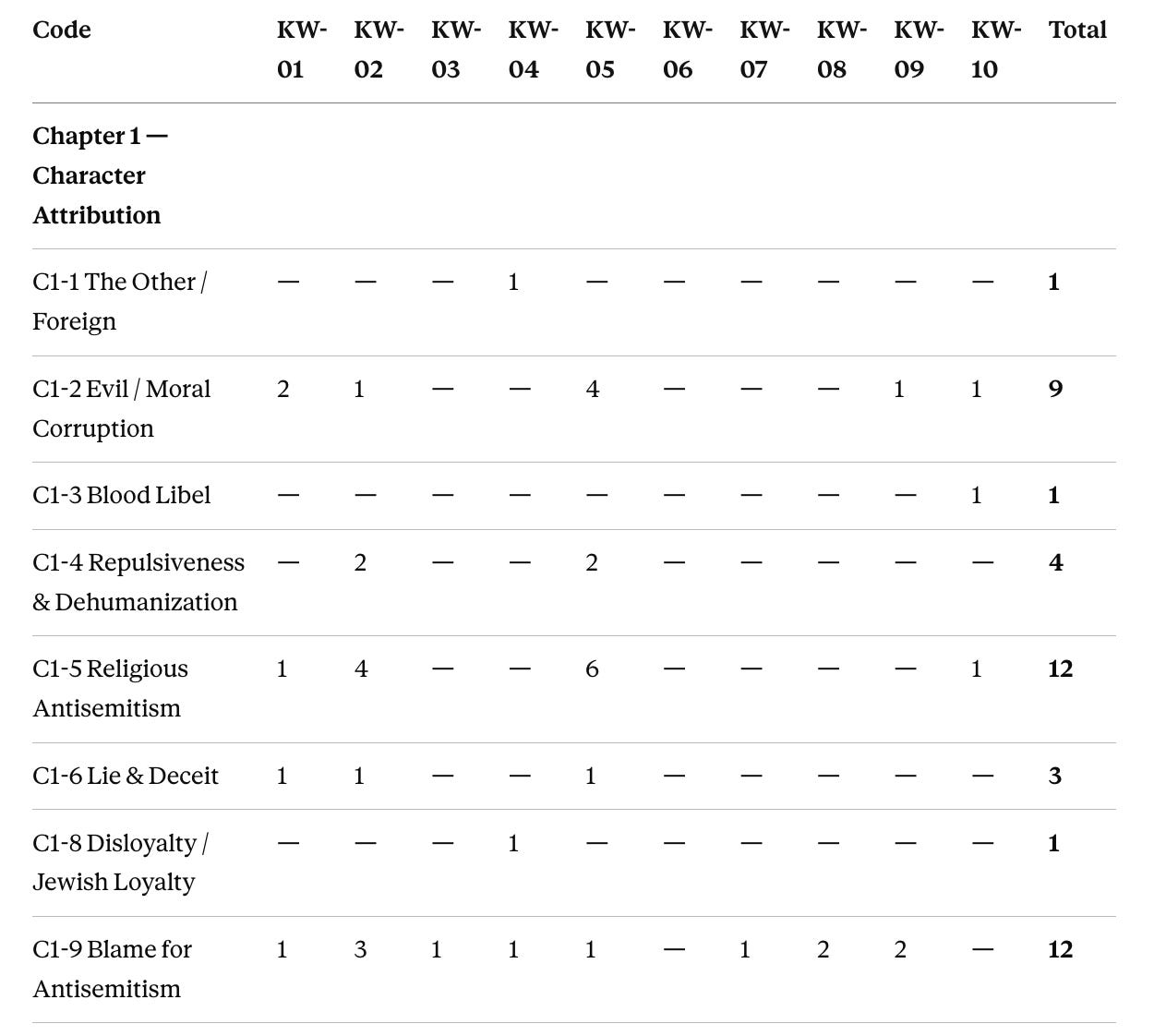
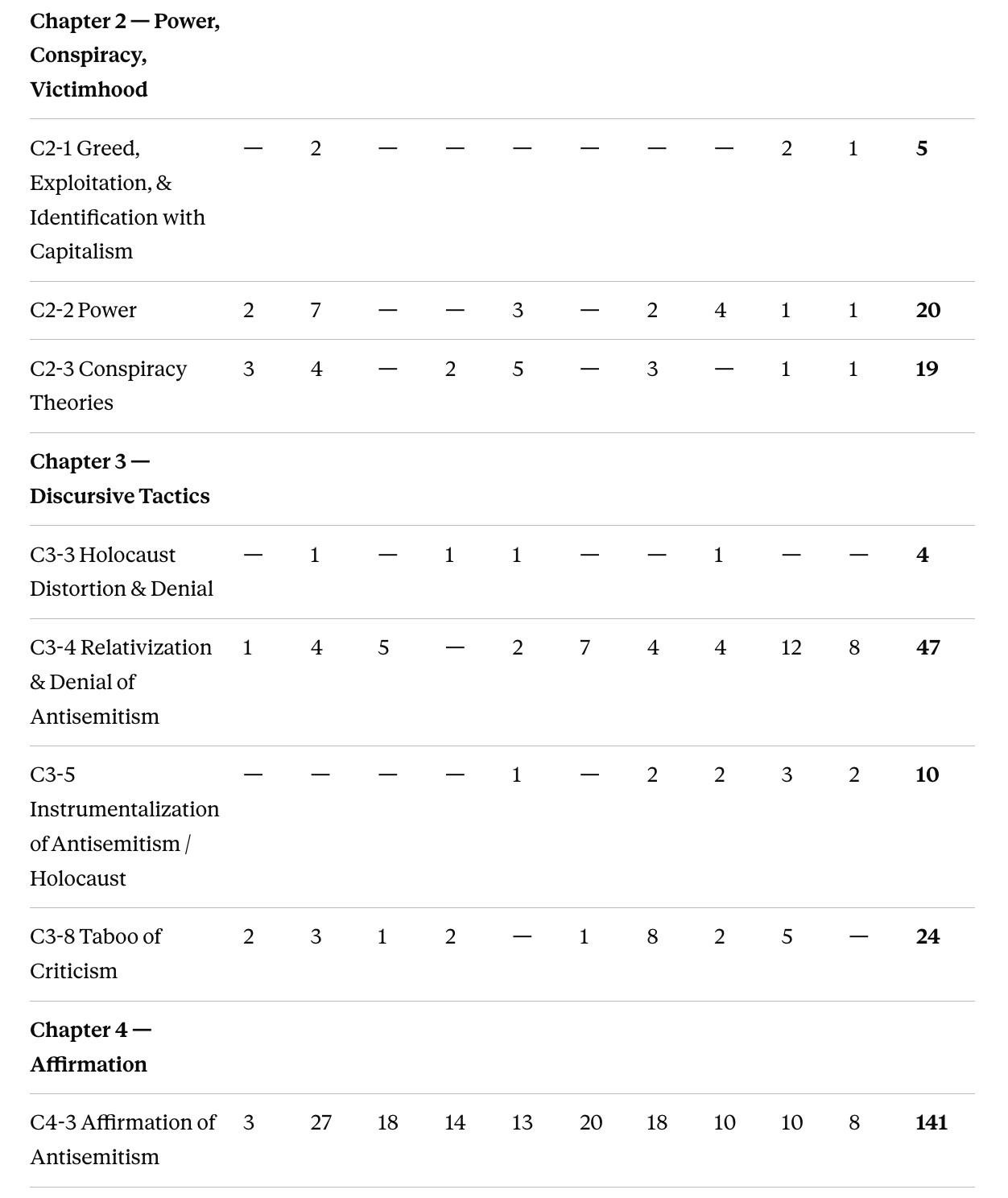
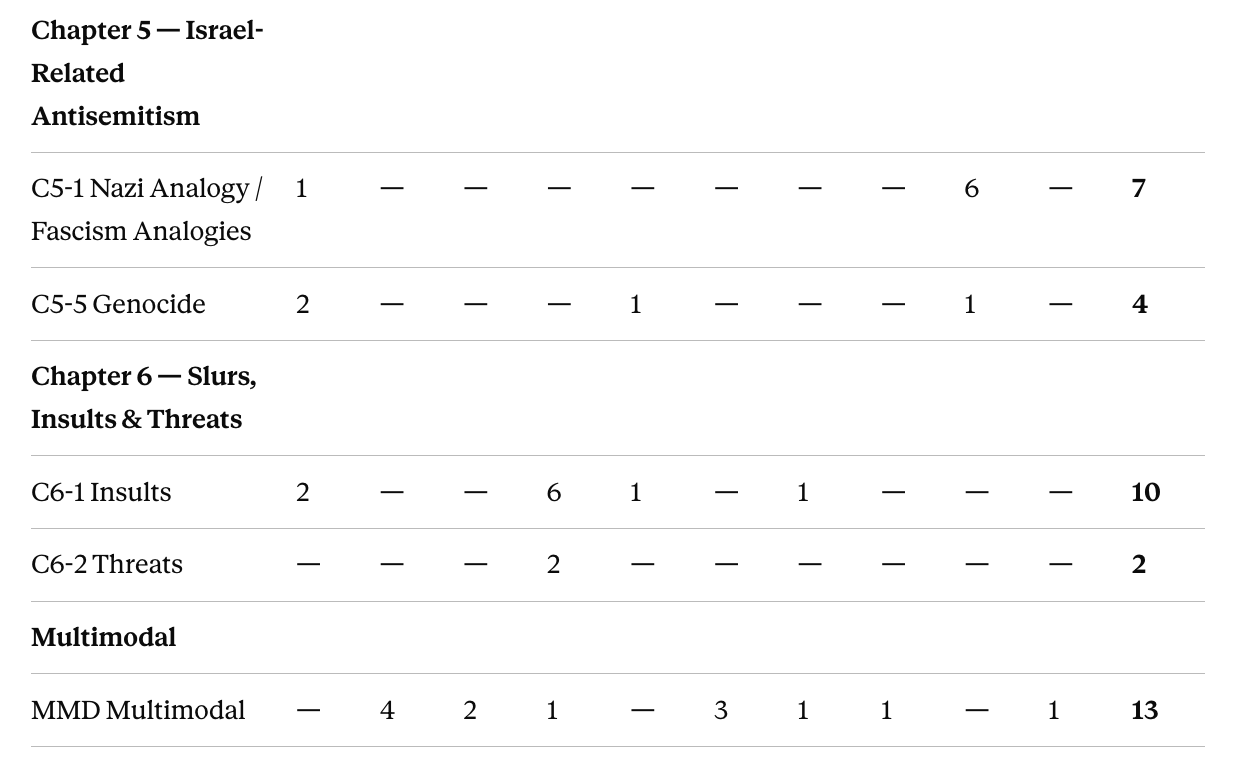
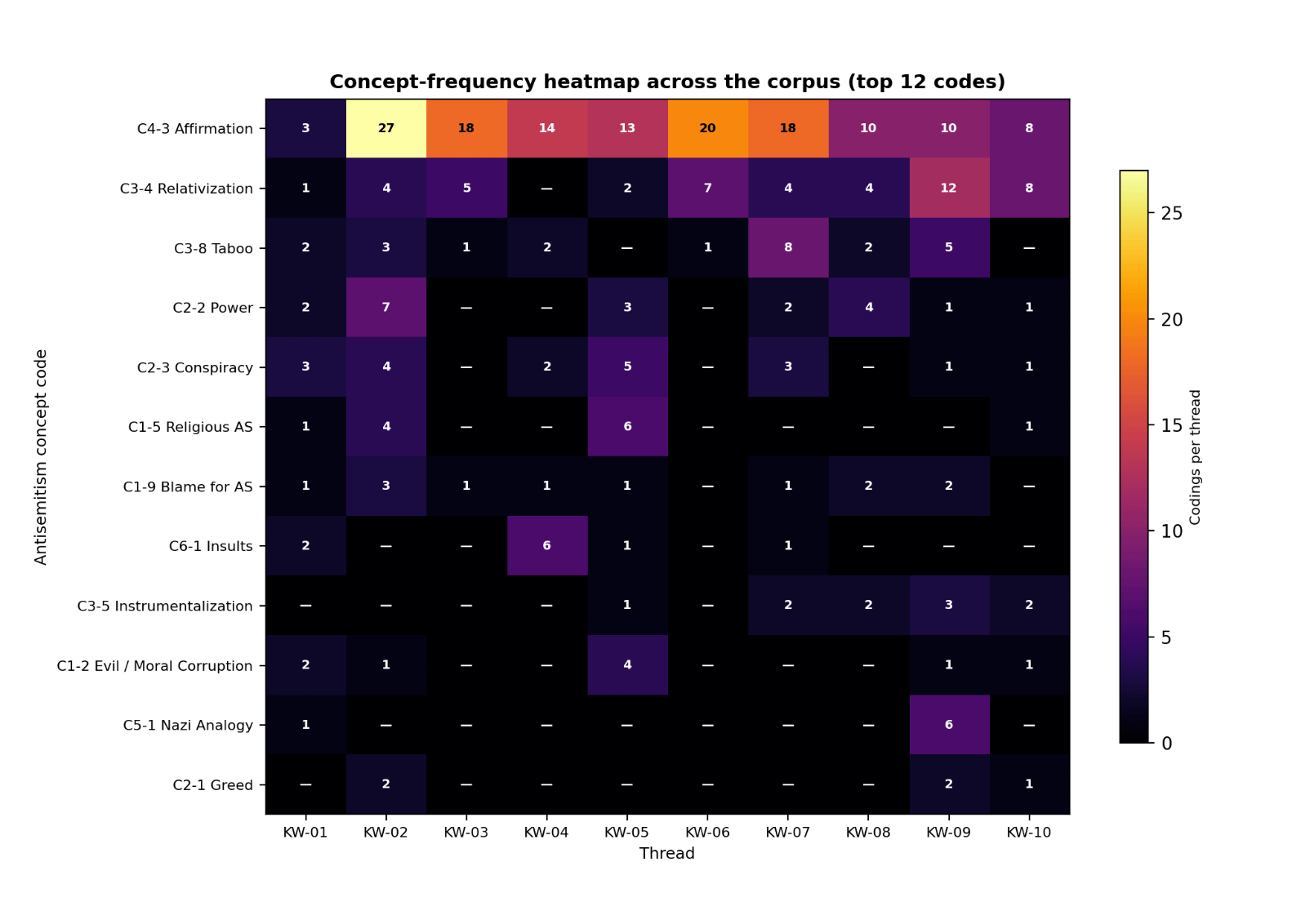
Supplementary Figure. Concept-frequency heatmap (top 12 codes). (To be re-rendered from the matrix in the main text.) The heatmap makes visible the same patterns the matrix records — Affirmation (C4-3) as the corpus’s modal register, densest in KW-02 (27) and KW-06 (20); the Relativization / Taboo / Conspiracy / Power secondary cluster, with Relativization (47) now the clear second register, densest in KW-09 (12); KW-05’s distinctive Religious Antisemitism (C1-5) concentration (6); KW-07’s Taboo (C3-8) peak (8); KW-10’s co-dominant Affirmation/Relativization profile (8/8); and KW-09’s Nazi-Analogy (C5-1) concentration (6) — at a single glance.
All counts reflect the team’s three-annotator post-adjudication consensus, including the puppet-rule audit applied to the KW-01 host-attack cluster (Comment 21 and Comment 54 reclassified from C2-2 to C2-3 per the standing rule that puppet/asset/agent/pawn/stooge metaphors invoke string-puller logic and code as Conspiracy rather than Power). The KW-04 C2-2 count of 0 — paired with a corpus-high C6-1 (Insults) count of 6 and the corpus’s only C6-2 (Threats) codings (2) — reflects the register shift discussed in the main-text footnote on the matrix: KW-04’s host-attack content operates through the slur-and-threat register rather than the puppet-family register that organized KW-01.
References
Becker, Matthias J., 2026a. “The Intervals Are Shrinking: Antisemitic Attacks in the US and their Digital Aftermath — Reactions on YouTube after the Temple Israel Synagogue Attack.” MJB’s Substack, 13 March 2026. https://decodingantisemitism.substack.com/p/the-intervals-are-shrinking-antisemitic
Becker, Matthias J., 2026b. “’Faker Than a Three Dollar Bill’: The White House Correspondents’ Dinner Shooting and the Conspiratorial Afterlife of Political Violence — A YouTube Discourse Analysis.” MJB’s Substack, 26 April 2026. https://decodingantisemitism.substack.com/p/faker-than-a-three-dollar-bill-the
Becker, Matthias J., 2026c. “At the Bottom of the Iceberg: Dan Bilzerian, the Congressional Run, and the Mainstreaming of Antisemitism.” MJB’s Substack, 1 May 2026. https://decodingantisemitism.substack.com/p/at-the-bottom-of-the-iceberg
Becker, Matthias J., Gabrielle Beacken, and Liora Sabra, 2026. “How Political Ambiguity Transforms Across Digital Platforms: Mechanisms of Discourse Radicalization in the Case of Zohran Mamdani.” NYU Ultraviolet, 12 January 2026. https://ultraviolet.library.nyu.edu/records/6m1xt-2nf20
Becker, Matthias J., and Liora Sabra, 2025. “Joe Rogan and the Descent from Reality.” The Times of Israel — The Blogs, 18 April 2025. https://blogs.timesofisrael.com/joe-rogan-and-the-descent-from-reality
Becker, Matthias J., Hagen Troschke, Matthew Bolton, Alexis Chapelan (eds.), 2024. Decoding Antisemitism: A Guide to Identifying Antisemitism Online. Springer Nature. https://link.springer.com/book/9783031492372
Blue Square Alliance Against Hate, 2026. “Kanye West’s History of Antisemitism: From ‘Death Con 3’ to ‘Heil Hitler’.” Command Center Insights, 24 June 2026. https://www.bluesquarealliance.org/command-center-insights/kanye-west-history-of-antisemitism
France, Lisa Respers, 2026. “Does anyone really want to deal with Kanye West?” CNN, 13 April 2026. https://www.cnn.com/2026/04/13/entertainment/kanye-west-ye-return
Gilson, Grace, 2025a. “Joe Rogan defends Kanye West’s ‘Heil Hitler,’ echoes antisemitic stereotypes in song.” The Times of Israel — The Blogs, 17 May 2025.
Gilson, Grace, 2025b. “Russell Brand defends Ye’s ‘Heil Hitler’ music video.” Forward, 13 May 2025.