
The Intervals Are Shrinking: Antisemitic Attacks in the US and their Digital Aftermath
Reactions on YouTube after the Temple Israel Synagogue Attack

AddressHate Research Scholar at NYU’s Center for the Study of Antisemitism | Lead, Decoding Antisemitism | Research Advisor, AddressHate | Editor-in-Chief, Digital Hate Review

Introduction
On March 12, 2026, a man identified in preliminary law enforcement reports as Ayman Mohamad Ghazali drove a truck through the entrance of Temple Israel in West Bloomfield Township, Michigan — one of the largest Reform synagogues in the United States, with approximately 12,000 members — armed with a rifle. What follows is based on official statements and media reports available within the first 24 hours of the attack; some details may be subject to revision as the investigation proceeds. According to those accounts, synagogue security engaged the attacker immediately; he was fatally shot inside the building after driving through a hallway. A security officer was knocked unconscious by the vehicle and hospitalized; dozens of first responders were treated for smoke inhalation after the vehicle caught fire. All students and staff at the synagogue’s early childhood center were reported evacuated safely. The FBI designated the attack a “targeted act of violence against the Jewish community” and took over the investigation within hours.
The attack did not occur in a vacuum. It unfolded against a backdrop of sharply rising antisemitic incidents across the United States — and as part of a broader, accelerating global pattern of violence against Jewish institutions. Temple Israel itself had received active shooter preparedness training from the FBI’s Detroit field office as recently as January 2026, a detail that is not incidental: it reflects the degree to which American Jewish communities have been compelled to treat armed attack as an operational contingency rather than a remote risk. That sense of operational urgency extended to law enforcement. Oakland County Sheriff Michael Bouchard stated at the post-attack press conference that local and national law enforcement had been in active communication for approximately two weeks before the attack, sharing threat intelligence and specifically discussing the potential for exactly this kind of incident. “There was no lack of preparation,” he said. The attack was anticipated — and it happened anyway. The Tree of Life Congregation in Pittsburgh — site of the deadliest antisemitic attack in US history in 2018 — issued a statement of solidarity in the immediate aftermath, noting that the Michigan attack had reawakened feelings of fear across the Jewish community. “We grieve for a lost sense of security,” its CEO wrote; “that we live in a world where Jews have to worship under the protection of armed guards; that preschoolers must be equipped to survive an active shooting situation.”
These words carry more than symbolic significance. They locate the Temple Israel attack within a sequence — Pittsburgh, Washington, D.C., Bondi Beach, now West Bloomfield — in which the intervals between mass antisemitic violence are not growing longer but shorter. This study does not attempt to explain that sequence. It examines one of its constitutive dimensions: the digital afterlife that unfolds in the hours after each event, in the comment sections of major news outlets, where the discursive response to antisemitic violence is formed before official narratives have settled and before grief has been given time to breathe.
This article draws on a dataset of 1,600 comments collected from eight major US news outlets’ YouTube channels within the first 24 hours of the attack. It analyzes how online publics responded to the Temple Israel attack — whether with empathy or antipathy, mourning or mockery, solidarity or conspiracy — and it documents the antisemitic discursive repertoires that emerged in that immediate window. The event is structurally distinct from the discourse events examined in prior work in this research line. The Washington Embassy shooting in May 2025, the Bondi Beach massacre in December 2025, and the YouTube reaction studies conducted under the Antisemitism in Real Time series all examined online responses to episodes in which the discursive positioning of Jewish actors was contested — where antisemitic discourse could hide behind geopolitical framings, inversion structures, or the ambiguities of armed conflict. The Temple Israel attack offers no such cover. A Jewish institution was attacked. The perpetrator is dead. The FBI has designated the event an act of antisemitic violence. The question is not whether the attack was antisemitic, but how the digital public responded to that fact.
That question is not rhetorical. The prior case studies give reason to expect that online comment sections will not simply reflect the dominant social consensus — that antisemitic violence against Jews is unambiguously wrong — but will fracture it, contest it, and in some cases invert it. The Washington Embassy analysis documented a near-total refusal of empathy in certain comment ecosystems, where Jewish grief was mocked as performance and the murder of two diplomats reframed as legitimate political consequence. The Bondi Beach analysis found that even under conditions maximally favorable to empathy — children present, a Holocaust survivor among the dead, an unambiguous terror attack on a Western democracy’s soil — antisemitic discourse achieved significant visibility, comprising between 5% and 17% of analyzed comments depending on platform. The present study tests whether the Temple Israel attack, with its distinctive features — a foiled attack, no Jewish fatalities among congregants, a named and identified perpetrator — produces comparable, diminished, or intensified antisemitic responses.
The perpetrator’s background introduces a further variable. Ghazali was born in Lebanon and became a US citizen in 2016. In the hours following the attack, before motive had been officially established, this detail became a significant flashpoint in comment sections — activating not only antisemitic conspiracy narratives but also Islamophobic framings, immigration discourse, and counter-accusations that shaped the discursive environment in ways that distinguish this case from prior episodes. The interaction between antisemitic and adjacent hate discourses is a central analytical concern of this study: not because Islamophobia and antisemitism are equivalent, but because they circulate in the same comment ecosystems and because understanding how they interact — whether they reinforce, compete with, or displace one another — is necessary for a complete account of what these spaces produce.
The findings are analyzed using the Decoding Antisemitism Lexicon and draw on the methodological framework developed across the Washington, Bondi, and Antisemitism in Real Time studies. They are presented here as a first analytical pass, intended to document the immediate discursive response and to identify the dominant repertoires before the news cycle moves on. A fuller report will follow.
Dataset and Methodology
The dataset comprises 1,600 user comments collected from YouTube videos posted by eight major US news outlets in response to the Temple Israel attack on March 12, 2026. Comments were drawn from the first video published by each outlet’s official YouTube channel covering the event, collected within the first 24 hours following publication. The sample size is 200 comments per outlet.
The outlets, their primary URLs, and their positioning within the mainstream US media landscape are as follows:
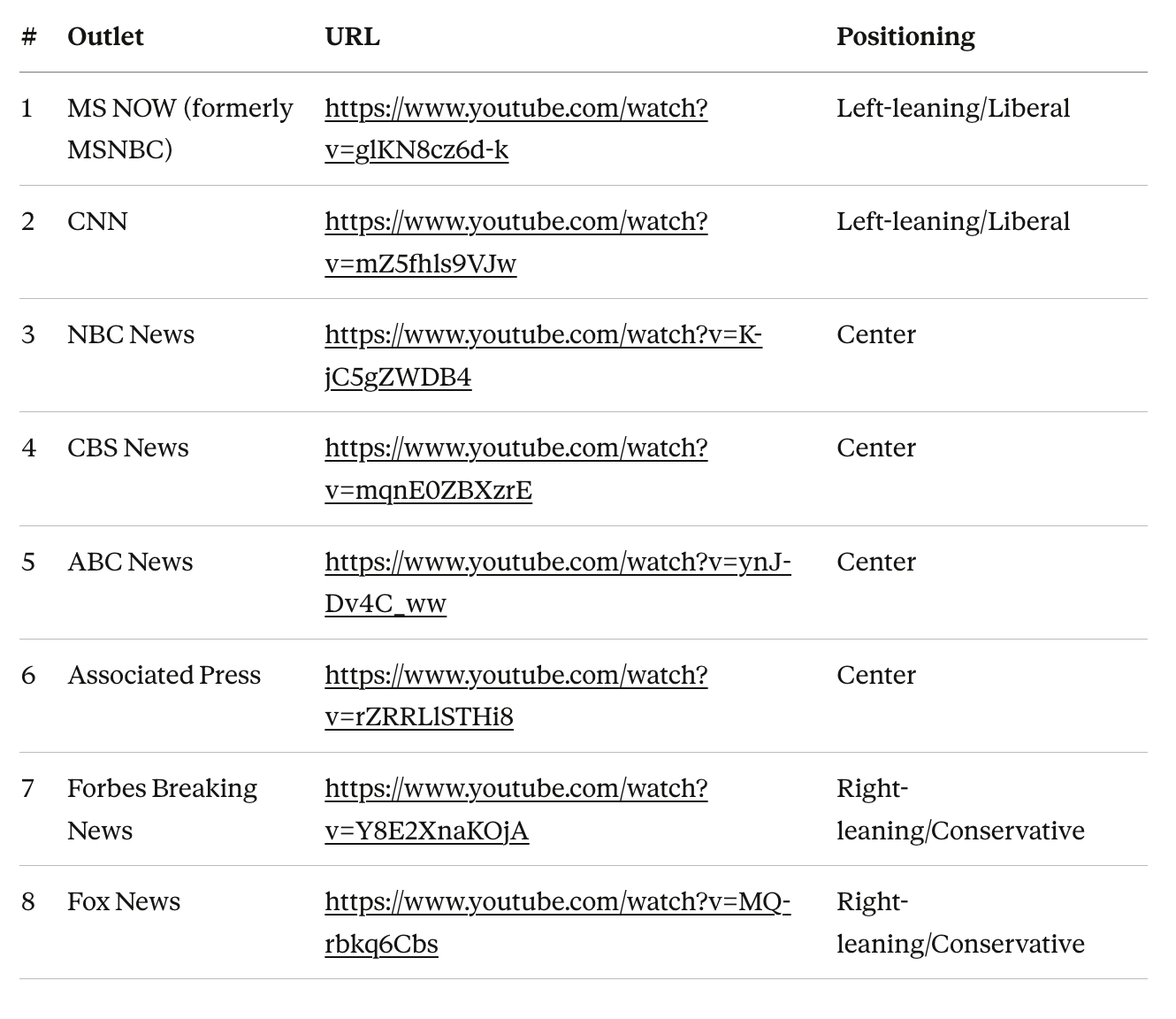
Several outlets published multiple videos covering the attack; for methodological consistency, only the first published video per outlet was analyzed. PBS NewsHour was excluded as comments were disabled; NPR was excluded due to insufficient comment volume; Breaking Points (Krystal Ball & Saagar Enjeti) published no coverage of the event.
Each comment was analyzed qualitatively using linguistic and multimodal close reading, supplemented by sequence and relational analysis where comments form part of reply chains. The analytical framework is guided by the Decoding Antisemitism Lexicon (Becker et al., Springer Nature, 2024), a research-based instrument for identifying explicit and implicit antisemitic discourse in digital environments. The Lexicon accounts for dog whistles, sarcasm, irony, visual and emoji-based signaling, and inversion structures, enabling systematic identification of hostile speech that evades surface-level keyword filtering. Quantitative coding of category frequencies is supplemented by qualitative close reading of representative examples. Intercoder reliability procedures follow the protocol established in prior studies in this research line.
The main analytical categories applied are:
Conspiracy narratives (antisemitic and non-antisemitic)
Power and Subordination narratives
Exploitation tropes
Instrumentalization of Antisemitism
Privilege narratives
Schadenfreude and Sarcasm
Blame, Guilt, and Inversion of Victimhood
Two further formations appear in the corpus but are treated as outlet-level analytical notes rather than standalone categories given their limited distribution: Jewish orchestration of social and demographic division (NBC, AP) and Nazi discourse/Holocaust denial (Forbes only). These are addressed in the outlet-level notes below.
A note on the Schadenfreude category. Prior studies in this research line — particularly Part II of the Antisemitism in Real Time series (Iranian retaliation, June 2025) and the Charlie Kirk assassination analysis (September 2025) — documented explicit Death Wishes and Glorification of Violence as the dominant affective register when Jewish actors or figures were killed or targeted at mass-casualty scale. The Temple Israel attack presents a structurally different outcome: no Jewish congregants were killed, all children were evacuated, and the perpetrator died. This outcome structure conditions a different affective repertoire. What the preliminary data show is not Death Wishes or Glorification of Violence in the register documented in prior studies, but rather Schadenfreude — satisfaction at the event expressed through sarcasm, irony, and mockery — alongside cynical detachment. The category is renamed accordingly for this study.
A note on cross-study comparability. This study applies the same annotation protocol and counting unit as the Washington Embassy, Bondi Beach, and Antisemitism in Real Time analyses. Aggregate antisemitic content rates across studies should nonetheless be interpreted with awareness of event-type conditioning: the discourse event structure — domestic antisemitic attack versus geopolitical military escalation versus mass-casualty terrorist attack — shapes which repertoires are available and plausible for commenters to deploy, and therefore conditions both the volume and the register of antisemitic response. These structural considerations are addressed in the analytical sections below.
Results
The following section summarizes outlet-level patterns before examining the dominant antisemitic formations across the dataset.
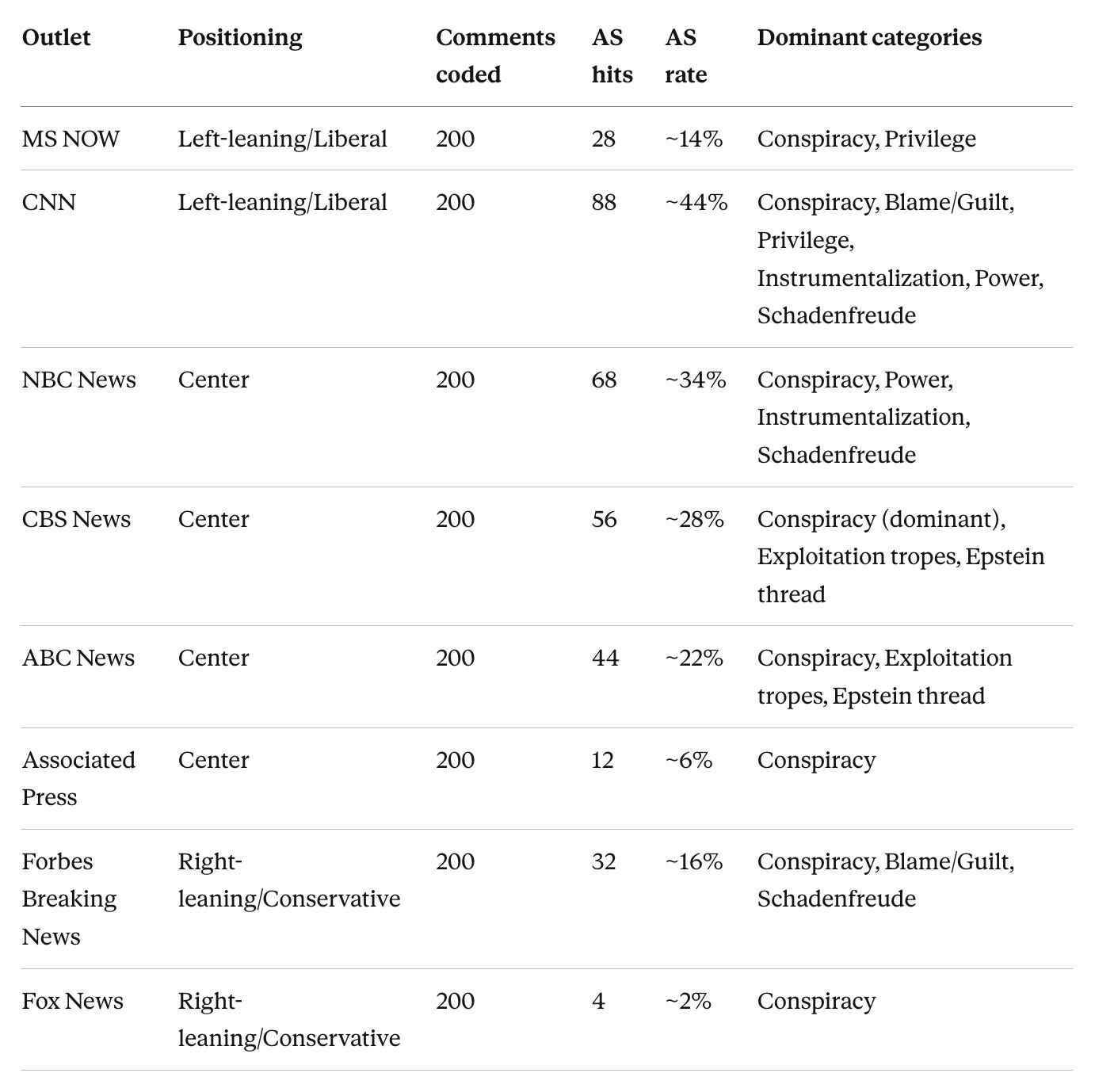
Summary of Comment Patterns by Outlet
MS NOW (28 hits, ~14%): The lowest hit rate among the left-leaning outlets, consistent with patterns documented in the AiRT Part III dataset, where MS NOW / MSNBC consistently produced lower antisemitic content rates than CNN. The dominant categories are Conspiracy narratives and Privilege arguments. The register is less overtly hostile than CNN but follows the same structural logics of false flag, subordination, and goy discourse.
CNN (88 hits, ~44%): The highest antisemitic content rate in the dataset — substantially above the dataset mean and higher than CNN’s rate in Part III (21%). The repertoire is the broadest of any outlet: Conspiracy narratives, Power and Subordination, Instrumentalization of Antisemitism, Privilege arguments, Blame and Guilt, dehumanization, and Schadenfreude all appear within the sample. Several comments display structural complexity that warrants close analytical attention.
NBC News (68 hits, ~34%): The second-highest rate in the dataset. Conspiracy narratives — particularly false flag and Mossad orchestration claims — are the dominant formation, constituting the majority of hits. A secondary cluster involves Power narratives and Instrumentalization of Antisemitism. The overall register is conspiratorial rather than overtly celebratory.
CBS News (56 hits, ~28%): Conspiracy narratives dominate to a degree unmatched elsewhere in the centrist outlets: the large majority of hits fall within this category. The defining feature is the Epstein thread — a formation documented as cross-platform in AiRT Part III that here re-emerges with striking intensity in response to a domestic antisemitic attack, adapted from its Part III distraction function into a framework for interpreting the attack itself as a Jewish operation.
ABC News (44 hits, ~22%): Conspiracy narratives again dominant, with a secondary cluster of Exploitation tropes anchored by a near-verbatim reproduction of the CBS Epstein comment across a separate outlet — confirming the Epstein thread’s cross-platform circulation as a recurring narrative template. The register tends toward sustained conspiratorial argument rather than compressed sarcasm.
Associated Press (12 hits, ~6%): The lowest hit rate among centrist outlets. Hits are concentrated in Conspiracy narratives, with one instance of a Jewish orchestration of social division trope. The low volume may reflect the AP comment ecosystem’s comparatively smaller and less algorithmically amplified comment base.
Forbes Breaking News (32 hits, ~16%): The most ideologically extreme content in the dataset at the individual comment level, including the only instances of explicit Nazi citation and Holocaust denial in the corpus. Conspiracy narratives dominate, with notable instances of Blame and Guilt, Schadenfreude, and Privilege arguments.
Fox News (4 hits, ~2%): The lowest antisemitic content rate in the dataset by a significant margin — a finding that is structurally counterintuitive given Fox News’ 20% rate in AiRT Part III. The most likely explanation is event-type conditioning: for a right-leaning audience, the Temple Israel attack activates a discursive repertoire centered on immigration, Islamist terrorism, and law enforcement rather than the Jewish-control-of-US-policy frame that dominated in the co-belligerence context of Part III. The false flag frame — sole antisemitic formation in the Fox sample — persists nonetheless.
Breaking Down the Predominant Concepts of Antisemitism in YouTube Responses
1. Conspiracy Narratives
Conspiracy narratives are by far the dominant antisemitic formation across the dataset, appearing at every outlet and constituting the majority of hits at six of the eight. The dominant sub-type is the false flag claim: the Temple Israel attack was not an antisemitic act of violence but a staged event, orchestrated by Israeli intelligence (Mossad), designed to manufacture Jewish victimhood and generate political sympathy for Israel. False flag claims range from compressed, unelaborated assertions to fully theorized conspiratorial architectures.
The most minimal instances perform the conspiracy claim as self-evident, requiring no argument:
“False flag” (NBC)
“Fake” (NBC)
“B TO THE S 🙄” (NBC)
“Mossad false flag operation” (NBC and CNN)
“FALSE FLAGS MANIPULATION DONT WORK ANYMORE .... STOP WITH THE BULLSHT” (NBC)
“Another psyop by Israel.” (NBC)
“This was obviously a false flag operation conducted by Israel you moron!” (ABC)
“Not really. Prob. self inflicted to cause some shit.” (Forbes)
The aggression in the ABC comment — “you moron!” — is notable: it performs the conspiratorial claim as self-evident truth that only the deliberately ignorant could contest, rendering skepticism itself a form of complicity.
A second cluster deploys ironic coding and wordplay to assert the conspiracy while maintaining deniability:
“I bet he left his Iranian passport in the car 😂😂😂😂😂😂 Mossad that you?” (CNN)
“Oy vey, what a cohencidence” (Forbes)
“Probably a new Gun Cohentrol Hoax” (Forbes)
“A: Same old trick / B: My thinking exactly! False Flag incoming!” (Forbes)
“The first of more to come… Begins with M and ends in AD… begins with F and ends in AG 🧿” (CBS)
“Smell like Israeli Mossad, well well well” (AP)
“Sloppy sympathy stunt by Mossad” (Fox)
The Iranian passport comment references a recurrent trope — Mossad operations staged with conveniently placed identifying documents pointing to an Arab or Iranian perpetrator — combined with a laughing emoji cluster that performs gleeful irony. “Cohencidence” — a portmanteau of “Cohen” (a common Jewish surname) and “coincidence” — signals that the event is a Jewish-orchestrated non-coincidence; the wordplay allows the claim to circulate with plausible deniability while remaining legible to audiences familiar with the code. The same substitution appears in “Gun Cohentrol Hoax” — Cohen + control, again substituting a Jewish surname to imply Jewish agency, this time behind gun control advocacy — compressing three conspiracy claims into four words: the attack is staged, Jews orchestrate gun control, and both are part of the same operation. The CBS comment spells out “Mossad” and “False Flag” through initial and terminal letter cues, with the blue eye (nazar) emoji deployed with ironic inversion. “Sloppy” at Fox implies the alleged Mossad operation was poorly executed — a variant of the “running out of public sympathy” formulation documented at CNN, positioning the conspiracy as a failing or amateurish operation.
A third cluster elaborates full conspiratorial architectures — theorizing the mechanism and motive behind the alleged staging:
“Mossad false flag opration. They are running out of public sympathy they always do these type of stunt... Investigate synagogue.....!!!” (CNN)
“Exactly. False flag attack trying to create sympathy for Israel.” (CNN)
“Oh please nobody is buying this shit Israel” (CNN)
“CIA/Mossad. They are manufacturing consent. Or attempting to.” (NBC)
“They have done this before you know... Mossad are notorious for pulling sh*t like this to increase support for Israel.” (CBS)
“False Flag. Satanyahu and Trump are desperate.” (MS NOW)
“Mossad taking out their own… I hate those people” (Forbes)
“Zionists shooting up Jewish temples” (Forbes)
The CNN comment’s claim that Israel is “running out of public sympathy” positions antisemitic violence as a renewable resource deliberately manufactured to replenish goodwill. “They have done this before” at CBS performs normalization — Mossad’s alleged conduct is framed as established historical record rather than speculation; “notorious” presents the extraordinary claim as common knowledge. “Satanyahu” — a portmanteau of Satan and Netanyahu — is among the most widespread demonizing compounds in digital antisemitic discourse, condensing theological vilification and political delegitimization into a single word; its deployment within a false flag claim performs a double function, casting the conspiracy as orchestrated by a literally satanic figure. “I hate those people” at Forbes is a rare instance where the conspiracy claim is accompanied by explicit ethnic hatred rather than the ironic detachment typical of many other comments.
The most theoretically elaborated false flag claims construct full causal chains:
“u believe in the greater Israel project?? Creating antisemitism to get 🧃 to move to Israel n bring the messianic age? All done by mossad” (NBC)
“just look at the motivation of Israel, what are they trying to accomplish, the greater Israel project, in order for them to accomplish that they need antisemitism to be on the rise. We are not paranoid. You are just blind. That is the only logical explanation.” (ABC)
“@JohnKoenig-s6d need to learn how Zionism is shaping what we’re seeing today. They’ve been doing it for over a century now and you’re too compliant to see it.” (ABC)
The NBC comment condenses several formations — false flag, Mossad orchestration, Jewish demographic manipulation, eschatological conspiracy — into a single post. The juice emoji (🧃) functions as a derogatory coded substitution for “Jews,” a phonetic dog whistle common in moderated comment sections. The ABC comment constructs a causal chain (Greater Israel project → need for rising antisemitism → manufactured attacks) and presents it not as speculation but as “the only logical explanation” — performing epistemic closure, positioning the conspiratorial framework as the rational default and skepticism as complicity. The third ABC comment adds a temporal dimension — “over a century now” — situating alleged Zionist orchestration within a longstanding historical pattern of Jewish long-range planning.
The Epstein Thread
A distinct sub-pattern within Conspiracy narratives — and the most significant cross-platform formation in the dataset — is the Epstein thread: the claim that Israeli intelligence orchestrated or was complicit in Jeffrey Epstein’s sexual exploitation network, and that the Temple Israel attack is either a false flag to distract from the Epstein files or direct evidence of Israeli operational methods. The thread was documented as a near-ubiquitous cross-platform motif in AiRT Part III, where it functioned primarily as a distraction narrative in the context of Operation Epic Fury. Its appearance here — in response to a domestic antisemitic attack on a Jewish institution — represents a structural adaptation: the Epstein conspiracy is no longer a distraction from geopolitical violence but a framework for interpreting antisemitic violence itself as Jewish-orchestrated. The most elaborated instance is constructed as a prosecutorial brief:
“Denial in the face of evidence is a characteristic of complicity: ‘Make sure to tell them that I am not Mossad :)’ - Jeffrey Epstein in a personal email. ‘Epstein is a Mossad asset’ - FBI investigation released in the Epstein files. Ehud Barak and Mossad agents stayed for weeks at a time in Epstein’s apartment, according to evidence released by the files. Robert Maxwell, an Israeli superspy, is father to Ghislaine Maxwell. He is buried on the Mount of Olives, and his funeral was attended by six Mossad agents and he was eulogized by the Israeli Prime Minister and the Israeli President. ‘Let the g0Y1m live in the real world’ - Jeffrey Epstein in a personal email. Jeffrey Epstein is featured in photos wearing an IDF sweater. Financial accounts document Jeffrey Epstein’s many contributions to Friends of the IDF.” (CBS)
This comment assembles attributed quotations, biographical facts, and documentary claims into an evidentiary chain, performing rigorous sourcing while constructing a totalized narrative in which Israeli intelligence, Jewish elite power, and sexual exploitation of children are inseparable. The Epstein email quote — “Make sure to tell them that I am not Mossad :)” — is presented as evidence of Mossad affiliation, when it could equally be read as a joke or deflection. The phrase “Let the g0Y1m live in the real world” — using character-substitution filter-evasion — activates the master/servant hierarchy of the goy trope. The overall structure exemplifies documentary antisemitism: the assembly of real, distorted, and fabricated elements into an apparently rigorous evidentiary presentation that makes the conspiracy appear empirically grounded.
The thread recurs at ABC in near-verbatim form:
“Friendly reminder that the Israeli government provided security for Jeffrey Epstein’s multi-million dollar apartment in New York City. Evidence published by Drop Site News.” (ABC)
“Friendly reminder that the Israeli government provided security for Jeffrey Epstein’s multi-million dollar apartment in New York City. This included cameras, access and monitoring of the rooms where girls were held. Evidence published by Drop Site News.” (CBS)
The near-identical phrasing across two separate outlet comment sections confirms the Epstein thread’s character as a recurring cross-platform narrative template — the same text, or near-identical text, circulating across multiple comment ecosystems.
The thread is extended at ABC through a chain of alleged Israeli false flag operations:
“Bingo. You’re exactly right bro. Remember Israel attacked their own embassy in the UK too. Israel/Zionism is the greatest enemy humanity has ever known. End the Jou Coup!” (ABC)
“Lavon affair, Hotel David Bombing, USS Liberty, WTC, we know your fruits” (ABC)
The second comment lists the Lavon Affair (1954), the King David Hotel bombing (1946) — rendered by the commenter as 'Hotel David Bombing,' inverting the name in a pattern consistent with the broader encoding strategies documented in this corpus — the USS Liberty incident (1967), and the September 11 attacks as evidence of a consistent Israeli pattern of false flag violence. “We know your fruits” — a biblical phrase (Matthew 7:16-20, “by their fruits ye shall know them”) — applies scriptural authority to the conspiratorial claim. The list-making strategy performs encyclopedic authority while condensing disparate historical events — some involving genuine Israeli actions, some contested, one a widely debunked conspiracy theory — into a single unified narrative of Jewish orchestration.
2. Power and Subordination Narratives
The Power and Subordination frame — the claim that Jewish actors exercise commanding authority over American political life, and that the US state is structurally subordinate to Jewish or Israeli interests — is the second most prevalent formation in the dataset and the one that most directly connects this study to the trajectory documented in AiRT Part III. Where Part III found the subordination frame dominant across all eight outlets in the context of US co-belligerence, its appearance here — in response to a domestic antisemitic attack, not a US–Israeli military operation — confirms that the frame has become sufficiently entrenched to operate independently of the geopolitical scaffold that gave it apparent factual grounding in 2026.
The most compressed Power formulations perform the subordination claim at the level of national identity:
“Owner of the USA – Israel.” (CNN)
“sure just what we need another president that bows down to Israel for everything” (NBC)
“shut up you goy and serve your masters” (CNN)
“Owner of the USA – Israel” performs the subordination frame in its most minimal form: not asserting that a specific president defers to Israeli interests, but that the United States itself is Israeli property. Like “United States of Israel” from the Part III Forbes dataset, it collapses the distinction between the two states entirely. “Bows down” retains a servility dimension without the explicit sexual humiliation register documented in Part III; its appearance in response to a synagogue attack is analytically notable — even when a Jewish institution has just been attacked, the Power narrative reasserts itself, redirecting attention from Jewish victimhood to alleged Jewish control.
A multi-turn exchange at CNN illustrates how the Power narrative is constructed dialogically:
A: “That’s the most police I’ve ever seen at a crime scene”
B: “Special treatments for chosen people. Don’t be jealous now.”
C: “Someone mentioned Israel and they all came running”
D: “They rule the world...” (CNN)
The exchange moves in four steps from an apparently neutral empirical observation to conspiratorial conclusion. The “chosen people” reference activates the theological dimension of the Power trope — Jewish claims to divine election recast as a mechanism of political privilege. The ellipsis following “They rule the world” performs world-weary resignation, as though the conclusion requires no elaboration.
The “Puppetmaster” formation from NBC encodes the subordination logic through a concealment metaphor:
“You honestly thought a live stream genocide and Netanyahu as Puppetmaster […] pulling the strings of the American war machine wouldn’t have consequences” (NBC)
This comment simultaneously functions as political causation argument and antisemitic claim — implying that the Temple Israel attack was a foreseeable consequence of Jewish orchestration, thereby attributing a degree of responsibility to the Jewish community itself.
3. Exploitation Tropes
Exploitation tropes position Jews or Jewish institutions as extracting resources — material, emotional, or political — from non-Jewish populations for instrumental benefit. In this dataset the category operates primarily through the ‘Mass Sympathy Collection Card’ at CNN, alongside the Epstein thread addressed above under Conspiracy narratives, where its exploitation dimension — the framing of Israeli intelligence as extracting sexual and political capital from non-Jewish victims — is analyzed in full.
“Here are 20 sharp, precise terms for the Mass Sympathy Collection Card: Victimhood Harvesting / Sympathy Mining / Grief Extraction / Manufactured Martyrdom / Outrage Farming / The Pity Racket / Suffering on Subscription / The Grievance Dividend / Tears as Currency / The Martyr Franchise / Bleeding for Profit / The Wound Economy / Sympathy Laundering / The Victimhood Cartel / Emotional Counterfeiting / Instrumental Victimhood / Performative Persecution / Grievance Arbitrage / Synthetic Suffering / The Persecution Dividend” (CNN)
This comment generates a taxonomy of twenty terms for alleged Jewish victimhood manufacturing, each combining economic or commercial language (harvesting, mining, extraction, laundering, arbitrage, dividend) with the vocabulary of suffering and persecution. The economic register activates the classical financial trope — the association of Jews with extraction and instrumental manipulation — applied specifically to the domain of suffering: Jewish grief is recast as a commodity to be produced, circulated, and monetized. The list format performs pseudo-analytical authority, mimicking intellectual categorization while deploying it in the service of dehumanization. It also illustrates a distinctive feature of digital antisemitism’s platform adaptation: elaborate, apparently neutral taxonomic language that evades keyword-based moderation filters.
“see cruisers parked outside Jewish houses in fl. Money and whining works” (CNN)
“Money and whining” condenses two classical formations — Jewish financial power and Jewish complaint as manipulation — into a single causal claim: Jews secure preferential police protection through a combination of wealth and performative grievance.
4. Instrumentalization of Antisemitism
The Instrumentalization of Antisemitism category covers comments that frame antisemitism not as a real social phenomenon but as a rhetorical instrument — a concept deployed strategically by Jewish actors to generate sympathy, deflect criticism, or advance political agendas. Its appearance in response to an antisemitic attack on a synagogue is structurally significant: the attack itself is reframed as evidence of Jewish instrumentalization rather than Jewish victimhood.
“Fake to push anti semitism narrative.” (NBC)
“Look how much coverage the fake news gives to anything against the tiny hats compared to others.....” (NBC)
“Oy Vey! Let’s have a national year of remembrance.” (NBC)
The first explicitly frames the attack as fabricated to advance an “antisemitism narrative” — positioning antisemitism as a rhetorical instrument rather than a real social phenomenon. The second introduces a media privilege argument via “tiny hats” — a derogatory coded reference to Jews through the kippah metonym — framing disproportionate media coverage of antisemitic violence as evidence of Jewish media control. “Oy Vey! Let’s have a national year of remembrance” deploys mock Jewish speech to ridicule the perceived disproportionality of Jewish responses to antisemitic violence: “Oy Vey” — typically an expression of grief — becomes a punchline, and the call for formal national commemoration performs the Instrumentalization frame in Schadenfreude register.
5. Privilege Narratives
Privilege narratives frame the institutional response to the Temple Israel attack — police presence, media coverage, political statements — as evidence of disproportionate Jewish power over state resources, at the expense of ordinary (non-Jewish) Americans. The category is concentrated at CNN and MS NOW, with instances at Forbes.
“Is every Patrol police car in the state at the synagogue 🕍” (CNN)
“Goyims need the same level of security.” (CNN)
“How well they patrol our streets, they cater to those greedy roaches but when an elderly woman needs help, it takes half to one hour to rescue her.” (CNN)
“@gaiazala3386 wel,.. whut wee no fur faKd iz that they wanuh giv that imij that mor reezoRsiz wouBbee alokeydİd to kuhvur thu joooW an synuhgagz, than redily iveyluhbuhl fur difrint uhmerikuhn[baring tUmp an& hiz sdeyt krOwneez, yes-(wOoo)men🦝🤏🐽” (CNN)
“Mmmmmmmhhhhh. Look at the thumb counts. They think we’re stupid. Only we goy do the dying” (MS NOW)
“Good g/0:ym” (MS NOW)
“wish police would come out like this for Americans.” (Forbes)
The CNN comments construct a privilege argument through the lens of policing resource allocation: the mass police response to the synagogue attack is presented as evidence that Jewish safety receives preferential state protection while ordinary Americans are left unprotected. The third comment escalates from the privilege argument to explicit dehumanization — “greedy roaches” — embedding the parasite/vermin metaphor, one of the most historically charged tropes in antisemitic discourse, within an apparently civic argument about fairness. The fourth comment encodes its message in phonetic misspelling so severe that content moderation cannot process it, while remaining readable with minimal decoding effort: “what we know for fact is that they want to give the image that more resources would be allocated to cover the Jews and synagogues than readily available for different Americans.” The derogatory emojis — raccoon (🦝, a common coded slur for Black Americans), pinching hand (🤏), pig snout (🐽, a longstanding antisemitic dehumanizer) — layer racialized contempt onto the privilege argument. The phonetic encoding is not merely technical evasion but a performance of community membership, signaling familiarity with a register of digital hate speech that operates below the threshold of automated detection.
The MS NOW comments frame the privilege argument through the goy discourse register. “Only we goy do the dying” inverts the victimhood of the Temple Israel attack entirely: in this framing, it is non-Jews who are the true victims, bearing the costs of violence while Jewish interests are protected. “Good g/0:ym” is an ironic inverted salute — praising the “good goy” as a term of contempt for non-Jews who serve Jewish interests. The deliberate misspelling “g/0:ym” uses character substitution to evade content filters while simultaneously signaling community membership in spaces where such coded formulations circulate.
6. Schadenfreude and Sarcasm
As noted in the Methodology section, prior studies in this research line documented Death Wishes and Glorification of Violence as the dominant affective register when Jewish actors were killed or targeted at mass-casualty scale. The Temple Israel attack — foiled, no Jewish congregant fatalities, perpetrator dead — conditions a different repertoire. What the data show is Schadenfreude: satisfaction at the event expressed through sarcasm, irony, and darkly comic wordplay, rather than explicit celebration of death.
“Remember a couple of elbows to the temple and they won’t remember their names 😮😅😊” (CNN)
“Oy Vey! Let’s have a national year of remembrance.” (NBC)
“Oy vey, what a cohencidence” (Forbes)
The CNN comment deploys a violent pun — “elbows to the temple” simultaneously referencing the anatomical temple and Temple Israel — to express satisfaction through wordplay. The emoji sequence (shocked face, laughing-crying face, smiling face) performs escalating amusement. The construction illustrates how Schadenfreude in digital antisemitism operates through humor as affective cover: violence is rendered entertaining and signaled through the emoji register. The NBC comment performs Schadenfreude through mock commemoration (this comment also appears under Instrumentalization of Antisemitism above, where its primary function as a vehicle for ridiculing Jewish grievance is analyzed; it is cited here for its affective register). The Forbes comment performs it through the “cohencidence” wordplay — the attack is not mourned but savored as a knowing joke about Jewish orchestration. (”Cohen,” a common Jewish surname, substitutes for “coin-” to signal Jewish agency while maintaining ironic deniability; see also “Gun Cohentrol Hoax” under Conspiracy narratives above.)
7. Blame, Guilt, and Inversion of Victimhood
The Blame and Guilt category covers comments that attribute collective responsibility for the Temple Israel attack to the Jewish community itself — framing the attack as a foreseeable or deserved consequence of Jewish or Israeli conduct. The category is concentrated at CNN, with instances at MS NOW and Forbes.
“Wow! They almost got a taste of having their own children murdered!” (CNN)
“Isreal is begging to be targeted with their actions. I feel bad for the children, but as a whole I say fk Isreal.” (CNN)
“and wb those poor poor Jews? Did they do anything to deserve being disliked or we all just… dun dun dun… antisemitic” (CNN)
“Of course i don’t support this. 99+% don’t. However. It’s to be expected after murdering a school full of girls...” (CNN)
“You honestly thought a live stream genocide and Netanyahu as Puppetmaster […] pulling the strings of the American war machine wouldn’t have consequences” (NBC)
“No one is more antisemitic than the Jews” (MS NOW)
“A: I wonder why people would hate them / B: Must be a cohencindence” (Forbes)
The first CNN comment frames the near-miss outcome as a missed opportunity for collective punishment: Jewish children’s safety is treated as a deprivation of deserved consequences. The second makes the collective guilt logic explicit — Israel’s actions make Jews “beg to be targeted” — while the partial concession (”I feel bad for the children”) intensifies rather than mitigates the hostility, carving out children as the sole exception to an endorsement of antisemitic violence. The third performs the blame/guilt trope through sarcastic inversion: antisemitism is reframed as rational response to Jewish behavior, with “dun dun dun” rendering the category itself absurd. The fourth wraps the blame attribution in a hedge — “Of course I don’t support this” — before delivering the causal claim: the attack was “to be expected” given Israeli military conduct. The NBC “Puppetmaster” comment, addressed under Power narratives, also functions here: by casting the attack as a consequence of Jewish orchestration of US foreign policy, it attributes a degree of responsibility for the attack to Jewish actors themselves.
“No one is more antisemitic than the Jews” performs blame through self-referential inversion: antisemitism is recast not as a prejudice directed at Jews from outside but as a pathology internal to Jewish identity itself, simultaneously denying its existence as an external social phenomenon and attributing collective moral failure to Jews as a group. The Forbes exchange — “I wonder why people would hate them / Must be a cohencindence” — naturalizes antisemitism as a predictable response to Jewish conduct, framing hatred as an effect rather than a prejudice (on the 'Cohen' substitution pattern, see Conspiracy Narratives above).
Outlet-Level Notes
Jewish Orchestration of Social and Demographic Division (NBC, AP)
A formation documented across two ideologically distinct outlets involves the claim that Jewish actors deliberately engineer social fragmentation and demographic disruption among non-Jewish populations:
“It’s just so funny to me how the jews here want open borders, but for some strange reason the same jews don’t want that for israel. It’s almost as if unchecked immigration is a weapon being used against us” (NBC)
“We’re being divided by Israel” (AP)
The NBC comment specifies the mechanism — open borders policy as a weapon of demographic destabilization — while the AP comment is more compressed, a bare assertion of Israeli agency over American social cohesion. Together, across outlets separated by political positioning, they confirm the presence of this trope in the dataset.
Nazi Discourse and Holocaust Denial (Forbes)
Two comments in the Forbes sample represent the most historically extreme content in the corpus:
“The Jews are our misfortune” (Forbes)
“Was it 6 million?” (Forbes)
“The Jews are our misfortune” — “Die Juden sind unser Unglück” — was coined by the German historian Heinrich von Treitschke in 1879, adopted as a Nazi movement slogan, and appeared as the closing line of every issue of Der Stürmer. Its appearance here without modification or irony represents direct citation of Nazi ideological language, offered as self-sufficient statement requiring no elaboration. “Was it 6 million?” performs Holocaust denial through interrogative insinuation — introducing doubt about the most documented genocide in modern history as a response to an antisemitic attack on a synagogue. Its appearance in this context is structurally characteristic of how antisemitic discourse uses events of Jewish victimhood as occasions for amplifying rather than contesting antisemitic formations.
Cross-Study Comparison: Washington, Bondi Beach, Temple Israel
This study is the third in a sequence of analyses examining antisemitic digital discourse following mass antisemitic violence. The Washington Embassy shooting (May 2025) and the Bondi Beach massacre (December 2025) provide the closest structural comparators: both involved lethal antisemitic attacks, both generated substantial YouTube comment corpora analyzed under the same methodological framework, and both documented the antisemitic discursive repertoires that emerged in the immediate aftermath. Placing Temple Israel alongside these two cases reveals both persistent cross-case patterns and event-specific divergences that illuminate how online antisemitism adapts to different attack structures.
Antisemitic content rates
The most immediately striking finding is the Temple Israel rate. The Washington analysis documented rates ranging from 24% (LiveNow from Fox) to 66% (Al Jazeera English) depending on outlet — a range reflecting both ideological positioning and the specific character of those comment ecosystems. The Bondi Beach analysis, drawing on five major American outlets, found rates between 5% (NBC) and 17% (CNN), with a mean substantially lower than Washington, attributed to event-type conditioning: the visual framing of families and children, the unambiguous Western-democratic setting, and the absence of geopolitical cover made the standard antisemitic inversions harder to deploy. The Temple Israel dataset, drawn from eight US outlets, produces a mean of approximately 17% — higher than Bondi’s mean but below Washington’s. The CNN figure of 44% is among the most striking outlet-level findings across the three studies, substantially exceeding CNN’s Bondi rate (17%) and suggesting that the domestic synagogue attack context does not suppress antisemitic discourse in left-leaning comment ecosystems in the way that victim framing at Bondi partially did.
Fox News presents the inverse anomaly: 2% at Temple Israel against 10% at Bondi and 24% at Washington (LiveNow from Fox, a comparable right-leaning outlet). The event-type conditioning explanation proposed for Fox in the outlet summary above — the Temple Israel attack activating an immigration/Islamist terrorism discursive repertoire that displaces rather than amplifies antisemitic conspiracy discourse — is consistent with the cross-study pattern: Fox’s antisemitic content rates are structurally responsive to whether the geopolitical context supplies a Jewish-control-of-US-policy scaffold, as it did in Washington (and in the AiRT Part III Operation Epic Fury dataset at 20%), and does not at Temple Israel.
Dominant categories
Conspiracy narratives — and specifically false flag and Mossad orchestration claims — are the single most consistent formation across all three studies. At Washington, they appeared under the heading of “Conspiracy Myths” and included explicit Mossad playbook and CIA false flag attributions. At Bondi, they included Mossad false flag claims and broader Jewish global control narratives. At Temple Israel, they constitute the dominant category across all eight outlets, with the false flag sub-type the most prevalent individual formation in the corpus. The persistence of the false flag response across all three studies is analytically significant: regardless of the actual character of the attack — whether it is ambiguous (Washington), unambiguous terrorism in a Western democratic setting (Bondi), or a foiled domestic attack designated antisemitic by the FBI (Temple Israel) — a significant proportion of commenters immediately recast Jewish victimhood as Jewish orchestration.
The Epstein thread, documented as cross-platform in AiRT Part III (Operation Epic Fury), emerges at Temple Israel as a domestic-violence adaptation — no longer a distraction from geopolitical military operations but a framework for interpreting an antisemitic attack on a synagogue as itself a Mossad operation. Its cross-outlet appearance at both CBS and ABC in near-verbatim form confirms the Epstein thread’s cross-platform circulation as a recurring narrative template.
Shifts and divergences
The most analytically significant divergence across the three studies concerns the Blame, Guilt, and Inversion of Victimhood category. At Washington and Bondi, inversion of victimhood was among the most prominent categories — commenters framed the murders as foreseeable consequences of Israeli conduct in Gaza, deployed casualty comparisons to delegitimize Jewish grief, and positioned the perpetrators as morally justified actors. At Temple Israel, this category remains present (particularly at CNN) but operates in a structurally modified form: since the perpetrator is identified as Lebanese-born rather than Palestinian, and the geopolitical causation argument is less readily available, the blame attribution is more generic — antisemitism as rational response to Jewish conduct in general, rather than as specific retaliation for Gaza.
The Schadenfreude category also shows cross-study evolution. At Washington, the “Kvetching intensifies” formation documented explicit mockery of Jewish grief. At Bondi, schadenfreude took the form of laughing emojis, popcorn GIFs, and the macabre “It was a Hanukkah menorah lighting” wordplay. At Temple Israel — where no Jewish congregants were killed and the perpetrator died — schadenfreude is more muted and operates primarily through irony, sarcasm, and wordplay (”elbows to the temple”; “Oy Vey! Let’s have a national year of remembrance”) rather than through the explicit celebration of death documented at Washington and Bondi. This shift is consistent with the event-type conditioning argument: the affective repertoire available to commenters is conditioned by the outcome structure of the attack itself.
Structural continuity
What cuts across all three studies is the structural refusal of empathy: in each case, significant proportions of commenters respond to antisemitic violence against Jews not with mourning or solidarity but with conspiracy, blame, mockery, or celebration. The specific formations shift — theological demonization prominent at Washington, victim-framing effects visible at Bondi, conspiracy dominance and Fox anomaly at Temple Israel — but the underlying discursive logic is consistent. Antisemitic violence against Jews does not, in these comment ecosystems, generate the empathetic consensus it might be expected to produce. Instead, it activates a repertoire of inversions, distancing moves, and hostile framings that have been documented with increasing precision across this research line. The Temple Israel dataset extends and complicates that documentation — and suggests that the discursive infrastructure enabling the normalization of Jewish death in digital public discourse remains, across events and platforms, firmly in place.
This analysis forms part of a larger comparative study on antisemitic discourse in digital public space following major antisemitic incidents; a full research report will be published in due course.