
When the Sentences Are Clean
Reading New York Magazine’s “Habibi City” after the accusation

AddressHate Research Scholar at NYU’s Center for the Study of Antisemitism | PI, Decoding Hate | Research Advisor, AddressHate | Editor-in-Chief, Digital Hate Review
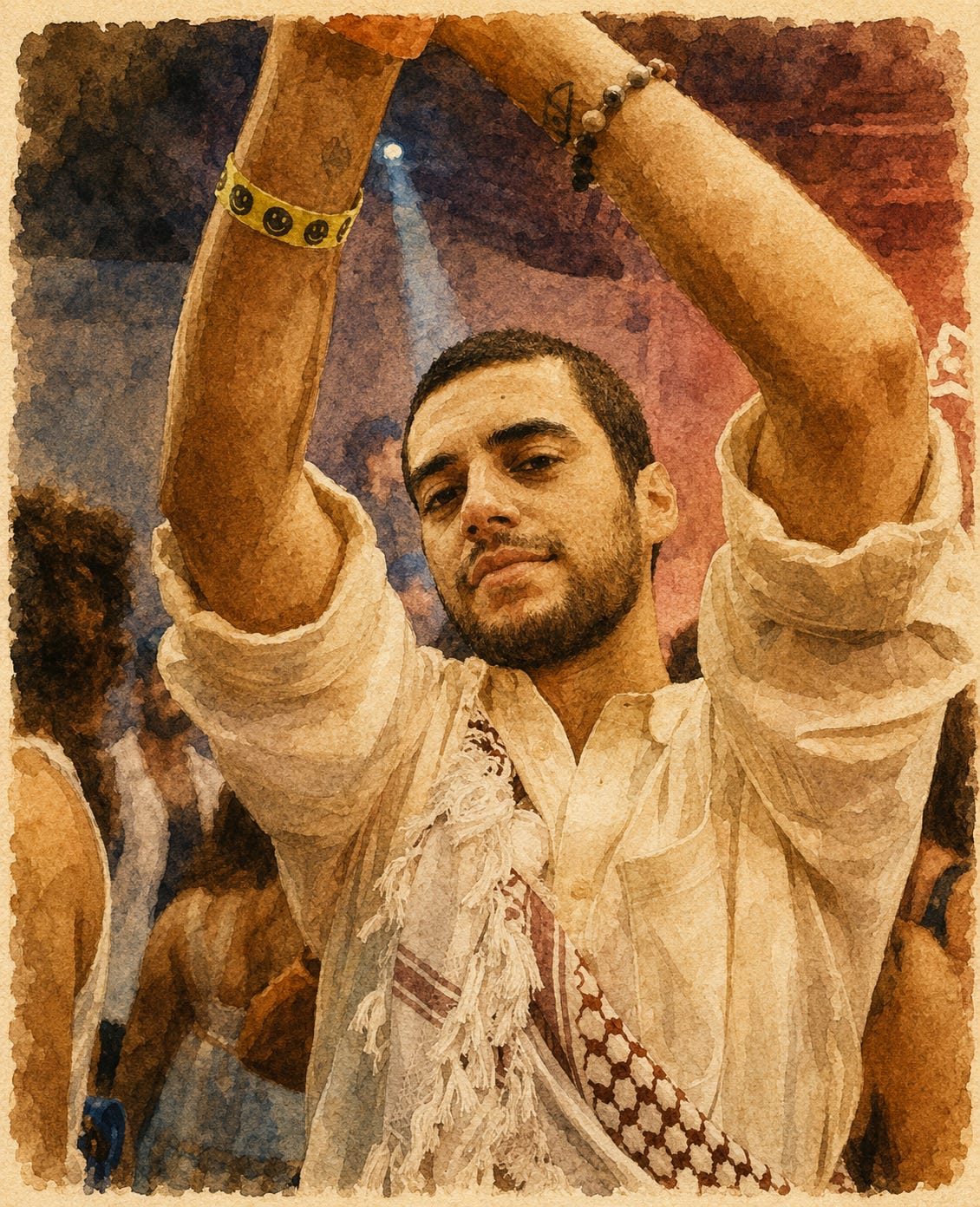
Table of Contents
Introduction
I have lived and worked in different parts of the world, and wherever I have been, I have appreciated what diversity gives a city — its food, its music, its religions, its arts, and the many different ways of telling its story. So when New York Magazine published “Habibi City,” a six-part cover package on the city’s SWANA cultures, I was sympathetic to the project.
The cover itself features a figure wearing a keffiyeh, which gave me some initial pause. I continued reading regardless.
By the time I reached the closing sentence of the anchor essay, however, I began to question my initial enthusiasm for the issue. The sentence describes what its subjects “still face”: “xenophobia, Islamophobia, and Zionism” [Arafat]. Xenophobia and Islamophobia are forms of prejudice directed at people. Zionism, by contrast, is a national movement: the movement for Jewish self-determination. The sentence names neither a government nor a particular policy nor a specific current within that movement. Instead, it reaches for the term that denotes the Jewish national movement as a whole, so that Israel in its existing form — or, indeed, any other political form that Jewish self-determination might take — is placed alongside forms of hatred. That is not criticism of a particular government or a concrete policy. The sentence instead works through reclassification: by placing Zionism alongside xenophobia and Islamophobia, it classifies it as a form of prejudice or hatred without ever having to make that argument explicitly. The accusation lies not in an explicit statement about Zionism but in the classification produced by the list itself, and the sentence is easy to read past for exactly that reason.
A few pages later, the claim that what happened in Gaza after October 7 constitutes a genocide is presented, without qualification or counter-position, as a condition of communal belonging — a belief members are expected to hold simply by identifying with the community [Arafat]. And a twenty-six-person list of those “shaping SWANA New York” explicitly stretches the category beyond its geographical boundaries while leaving no room for a single Middle Eastern Jew among those chosen to define it [Portfolio]. These are not the same kinds of evidence, and this essay separates them before evaluating either.
I have spent more than fifteen years studying language and discourse, much of that time focused on how prejudice becomes visible in language. A text can fail a community in different ways, and those ways are not interchangeable. A sentence can itself cross the line into antisemitism, as I will argue the closing triad does. A sentence can remain clean — unobjectionable when read on its own — while still participating in a larger asymmetry, as the portfolio’s individually defensible entries do. And a proposition can change status as it moves from one part of a publication to another — from a claim attributed to others to a background assumption in the publication’s own voice, which is the path the genocide allegation takes across these pages. Each requires a different kind of analysis. Much of what concerned me in “Habibi City” does not belong to passage-level coding at all, but to patterns that emerge around and between individual passages.
Put simply, much of the structural problem I identify is one of bias and exclusion — writing a community out of a story to which it belongs, or granting it presence without membership. Separately, a number of passages cross the framework’s threshold for antisemitism. These are different findings, produced by different tests.
The package celebrates something I genuinely value about this city: cultures that live alongside one another, argue with one another, and make the place larger through that very friction, without requiring any one of them to disappear so that another can be seen. A cultural account of SWANA New York could have made room for that plurality, Jews included. It could also have avoided turning contested political claims into tests of cultural belonging. The problem with this package, then, is not that it is political — its own editors say so — but that its politics repeatedly distribute agency, explanation, and belonging in a single direction.
What follows sets out that reasoning section by section and applies the same standard to the package and to its critics.
I. Two failures of reading
I read all six pieces closely, using guidelines from my Decoding Antisemitism project, published before this controversy in our open-access Lexicon (Becker, Troschke, Bolton & Chapelan, eds., Decoding Antisemitism: A Guide to Identifying Antisemitism Online, Palgrave Macmillan/Springer Nature 2024). The rules are deliberately conservative: a passage codes only when the text itself, read in its co-text and relevant context, supplies the evidence the framework requires. This may take the form of a stereotype, a demonizing attribution, or a generalization directed at Jews or, under specified conditions, at the Jewish state as such. Such forms cannot be identified by keyword matching alone. Context can resolve a signal the text carries; it cannot manufacture one that is not there. A passage that provides no such evidence is, in this essay’s working vocabulary, clean. That is a coding result, not a verdict that the passage is fair or harmless. The distinction is what the title turns on: most of what appears on these pages is clean, and what remains to be described is what a text can still do once the coding is finished.
That description happens at three levels, and keeping them apart is this essay’s central discipline. The first is coding, addressed chiefly in Sections II through IV. The second is structure: patterns in who gets named as an agent, who gets explained and how, and who counts as belonging. These become visible only across multiple passages and are addressed in Sections V and VI. The third is reception, addressed in Section VII. Two rules govern all three. First, what a pattern does is a property of the published, edited text, not of what any writer privately intended; textual analysis cannot access private intention. Second, a pattern is not evidence of prejudice simply because it is a pattern. Its relationship to antisemitism has to be demonstrated, not assumed.
The two examples that follow put the context rule to the test, one from each side of the controversy, because the discipline this essay asks for should be demonstrated before it is applied.
From the magazine’s side: the anchor essay, as first published, described FeelBeit — the partnership behind a Palestinian-Israeli performance at Barzakh Café — as “an anti-Zionist, pro-dialogue artistic partnership” [Arafat, as first published]. FeelBeit is in fact an Israeli-Palestinian arts house on the seam between East and West Jerusalem, founded to bridge the two communities, which has brought tens of thousands of Israelis and Palestinians together in roughly equal numbers since October 7. The magazine corrected the description within a day, and the page now carries a correction note recording the change. The error is limited but revealing: it ran in the same direction as the framing a quoted source states openly a few sentences earlier (”Of course, they’re not Zionists” [Arafat, quoted source]). The misdescription tracked the surrounding frame rather than the object.
From the backlash’s side: a claim circulated on social media — though, so far as I found, not in statements by the organized critics — that the magazine had deliberately set the cover in Fraktur, the blackletter typeface associated with the Nazi era. The claim is documented in the subsequent coverage: JNS attributed a version of it to a named journalist, while the New York Post reported the accusation in a critical article but also included the correction. The typeface is an Arabic-inspired face called Lydia, as the magazine confirmed when asked. The error is methodologically parallel to the first: Arabic-influenced letterforms were interpreted as a Nazi code. I raise it in the critique’s own interest, not against it — a false typography claim is a gift to anyone who wants to dismiss the serious objections wholesale, and the serious objections, as will be seen, deserve better. In both cases, the interpretation tracked an available frame rather than the object — the failure the rule above is designed to prevent, on both sides of the argument.
The six pieces under examination are Zaina Arafat’s central essay, Madeline Leung Coleman’s restaurant piece, Maya Abuali’s oral history of culinary family dynasties, the editors’ unsigned portfolio of twenty-six figures from the scene, Jasmine Vojdani’s nightlife piece, and Hershal Pandya’s comedy piece; “Welcome to Habibi City” in the package navigation is the central essay under an alternate title, not a separate piece. Quotations below are tagged and linked to their source article; where words belong to a source quoted within a piece, the tag says so.
II. Reclassification: Zionism in a series of hatreds
I begin with the sentence most prominently quoted in the backlash, the anchor essay’s closing inventory of what SWANA New Yorkers “still face”: “xenophobia, Islamophobia, and Zionism” [Arafat]. The strongest objection was definitional, and the definitional anomaly holds up under scrutiny. Xenophobia and Islamophobia name prejudices against people; Zionism names a national movement. Placing them in a single series therefore reclassifies a project of self-determination as one of the prejudices directed against its subjects. A simple editorial test shows why the sentence is anomalous. Fill the third slot with any other people’s national movement and the anomaly becomes visible. “Irish American New Yorkers still face xenophobia, anti-Catholic bigotry, and British unionism” would not survive a copy desk, because a political movement one opposes is not a prejudice one suffers. The same holds for the reverse of the sentence under discussion: it is difficult to imagine comparable mainstream coverage printing “Israeli New Yorkers still face antisemitism, xenophobia, and Palestinian nationalism,” and for good reason, since Palestinian nationalism is a movement for self-determination rather than a form of hatred, whatever has been done in its name.
The sentence could instead have named a current within Zionism — Kahanism, settler extremism, or another specified tendency — but it selects the umbrella term: the term that covers the movement from Herzl to the Israeli dissidents the package itself profiles with sympathy. That choice is a property of the published sentence, regardless of what the writer intended.
The scope of that choice is the point. A sentence that placed Kahanism among the hatreds would delegitimize Kahanism. A sentence that places Zionism there delegitimizes the project as a whole — the Israel that exists, any Israel that could exist, and the self-understanding of everyone for whom some form of Jewish self-determination remains the answer to a question European history asked. That question was not posed by Jews. It was posed by the exclusions and atrocities of European states, accumulating to the genocide of European Jewry — committed by my own nation and its collaborators — and the movement the sentence classifies as a hatred is, whatever else it has become, the political answer a persecuted people gave to that history. That is the difference between criticizing a current within Zionism and classifying Zionism itself as a hatred.
Moving a national movement into an inventory of hatreds delegitimizes by classification rather than by predication: nothing evil is asserted about Zionism; it is simply filed among the social evils. This classification therefore bears not only on the movement itself, but also on the state it produced and on those whose self-understanding is bound to it. The coding question can therefore be stated precisely: does classifying the movement for Jewish self-determination as a form of hatred amount to an implicit denial of that self-determination? Under the convention applied here, it does. A sentence that files the movement for Jewish self-determination among group hatreds is not criticizing a policy, a government, or a current within the movement; it demonizes and delegitimizes the project as such, in every shape the project could take in the present — the sentence’s subjects would “face” Zionism no less under any other Israeli government, because what has been classified as a hatred is not a government’s conduct but the movement itself. Nor does the sentence operate alone in the essay. It closes a piece that has already presented the Gaza genocide allegation as a condition of belonging (Section III adjudicates that passage). In that position, the reclassification of Zionism activates and indirectly reinforces the earlier frame. I treat that as an aggravating feature of the same finding, not as a separate one. The framework’s published criterion here is denial of Israel’s right to exist. Under the convention applied here, the sentence reaches that result indirectly, by demonizing and delegitimizing Zionism as such. The sentence codes. I state that decision openly because I am an editor of the framework being applied. A more restrictive reading is possible: the sentence could be treated as a single indicator rather than a coded instance, on the ground that it contains no explicit predicate and no reference to Jews as a collective. Nothing in the structural findings below depends on rejecting that alternative. But the restrictive reading mistakes the sentence’s grammar for its content: what the sentence lacks in predicates, it accomplishes by classification. Section V will show what this sentence is the endpoint of.
III. The genocide accusation in contemporary discourse
The genocide language requires more care, because the framework’s published convention is stricter here than parts of the surrounding public debate assume, and because the package’s instances fall on different sides of it. Under the published convention in Becker et al. 2024 (Bolton, ch. 32), a generalized accusation that the State of Israel has committed or is committing genocide against the Palestinian people falls within the coded concept. The same chapter draws two boundaries. Its sole non-antisemitic example is an accusation bounded to specified actors within a limited time — “some far-right parties in Israel right now” — and the chapter states that genuine investigation into potentially genocidal activity cannot be antisemitic. The framework therefore distinguishes three things: a generalized accusation against the Israeli state, a bounded accusation against specific actors or conduct, and an investigation that remains open to evidence. The package contains the first two; the investigation clause is illustrated below by a historian’s changing judgment and by the legal process, neither of which belongs to the package itself.
The anchor essay’s version appears as a condition of communal belonging: “To be in SWANA community meant embracing a set of shared beliefs... That what happened in Gaza in the aftermath of October 7 constitutes a genocide” [Arafat]. One may find it remarkable that a contested historical and legal judgment is presented as a membership criterion, and I do. As a matter of textual analysis, the formulation is grammatically agentless and is introduced as a community’s belief rather than asserted in the writer’s own declarative voice. Neither the missing grammatical agent nor the fact that the claim is attributed to the community is sufficient to exempt the passage. The agent is recoverable from the surrounding narrative without being named in the sentence — the essay’s own account of protest, boycott, and grief makes Israel the salient referent of “what happened in Gaza in the aftermath of October 7.” The omission of the agent therefore does not narrow the accusation. And the reporting frame does not distance it: the writer presents the belief as a condition of communal belonging and nowhere rejects or qualifies the allegation. Nor does the attribution distance the writer from the claim. What distinguishes this from ordinary journalistic attribution is not that the writer reports a belief, but that the belief is made a condition of belonging, left without qualification or counter-position, and embedded in a first-person communal narrative. That is the passage’s immediate co-text, and the finding rests on it. The package also provides an additional editorial context — the same proposition subsequently appears in authorial and unsigned editorial voice elsewhere. The published convention supplies the concept: the generalized state-level genocide accusation. I apply one additional adjudication rule here: when such an accusation is made a condition of belonging and presented without qualification or counter-position, I treat it as ratified rather than merely reported. As in Section II, I state that judgment openly because I am an editor of the framework being applied. Under that rule, the passage codes. What the reporting frame changes is not the verdict but the mechanism, which the trajectory below makes visible.
The restaurant feature’s version differs in kind. There the writer states, in her own voice and as presupposed fact, that “awareness of Israel’s genocide of Palestinians” [Coleman] has transformed how New Yorkers eat, and she describes a Jewish friend “horrified by Israel’s genocide” [Coleman]. A third authorial token — “those horrified by the genocide” [Coleman] — is anaphoric to the first; throughout this essay, anaphoric repetition is counted as part of the same passage rather than as a separate unit. The linguistic mechanism is central to the trajectory this section traces. “Awareness of X” belongs to the class of constructions linguists call factive: it presupposes the truth of X and asserts only something about people’s relation to it. Negation shows the difference. Denying that eating habits have changed does not deny the genocide claim; that claim remains in the background as something already taken for granted. To contest it, the reader has to challenge the sentence’s premise rather than its assertion. And the content so backgrounded names the state as agent and generalizes the victim group, which is the formulation the chapter identifies. The feature then hands its strongest predication to a quoted source, capping its run of Israeli relabeling examples: Israeli restaurants are re-labeling themselves “because their state is genocidal” [Coleman, quoted source]. At this point, the claim has shifted from what the state has done to what the state is. It is quoted without rebuttal, and the source’s own sequel intensifies rather than softens it: “If they want to distance themselves from that, then that says it all” [Coleman, quoted source]. The same source supplies a second token elsewhere in the feature — Palestinian restaurant-going as “the only positive thing against the backdrop of the genocide” [Coleman, quoted source]. Under the published convention, the feature’s own formulation falls within the coded concept, and the quotation intensifies the claim, from an allegation about conduct to an assertion about the state’s character.
Four further observations complete the picture. First, the same feature reports of two Israeli chefs that “they now both consider what the Israeli government is doing to Palestinians to be genocide” [Coleman, reported chefs] — indirect speech, so the bounded wording is at least in part the writer’s own rendering of their view. The formulation is bounded to a specified actor, the government rather than the state as such, and it falls on the non-coding side of the convention’s own example. That result demonstrates that the convention discriminates between forms rather than covering all of them indiscriminately.
Second, the convention’s investigation clause has real extension. Omer Bartov, cited in that chapter as an authority for disciplined use of the concept, changed his public judgment on Gaza between 2023 and 2025 — from finding no proof of genocide to reaching what he later called an inescapable conclusion to the contrary. His trajectory illustrates the mode the clause protects: a claim bounded to conduct and period, tested against evidence, argued through, and open to revision. The legal process illustrates the same distinction: as of mid-August 2026 the ICJ has issued provisional measures but no judgment on the merits, and the case remains pending in written pleadings (Order of 21 May 2026, ICJ). An unsigned magazine entry that treats a conclusion like this as background fact is doing something categorically different from what the court, or the historian, is doing. The point is not which conclusion is correct; it is whether the proposition is being investigated or presupposed. The line the framework draws does not run between conclusions; it runs between modes of assertion, and the distinction is methodological, not ideological: it turns on how a claim is made, not on whether its conclusion is disputed.
Third, the presupposed usages share a property that connects the mode of assertion to the content asserted. Genocide is not a synonym for mass death. The concept’s defining element, from Lemkin’s coinage through the 1948 Convention, is intent — acts committed “with intent to destroy, in whole or in part, a national, ethnical, racial or religious group, as such” — the requirement that distinguishes genocide from war crimes and crimes against humanity and that makes the court’s threshold as demanding as its jurisprudence shows. In ordinary public discourse, “genocide” is also sometimes used more loosely, as a general term for extreme destruction and mass death. The package’s presupposed uses appear to operate in that broader sense rather than engaging the legal or analytical question of genocidal intent. None of these passages addresses the question of intent or the other criteria required for a genocide determination. The term therefore enters the text as a conclusion already settled rather than one being established. And the loosening is paired with a selectivity the package itself makes measurable. Its pages contain three agents of large-scale violence in the writers’ own voices: Israel, the American military — whose strike on a school in Minab, the nightlife feature reports without hedging, “killed more than 100 children” [Vojdani] — and the Iranian regime. The term is broad enough, on this looser public usage, to apply to all three cases. Yet in these twenty thousand words it is applied to only one state’s conduct. That combination is not an argument about what happened in Gaza, and this essay does not offer one. It is a describable property of how the word is used on these pages, and it is the property that the trajectory below carries from article to caption.
The direction of that loosening is not arbitrary. A genocide claim bounded to conduct — this government, this campaign, this period — remains falsifiable in principle: a change of government, a change of policy, a cessation of the acts in question would alter the claim’s basis. A genocide claim framed as a statement about a state’s character is much less responsive to changes in specific conduct or government policy. Once the accusation attaches to what a state is rather than to what a specific government does, conduct-level evidence has far less purchase on it, because the claim was never primarily about conduct in the first place. This is why the package’s presupposed instances are worth distinguishing from its bounded one: the two Israeli chefs’ formulation, bounded to “what the Israeli government is doing” [Coleman, quoted chefs], names an actor and an action, and could in principle be answered by a change in either. The unbounded instances — the state named as agent, the state’s character asserted outright — are far more insulated from any such answer.
The accusation’s lexical field is wider than the term itself. The anchor essay twice reaches for an exterminatory concept without the word: its subjects’ families were “living under the threat of annihilation” [Arafat], and the closing sentence names “occupation, displacement, annihilation” as what “we’re up against” [Arafat]. Annihilation is no more a synonym for war or mass death than genocide is; it denotes destruction that is total — the concept whose intended pursuit the genocide accusation asserts. Both tokens are grammatically agentless, and Section VI examines that mechanism; what belongs here is that the closing series does not leave its agent equally open at every position. Occupation and displacement carry, in this discourse and in the essay’s own co-text, a conventional agent, and the series’ third member inherits that assignment by parallelism. Under the convention applied here, neither token codes on its own: no state is named, and the sentences assert a threat against the community rather than an act by a state. What they add to this section’s finding is the field: the generalized accusation is present in these pages not only where the word genocide appears but in an exterminatory vocabulary surrounding it, agentless in every instance.
Fourth, tracked across the package, the accusation migrates from the first mode into the second. It enters as an attributed proposition in a personal essay; it becomes an authorial presupposition in a staff writer’s reported feature, now with the state named as agent; and it settles as an unsigned editorial presupposition in the editors’ portfolio entry for a singer, described as collaborating on a song “for a generation watching a genocide unfold over social media” [Portfolio, editors’ entry]. The progression is one of editorial uptake: at each step the claim is asserted less and assumed more, and the voice carrying it becomes less attributable to any individual. Under the convention applied here, the first passage already codes on its own. The later instances do not make it antisemitic retroactively. What the sequence shows is a separate finding: how thoroughly the allegation is absorbed into the publication’s own voice — from ratified attribution, to authorial presupposition, to unsigned editorial presupposition. This trajectory of naturalization, rather than any single sentence, is the structural finding.
The anchor essay in fact carries the accusation in attributed form twice: alongside the membership passage, its account of the Bidoun essay “House Arab” reports that writer’s belief that news organizations would “eventually get around to calling Israel’s aggression a genocide” [Arafat]. Attributed, and non-coding under the convention — but the paraphrase frame casts the conclusion as overdue (”get around to”), and the descriptor “Israel’s aggression” is supplied in the reporting voice.
IV. A joke and its ratification
One further passage requires coding adjudication before the structural analysis, and it comes from the piece the controversy has touched least. The comedy feature recounts a bit by Malik Elassal: an errant Israeli missile landed in his grandmother’s house in Lebanon during Israel’s occupation in the 1980s, and the family survived only because the missile malfunctioned. The punch line, the writer reports, is “a well-disguised callback to an earlier bit about Kanye West’s antisemitic rhetoric” [Pandya]: “I still listen to Kanye sometimes... I feel that’s fair” [Pandya, quoted comedian].
Kanye West’s targets are not Israeli policies but Jews as Jews: he is among the most prominent figures in American culture to have openly praised Hitler and trafficked in antisemitic conspiracy narratives, a body of output whose audience reception I have analyzed in a separate study under the same framework. The bit makes continued consumption of that rhetoric “fair” — a word from the vocabulary of balance and just deserts — as a response to an Israeli military act. The operation is an attribution of collective liability: Jews as such are made answerable for the conduct of the Israeli state, and hostility toward them is presented as a proportionate entry in a ledger. The vehicle is humor, and the analysis does not depend on a theory of laughter: the question is not whether audiences laughed, or why, but how the writer treats the premise.
The coding question is the one Section III adjudicated — reported material, and what the reporting frame does with it. The joke belongs to the comedian; the frame belongs to the writer, and the frame is not neutral. The punch line is introduced admiringly (”well-disguised”) and evaluated in the authorial voice: it “lands well” [Pandya]. Nothing in the passage qualifies, complicates, or distances. Under the ratification rule stated in Section III, the passage codes. As before, I state the judgment openly because I am an editor of the framework being applied, and as before a more restrictive reading exists: “lands well” is, by the genre conventions of comedy writing, a craft verdict on a joke’s construction, and a reader who holds craft judgment apart from premise endorsement will count this as a ratified boundary case rather than a coded instance. That reading has more to stand on here than its counterpart did in Section III. What no reading removes is the premise the joke constructs: that antisemitism can be a fair price for Israeli conduct.
V. Structural regularities
The critics were not wrong to sense that something beyond individual sentences was at issue, and some of them named it with considerable precision. End Jew Hatred objected that the package defines belonging around a prescribed position on Gaza, “effectively pushing Mizrahi Jews, whose families lived across the Middle East and North Africa for generations, out of their own regional identity.” A commentator condensed the same point into a single sentence: “you can’t be Middle Eastern anymore unless you say ‘genocide’ and ‘free Palestine’.” Advocacy can identify a pattern, but a framework should be able to demonstrate it and define its limits, and when I examined the package’s distribution of agency, causation, and belonging rather than its quotable sentences, a set of distinct regularities emerged, pointing in the same direction.
The first regularity concerns agency. Across the package, Israel appears as an explicit agent of violence in the writers’ own prose: “the Israeli assault,” “the U.S.-Israel 12-day war on Iran” [Arafat]; “Israel’s atrocities in Gaza and Lebanon,” “Israel’s siege of Lebanon” [Pandya]. October 7 appears fourteen times in the package’s writer and unsigned editorial voices, six times in the anchor essay alone. Every occurrence appears as a date: “after October 7,” “came October 7,” “in the aftermath of October 7.” The event has no named perpetrator anywhere in those voices. The relevant comparison is not the number of references but their grammatical form; the counts establish the distribution of forms, not by themselves the interpretive weight of any repetition. Hamas is never named in any writer’s voice. The name occurs exactly once in the package’s twenty thousand words, inside a quotation — a café owner reporting the harassment he receives (”’You’re a terrorist,’ or ‘Hamas supporter’”) [Coleman, quoted source] — that is, as an anti-Arab slur aimed at a package subject, and never as the perpetrator of October 7. Victims of October 7 surface exactly twice, in both cases inside Israeli-attributed material rather than in narration: a chef’s “yellow-ribbon pin symbolizing the Israeli hostages” [Coleman], described as part of her pro-Israel self-presentation, and two Israeli chefs’ quoted Instagram post mourning “the horrific and brutal acts on Oct 7th” and, in the same post, “the massive killing in Gaza” [Coleman, quoted post]. Acknowledgment of the attack and its victims exists in the package, in other words, only as something Israelis are depicted doing.
The nightlife feature states without hedging that “the Iranian government had shut down the internet and begun a violent crackdown,” reports celebrations of the death of Ayatollah Khamenei, and describes “an American strike on a school in Minab, Iran” that “killed more than 100 children” [Vojdani]. A comparison elsewhere in the package rules out the simplest stylistic explanation, that these writers avoid naming perpetrators generally: the Iranian regime and the American military are both named as agents of violence; among the large-scale violent events discussed in writer and editorial voice, October 7 alone has no named perpetrator. The result is a systematic asymmetry in who gets named as an agent of violence, and it holds across six texts by different writers, which is what makes it a property of the package rather than of any sentence or any author.
The asymmetry acquires a describable effect when combined with the finding of Section II. In a text where the attack of October 7 exists only as a date, where the movement of Jewish self-determination is classified among the things the package’s subjects suffer, and where Israeli violence is repeatedly given an explicit agent while October 7 is not, explicit agency is assigned asymmetrically — and victimhood associated with October 7 appears only through Israeli-attributed material. The role of the organization that carried out the attack is structurally backgrounded: across the package, the date and the communal aftermath are supplied repeatedly, the perpetrator is supplied nowhere in writer or editorial voice, and the victims enter only through Israeli-attributed material.
A related asymmetry may operate on the package’s one report of violence against its Israeli subjects. The restaurant feature writes that “some Israeli restaurants have been vandalized, spray-painted with notices that accuse them of co-signing the Israeli government’s project” [Coleman]. Photographs circulating in the reception show New York restaurant vandalism whose notices include “Genocide Cuisine,” “Israel Steals Culture,” and a swastika; whether these depict the incidents the sentence describes I could not independently confirm. If they do, the sentence’s paraphrase performs a bounding operation in the opposite direction from Section III: an antisemitic symbol and a characterological slogan rendered as a bounded political critique. This is a conditional structural observation, not a finding; it stands or falls with the identification of the incidents.
The distribution can be displayed in full, since the claim should be checkable rather than taken on trust:
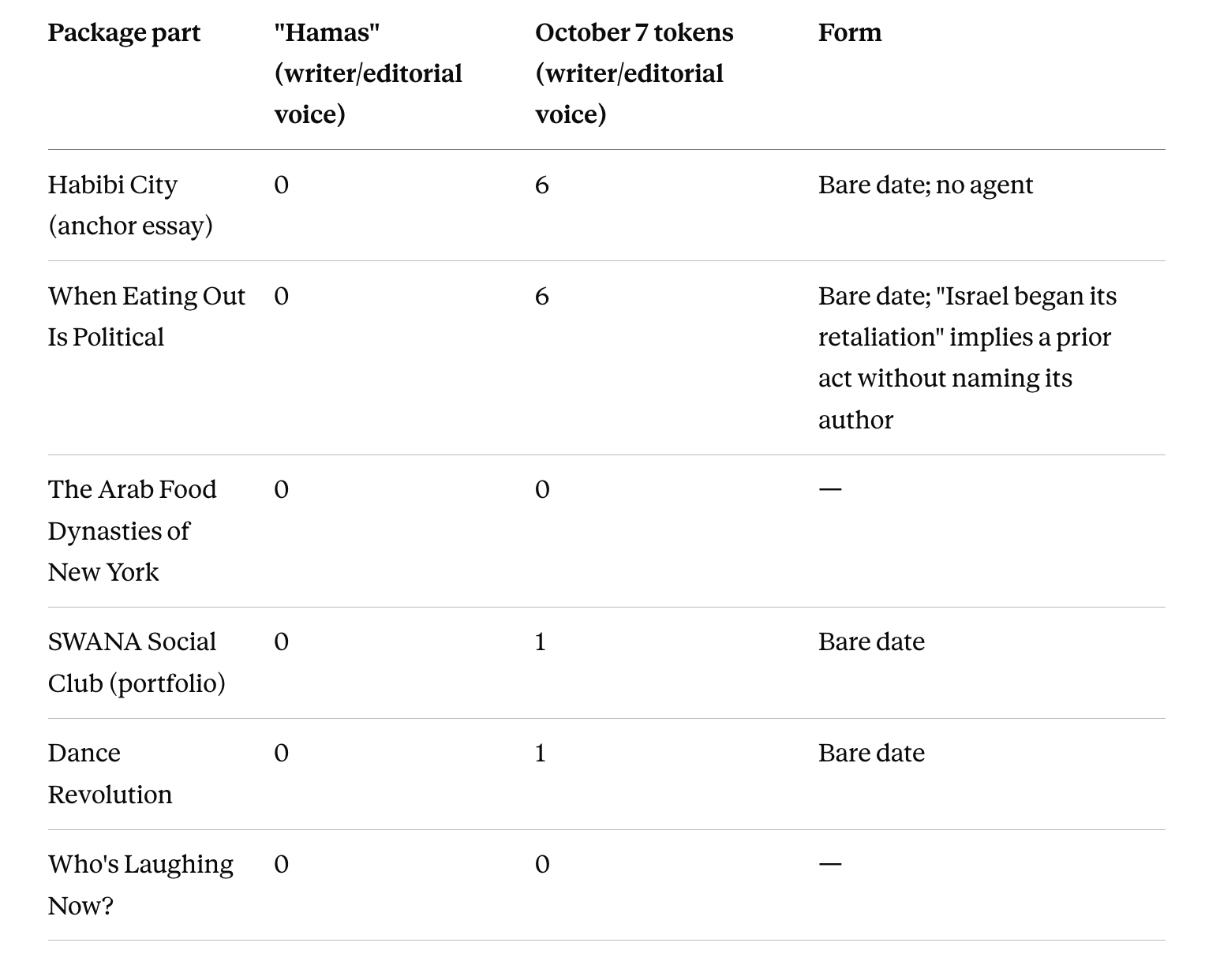
Counting procedure: counts include only explicit tokens of the date (”October 7,” “Oct 7th”) and of the name “Hamas,” in body prose, captions, and entries, classified by voice (writer, unsigned editorial, quoted subject); periphrases (”the attack,” “the war”) were logged separately and are discussed in the text where relevant. The name Hamas occurs once in the package, inside quoted harassment speech in the restaurant feature, as addressed in the text.
The package’s one sustained depiction of pro-Israel patrons belongs to the same account of distribution. In the restaurant feature’s report from Laser Wolf and K’Far, the customers who appear after October 7 arrive wearing flag pins, “eager to engage their servers in conversations about Israel,” and are given exactly one direct quotation: “We gotta carpet-bomb everyone” — capped by a former manager’s verdict, “this is a bloodthirsty environment” [Coleman, quoted sources]. Every element is quoted or attributed, each utterance is bounded to specific unnamed customers, and none of it codes. Two distributional facts remain. The first is selection: the only exterminatory wish quoted anywhere in these twenty thousand words belongs to pro-Israel patrons. The second is arrangement. A paragraph earlier, the feature quotes the restaurateur Steve Cook on his own clientele: “Our Jewish clientele, I think, gets an extra level of satisfaction from coming here because they know what they’re supporting” [Coleman, quoted source]. In Cook’s mouth the sentence is benign — the referent of “what they’re supporting” is his restaurants, or Israel as he understands it. The text then supplies a different completion: within the same passage, what the clientele knowingly supports is illustrated by the carpet-bombing comment and the manager’s “bloodthirsty.” An open slot, filled by adjacency rather than assertion — a mechanism Section VI examines in the package’s imagery — and it operates here on the package’s only occurrence of the phrase “Jewish clientele.”
The second regularity concerns how people are introduced. In the restaurant feature’s introductory passages, every Israeli chef I examined is introduced through a state connection: one “got into cooking while serving in the IDF” [Coleman]; another’s story runs through a brother killed in service and a Ministry of Tourism ambassadorship; a third is introduced serving food to soldiers near Gaza. Arab and Iranian chefs arrive connected to the family: grandmothers, home kitchens, wild greens carried in a suitcase from Galilee.
The obvious alternative explanation is selection: perhaps these Israeli chefs’ biographies simply run through the state, and a food feature naturally introduces cooks through culinary inheritance. The feature’s own material argues against this. Family material was available on the Israeli side — a Moroccan grandmother and “Persian and Yemeni Jewish roots” [Coleman] both appear in the text — and is used there to explain the provenance of dishes rather than to introduce a person, while the two dissident Israeli chefs, whose state connection is least salient, are introduced through the controversy surrounding their restaurant rather than through a kitchen. Several of the state connections are, moreover, accurate and newsworthy. Within the introductory passages I examined, the asymmetry is complete: I found no Israeli figure introduced through family cooking and no Arab figure introduced through a state. In these introductory passages, Israeli cultural presence is made legible chiefly through the state, which is congruent with the characterological quotation discussed above. The feature separately contains a quoted source who characterizes her former employment at an Israeli restaurant in this register — “I realized our whole job was propaganda” [Coleman, quoted source] — a judgment that belongs to the source, not a corroboration of the distributional finding, though the two are congruent.
The third regularity concerns explanation. Both communities have at different times adopted the label “Mediterranean” in place of national identification, and the feature presents the conduct as comparable: in each case the label substitutes for an explicit national identification in a market where that identification is treated as commercially risky. When Arab restaurateurs did so, the feature supplies an exculpatory cause: stereotype, post-9/11 fear, the only available way to bring customers through the door. When Israeli restaurateurs do so now, the explanation supplied is guilt, delivered by the quotation that closes the section: they are distancing themselves from a genocidal state. The same act of softening national identification receives oppression as its explanation for one group and culpability as its explanation for the other.
The explanation asymmetry extends into the feature’s historical narrative of the two cuisines’ fortunes in New York. Arab, Iranian, and North African food, in the feature’s account, was “assigned” its role — “cheap, quick, outer-borough” — and its makers “tended to submerge their origins in euphemisms: They called their food ‘Oriental,’ then ‘Mediterranean’” [Coleman]. The New Israeli chefs of the same account “cruised free of post-9/11 baggage,” their cuisine backed by “this young country, which was so richly funded and supported by our own,” and “the promoters of New Israeli cuisine gave themselves permission to be expensive” [Coleman]. The passage also states, in authorial voice, that “many of the dishes were Palestinian.” As with the relabeling explanation, the narrative therefore gives the same market behavior opposite explanations: the region’s non-Jewish cuisines are acted upon — assigned, relegated, forced into euphemism — while the Israeli cuisine acts — cruises, announces, gives itself permission — with external funding named for the second group only. Under the convention applied in this essay, none of these sentences codes: no unit generalizes about Jews, and each assertion, taken alone, is a defensible economic or culinary-historical claim. What the sequence does is distributional, and it runs in the direction the third regularity has already established: advantage, agency, and appropriation accumulate on one side of the narrative; constraint and dispossession on the other.
The fourth regularity concerns belonging, and it is where the critics’ strongest intuition finds its textual basis. The editors’ portfolio of twenty-six people “shaping SWANA New York” is the package’s most explicit act of category construction, and its category is elastic by its own account: it extends to Pakistani, Indian, and Afghan New Yorkers, outside the acronym’s own geography, on the stated ground that they “have helped build community all the same” [Portfolio]. The elasticity runs outward, and it does not include a single Middle Eastern Jew among the twenty-six people selected to define who is shaping SWANA New York — even though the anchor essay elsewhere depicts an Arab Jewish singer leading an annual Mimouna at the scene’s flagship café, a person demonstrably inside the community being portrayed. The exclusion is from the definitional list, not from the package’s pages: presence is granted, while membership in the defining set is not.
The portfolio’s elasticity has a counterpart in the anchor essay’s own prose, where the membership question is posed explicitly and answered asymmetrically. Of the mayor, Zohran Mamdani, the essay writes that he “is not technically from the SWANA region, but he is deeply embedded in its culture” [Arafat] — the category extended outward, on grounds of embedding, to a figure born outside its geography. Of Israelis, the same essay writes that “the question of whether Israelis can claim a connection to it, particularly given the political framework of terms like SWANA, is complicated — and it gets more so depending on a person’s ethnic background” [Arafat]. The two sentences state the rule the portfolio applies: cultural embedding suffices for entry from outside, while connection from inside the region’s geography is conditional — and conditional, by the sentence’s own final clause, on ethnicity. That is the membership boundary of the fourth regularity, this time not inferred from a list but stated in the essay’s own voice.
The criterion the portfolio states — helping build community — is a test, and it can be applied to the region the acronym names. New York holds generations-old communities from that region beyond its Arab, Iranian, and South Asian ones: Coptic, Maronite, and Armenian New York, and, above all, the city’s Syrian, Egyptian, Lebanese, Bukharian, and Persian Jewish communities — communities that fall squarely within the region’s geography and have long-standing histories in New York. Measured by the portfolio’s own criterion, these communities have been building New York for longer than the scene the package celebrates has existed. None appears among the portfolio’s twenty-six entries. The point is not that a portfolio must include everyone; no list can. The point is that this portfolio’s elasticity is a stated principle, and the principle was available — it carried the category to Karachi and Kampala — and was not extended to the region’s own minorities or its Jews. That distribution rules out the simplest defense of the Jewish absence, that the list was merely finite. And it sharpens rather than absorbs the specific finding. Among the communities the elastic category passes over, the Jewish case is distinct: the package depicts Jews inside the scene’s own spaces, grants them presence in its pages, and then assigns them the grammar of transmission rather than membership. The general narrowing is a fact about the category. What happens to Jews within it is a structure of its own.
Middle Eastern Jews are present elsewhere in the package in one recurring role, as conduits: a Moroccan grandmother explains an Israeli chef’s repertoire; “Persian and Yemeni Jewish roots” explain a falafel empire; Jewish immigrants “imported” dishes. The pattern is visible in the grammar of these sentences. Jewish presence appears in possessive and instrumental constructions — roots that account for someone’s cooking, ancestors through whom dishes traveled, immigrants by whom foods were brought. Jewish presence appears as something transmitted through ancestors, family roots, or migration rather than as a contemporary community speaking in its own right. In the passages examined here, Jewish culinary presence repeatedly appears through transmission rather than as a living contemporary tradition practiced in its own name. The portfolio establishes the membership boundary; the recurring conduit constructions across the other pieces reinforce it. The cumulative effect is to render Jewish presence in the region legible primarily as transmission rather than as membership: Jews are acknowledged as historical transmitters of the region’s culture, and they are not represented among the contemporary constituents selected to define the community. This is subtler than erasure — it is acknowledgment without membership — and it is invisible at the sentence level. It gives textual form to an injury that the Syrian Jewish attorney quoted by the Post described in his own terms: he knows, he said, what cultural erasure looks like.
A related tension runs through the package’s account of belonging itself. The anchor essay presents a set of shared beliefs as the condition of SWANA community. The package’s own Iranian strand does not fit that frame: its politics, as the nightlife feature reports them, run through opposition to the government of a SWANA state — the prohibition located in Tehran, the celebrations at the regime’s losses — rather than through the consensus the anchor essay stipulates. The membership criterion the package announces is narrower than the scene the package documents, and the discrepancy is visible within its own pages.
One further passage belongs here, because it shows the multimodal dimension of the same architecture and because it is, on the sentence level, the package’s most contested item. The restaurant feature describes a menu at the Palestinian chain Ayat as “a cheerful tourist-style map in which the land mass currently called Israel is titled ‘Discover Palestine’” [Coleman]. Two layers require separation. The map itself performs a cartographic replacement: one polity’s name is replaced by another’s. That makes it a visual counterpart to the denial-of-existence structure discussed above. It does not argue the point explicitly; it presents the replacement as though it were simply the map’s description of reality. The cheerful tourist-guide format softens the presentation without softening its content.
The writer’s sentence is a second layer, and its key element is one word. The map itself does not say “currently”; the map says “Discover Palestine.” The temporal qualifier is the writer’s own contribution, and it does something the map cannot: it renders the name — and with it the polity — provisional, a designation that holds for now, awaiting revision. Free indirect description leaves open whether the writer adopts the map’s replacement; it does not leave open who chose the adverb. A sentence that presents a state’s existence as an interim condition does more than describe a menu: what is “currently called” one thing is expected, by the word’s own logic, to be called something else, and the formulation makes the state’s replacement sound like a realistic, even natural, outcome. That is delegitimization in the writer’s own voice — indirect, unargued, and easy to read past; it is precisely this inconspicuousness that allows such formulations to circulate unchallenged. The framework’s published criterion here is denial of Israel’s right to exist; a formulation that renders the state’s existence provisional, its replacement natural, meets that criterion, and it is on this basis that the sentence stands among the passages this essay identifies as antisemitic. A reader who takes “currently called” as cartographic pedantry rather than temporalization will resist this reading, and the disagreement is worth having on exactly these terms. What was never undecidable is the evaluative frame that follows, which grades the map as merely the far end of a legitimate spectrum: “Not everyone is so combative” [Coleman].
These regularities converge on a pattern stated nowhere in the package, and the clearest evidence for it lies in the anchor essay alone: across that essay’s account of the past twenty-five years, Zionism comes to occupy a structural position analogous to the one Islamophobia occupies in its account of the post-9/11 period. The persecuting forces of the anchor essay’s early sections — surveillance, the tapped phone line, the Muslim ban — give way, as the narrative reaches the present, to pro-Israel actors in the corresponding slots — the tabloid’s recurring coverage of the First Lady, the petition to bar the mayor from the 9/11 commemoration — with the same community in the affected position, until the closing triad makes the substitution lexical. Whether this positional succession reflects design, drift, or the shape of the writer’s experience is not something textual analysis can determine, and the finding does not require it. The most-quoted sentence is not the argument. It is the endpoint of a pattern built across the preceding five thousand words; reading it as an isolated sentence therefore misses the structure in which it occurs.
One further observation belongs at the end of this section, because it concerns the condition that makes these regularities possible: the package’s topical selection. A celebration of a city’s cultural abundance carries no generic requirement to adjudicate a war being fought some nine thousand kilometers — roughly five and a half thousand miles — away, and the package’s recurring turn to that war (a genocide presupposed in an editors’ entry, October 7 as the hinge of communal life, an accusation about the character of a foreign state lodged in a restaurant feature) is a choice of subject matter before it is any choice of words.
VI. The suppression frame and its missing agent
The frame this section examines is established in the package’s prose before any image carries it. The anchor essay presents its community as “living under the threat of annihilation” [Arafat], as not permitted to show itself openly, and its closing sentence pairs the hatreds its subjects face with the costs of speaking out against them — propositions in which expression figures as constrained and visibility as risk. Those sentences, not any symbol, constitute the suppression frame. The questions this section asks of that frame are what the package’s most visible emblem adds to it, and who, within the package’s own pages, is doing the suppressing.
The watermelon, in this context, is the Palestinian solidarity emblem whose origin lies in the years between 1967 and 1993, when Israel banned the Palestinian flag in the occupied territories and the fruit’s colors served as a substitute. It is not per se an antisemitic symbol, and the suppression it originally encoded was real. The package itself contains the symbol’s range: in the restaurant feature, the same watermelon appears as small pins that an anti-Zionist Jewish server handed out to his co-workers at an Israeli restaurant [Coleman] — intra-Jewish dissent, which is why its meaning has to be read from context rather than assigned in advance. In the visual culture of the United States, the same fruit also carries an unrelated and much older burden as a motif of anti-Black caricature; that a single image can carry both histories at once is this essay’s rule in miniature — a symbol’s meaning is assigned by context rather than carried by the object. In the nightlife feature’s lead photograph — “A Haza party at Elsewhere in August” [Vojdani] — the emblem appears as watermelon-patterned fans at a ticketed Bushwick party: a symbol that began as a substitute for a banned flag, now a fashion accessory, its historical meaning still available beneath a narrative of contemporary visibility. The anchor essay half-notices the coexistence itself: “our visibility and clout increases alongside suffering, trauma, and despair in our home countries” [Arafat]. The frame is not invented for this package, either — it continues the anchor writer’s published literary project, whose forthcoming essay collection is described by its publisher as addressing Palestinian vulnerability “to censorship, violence, and erasure.”
The same logic applies to the keffiyeh, most visibly on the package’s own cover. It is not per se an antisemitic symbol; it is Palestinian national dress with a documented history as a secular nationalist emblem, adopted as a marker of solidarity with the Palestinian cause. But its meaning, like the watermelon’s, is not exhausted by that history. In specific contexts and specific hands, the same garment has been deployed as a marker within antisemitic discourse — a use its most common wearers neither intend nor endorse, but one that remains in the symbol’s available range regardless. A wearer’s intent may determine which meaning is active in a particular context, but it does not erase the symbol’s other available meanings. That is the same rule the watermelon required — meaning assigned by context — applied in the other direction: context can activate a layer, and context can fail to close one off. The package’s cover puts the symbol into exactly the kind of general circulation, as cover art rather than as a specific individual’s statement, already described above for the watermelon fans: a symbol with a suppressed and a normalized register held together in a single image, readily available to viewers as simple cultural affirmation.
The essay’s closing paragraph then performs the frame’s most consequential move, and deixis analysis makes the move visible. The essay ends with an invocation of sumud, Palestinian steadfastness, and the sentence: “No matter what we’re up against — occupation, displacement, annihilation — we can’t afford to lose our cool” [Arafat]. Reference words of this kind — the linguist’s deixis — do their work below the level a reader normally checks. The dominant referent of “we” throughout the essay has been SWANA New Yorkers: people at bookstores in Greenpoint, parties in Bushwick, a mayor’s cultural orbit. The three predicates can of course hold of a wider “we” — diaspora families have members under occupation, and displacement belongs to many of their histories. The mechanism is the shift in reference: “we” moves from the New York scene the essay has been describing to a transnational collectivity facing annihilation, without the shift being explicitly marked. The surrounding sentences do prepare a transnational reading — “diasporic communities,” “home countries” — but the shift itself is never marked: the essay does not signal the point at which “we” ceases to denote the Brooklyn scene and comes to denote the wider collective, and the proposition is made without explicitly specifying either the expanded referent or the agent.
The transfer has a further consequence. The word “annihilation” also hides the actor grammatically: someone annihilates, but “annihilation” turns that action into a noun and leaves the actor unstated. The essay, having twice invoked the threat (”living under the threat of annihilation” earlier, “annihilation” here), never names that actor. The text leaves the agent underspecified. One possible completion is supplied by the essay’s own present-day sections, whose pro-Israel actors lie nearest to hand; the text names none, and the wider discourse offers others. This is how a text can make an exterminatory-agent interpretation available without containing an explicit accusation: the exterminatory concept is supplied, the pronoun brings the conditions of the wider conflict into the local scene without marking the shift, and the agent slot is left for the reader to fill. This is not evidence that the package encodes that completion; it is evidence that the frame leaves its agent structurally open. The editors’ portfolio supplies the same construction in unsigned voice: a textile artist’s tatreez workshops “emphasize its history as a form of resistance to cultural erasure” [Portfolio, editors’ entry] — erasure, like annihilation, a nominalization whose agent appears nowhere on the page. Whether audiences fill the opening with familiar antisemitic control narratives belongs to the reception record, taken up in Section VII. The suppression frame raises a related but distinct question, because the claim of not being permitted to show oneself likewise presupposes an agent, and the package leaves that slot open as well.
The comparison the package itself provides makes the openness of the slot visible. For the Iranian strand of the scene, the frame of forbidden joy names its enforcer: the nightlife feature’s queer Iranian party organizers locate the prohibition in Tehran, in “the country you or your parents grew up in” [Vojdani], and their claim that dancing constitutes protest is coherent on those terms, because the regime that forbids the dancing is named on the page. The Palestinian suppression frame, by contrast, is maintained without a named enforcer anywhere in the package; the obstacles actually specified are a tabloid, a petition, and editorial caution at a legacy magazine. The claim that speech about a subject is tabooed presupposes an agent with the power to police discourse: the assertion that one is not permitted to say something requires someone doing the not-permitting. Readers can complete that presupposition in many ways. Platforms, employers, and political opponents are all candidates, and so is the state — and among these stands the oldest one, the antisemitic tradition’s claim about who controls what may be said. The package supplies no completion at all. The question stands posed, in prose and photography, in a discourse environment where all of these answers, including the last, are in active circulation. Whether, and in which communities, the open slot is filled with the antisemitic completion is an empirical question, and a corpus study of the discourse surrounding the symbol could answer it. The package itself stops at the threshold of the question.
VII. What the reception confirms
The package was condemned within a day, in reader forums and statements from Jewish organizations; within two days, in an essay in The Free Press and an exclusive story in the New York Post; within three days, the story had reached the Israeli press (Ynet, i24NEWS). Almost all of the critical voices came from within the Jewish community; criticism from outside it was, so far as I found, almost entirely absent. Whether that is because there was nothing there to see, or because what was there is not the kind of thing a sentence-quoting public knows how to see, is a question this section’s specimens help answer.
The reception is relevant to this analysis in one specific way beyond that question of origin: it shows at least one of the package’s open structures being completed by a reader, within hours of publication, in the direction the analysis identifies. A word on scope before the evidence: this section examines the retellings — press coverage and organizational statements — together with individual reactions cited as specimens. The comment sections beneath the six articles, more than four hundred entries at this writing, are not analyzed here; they would require a study of their own. On a city forum on publication day, a reader re-read the anchor essay’s account of communal grief — the coming together of people whose families were “living under the threat of annihilation” [Arafat] — as its opposite: “their biggest issue with Oct 7 was the fear of reprisal, not the massacre.” The reading is uncharitable, but the article’s construction leaves room for it. Because October 7 has no named perpetrator in the package’s narration, because its victims appear only in attributed Israeli material, and because the community’s grief is described without its object ever being specified, a hostile reader can fill the empty position with the least charitable interpretation of motive. An omitted agent remains available for readers to supply, and in this case at least one demonstrably did.
The coverage confirms a second claim of the analysis, concerning reading practice. The i24NEWS summary of the controversy misquoted the package’s most contested sentence, mislabeled October 7 in a photo caption, and described a package exceeding twenty thousand words as “roughly 5,000-word” — close to the length of the anchor essay alone, a figure consistent with a reading limited to that one article, though it does not prove one. The consequence goes beyond scorekeeping. A criticism that appears to have confined itself to the anchor essay was pointing at real coding findings — the triad and the ratified genocide allegation — but the criticism did not itself apply the convention that distinguishes those findings from the many passages that do not code, and the press coverage chain examined here did not reach the restaurant feature’s two authorial formulations at all. A reading practice organized around the extraction of one quotable sentence fails in two directions at once: it condemns passages that do not warrant condemnation, and it misses the passages that do. And at each step of the coverage chain, the package’s text was altered in the direction of the teller’s frame — a bounded quotation universalized, a contested description hardened, a protest converted into an apology. Among the retellings examined here — including the most careful — each shifted the text toward the teller’s thesis; the items are named or linked where they are used.
One reception item worked in a third register, and it complicates the picture in both directions. Tablet magazine published an Instagram carousel of annotated screenshots from the package — highlighted passages with sardonic captions, framed as reading the main articles “so you don’t have to” [carousel]. Two of its features matter analytically. First, it read further into the package than the press chain did: among its exhibits is the restaurant feature’s authorial formulation “horrified by Israel’s genocide” — one of the two passages Section III codes — so the reception did, in this register, reach what the coverage chain missed. What it did not do is distinguish that coding-positive exhibit from the boundary cases, the structural observations, and the merely mockable passages displayed at the same pitch alongside it: everything in the carousel is presented as equally damning, which is the bundling this essay has described, executed in a new medium. Second, it supplies the alteration pattern in visual form. One slide crops the closing triad to “none of this means SWANA New Yorkers don’t still face ... Zionism,” deleting “xenophobia, Islamophobia, and” from the image — isolating the term the teller’s frame requires and stripping away the series whose construction is, as Section II showed, precisely where the sentence’s problem lies. The crop makes the sentence easier to condemn and harder to analyze, in one gesture.
One organizational statement stands apart from the retellings examined above as the strongest specimen in the corpus. AJC New York published a statement responding to the magazine’s response — taking up its offer of good-faith discussion and returning it: “Good-faith discussion begins with confronting what was actually published.” Unlike the coverage chain, the statement plays by the rules this essay has asked for. It stays on the page: it quotes the package rather than characterizing it, makes no inference about ownership or motive, and answers the publisher’s defense directly — the defense examined in Section VIII — so that the two form the exchange that section describes, the sentence-quote and the institutional shrug finally addressing one another. And it does something no other retelling does: it asks an editorial-layer question — how did this “make it through the editorial process” — a gesture toward the second level, structure, rather than another extraction of a quotable sentence. The specimen confirms this section’s diagnosis in a stronger and more generous form than the garbled retellings could: even the most disciplined organizational statement in this reception — text-immanent, accurate in its quotations, echoing the magazine’s own language back at it — points at real findings without the convention that would sort its exhibits into their kinds. The criticism is right that there is something to confront; it cannot yet say what kind of thing each exhibit is. That is not a failing peculiar to one organization; it is the state of our public practice.
The reaction corpus also contains material of a different kind — explicit essentializations of the SWANA community, expulsion formulas, and unsourced demographic alarm, in named commentary as well as anonymous comments — which deserves the same framework-based analysis this essay has applied to the package, and will receive it in a separate study. The errors in this event are not equivalent objects — a structural framing pattern, a factual garbling, an overbroad accusation, and an explicit slur are different things — and the claim is not that they are morally interchangeable but that the same discipline applies to all of them. The subject of this essay is the package itself, and the analysis needs the space.
VIII. Three modes of reading
The findings of this essay can be stated in one place. Under a published, deliberately conservative convention — and, where the convention did not mechanically decide a case, under adjudication rules stated openly in Sections II through V — six passages in this package are antisemitic: a sentence that classifies the movement for Jewish self-determination among the hatreds its subjects face; three realizations of the generalized genocide accusation — one ratified as a condition of communal belonging, two presupposed in a staff writer’s own voice; a reported joke whose premise makes antisemitism a fair response to Israeli conduct, ratified by the admiring frame that presents it; and a sentence that renders Israel’s existence provisional in the writer’s own choice of adverb — “currently called.” Around them, a quoted formulation intensifies the allegation from what the state has done to what the state is, and the same accusation travels a documented trajectory from attributed belief to unsigned editorial background fact. And beneath the sentence level, four structural regularities run through six texts by different writers: agency assigned to Israel and withheld from the perpetrator of October 7, never named as such in twenty thousand words; Israelis introduced through the state while their neighbors arrive through the family; the same act of softening national identification explained by oppression for one group and by guilt for the other; and a category of belonging elastic enough to reach Kampala and Karachi but not the region’s own minorities or its Jews — a rule the anchor essay also states in its own voice, extending membership outward on grounds of cultural embedding while making Israeli connection conditional on ethnicity. A fifth structure, the suppression frame, poses the question of who forbids and never answers it, leaving open a slot that the oldest antisemitic narrative stands ready to fill — and the reception shows readers beginning to fill the package’s open structures within hours of publication.
Any one of these, alone, could be argued down. An unnamed perpetrator could be house style; a state-framed introduction could be biography; a membership list could be an oversight. The finding of this essay is that they are not alone. The four regularities documented in Section V run in the same direction — agency toward Israel, victimhood away from it, explanation against it, membership away from Jews — and a package in which four distinct asymmetries align is not exhibiting four coincidences. It is exhibiting a direction, and this essay has named that direction — antisemitic — only where its own convention licensed the term, withholding it everywhere the convention did not.
Asked to respond, the magazine said that its cover story explores a subculture whose coverage carries “an irreducible political dimension,” that it endeavored to capture “the tensions and live debates” within the community, and that it welcomes good-faith criticism — an offer at least one organizational critic took up directly (Section VII). As a description of the package’s best passages, the statement is accurate: the Barzakh café material — in which a Mauritanian owner hosts an Arab Jewish singer’s annual Mimouna, refuses the demand that Israelis be excluded from his stage, and insists that the word dialogue not become taboo — records live debate with genuine care, and depicts a community considerably more pluralist than the package’s framing suggests. As an answer to the findings above, the statement is not a weak response but a category error. The objections that matter are not about whether debates were included; they are about how agency, explanation, and membership were distributed around those debates, and about an accusation that hardened from claim into background between the package’s first article and its captions. The defense answers a question nobody serious was asking.
This is why the two modes that have dominated the controversy both failed, though not symmetrically. The sentence-quote mode was pointing at something real: it found the triad, it found the genocide language, and its strongest practitioners reached toward the editorial layer without instruments to describe it. Its failure was one of precision — it bundled coding-positive passages, boundary cases, and structural patterns as though they were one kind of evidence, condemned passages that do not warrant condemnation, and in its press-coverage form never reached the restaurant feature’s authorial formulations at all. The institutional mode failed differently and more completely: it defended sentences no one needed defended and declined the structural question entirely. An imprecise accusation that was substantially grounded met a precise-sounding defense that addressed nothing. Those are not equivalent failures, and a discipline of reading should be able to say so.
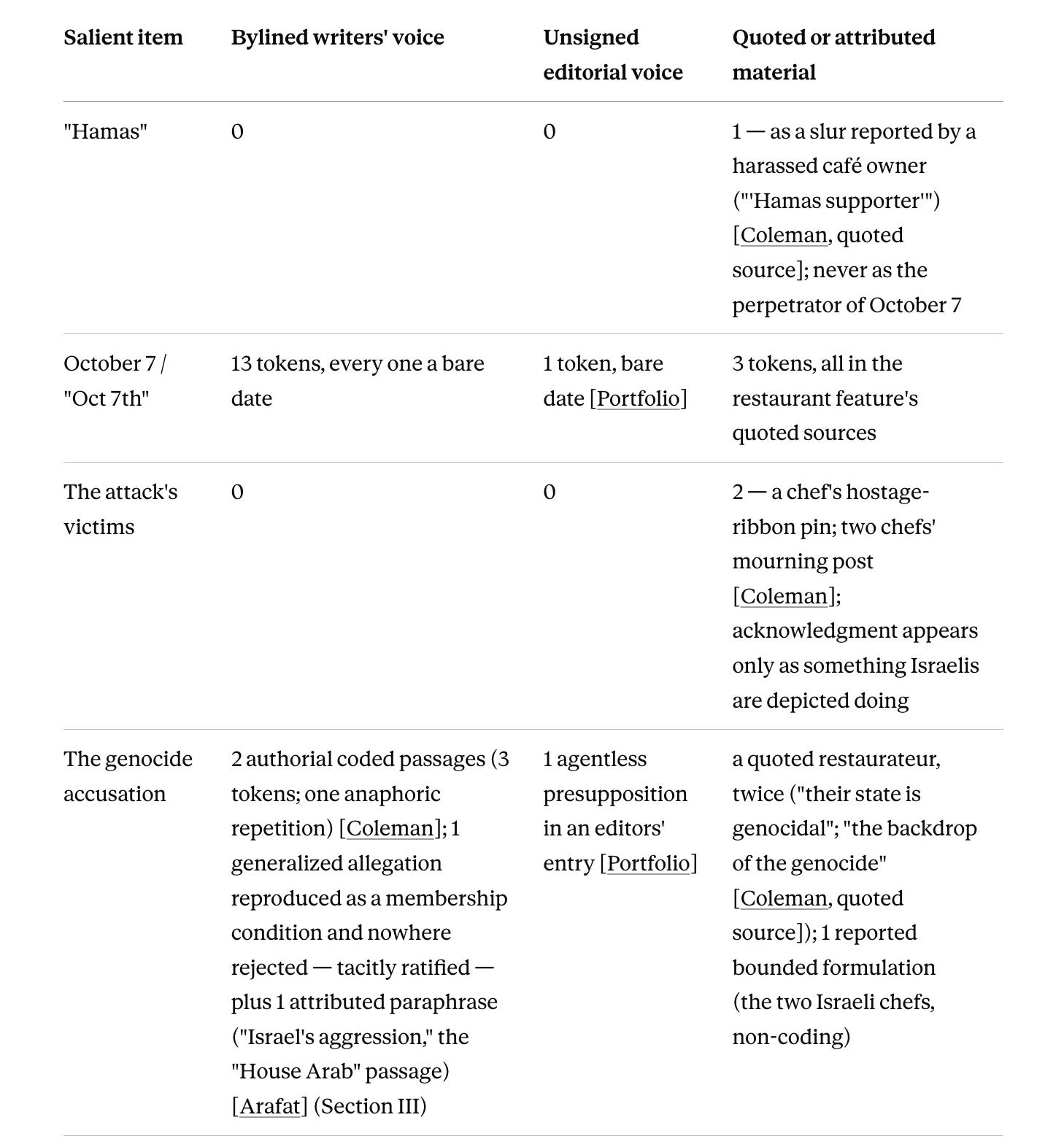
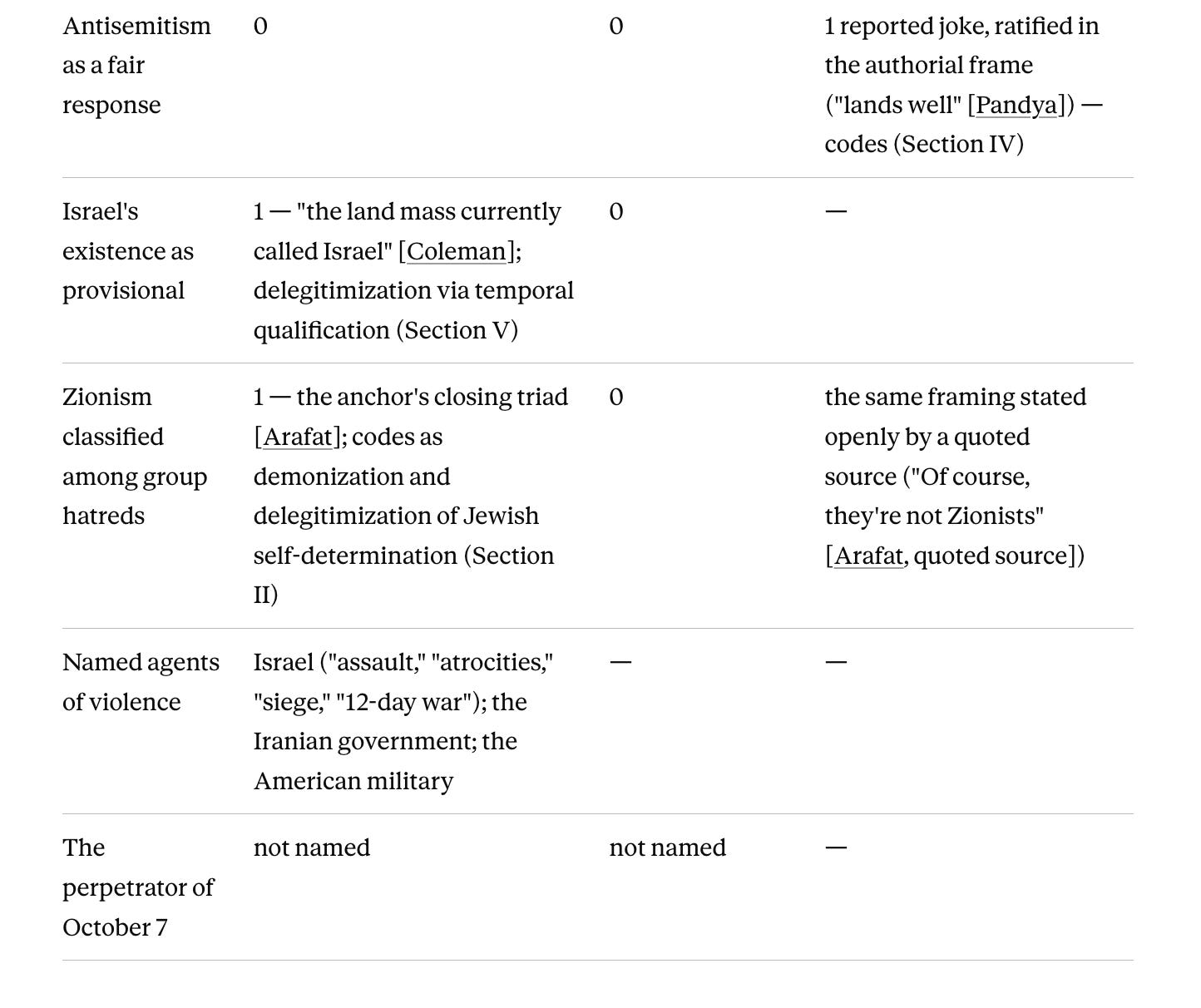
There is a third mode, slower and less satisfying, and it is the one this essay has tried to practice: a framework that can say where the line is, show which passages fall on which side of it, apply the same tests to every party including one’s own, and then continue past the line to describe what a text’s architecture does beneath its non-coding sentences. The distribution that mode has documented is summarized below, so that the whole of it is checkable at a glance; every row was verified against the live pages on August 15, 2026.
Read with the instruments this essay has demonstrated, “Habibi City” documents how a framing becomes normalized in prestige cultural journalism — a framing that does not announce a prejudice but makes an antisemitic interpretation more structurally available, through the asymmetric treatment of Israel and Israelis, and the exclusion of the region’s Jewish communities, running in the same direction. Normalization here means something specific and shown: a contested proposition moving from marked claim to unmarked background assumption — classification passing as description, an accusation arriving as background rather than as argument. A number of passages cross a conservative line into antisemitism itself. They sit embedded in a much larger body of clean sentences whose architecture runs in the same direction, published in the register of celebration, where structural asymmetry can pass as cultural description. The sentences are clean. The structure is not. Whether this mechanism characterizes the genre more broadly is a question for a larger corpus; its presence in this package is no longer a question. Whether it travels beyond the genre is a different question, and one comparison on record suggests it does: in a previous study, I analyzed the mayor’s June 18 championship rally — a civic celebration whose rhetorical center went to a federal lobbying organization and the war, as the Jewish Telegraphic Agency reported — under the same framework applied here. Establishing how far the mechanism travels is that larger corpus’s task, not this essay’s. What remains unbuilt is the public practice that can see it — patient, evenhanded, attentive to structure as much as to sentences, and willing to apply the same tests to every party, including its own. This essay is one exhibit of that practice. The package is one exhibit of why it is needed.