
"JEWMAXXING": How Clavicular's Online Community Received His Visit to Israel
Antisemitism as in-group discipline: six X threads on Clavicular's Israel trip, July 2026

AddressHate Research Scholar at NYU’s Center for the Study of Antisemitism | Lead, Decoding Antisemitism — PI, Decoding Hate | Research Advisor, AddressHate | Editor-in-Chief, Digital Hate Review

Special thanks to Emily Carmeli, President of AddressHate, for the original idea behind this case study.
Executive Summary
Between July 8 and 14, 2026, Braden Peters (“Clavicular,” b. 2005), one of the most prominent figures of the “looksmaxxing” subculture, visited Israel — streaming from Tel Aviv, visiting the Western Wall, and appearing alongside an IDF soldier who became the second target of the backlash. Six months earlier, Peters had made international headlines as part of the Miami nightclub group singing along to Ye’s “Heil Hitler.” His visit divided pro-Israel and Jewish public discourse between a pro-engagement camp — which hoped his enormous reach could carry positive impressions of Israel into a Gen-Z male milieu no conventional actor reaches — and critics who held that engagement conferred legitimacy at unacceptable cost. Yet much of the argument on both sides rested on assumptions about how Peters’ audience and surrounding online milieu would receive the visit. To our knowledge, no empirical analysis of the publicly observable reception attached to Peters’ own account existed. This study addresses that gap by examining the public reply sections attached to Peters’ own X account.
Research question: How did Clavicular’s own online community publicly interpret and respond to his visit to Israel? This is not a study of whether Peters himself changed; it is a study of how his community reacted when one of its central figures publicly affiliated with Israel.
We — Decoding Hate, the research hub at NYU's Center for the Study of Antisemitism, in collaboration with the think tank AddressHate — collected all replies recoverable from six X threads posted during the visit (1,215 unique authors) and annotated them as 1,379 analytical units — text, images, and memes, with longer replies split into separately coded sub-units — using the project’s peer-reviewed Decoding Antisemitism Lexicon (cited in full under Research design). Every borderline case was resolved through documented, corpus-specific rules.
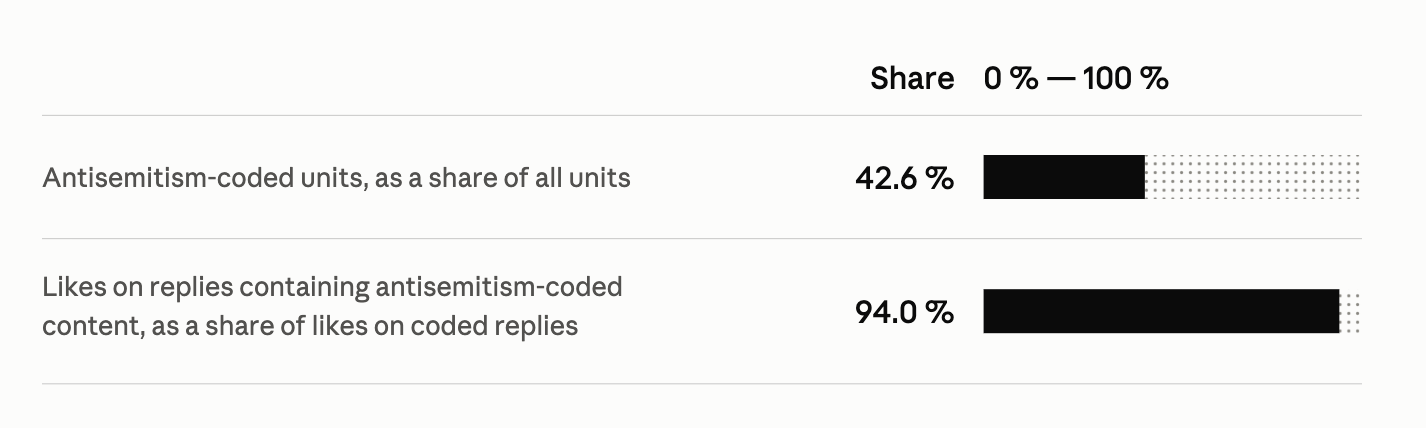
The findings reveal a clear overall pattern despite substantial variation across the six threads. More than two units in five (42.6 %) carry antisemitic content — and the engagement distribution was starker still: antisemitic replies received more than nine out of every ten likes recorded on coded replies (see Overall statistics). Antisemitism peaked at 59.6 % in the "STATUSMAXING" thread (X-4) and 58.2 % in the arrival thread (X-2).
And the antisemitic share does not exhaust the hostility: a further 5.9 % of units attack Peters or the trip with no group-based content at all — insults, hypocrisy charges, plain rejection — rising to 17 % once non-antisemitic servility and other group-based hostility are counted. These categories are mutually exclusive by construction and together account for roughly six in ten units (Table 1). What varies is not whether the visible reply environment rejected the visit but which vocabulary the rejection employed. Replies showing any genuine rethinking of Israel — surprise, curiosity, a revised view — are rare; where users defended anyone, they overwhelmingly defended Peters, not Israel, Israelis, or Jews. Within hours, the tone was set by the milieu’s two most famous voices. Their replies — declaring the trip career-ending, cursing Israel’s existence, and recasting Peters as a manipulated asset — drew approximately 54,000 likes combined and open the Introduction.
Four findings structure the analysis, and one conceptual claim organizes them: affiliation with Jews or Israel can itself become the trigger for the antisemitic reclassification of the affiliating non-Jew.
First, the dominant hostile storyline is not abstract “Jewish control” rhetoric but its personal application: Peters recoded as bought, captured, and honey-trapped, and finally declared Jewish himself (”Stfu jew,” “Kikevicular,” memes editing a kippah onto his head) — antisemitism deployed as a disciplinary tool against one of the community’s own, what this study terms in-group discipline.
Second, the same step-by-step pattern — disappointment, then “he’s being controlled,” then “the Jews control him,” then “he is one of them” — was documented in the reactions to Jordan Peterson’s Netanyahu interview (Becker 2024) and reappears here in a younger, more visual influencer milieu; the study calls it the dethroning arc.
Third, part of the outrage responds to events that never occurred: a fabricated photo of Peters with Minister Itamar Ben Gvir — watermarked by a self-labeled parody account — circulated as real and anchored a demonstrable cluster of hostile replies. Part of the factual ground these replies reacted to was synthetic.
Fourth, the antisemitism and the misogyny are not separate problems but one fused system: in the July 13 thread, 31 of 47 misogyny-coded replies are simultaneously antisemitic, and their primary target is the soldier — the only participant in the entire episode to face institutional sanction.
The answer to the research question, within the visible reply sections on Peters’ own account (one component of the visit’s reception, though the most public one), is stark: not new thinking about Israel, but conspiracy narratives, public punishment for the affiliation itself — what this study terms affiliation punishment — and, at the edges, open neo-Nazi imagery. The pattern is consistent with ideological self-stabilization performed in public: potentially disconfirming evidence was not ignored but repeatedly reinterpreted, visibly, through established narratives of capture, betrayal, and conspiracy.
Table of Contents
Introduction
The visit quickly became a national and international controversy. Israeli media reported Peters’ walkout from a Channel 13 interview when asked to apologize for the “Heil Hitler” episode (Jerusalem Post), the disciplinary action taken against the soldier who had appeared with him (i24NEWS, Ynet), and sharp disagreement among pro-Israel voices over whether engagement represented strategic outreach or irresponsible legitimization (JTA / Jerusalem Post); international coverage framed the episode variously as influencer diplomacy, reputational laundering, and a failed propaganda exercise, and by week’s end even a United States congresswoman had been asked to comment (Jerusalem Post). Within the debate, three positions crystallized.
Strategic engagement: Peters’ reach — approximately 2.2 billion third-party clip views in March–April 2026, per a marketing-affiliated and unaudited figure — extends into a manosphere-adjacent milieu whose encounters with Israel are otherwise mediated through conflict imagery, conspiracy narratives, and adversarial influencer culture, and whose discourse, as this project’s research documents, recurrently combines antisemitism, misogyny, racism, and homophobia with distrust of democratic values and a tendency toward authoritarian worldviews; as one Jerusalem Post opinion piece put it, “the alternative isn’t a better messenger. For most of this audience, it’s no messenger at all” (Gerstley, Jerusalem Post).
The legitimization critique: hosting Peters normalized a figure embedded in antisemitic and misogynist environments — a culture, in another Jerusalem Post op-ed’s phrase, that “mistakes influence for integrity” (Abramowitz-Silverman, Jerusalem Post).
The attention-arbitrage reading: the visit was neither diplomacy nor redemption but monetized controversy — Peters said openly that he came because Israel was trending and no major influencer had streamed from it. (The debate had a further, sharply gendered dimension, taken up below in the misogyny analysis, where it belongs.)
Across that debate, participants assumed something about how Peters’ own audience would respond. Supporters assumed exposure might soften attitudes — that nightlife, food, and friendships from Tel Aviv could reach a milieu whose image of Israel is otherwise entirely secondhand. Critics assumed the visit would normalize extremism or provoke further antisemitism. These claims pointed in opposite directions, and all of them were speculative: no study examined how Peters’ community actually received the visit. This paper is that study. Its question: how did Clavicular’s own online community publicly interpret and respond to his visit to Israel? Did users express curiosity or revise prior assumptions? Did they respond to ordinary scenes from Tel Aviv as potentially disconfirming experiences? Or did established narratives absorb the visit instead — recasting Peters as bought, controlled, sexually manipulated, or secretly a Jew?
On July 10, 2026, Peters announced his first Tel Aviv livestream: “Live on Kick! With special guest…” The reply section answered before the stream began. Dan Bilzerian, one of the manosphere’s most-followed figures, wrote: “Good way to destroy your reputation” — at approximately 26,000 likes the single most-engaged reply in the corpus. The comment contains no antisemitic keyword, no slur, no conspiracy claim; in the context of the thread, it presents contact with Israel as reputationally disqualifying. Sneako — Peters’ erstwhile associate from the Miami “Heil Hitler” episode — posted “Fuck Israel free Palestine” into the same thread (≈21,000 likes). Three days later, under Peters’ photo beside an Israeli soldier, Sneako supplied the conspiratorial completion: “You need to know that you were her assignment” (≈7,000 likes). Between these three utterances — rejection, delegitimization, capture — runs the arc this study will document across more than a thousand replies. The argument, stated at the outset: in this corpus, one major function of antisemitic repertoires — alongside, not in place of, the direct hostility toward Jews the corpus contains in abundance — is the disciplining of a perceived in-group member’s affiliation with Jews and Israel: antisemitic repertoires operating as a social technology for regulating the community’s own boundaries.
A word on scope. Reply data cannot measure silent viewers, private attitude change, or the full reception of the livestream; and three terms this study keeps distinct are worth fixing here: Peters’ audience includes millions who never comment; his milieu is the broader subcultural formation he belongs to; the reply environment is the observable discourse attached to his posts. This study analyzes the reply environment — exhaustively, within the replies recoverable at the time of collection — and infers from it only what a reply environment can show: how the visit was publicly interpreted, rewarded, rejected, and reframed in the space attached to Peters' own account.
Because several of this study’s terms are related but not interchangeable, their hierarchy is stated here once. Affiliation punishment is the overarching social process: the public sanctioning of an individual for establishing, or appearing to establish, social proximity to a stigmatized group. The process is general; this study analyzes its antisemitic form — affiliation with Jews or Israel, hereafter simply affiliation. In-group discipline is that process’s social function — what the punishment accomplishes for the community that performs it. The dethroning arc is the recurring sequence through which the process unfolds in this and comparable corpora. Reclassification is the mechanism of identity reassignment operating within that sequence, and judaisation is its strict antisemitic form — the rewriting of the non-Jewish target as Jewish. When later sections use one of these terms, they refer to that level of the hierarchy and no other.
Dataset
The corpus consists of all replies recoverable from six trigger posts on Peters’ X account (@Clavicular0) at the time of collection (July 15, 2026): replies from 1,215 unique authors, posted July 9–15. The collected material was annotated exhaustively. The six threads, chronologically: a July 9 post from the hours before the trip became the dominant topic of his reply sections (138 units), the July 10 arrival announcement (359 units), Peters’ apolitical defense of later that day (358 units), the July 11 “STATUSMAXING” post (141 units), the July 13 critique of Israeli media coverage (121 units), and the July 13 post beside the IDF soldier (262 units): 1,379 annotated units, of which 16 % carry attached media, inspected wherever recoverable. The corpus flow, stated once: all recoverable replies from the six threads were collected on July 15 and segmented into 1,379 adjudicated analytical units — longer replies containing separable quoted material were divided into separately coded sub-units — which form the quantitative results reported in the tables. Units are individual X replies, with attached media coded as part of the same unit under the same annotation protocol, quoted material coded against the replying author’s stance, and author handles logged as a separate signal layer rather than as unit content; one unit counts once toward prevalence regardless of how many codes it carries. Media items were inspected wherever recoverable; units whose media could not be retrieved are excluded from visual analysis and marked as such. All comments are quoted verbatim; author handles of private individuals are not republished in public outputs, and the soldier is referenced only through the already-public record. A legal note: Peters is the defendant in a pending civil lawsuit alleging sexual assault of a minor, which his counsel denies; no criminal charge exists, escalated versions of these allegations circulate in the reaction discourse, and this study treats all such circulating versions as rumor artifacts — objects of analysis, never statements of fact.
A note on platform selection. X hosted the most directly attributable and methodologically recoverable public response to Peters’ own trip-related posts. The trip’s video content ran on Kick, but livestream chat is ephemeral — it scrolls in real time, carries neither stable threading nor per-message engagement metrics, and no complete and verifiable archive was available to the research team. Peters’ Instagram presence contributed only a handful of tangentially related posts during the trip window, generating no comparable reply discourse; and YouTube carried the episode mainly through third-party clip channels, whose comment sections react to a re-uploader’s framing rather than to the influencer’s own speech acts (the project’s YouTube-based studies — the Antisemitism in Real Time series, the Kirk analysis, Catchy Hatred — cover that reception mode; this study deliberately extends the research line to X). The choice of X is therefore methodological, not residual: Peters’ account hosted the trip’s discursive events themselves — the announcements, the apolitical defense, the soldier photo — with public reply threads attached directly to his posts, stable URLs and timestamps enabling temporal analysis, and public like counts enabling the engagement-weighted measures reported below. X provided the only directly attached, stable, and retrospectively collectable reply corpus identified for this study.
Research design
Annotation was conducted by the Decoding Hate research team following the linguistic and multimodal close-reading protocol of the AiRT series, guided by the DA Lexicon (Becker et al. 2024). In contrast to previous Decoding Antisemitism and Decoding Hate studies, which typically annotate a defined sample of each comment section (on the order of 100–200 units per thread), this study annotates the entirety of each collected reply section — every reply in each of the six threads, exhaustively rather than by sampling — which removes selection effects within threads and permits genuine thread-level comparison. Annotation proceeds at the unit level with three layers per unit: track, i.e. the hate ideology addressed (antisemitism; misogyny; other group-based hostility; supportive/counter-speech), concept(s), i.e. the stereotypes and other imagery drawn from the antisemitic or other repertoire, and register (explicit / coded / co-textual, with a separate visual register for media-borne concepts). Two corpus-specific coding decisions require statement. First, bare servility allegations — “sellout,” “how much do they pay you” — without ethnoreligious or conspiratorial markers are tracked as their own register (the individual-scale analogue of the subordination frame in Becker 2024 and 2026b) and are not counted as antisemitism; they upgrade only where the mechanism recruits Jewish-money, goy-servitude, covert-control, or soul-devil concepts. Second, Israel-directed slogans, toponym erasure, and legal-institutional atrocity framings are coded in this corpus as delegitimization of the Jewish state: addressed to an influencer’s lifestyle stream rather than to news coverage of a war, such utterances can be read, in this interactional context, as performing pariah-marking rather than policy advocacy. In this interactional setting the delegitimization family is a constitutive part of the corpus’s antisemitism, not an adjacent category, and it is counted as such; because the boundary is drawn differently from AiRT Part IV (§ Forms of Rejection), where the same forms appear in news-commentary contexts, the decision is documented here explicitly. A further category, adjudicated for this corpus: units performing rejection over the visit — unfollowing, “stay there,” career-over declarations — are coded as affirmation of (Israel-related) antisemitism only where the context independently supplies the Israel-as-pariah norm these units enact — the unit replies to or endorses an antisemitic proposition, carries a group marker or recognized formula, or its author or attached media establishes the referent in the local exchange; generic rejection that cannot be contextually resolved remains affiliation punishment outside the antisemitism count. For Table 1’s summary rows, the definitions are: rejection without antisemitism covers units coded as attacking Peters or rejecting the trip — insult, mockery, hypocrisy charges, dismissal, staged-stream claims, political critique — including those carrying servility or other group-based hostility, but no antisemitic or misogynistic content and neither supportive nor counter-speech coding; its narrower core, units with no group-based coding of any kind, comprises 81 units (5.9 %). Both rejection rows count only units affirmatively tracked as hostile or critical during annotation: replies whose hostility was incidental to an otherwise untracked unit — passing mockery, hypocrisy asides, generic insult without a coded stance — remain outside the count, so the rejection figures, and the cumulative hostile-in-any-register row built on them, are conservative floors rather than exhaustive tallies of negative sentiment. Hostile in any register is the sum of the antisemitic and rejection rows, which are exclusive by construction. Supportive covers units endorsing Peters — his take, his conduct, or the visit; units welcoming the visit or speaking positively of Israel itself form the Israel-positive subset discussed under Overall statistics (the apolitical-defense thread’s large supportive bloc endorses Peters’ right to silence, not Israel). Counter-speech covers units contesting the hostile discourse itself — naming or pushing back on the antisemitism — including critical Jewish and Israeli voices rebuking Peters’ prior conduct; pro-visit endorsements are not counter-speech and are counted as supportive. Affirmation of an antisemitic norm is part of the phenomenon, and the corpus counts it accordingly. Attitude revision was coded only where a unit met at least one defined indicator: explicit surprise, explicit revision of a stated prior view, acknowledgment of a previous misconception, a humanizing observation about Israelis or Jews as people, or admiration replacing prior hostility; absence of these indicators, not impressionistic reading, grounds the finding that such units are rare. We adjudicated every boundary class against a documented, corpus-specific rulebook to ensure internal consistency. A language model (Claude Fable 5, Anthropic) was used to structure and organize the discourse material and the research team’s working notes; it did not determine inclusion or make final coding decisions — all analytical categories, boundary rules, and adjudications follow the project’s expert annotation framework and were reviewed by the research team.
Empirical findings
Overall statistics
Across the 1,379 units, 42.6 % carry antisemitic content, with sharp variation by trigger: 58.2 % in the arrival thread (X-2), 59.6 % in the "STATUSMAXING" thread (X-4), 37.8 % in the thread beside the soldier (X-6), 30.4 % in the pre-trip July 9 thread (X-1), 33.8 % in the apolitical-defense thread (X-3), and 27.3 % in the media-critique thread (X-5). The last two carry the corpus’s two sizeable supportive blocs — 24 % and 22 % — supporting, in each case, Peters’ stance rather than Israel. A further tenth of the corpus carries the servility register (including units co-tagged with antisemitism); homophobic, transphobic, ableist, racist, and anti-Muslim content without a Jewish/Israel referent runs throughout; counter-speech totals about 1.5 %. The range extends to open neo-Nazi iconography and far-right meme culture in a mainstream reply section: the arrival thread carries a photograph of what appears to be George Lincoln Rockwell, founder of the American Nazi Party, captioned “No one cares about your jew bullshit” — and around it circulate Pepe the Frog variants, the “happy merchant” caricature, Hitler-valorizing macros, and Nazi meme templates, the standard visual repertoire of far-right online spaces surfacing in the reply section of a lifestyle influencer (the visual layer is analyzed in §10). Two prevalence figures must be read together, because they measure different things. Counted by unit, with every analytical unit weighted equally, 42.6 % carry antisemitic content. Counted by attention, the picture inverts: of the roughly 113,700 likes recorded on coded replies across the six threads, 94 % sit on replies containing antisemitism-coded content; under the corpus-specific rules documented above — including contextual affirmation of an antisemitic pariah norm — all ten of the corpus’s most-liked replies are antisemitism-coded, and the top fifty carry over 90 % of their combined like-mass on antisemitic units. Antisemitism is not the majority of voices in these threads, but it is the overwhelming majority of attention: the 42.6 % measures prevalence across units; the 94 % measures its share of engagement recorded on coded replies. Although like counts do not reproduce X’s ranking algorithm, their concentration shows that antisemitic replies occupied the most publicly rewarded layer of the discussion — and the concentration holds at every level: nearly every reply above 400 likes across the hostile threads is antisemitism-coded, affirmation-coded, or servility-coded. (Like counts as recorded at collection.) This visibility pattern is partly a function of who posted — several of the highest counts belong to major accounts whose reach precedes any single reply — so we treat it as evidence about which replies were most publicly rewarded and therefore likely to be especially visible, not as a measure of ideological distribution among ordinary users.
Figure 1. The visit as a sequence of triggers: antisemitic share of replies by thread, in posting order (bars show share of 100 %).
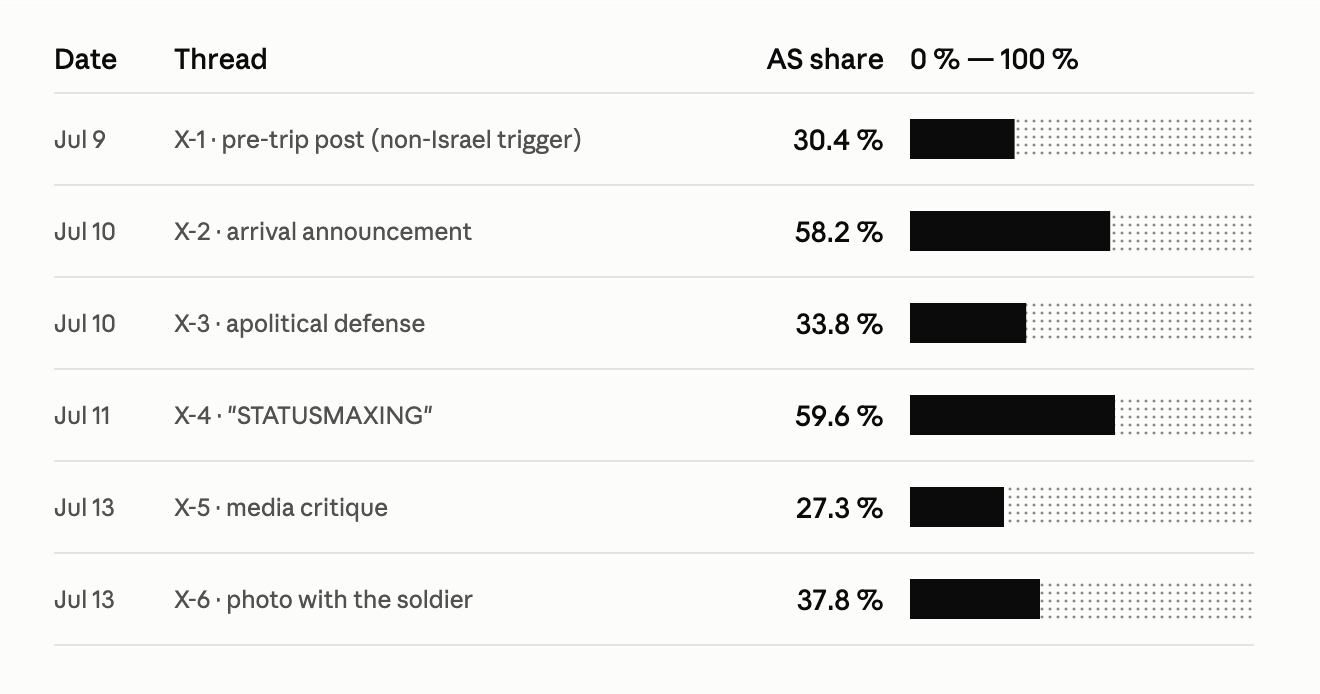
The rate varies sharply with the trigger — the threads also differ in timing, participants, and reach, so the variation is descriptive rather than causal: it more than doubles between Peters' apolitical defense and his status performance one day later, and even the pre-trip thread — whose trigger has nothing to do with Israel — reaches 30.4 % once the Israel frame saturates his reply sections. The corpus's lowest rate, 27.3 %, appears in the media-critique thread, which also contains one of the study's two sizeable supportive blocs.
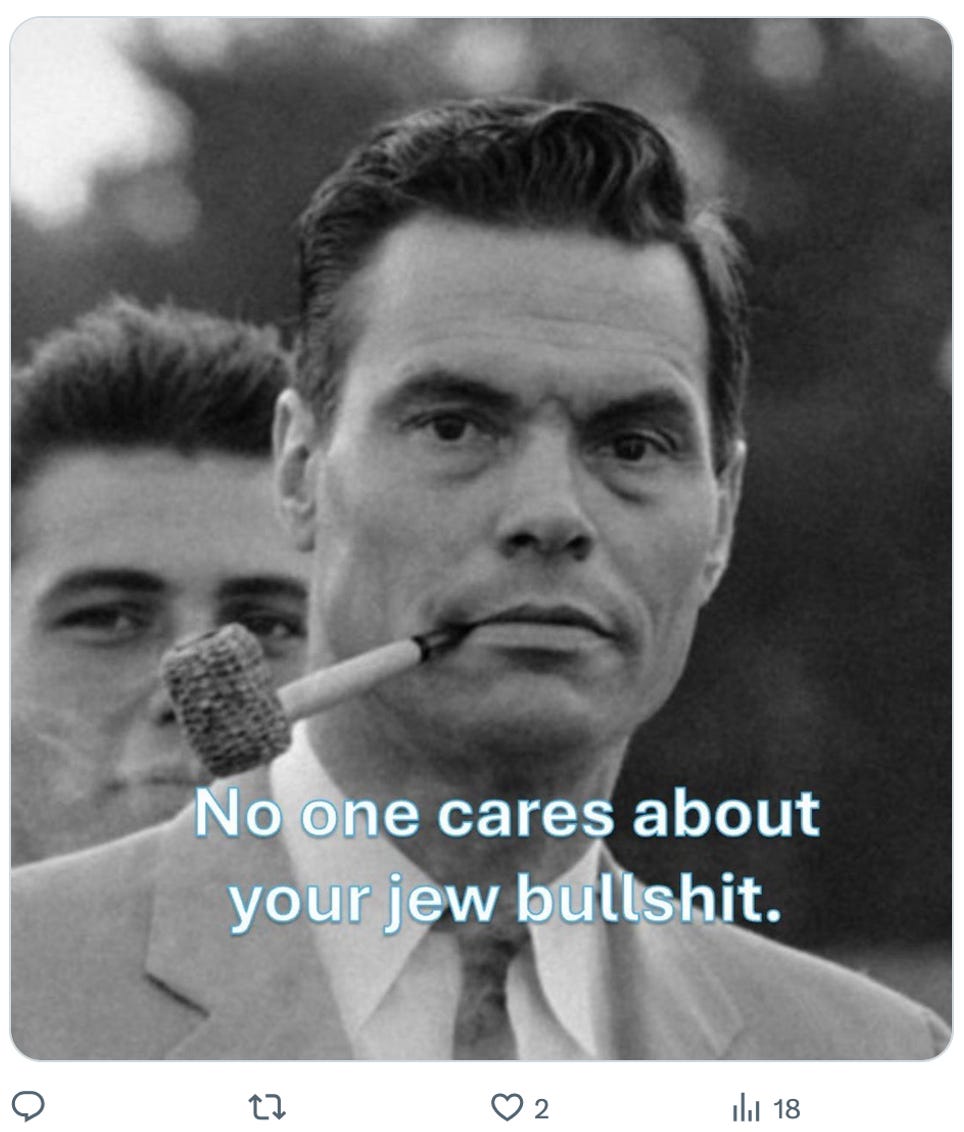
Figure 2. What was said vs. what was rewarded (six threads; bars show share of 100 %).
A further register must be read alongside these: 81 units (5.9 %) attack Peters or reject the trip without any group-based content at all — hypocrisy charges, insults, staged-stream claims, plain political critique — rising to 234 units (17.0 %) when units carrying servility or non-antisemitic group hostility — but no antisemitic or misogynistic content — are included (Table 1). This register matters twice over. First, it shows that hostile criticism of Peters without antisemitism was a fully available, well-populated option in this discourse — the 42.6 % who reached for antisemitic material were making a marked choice, not following the only script on offer. Second, it identifies the reservoir: the non-antisemitic rejection register shares its grievance structure with the antisemitic one — sellout, hypocrite, fallen idol — and that structure can at any point be filled with antisemitic concepts, as the pre-trip thread's intra-day escalation, documented below, demonstrates. The plain attacks are not the opposite of the antisemitic ones; they are their recruitment surface.
The other side of the ledger is small but must be reported with the same care. The adjudicated corpus contains 136 supportive units (9.9 %) and 21 units of explicit counter-speech (1.5 %) — users directly contesting antisemitic replies. Supportive units concentrate principally in the apolitical-defense thread (85 of 136), with a second bloc in the media-critique thread (26), and its content is revealing: it consists overwhelmingly of in-group loyalty to Peters — defense of him against his critics — rather than endorsement of the visit, positive statements about Israel, or any revision of prior views. The bloc’s top unit is exemplary: “This is genuinely the best take I have seen from a 20 year old” (≈574 likes) endorses his right to silence, not the country he was standing in. Only units that speak positively of the visit or of Israel itself — “Have a great time! Enjoy Israel just like you would enjoy any other awesome vacation destination” (≈436 likes) — actually push against the pariah norm the antisemitic registers enforce, and these are a small minority within this already small bloc. Counter-speech, at roughly 1.5 % of the corpus, was outnumbered by antisemitic units by roughly 28 to one.
The July 9 thread sharpens the picture from its edge. Its trigger concerns alcohol advice and a statement about a Miami club — not the trip — and its replies from the morning of July 9 run 15 % antisemitic, in the thread’s native register of drug-hypocrisy mockery. From that afternoon onward, as news of the Israel trip saturated Peters’ environment, the same thread’s rate climbs to 37 %: reclassification, collective-marker formulas, slogans, and an Epstein–Mossad blackmail attribution flood a conversation about nightclub liability. The Israel frame did more than dominate the Israel threads: it became salient even within a thread whose original trigger concerned something else entirely.
Table 1. Corpus overview and headline rates. Each cell shows n (within-thread %); corpus column shows n · share of 1,379. Rejection, core = hostile/critical units with no group-based coding of any kind; Rejection, broad adds units carrying only servility and/or other-group hostility tags; both are exclusive of the Antisemitic row, and the Hostile row sums the Antisemitic and broad-rejection rows. Threads chronological: X-1 pre-trip post (Jul 9) · X-2 arrival announcement (Jul 10) · X-3 apolitical defense (Jul 10) · X-4 status performance — trigger word “STATUSMAXING” (Jul 11) · X-5 media critique (Jul 13) · X-6 photo with the soldier (Jul 13).
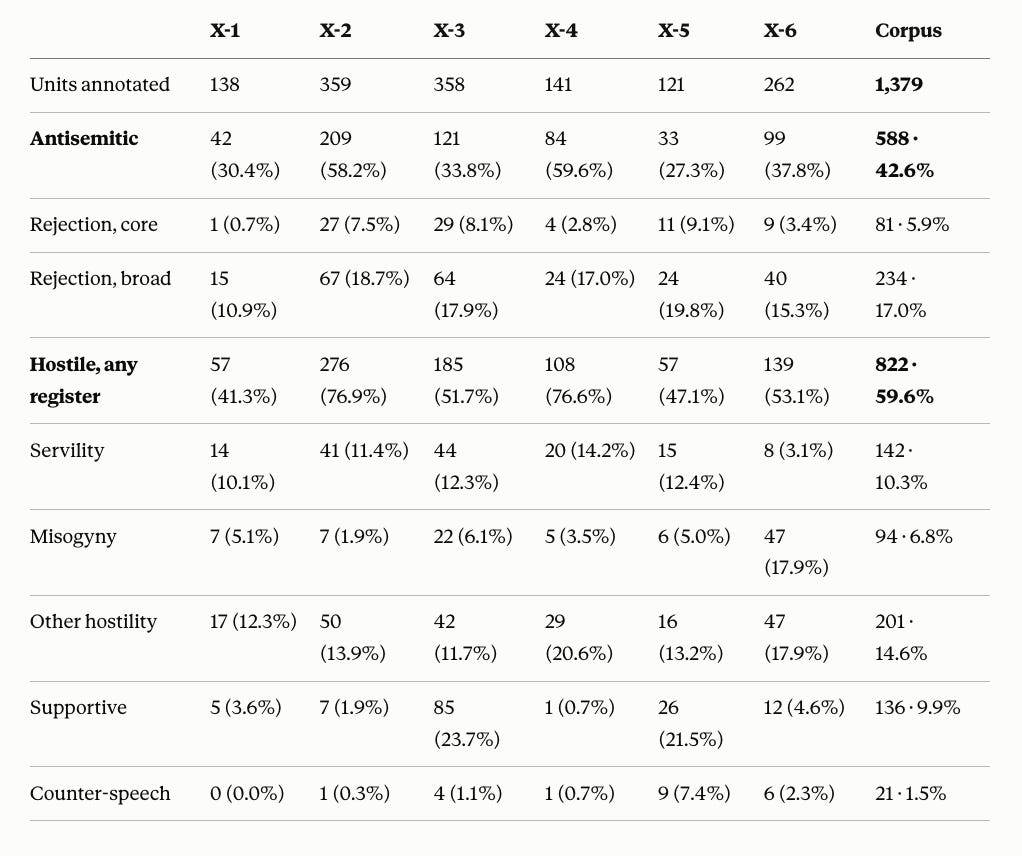
Most-engaged coded reply per thread: X-1 “Jew cock sucker” ≈ 12 · X-2 “Good way to destroy your reputation” ≈ 26K · X-3 child-torture attribution ≈ 4.2K · X-4 “JEWMAXXING” ≈ 7.9K (8:1 over the 1K trigger) · X-5 welcome-to-the-club reclassification ≈ 98 · X-6 “you were her assignment” ≈ 7K.
Multi-track units are counted in every applicable register row; percentages are of thread n. Row definitions: see Research design.
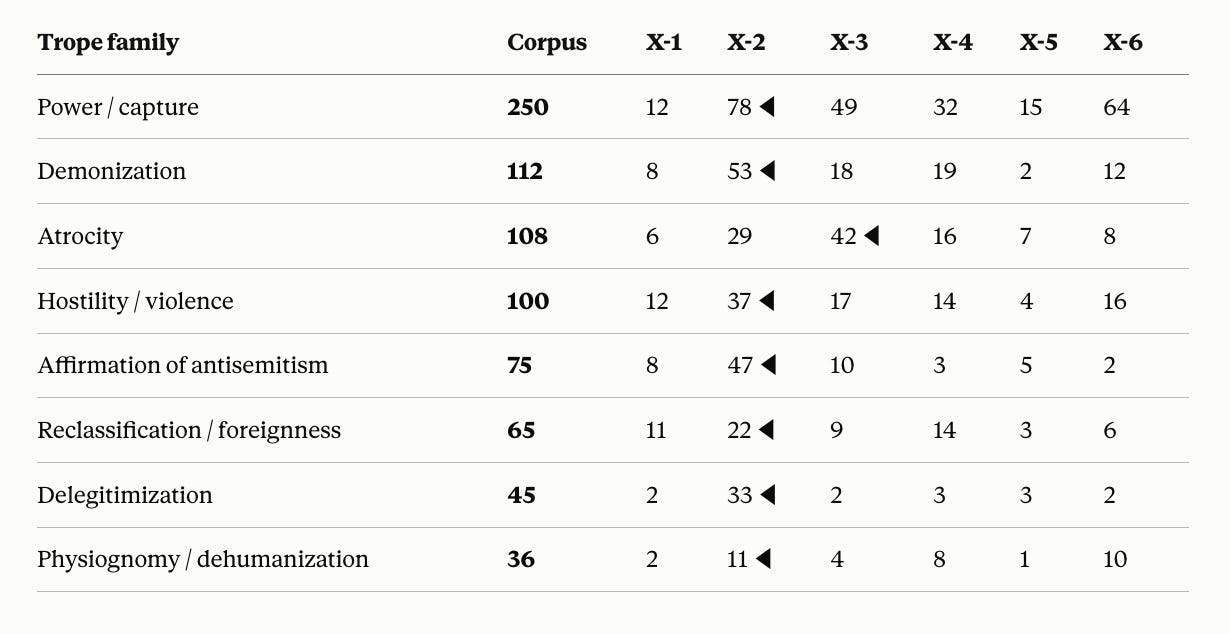
Table 2. Antisemitic trope families by thread — what dominated where. AS-coded units; multi-label counts; thread columns chronological (thread key as in Table 1). ◀ = the family’s highest-frequency thread. Families aggregate DA taxonomy concepts — power/capture: power, conspiracy theories (AS-C2-2, AS-C2-3); demonization: evil & moral corruption, religious antisemitism (AS-C1-2, AS-C1-5); atrocity: genocide, terrorist state, Nazi analogy, blood libel & child murder (AS-C5-5, AS-C5-4, AS-C5-1, AS-C1-3); hostility/violence: insults, threats, death wishes, deportation/exclusion commands (AS-C6-1, AS-C6-2, AS-C6-4, AS-C6-8); affirmation of antisemitism (AS-C4-3); reclassification/foreignness (AS-C1-1); delegitimization: denial of Israel’s right to exist (AS-C5-7); physiognomy/dehumanization (AS-C1-4). A unit counts once per family regardless of how many of its codes it carries.
In one sentence: the arrival announcement concentrated nearly every register, the self-defense drew the atrocity charges, and the woman drew the misogyny-fused conspiracy.
The registers in detail
The subchapters below present the qualitative material in two blocks. Sections 1–3 document the disciplinary registers aimed at Peters himself — capture, servility, reclassification and expulsion — in the order of the dethroning arc they compose. Sections 4–6 document the image of Israel that licenses that discipline — atrocity, demonization, delegitimization — escalating from alleged acts to attributed essence to denied existence. Sections 7–10 then treat the fusion registers (misogyny, homophobia) and the carrier layers (lexicon, visuals) that run through both blocks. Within this structure the ordering broadly tracks corpus frequency (Table 2): the power register is the largest family, and the servility register is reported directly after the power register it scaffolds.
1. Power and conspiracy: the capture of a gentile
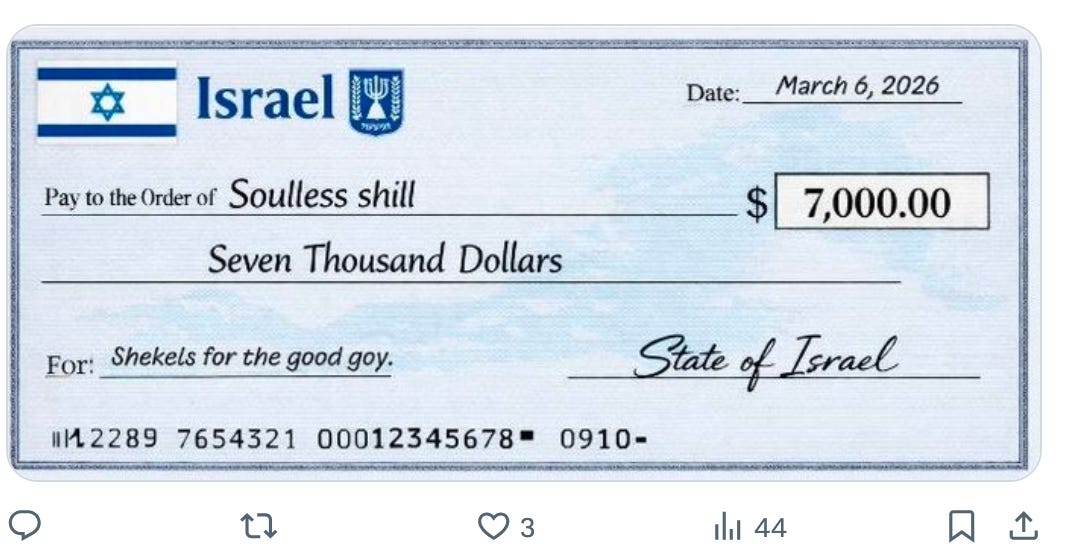
The dominant register personalizes Jewish-power conspiracy as the capture of the affiliating gentile. In the arrival thread the mechanism is economic — purchase, shekels, orchestration:
“Pick a Goy and have him push the body dysmorphia agenda. But we’ll call it looksmaxxing.” (≈2,800 likes — a protocols-format fabricated quote attached to a photo of a Haredi man with a walkie-talkie)
— flanked by an Epstein-blackmail warning and, at the fringe, historical-conspiracy stacks (USS Liberty, JFK). The repertoire’s historical depth surfaces in a single aside, a medieval canard revived intact in a Gen-Z reply section:
“Careful with your coins, they might clip them.”
The capture claim also takes its most bodily form — the influencer as a literally operated object:
“A sea of kikes and you’re some billionaire jew puppet, your fame is fading buddy. More like puppet maxxing, get the hand out of your ass, loser.”
The puppet figure renders the control thesis physical: not influenced but operated, a body with a hand inside it, in an environment described through the slur as an immersive mass (”a sea of kikes”). The unit stacks four registers in two sentences — slur, puppet-servitude, the “-maxxing” morphology, and the fame-loss verdict — a compact demonstration of how the capture, carrier, and total-loss layers travel together.
Three days later, once a woman entered the frame, the mechanism turned sexual-conspiratorial: the honeypot/handler/”assignment” complex dominates the July 13 thread (31 units), from full articulation down to bare two-word formulas — a frame lexicalizing in real time:
“You need to know that you were her assignment.” (Sneako, ≈7,000 likes)
“she’s telling someone else everything you say to make sure you’re not a spy”
“Honeypot maxing”
The handler figure is not left abstract: the corpus names one. The rabbi publicly reported as the visit’s facilitator is recast, in the reply sections, as an intelligence officer running an asset:
“call @FarroYossi for permission. You’re handlers”
Around this core, the register runs the full scale of explicitness — from two-word capture celebration to fully engineered-world paranoia:
“They got em boyz”
“he is being programmed by the folks around him”
“a hollow facade engineered to manipulate children…” (≈46 likes — the industry itself as an engineered deception, agent unspecified at saturation)
And the register has its emblem. The arrival thread carries the classic control-iconography of the tradition, unmodified: a serpent marked with the Star of David strangling the American eagle.

Jewish power figured as a snake choking the United States — the visual grammar of a century of antisemitic caricature, reposted into a Gen-Z reply section.
The narrative also has a long-game variant, the fully articulated infiltration timeline: Peters as a plant rather than a purchase, his role to defuse the awakening at its critical moment:
“The s guys a jew asset. He will trickle bullshit out there trying to slowly manipulate until right when the goyim are coming together to fight against tiny hats then say some shit like jews are our friends”
And the capture narrative has a terminus. In its completed form, the asset, once used, is liquidated — the corpus repeatedly forecasts Peters’ death at the hands of the power that allegedly bought him, and it has already verbified the scenario through the killing of Charlie Kirk, whose digital afterlife this project analyzed in an earlier study:
“Get ready to be Charlie Kirked.”
“After your botched nose job, if you suddenly die we genuinely won’t know if it was Mossad or if you actually killed yourself.” (≈18 likes)
“She’ll be running your podcast within 2 yrs while we argue over how much you loved Israel before your exploding face puff powder death”
The verbified Kirk conspiracy is not this corpus’s invention but the newest entry in a long lineage of assassination attributions: the JFK killing laid at Israel’s door (present here in its own right — “JFK died for this”), the Epstein “didn’t kill himself” formula, whose logic the Mossad-or-suicide unit above reproduces exactly, and, most recently, the preemptive “Remember, Dan is not suicidal” declarations that circulated around Dan Bilzerian, analyzed in an earlier study from this project. The corpus even closes that loop: Bilzerian himself — the figure around whom the not-suicidal formula was coined — appears in these reply sections as the single most-liked voice (§3).
Taken together, these formulas construct a sequence running from purchase through capture and use to liquidation — the shape of the corpus’s largest trope family (250 units, Table 2). The conspiracy grants its target no exit, a point the expulsion analysis below (§3) returns to.
One temporal detail deserves emphasis. The photo with the soldier — the ostensible “evidence” for the honeypot claim — was posted July 13. But the corpus contains the same frame four days earlier: a July 9 reply already casts Peters as controlled by a Jewish girlfriend (the unit is presented in §7), at a point when no woman had yet appeared in his trip coverage at all. The honeypot narrative was not inferred from the photo; it existed before its evidence did, and the photo was slotted into it. A possible second early instance within the July 13 thread itself is under timestamp verification.
2. The servility register — the antechamber
Directly adjacent to the conspiracy register, and deliberately reported beside it, sits the bounded servility discourse:
“Sellout.” (≈105 likes)
“What a money whore”
“You really selling yourself HARD, dont ya”
“Dumbest decision you’ve made so far.”
These units name no Jewish mechanism and are not coded as antisemitism — but they supply the narrative scaffolding on which the coded units build, as in the Peterson and Trump-era corpora (Becker 2024, Group B1; 2026b). The correlation is the point: in both threads, the servility register and the capture register tell the same story at two levels of explicitness, and individual commenters move between them freely. Where the servility register names its mechanism — shekels, “good little goy,” a soul sold (the soul-transaction necessarily supplying a devil as counterparty) — it crosses into the coded corpus. The crossing point has its own codeword:
“The final boss of humiliation rituals. Fucking pathetic” (≈81 likes — “humiliation ritual,” the far-right formula for degrading acts demanded of public figures by a hidden power: the sellout charge upgraded into orchestration)
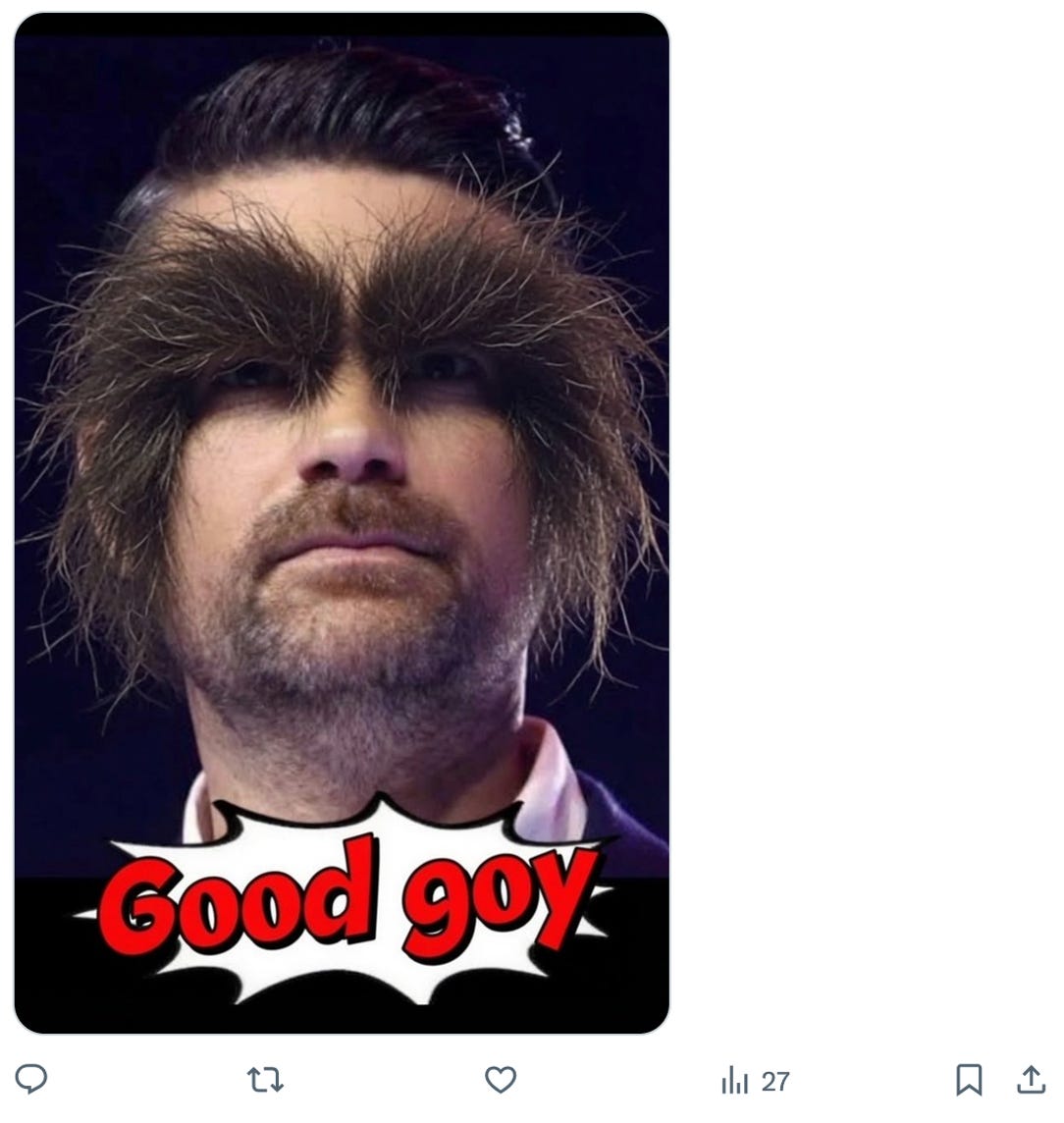
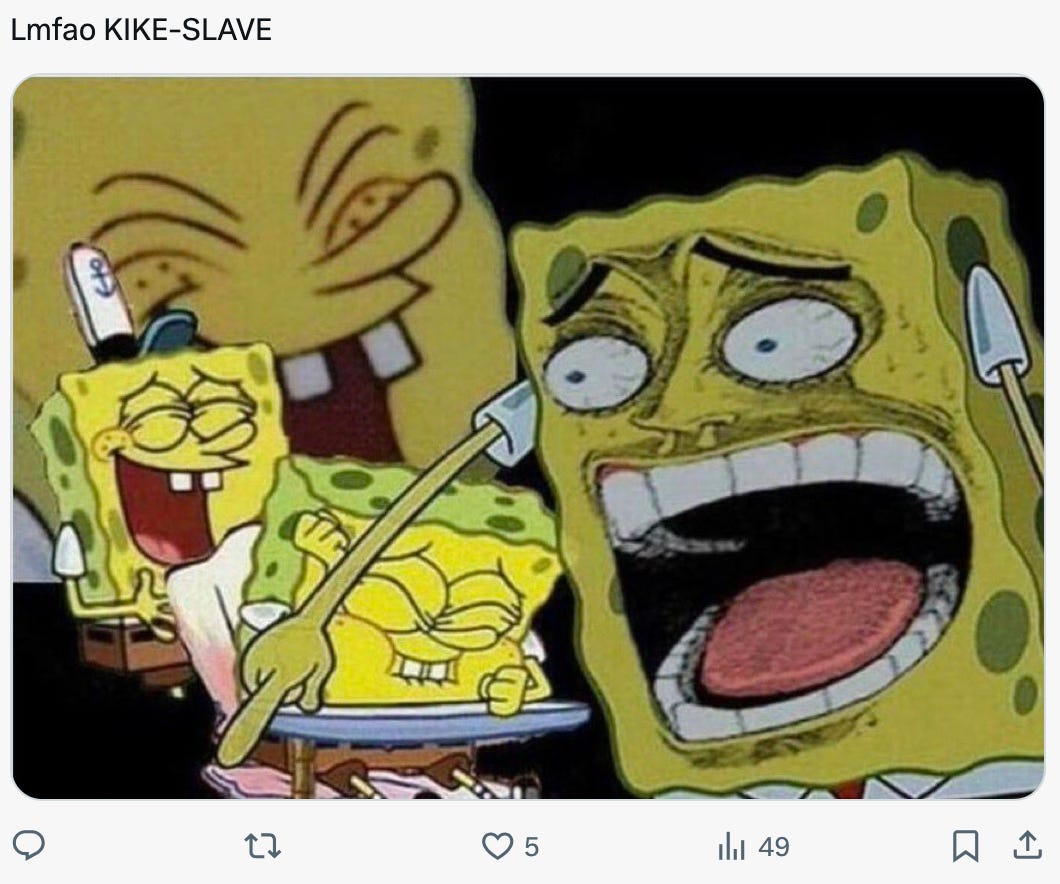
3. Reclassification: the gentile expelled
A boundary note before the material: judaisation — in the strict sense defined in the Introduction — operates here through slurs, names, attributed religious markers, physiognomic stereotypes, or manipulated imagery, a pattern first documented at scale in the reactions to Jordan Peterson’s Netanyahu interview (Becker 2024). It does not cover every capture claim or purchase allegation: capture denies the target’s autonomy; judaisation rewrites his attributed identity; expulsion removes him from the in-group. The three are stages of one broader process — affiliation punishment, as defined in the Introduction — whose social function this study calls in-group discipline.
The corpus documents a recurrent, multi-stage apparatus for expelling the affiliating gentile from gentile status. Onomastics — the same suffix-Jewification pattern as “Juden Peterstein” in the Peterson corpus and “Trumpstein” in the Trump corpora:
“Kikevicular” (≈490 likes)
“Claviculberg”
Direct address:
“Stfu jew” (≈730 likes)
“we know you are a kike, stop capping”
“Aren’t you Jewish you psyop” (posted July 9 at 07:26, hours before the arrival announcement — the crypto-Jew question live on day one, and already fused with the asset frame)
“Sell out. You used to call out the shabbos goyim. Now you are one.” (the canonical servitude concept — the shabbos goy, a gentile in Jewish service — deployed as a before/after verdict: the entire dethroning in eleven words)
The apparatus then turns visual, the reclassification performed on Peters’ own appearance:
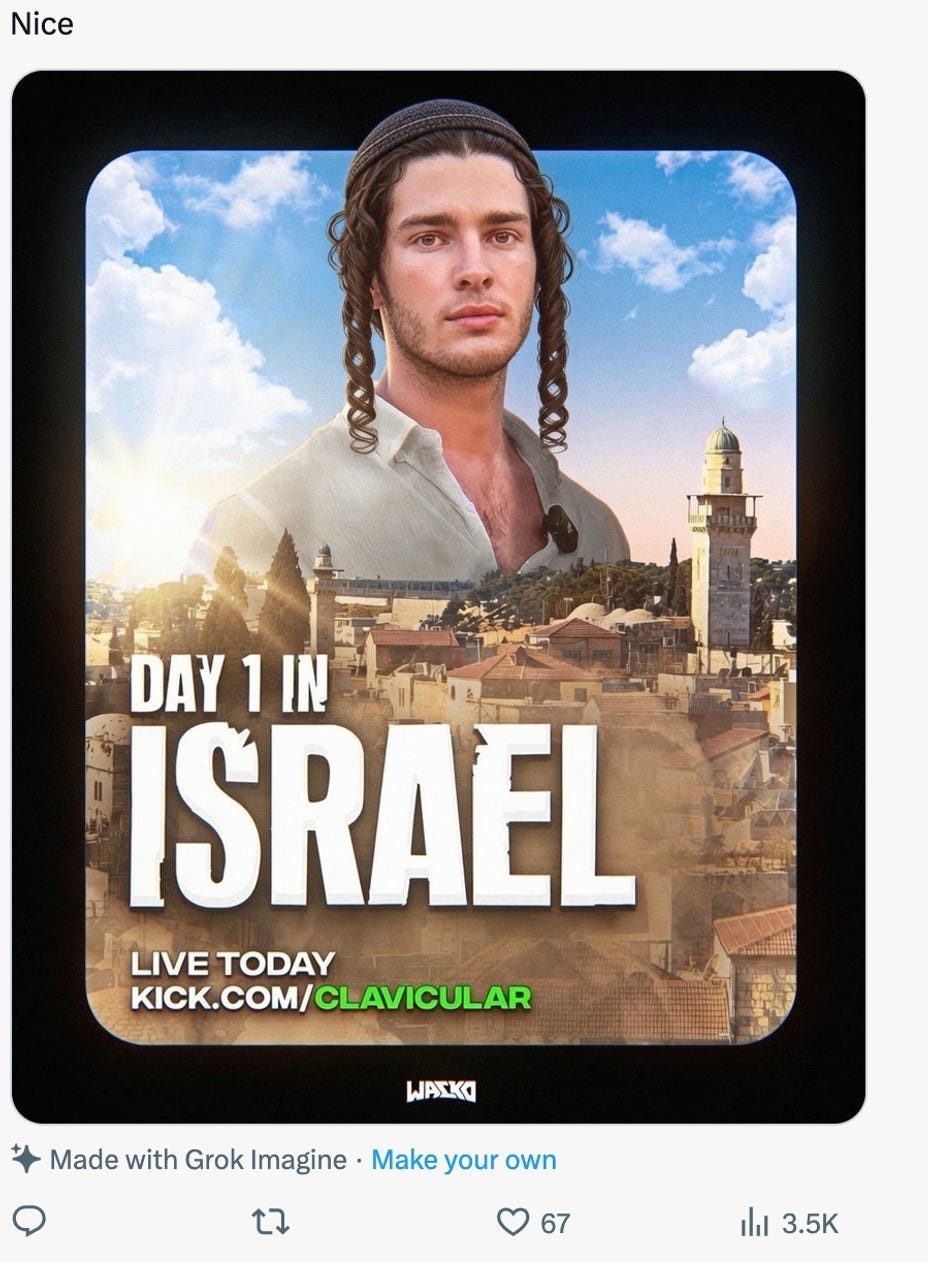
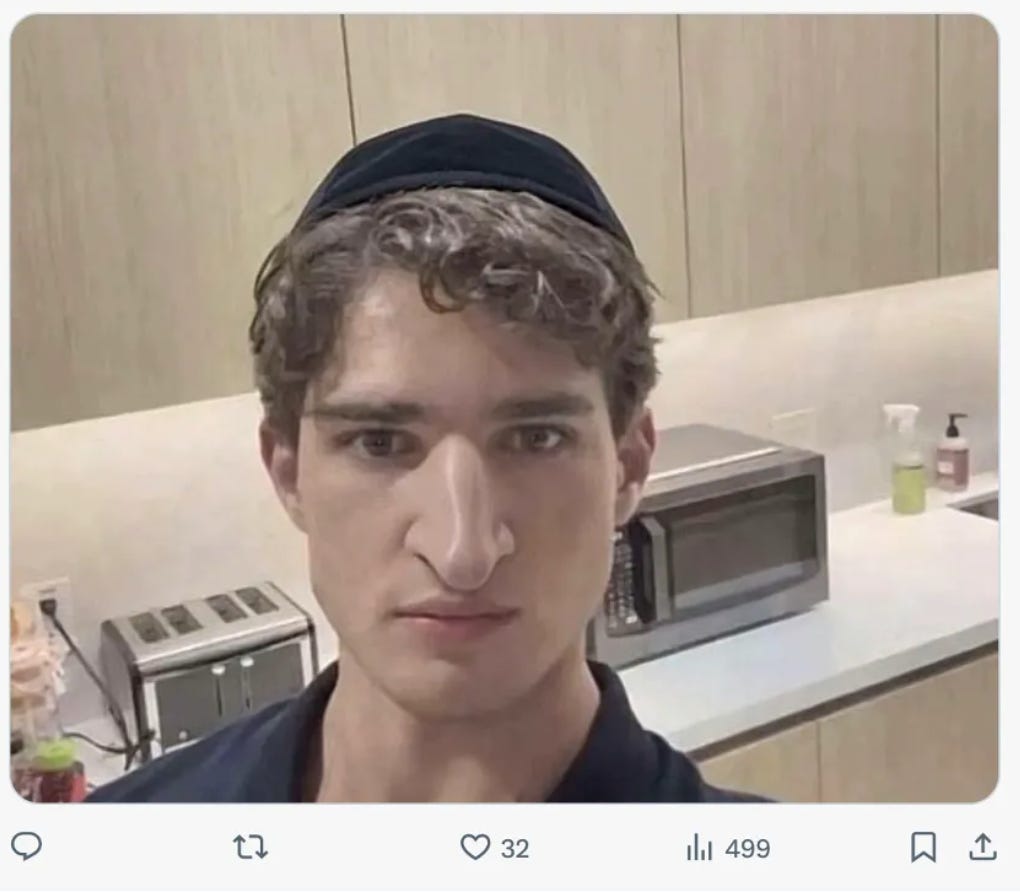
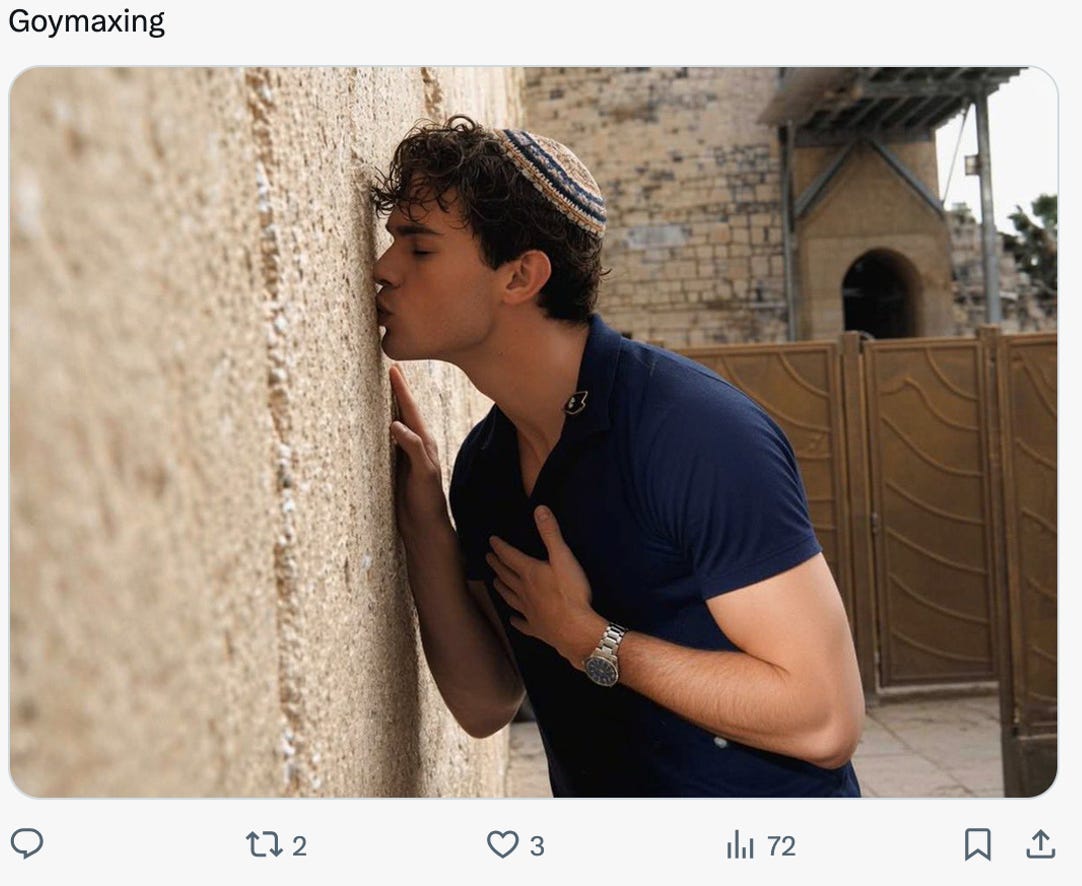

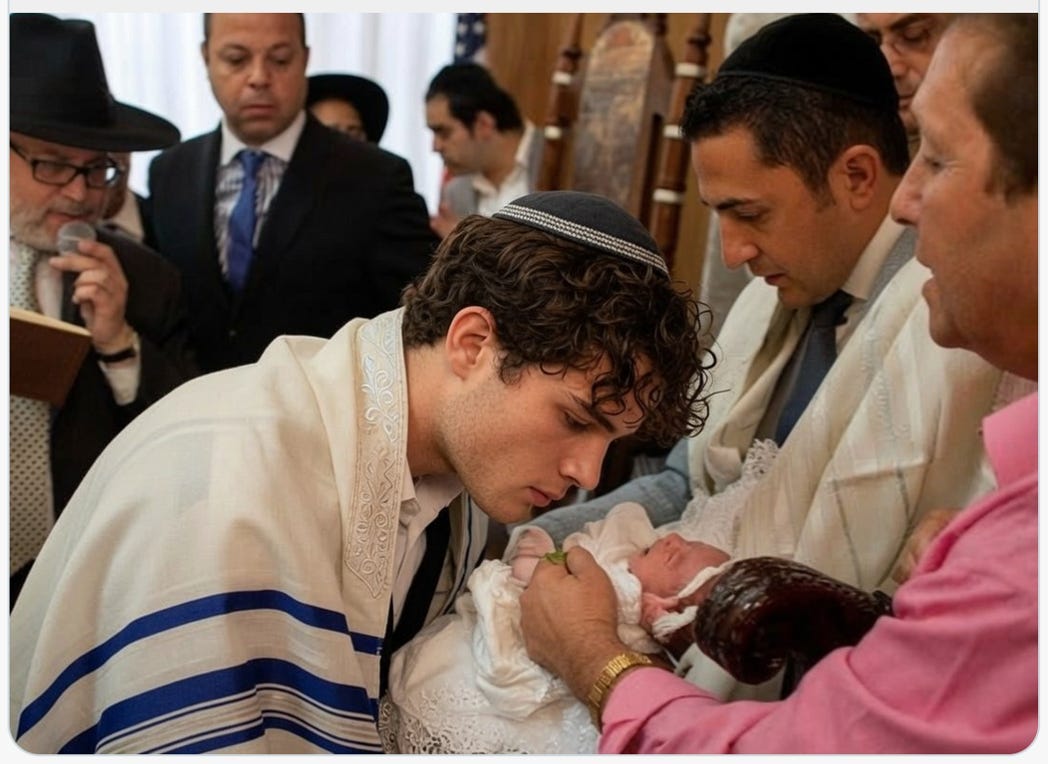

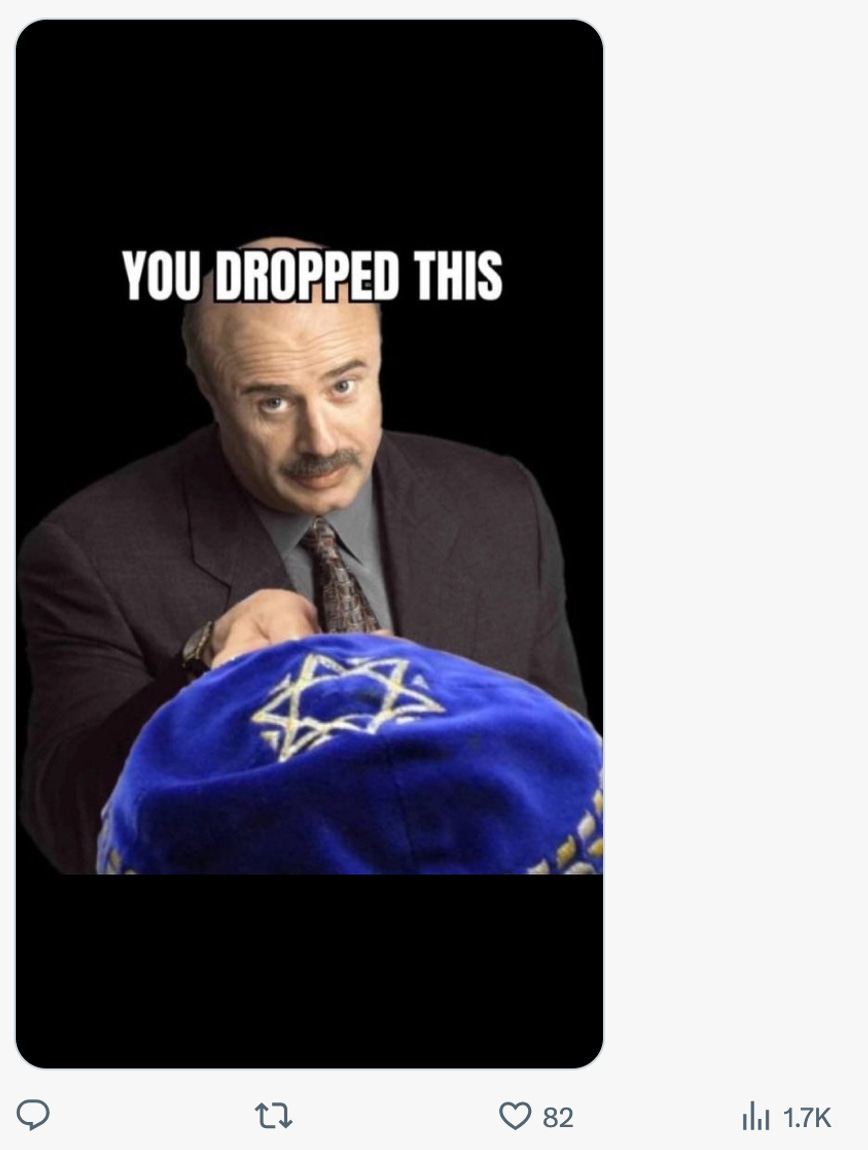
“now we know the reason he got a nose job, it was so he could get closer to kiss the wall” (≈67 likes)
“Did you slam yer nose into the wall before you kissed it?” (≈260 likes — posted from a handle carrying the “110” expulsion codeword)
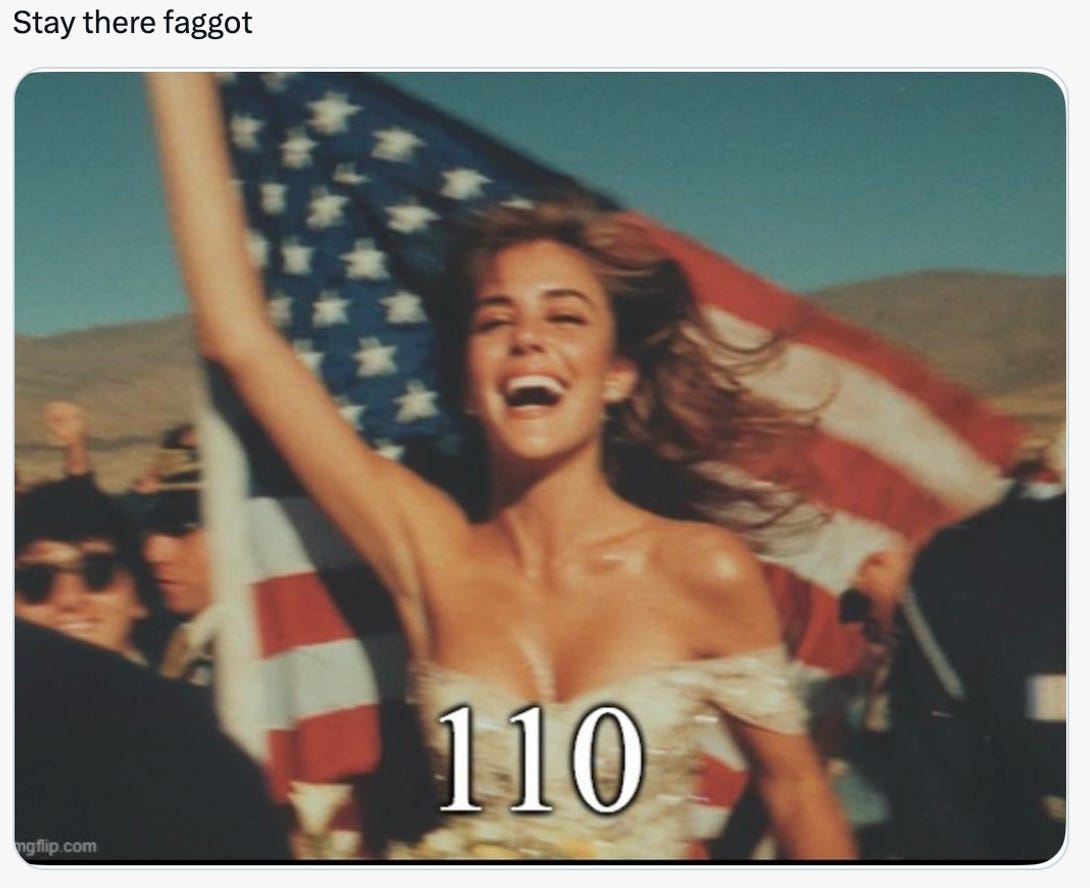
The subculture that built its identity on measuring faces here converts its own core practice into the oldest physiognomic stereotype in the antisemitic repertoire. The logic completes itself in a single image: a meme of a celebrating woman with the US flag captioned “110” — the far-right expulsion-count codeword (Jews expelled from “109 countries,” America the 110th) — aimed at the reclassified Peters with the caption “Stay there”: first recoded as a Jew, then included in the imagined expulsion. The same codeword operates one layer deeper in the platform’s architecture: the author of one of the corpus’s most-liked physiognomic taunts posts from a handle carrying “110” in its name — the expulsion fantasy worn as identity.
Rejection as affirmation — the total-loss family. The expulsion has an enforcement arm, and it contains no antisemitic vocabulary at all:
“Unfollowed.”
“Stay there.”
“It’s shalomver” (a nonce blend of shalom and the doomer formula “it’s over”)
“Good way to destroy your reputation” (Bilzerian, ≈26,000 likes — the corpus’s most-engaged utterance)
“Have you ever seen mafia movies? Resignation from the mob is usually gruesome.” (membership as mob, exit as death — the discourse articulating its own enforcement logic)
Each enacts the same proposition: contact with Israel means losing everything, because Israel is a pariah whose touch contaminates — and, per the mafia unit, that the alleged membership can be neither kept nor safely resigned. One unit narrates the loss as a completed biography, with both endpoints named:
“Went from funny nick fuentes streams to a goy jew lover kissing the wall. Insane fall off” (≈41 likes)
Where most total-loss declarations assert ruin without specifying what was lost, this one states the community’s value scale outright: the prelapsarian state is the Fuentes-sphere affiliation (”funny nick fuentes streams”), and the fall is the affiliation with Jews — “goy jew lover kissing the wall” stacking the servitude label, the reclassifying address, and the submission ritual into a single fallen identity. The unit is the dethroning arc told as before-and-after in one breath, by the community, about itself.
The expulsion even has a stated readmission price. Where the servility register taunts Peters for kissing the Wall, the rejection register names the ritual that would undo it — desecration:
“The first mfer to stream going to the wall and spitting or pissing on it, is gonna ascend to mythical levels of legendary… TRUE ASCENSION SON” (an incitement echoed in the arrival thread: “pull a KING move and piss on that wall”)
The site of his submission is designated as the site of his possible redemption; the community that expelled him specifies the profanation through which he could return. Coded as affirmations of Israel-related antisemitism, these units ratify the shun-norm for every onlooker — which is how a norm becomes ambient without ever being argued — and their survival across surfaces (a slang token, a Hebrew-marked coinage, a marketing observation) shows the frame circulating beneath the threshold of every keyword-based detection system.

4. The atrocity register: genocide, child-killing, and Nazi analogy
The corpus’s third-largest register (108 units) attributes atrocity: genocide, child-killing, and Nazi-analogical framings directed at Israel and, through his presence there, at Peters himself:
“Fuck each and every zionst. Child killing freaks” (≈8,800 likes — the arrival thread’s second-most-engaged reply)
“You hang out with people responsible for genocide”
“Did they let you shoot a kid or rape a prisoner, or is that only for jews?” (Jake Shields, ≈4,800 likes)
The register also arms itself, converting the attribution into a dare:
“More like GENOCIDEMAXXING. Why don’t you walk up to an IDF soldier and ask him to finish your botched nose job with his rifle butt?” (≈260 likes)
The taunt presupposes that Peters’ actual experience — present, safe, filmed — is false, and that contact with the “real” Israel would maim him: the disconfirming evidence is not disputed but converted into a challenge whose terms already assume the atrocity frame. It is the self-stabilization mechanism of the Discussion performed in a single reply, with the violence wish routed through the genocide attribution and the whole packaged in the subculture’s own morphology.
The complicity transfer is the register’s signature move — and the Shields unit shows the register’s essentializing core: atrocity figured not as a state’s crime but as a Jewish privilege, the same slide from individual accusation to collective essence that this project documented in an earlier analysis of abuse allegations recast as “organized state policy”. The family is internally heterogeneous, and the coding preserves the differences: Israel-directed atrocity accusation, Nazi analogy and inversion, Holocaust denial, Holocaust derision, and collective transfer to Jews or to the influencer are distinct forms, antisemitic on different grounds, and are reported here as one frequency family only for the corpus overview. The derision form has its own coinage in this corpus:
“From clubacaust to Tel Aviv within 6 months” (23 likes)
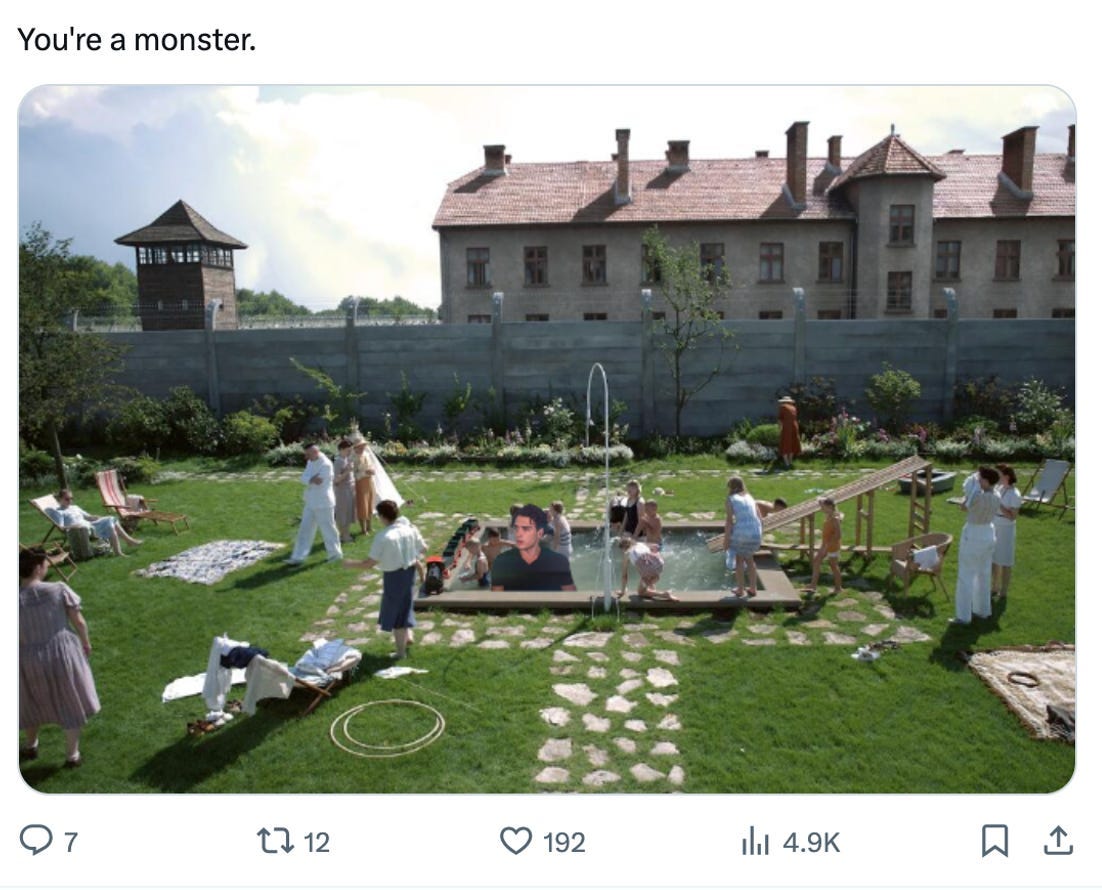
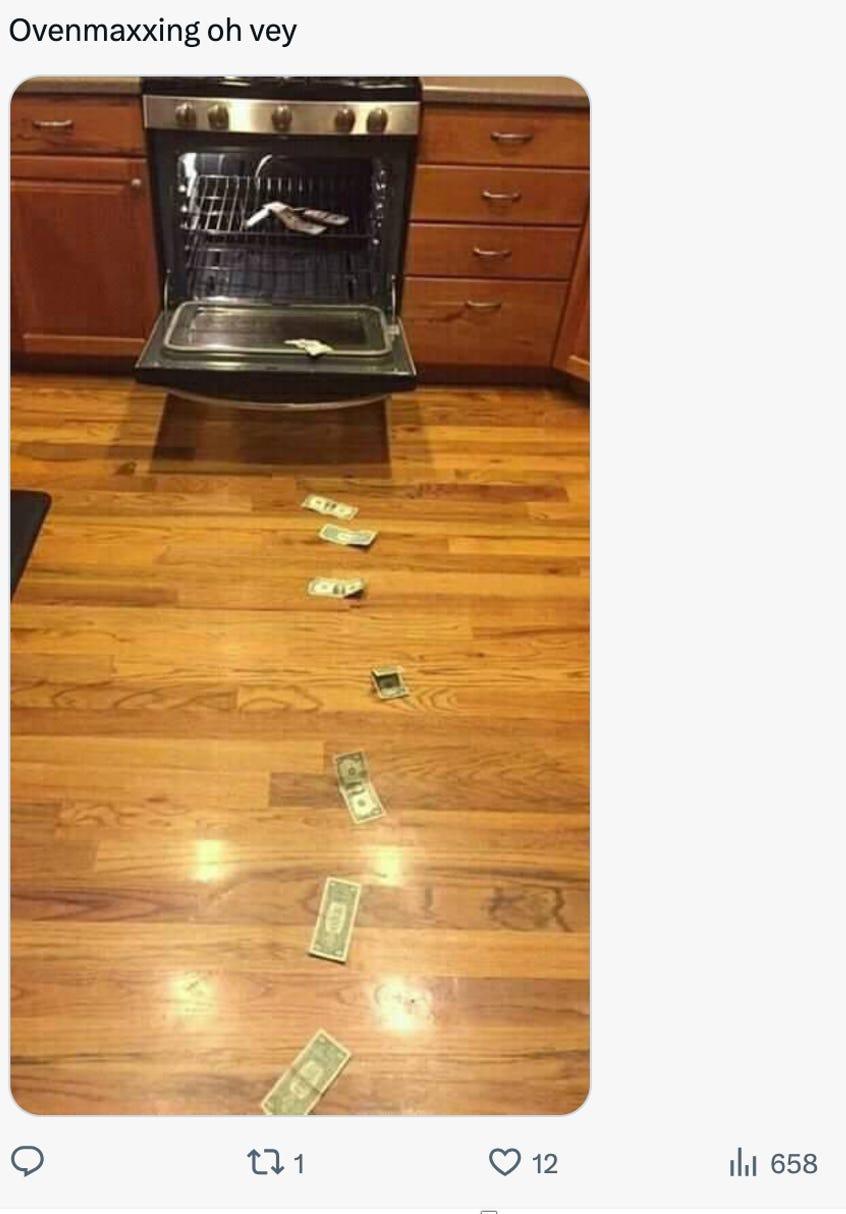
“Clubacaust” — the Miami “Heil Hitler” club episode blended with the Holocaust — compresses the entire affiliation arc into six words while trivializing the Shoah in a single morpheme: the community narrates Peters’ trajectory from Nazi-adjacent transgression to Israel affiliation in Holocaust-derisive vocabulary, treating both endpoints as content for the same joke. The soldier-photo thread escalates the coinage from derision to demand — a call for “clubocaust 2” — completing the move from mocking the episode to requesting its repetition. The register peaks in the thread where Peters declared himself apolitical: 42 of that thread’s antisemitic units carry it, led by a second Jake Shields reply at ≈4,200 likes — “You are helping a country that tortures and kills children. Every International body says Israel is committing war crimes” — which places two Shields units at a combined ≈9,000 likes atop the register, elite amplification in the most literal sense — the claim to be outside politics was answered with the heaviest accusatory material in the corpus, because within this discourse there is no apolitical presence in Israel: location is complicity. At the register’s edge, atrocity attribution shades into Shoah derision and inversion — Holocaust-denial and oven imagery documented in the visual layer below — completing a spectrum that runs from pseudo-juridical accusation to open celebration of the crime it invokes.
5. Demonization: Israel as evil
Distinct from political rejection, a family of 112 units attributes evil as essence — the oldest theological layer of the antisemitic repertoire, in Gen-Z orthography:
“Israhell” (recurring across threads as a fixed spelling)
Israel as “demon country”
The theology is most fully articulated in the corpus’s soul-sale units, where affiliation is figured as a Faustian bargain and Israel as the devil buying:
“Not worth your soul, buddy.” (≈216 likes — one of the register’s most-engaged units)
“They’ll entice you… All for your soul. It’s the devil’s game.”
This is where demonization meets the purchase register (§1): the soul-sale formula requires a devil as counterparty, so every “sold your soul for paper” unit presupposes that the buyer is evil in its essence. The frame also attaches to the people, not only the transaction — Israelis figured as a “murderous cult,” Israel as a “demonic psychopath” — and, at its sharpest, folds back onto Peters himself, the evil-attribution completing the reclassification of §3:
“demonic Jew demon” (Peters addressed directly — demonization and reclassification collapsed into one phrase)
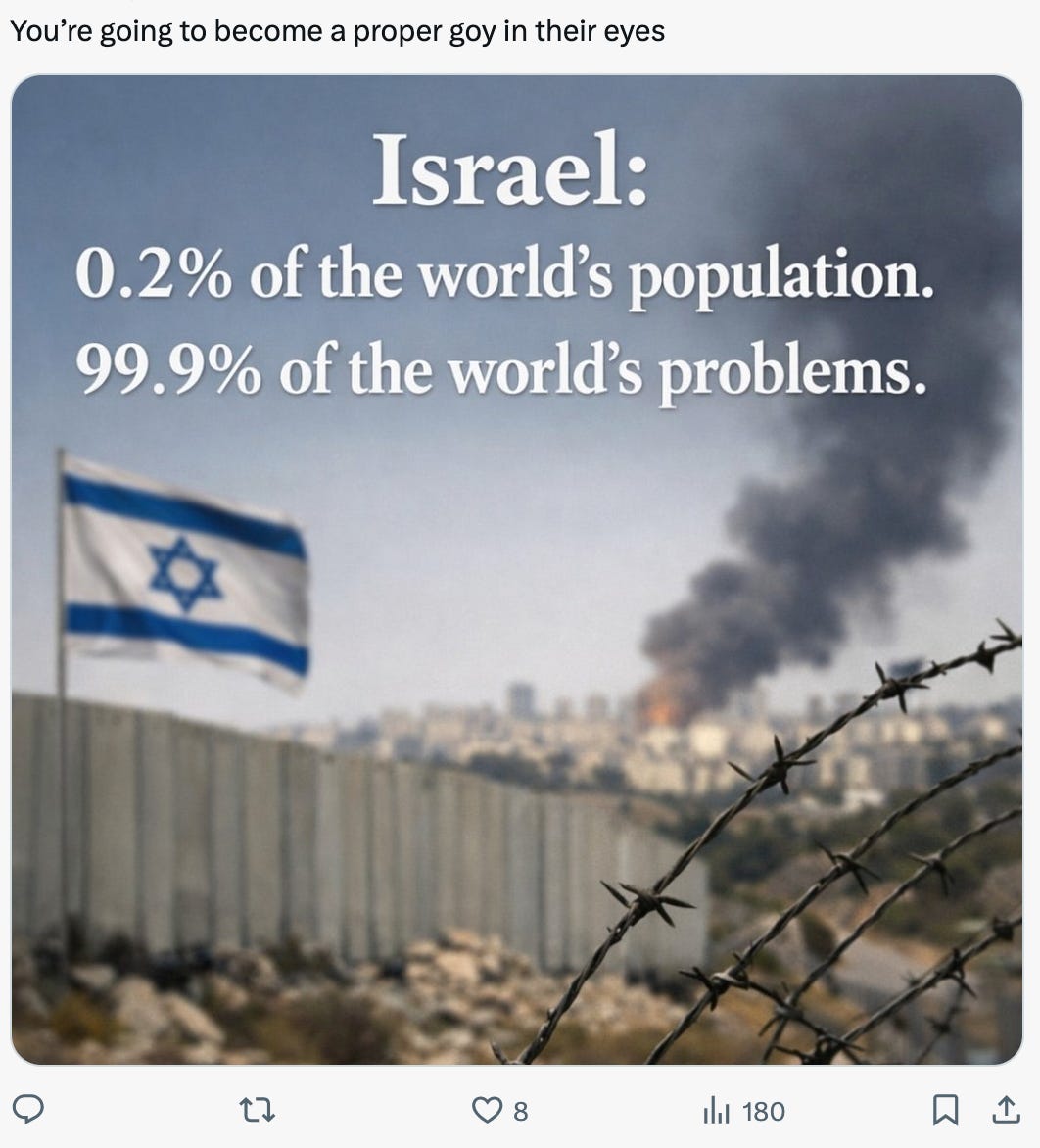
The essence-attribution also arrives in the subculture’s own morphology:
“Lol your statusmaxing in the most hated country in the world why don’t you go rapemaxxing now that your there” (≈31 likes)
Two moves happen in one sentence. “The most hated country in the world” states the pariah norm as settled global consensus — the universal-hatred formula. And “go rapemaxxing now that your there” treats mass rape not as an allegation about specific acts but as a standing national activity, available to any visitor the way nightlife is: atrocity attributed as essence, rendered in the “-maxxing” template that folds it into the milieu’s everyday idiom. The unit is the corpus’s terminus of a trajectory this project analyzed in the mainstream press cycle it feeds on — the recasting of individual abuse allegations as “organized state policy” (Becker 2026c): once atrocity has been promoted from act to essence, it can be offered, casually and in a lifestyle vocabulary, as something one does in Israel.
In plain terms: where delegitimization says Israel should not exist, demonization says Israel is evil in its being — and it is the second claim that licenses everything the atrocity register (§4) asserts.
6. Delegitimization
Israel-directed slogans and erasures are coded in this corpus as delegitimization of the Jewish state (see research design):
“Fuck Israel free Palestine” (Sneako, ≈21,000 likes)
“This is literally Palestine, dude” (≈1,700 likes)
“It’s called PALESTINE!”
— alongside stolen-land framings and “from the river to the sea.” Addressed to a lifestyle stream, they function here as pariah-marking rather than policy argument, and they cluster almost entirely in the arrival thread: the slogan register fires at the event; the conspiratorial-misogynist register fires at the woman, three days later.
7. Fusion with misogyny
The public meta-debate around the visit was itself sharply gendered, and that context belongs here rather than in the introduction. Women who warned about a figure facing sexual-assault allegations reported being dismissed as failing to see “a greater strategy that we women don’t see because we’re emotional about sexual assault” (Silverman, Jerusalem Post); a second Jerusalem Post essay read the episode through a longer communal pattern in which those who warn about a predator inside the tent — most often women — are recast as the problem (Tayer, Jerusalem Post). The punitive energy followed the same line: creators who collaborated with Peters received death threats; a prominent pro-engagement advocate received character-directed attacks; men advancing the same arguments drew substantive rebuttal without equivalent character destruction. And the episode produced exactly one institutional sanction: the IDF disciplined the soldier who had appeared in the livestream — a suspended jail sentence, professional disqualification, and transfer — the only consequence imposed on any participant in the entire affair, an asymmetry Israeli commentary itself began to name, asking why she was the only participant ostracized while the male influencers who hosted and amplified Peters faced none.
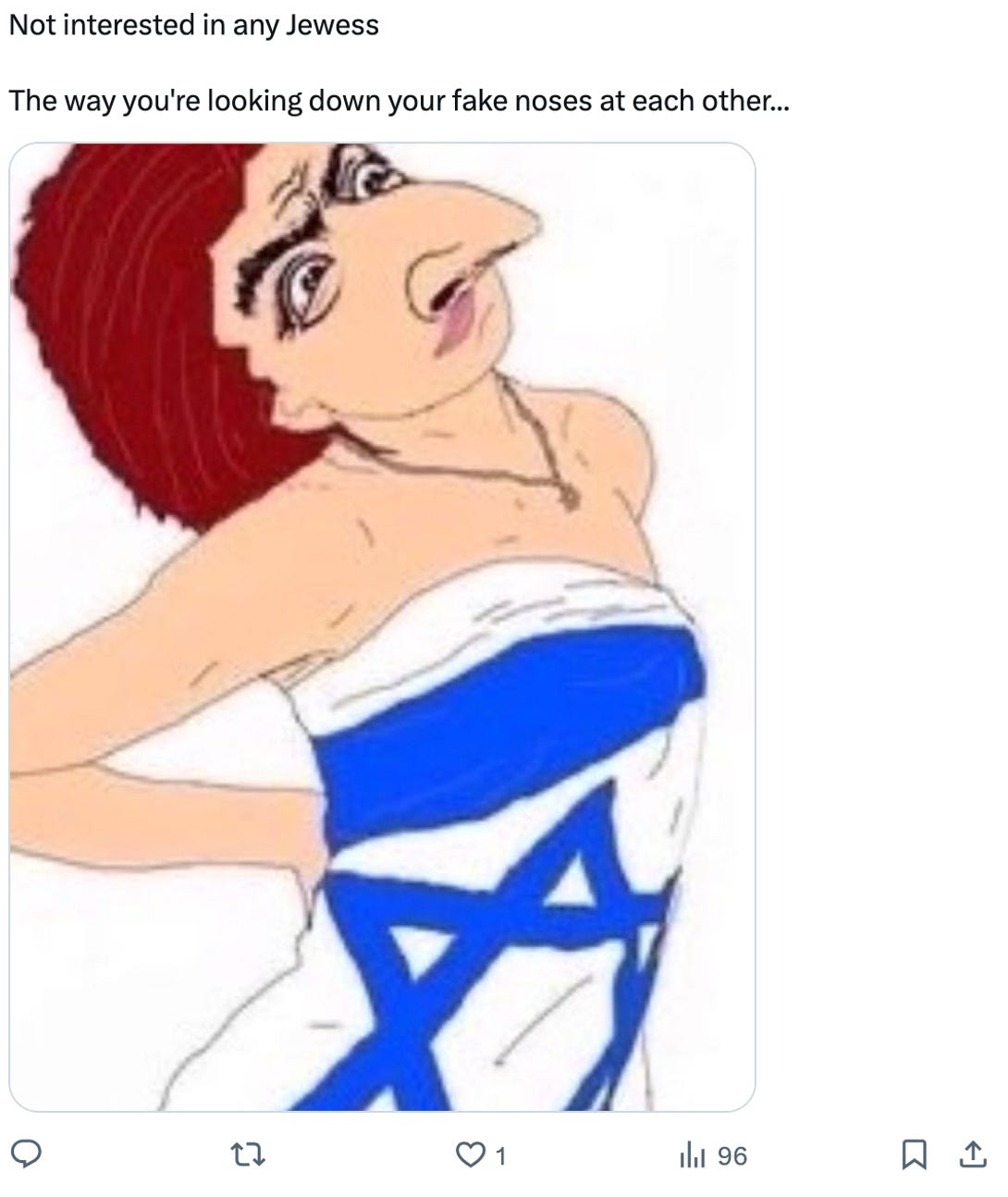
Inside the corpus, the structure is dyadic: Peters is punished as the allegedly captured man; the soldier is punished as the alleged instrument of capture. Misogyny does more than accompany the antisemitic narrative here; it supplies its causal mechanism: the Israeli woman is represented as the sexual instrument through which Jewish or Israeli power captures the male target. In the July 13 thread, misogyny is accordingly not a parallel phenomenon: 31 of its 47 misogyny-coded units are simultaneously antisemitism-coded, and roughly 29 target the soldier or Israeli/Jewish women specifically — as honeypots, “hags,” state property “ran through” by the military, or transphobically denied womanhood:
“she is a trap” (a deliberate double meaning, fusing the transphobic slang with the honeypot claim)
“YOU GET BENT OVER BY YOUR JEWISH WHÓŘE GF DAILY.” (July 9 thread, 09:41 — heavy evasion diacritics; posted four days before the soldier photo existed — the temporal priority analyzed in §1)
Nor does the fusion confine itself to the soldier. When a journalist’s interview with Peters entered the corpus as a quote-tweet trigger, the same apparatus turned on her:
“Bari Weiss bff / concubine is rocking w you” (≈120 likes — the journalist recast as sexual property within a Jewish-network frame)
“have they let you take Hebrew classes yet or are they still treating you like a half-breēd reject?” (≈29 likes — racialized exclusion and misogyny in one address, evasion diacritic included)
And the register can invert its target: rather than degrading the women as Jewish instruments, one unit antisemitically reclassifies them as false whites — deploying the far-right “fellow whites” meme, which alleges that Jews deceptively claim whiteness to subvert from within:
“1. ‘Looksmaxing’ influencer thinks ‘All these [jewish] women are good-looking.’ You can’t make this stuff up… 2. ‘Well, hello there, fellow White women.’ Follow @[account] as we max our way out this mess” (≈100 likes)
Peters’ compliment to Israeli women is recoded as a category error — they are not white women but Jews posing as such — and the correction doubles as recruitment: the reply closes with a follow appeal, the thread functioning as an acquisition surface for white-nationalist content.
Standalone sexism is the minority pattern; the misogyny is instrumental to the antisemitic frame, degrading the woman in order to deny the relationship’s reality and complete the capture narrative. The arrival thread, by contrast, contains almost no misogyny (7 units) — the register rises sharply when a woman enters the frame. That the only institutional sanction of the entire episode fell on this same woman gives the fusion its bitter real-world coda.
8. Fusion with homophobia, and the pedophilia attribution
Two further hostility registers fuse with the antisemitic frame, and the corpus’s imagery and address forms make both unmissable. The first is homophobia as the idiom of capture: the affiliating gentile is not only bought and controlled but sexually subordinated, and the subordination is homophobically coded. The slur and the reclassification arrive fused in a single breath:
“FAGGOT JEW.”
“Ok jew, yer a faggot.”
“Fucking fag. Bending over for the Jews” (the sexual-subjugation formula with the collective marker — coded as affirmation of antisemitism)
“jew cocksucker” / “Jew cock sucker” (recurring across threads as a fixed formula)
And the register runs from bare slur to erudite allusion:
“See if they’ll hook you up with a free Magnus Hirschfeld surgery.” (≈57 likes — a Weimar-sexology dog-whistle: Hirschfeld, the Jewish founder of Berlin’s Institut für Sexualwissenschaft, invoked as the origin figure of the Jews-as-engineers-of-sexual-deviance canard; decoding it requires a historical literacy the register’s bare slurs do not)
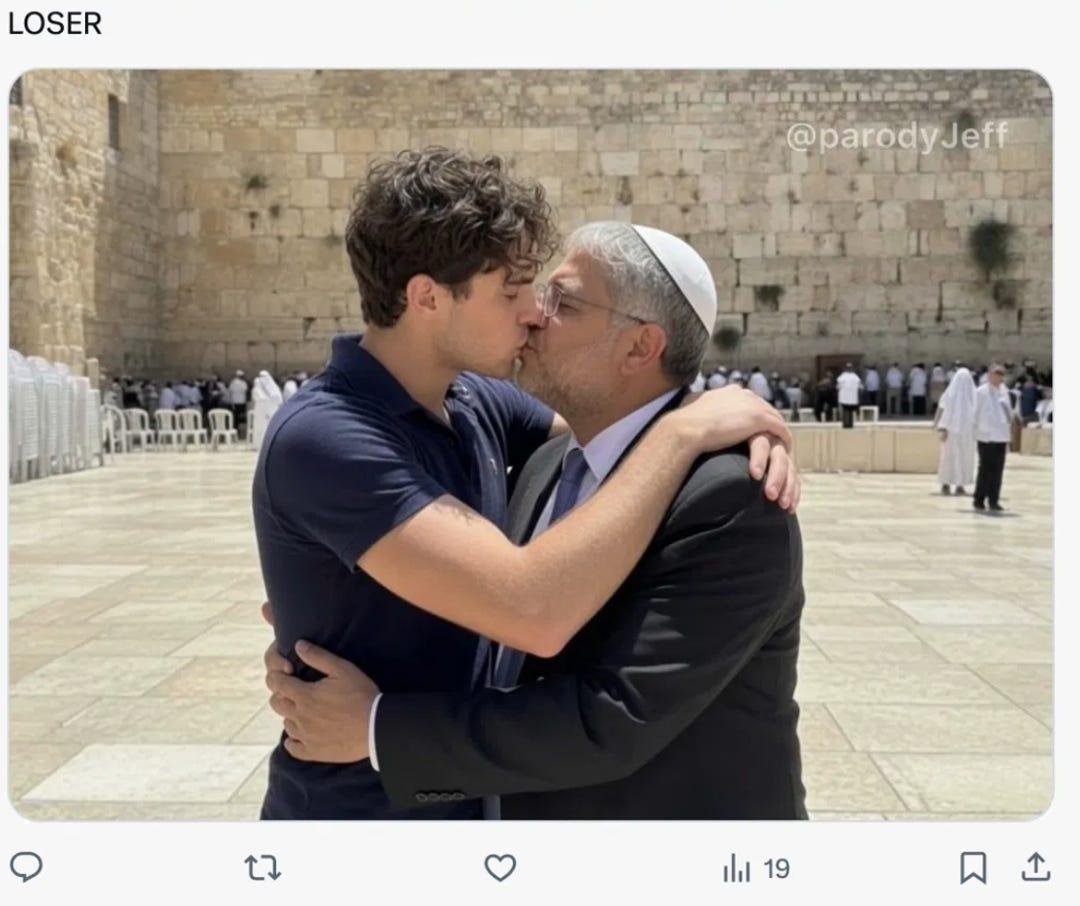
The same logic drives the corpus’s second fabricated image — Peters kissing a kippah-wearing man, from the same self-labeled parody account as the Ben Gvir fake (see chapter 10) — and the replies that treat it as evidence (”was this your handlers making you kiss a dude?”): homophobic degradation supplied the visual proof of capture, just as misogyny supplied its causal mechanism. At the state level, the register generalizes into degeneracy attribution — Israel figured as a nation of sexual deviance — a small register in this corpus but among its most theologically loaded.
The second register is the pedophilia attribution — the oldest child-focused libel in the antisemitic repertoire. It is coded only where the child element is explicit in the unit, as in direct attribution:
“Of course all the little children are at a tiny hat club, they love them young. Disgusting.” (the kippah codeword fused with the child-predation charge)
“Be careful that they don’t record you secretly screwing underaged girls and boys. They are known to blackmail influencers and politicians (Epstein…).”
— and as morphology: the circumcision-ritual mockery coinages documented below (”Metzitzahmaxxing,” “babyforeskinmaxxing,” ≈570 likes). A boundary note governs the adjacent Epstein complex: Epstein references default to the blackmail/kompromat family, not to the pedophilia attribution, unless the minor element is stated. “No wonder you visiting Israel to run a blackmail operation like Jeffery Epstein as Mossad” therefore codes as conspiracy (§1), not as child-focused libel; the same rule holds for the trafficking insinuation aimed at the Miami club and for the AI-generated Israeli flag bearing Epstein’s face documented in the visual layer, whose recoverable content is the blackmail-state emblem. Only where a unit fuses the two — as in the “underaged girls and boys” warning above — is the child-focused concept counted. The pattern completes the disciplinary logic: the community that welcomed Peters is figured as predatory toward children, so that his presence among them becomes complicity in the ultimate crime — the same complicity transfer the atrocity register performs, executed through the libel with the longest history.

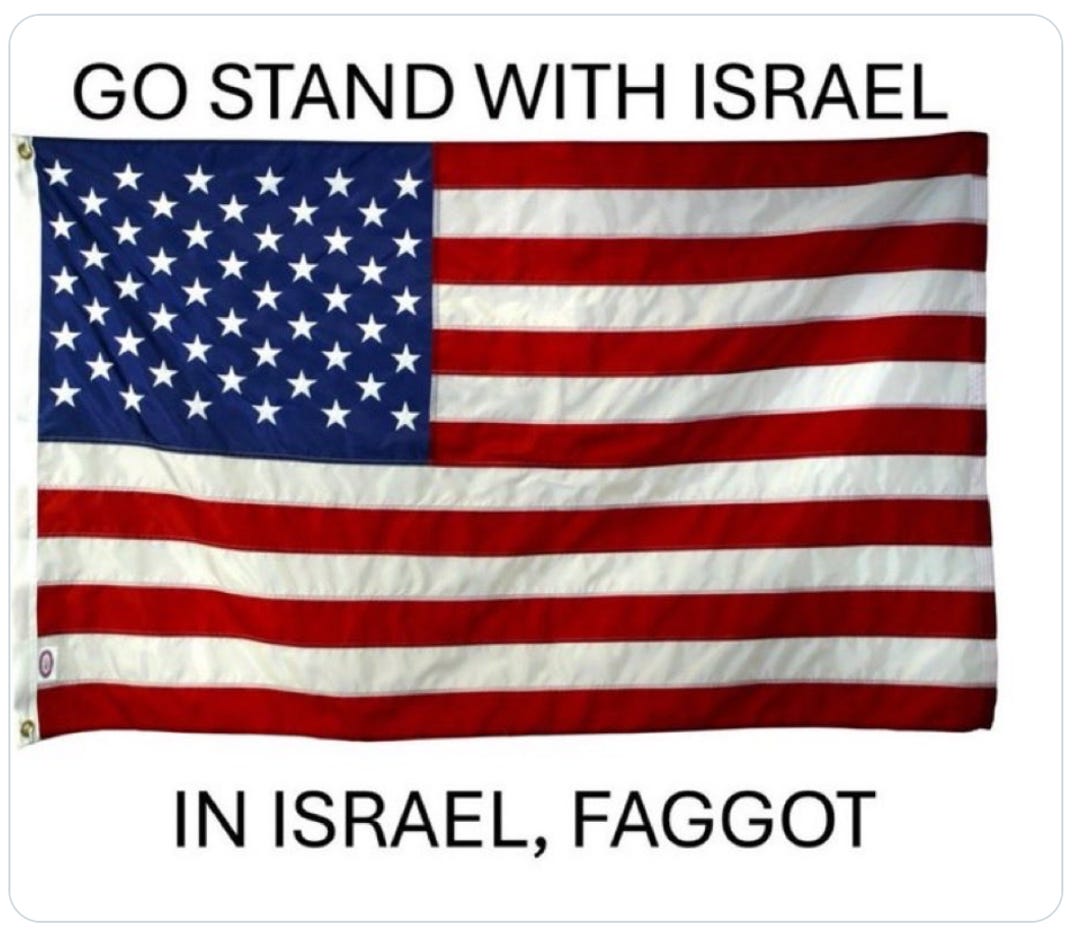
9. Lexical innovation
The reaction discourse is conducted in a subcultural vernacular fusing with antisemitic concepts in real time. The “-maxxing” template alone yields:
JEWMAXXING (≈7,900 likes) · shekelmaxxing (as a username) · goymaxxing · goyslopmaxxing · smallhatmaxxing · Metzitzahmaxxing · babyforeskinmaxxing (≈570 likes) · Genocidemaxxing
The template’s carrying capacity is demonstrated in a single unit — one author running the full classical inventory through the subculture’s morphology:
“Pedophile maxxing. / Genocide maxxing. / Satan maxxing. / Antichrist maxxing. / Goy maxxing. / Cannibal child eater maxxing. / Epstein Fortnite account maxxing.” (≈84 likes)
Blood libel (”cannibal child eater”), demonization, atrocity attribution, goy servitude, and the Epstein complex — the classical repertoire in one suffix. Beyond the template, the coinage work extends to slur formation (”kikussy”) and to the discourse’s evidence culture, self-satirized in a four-word deceit formula that ventriloquizes the Jewish voice as inherently untrustworthy:
“Source trust me goy”
The lexical layer, finally, extends into the author field itself. Handles and display names in this corpus carry the repertoire as identity rather than utterance: the goy- and shekel-morphology adopted as usernames, ethnic slurs embedded in account names, a handle declaring misogyny as a self-description, the numeric expulsion codeword “110” worn as a name, an account calling itself “tired of Jews,” and display names adopting the name of a US antisemitic hate group (Goyim Defense League) — the last already encountered attached to two of the visual exhibits above. Per protocol these accounts are not named here, but the pattern matters analytically: a comment is composed for a moment, a handle is chosen once and worn across every interaction the account will ever have. Where the reply text shows the repertoire activated by an event, the nominal layer shows it installed as self-presentation before the event existed — and it marks a moderation blind spot, since handle-level signals are invisible to systems that evaluate comments one at a time. The wall-pilgrimage taunt lexicalized as “kiss the wall (goy),” “wall kisser,” and the single-word coinage “Kissthawallmaxing” — the servility taunt compressed into the subculture’s own morphology; the far-right canon supplied “Every Single Time,” “Shut it down,” “goy cattle,” “tiny hat,” and the numeric “110”; counter-discourse answered in the same morphology (”slutmaxxing,” in a critical commentator’s coinage — evidence of the template’s cross-camp productivity). None of these items is legible to standard lexicon-based detection; all were fully legible to the in-group. Moderation-evasion orthography (”K!ke,” “jevv,” a Cyrillic о in “Gоу,” a leet-spelled “l< i l< €,” an evasion diacritic in “half-breēd”) documents users engineering around exactly the keyword filters whose insufficiency this vocabulary demonstrates.
10. The visual layer and the synthetic substrate
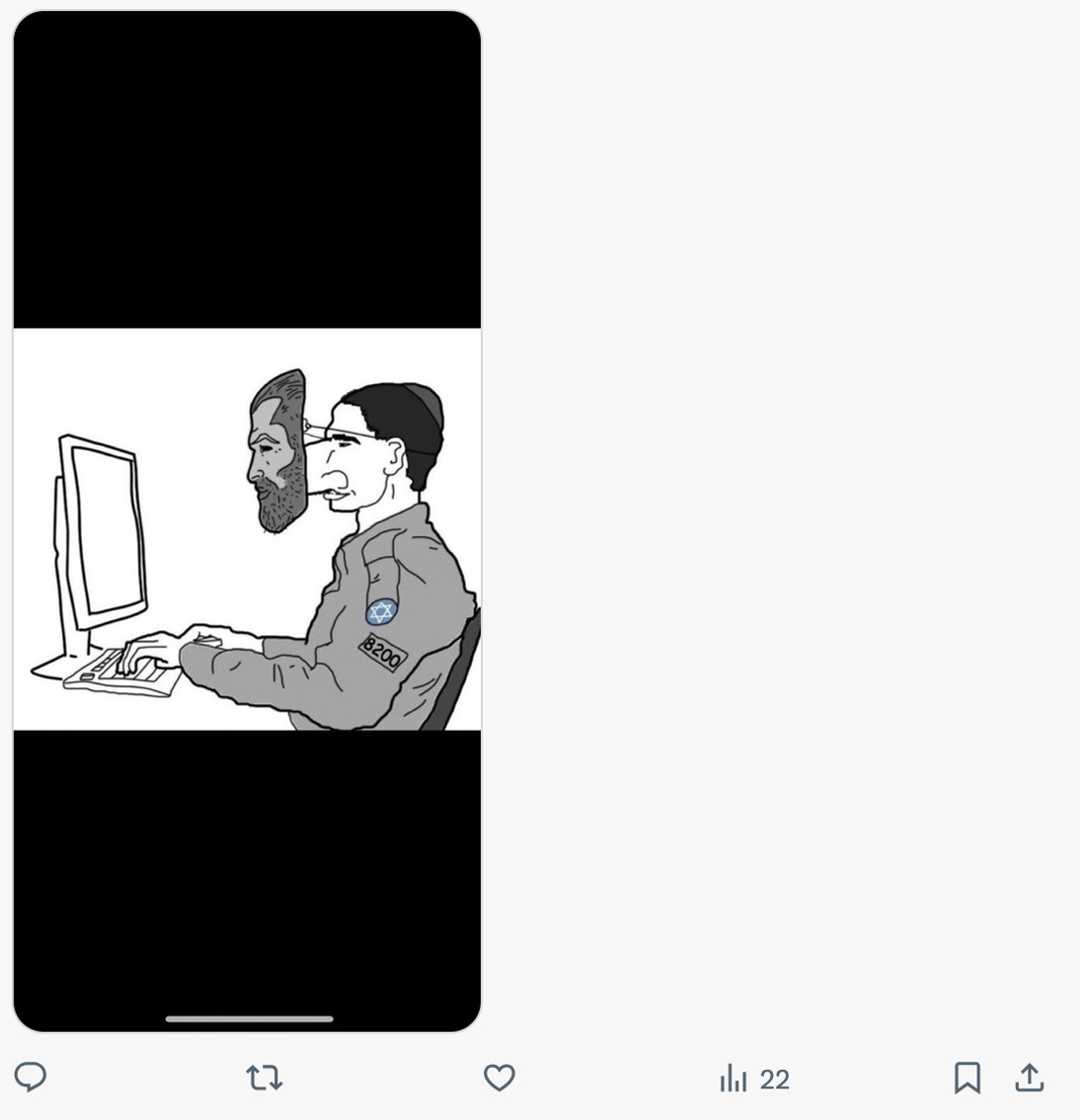
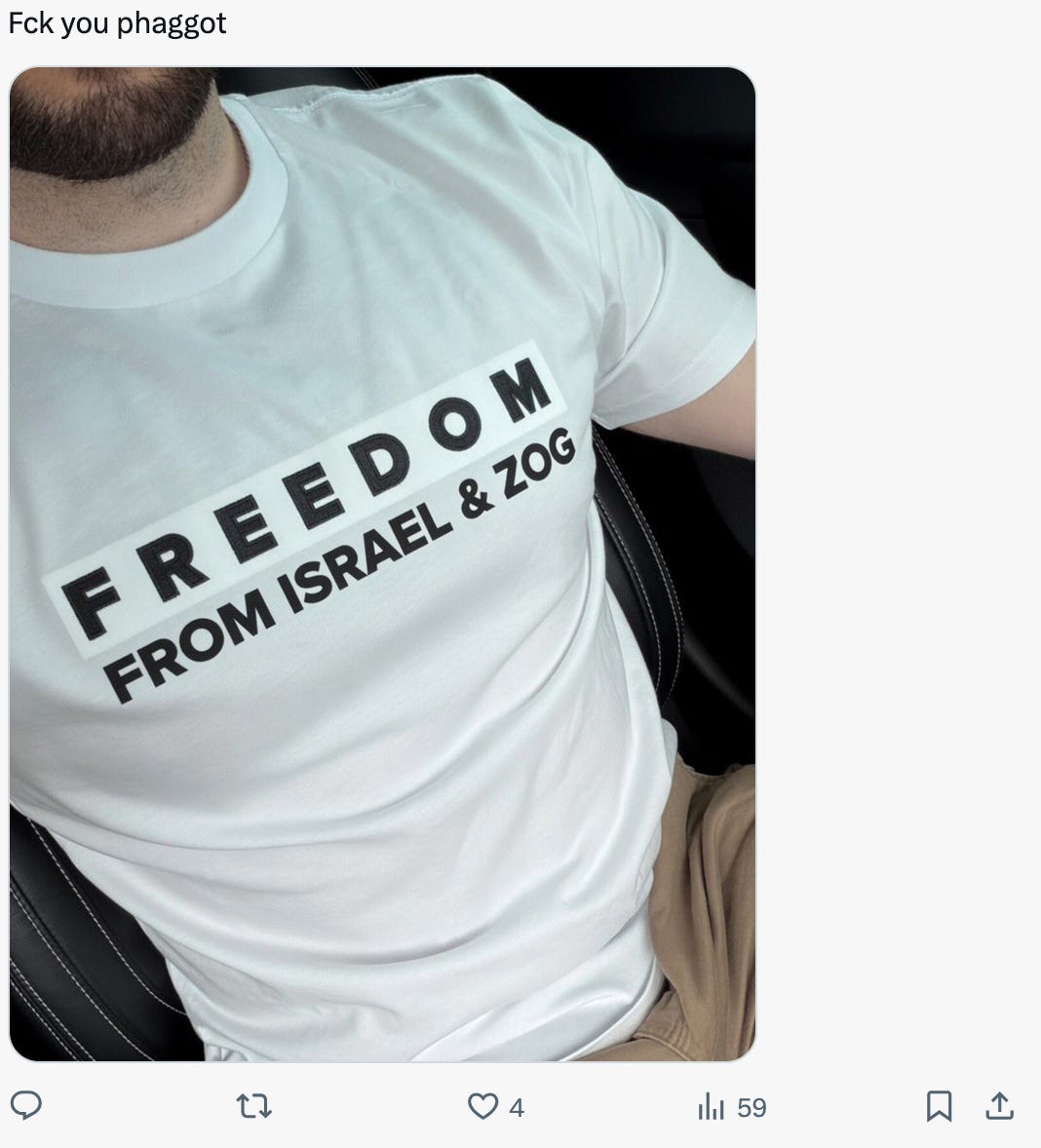
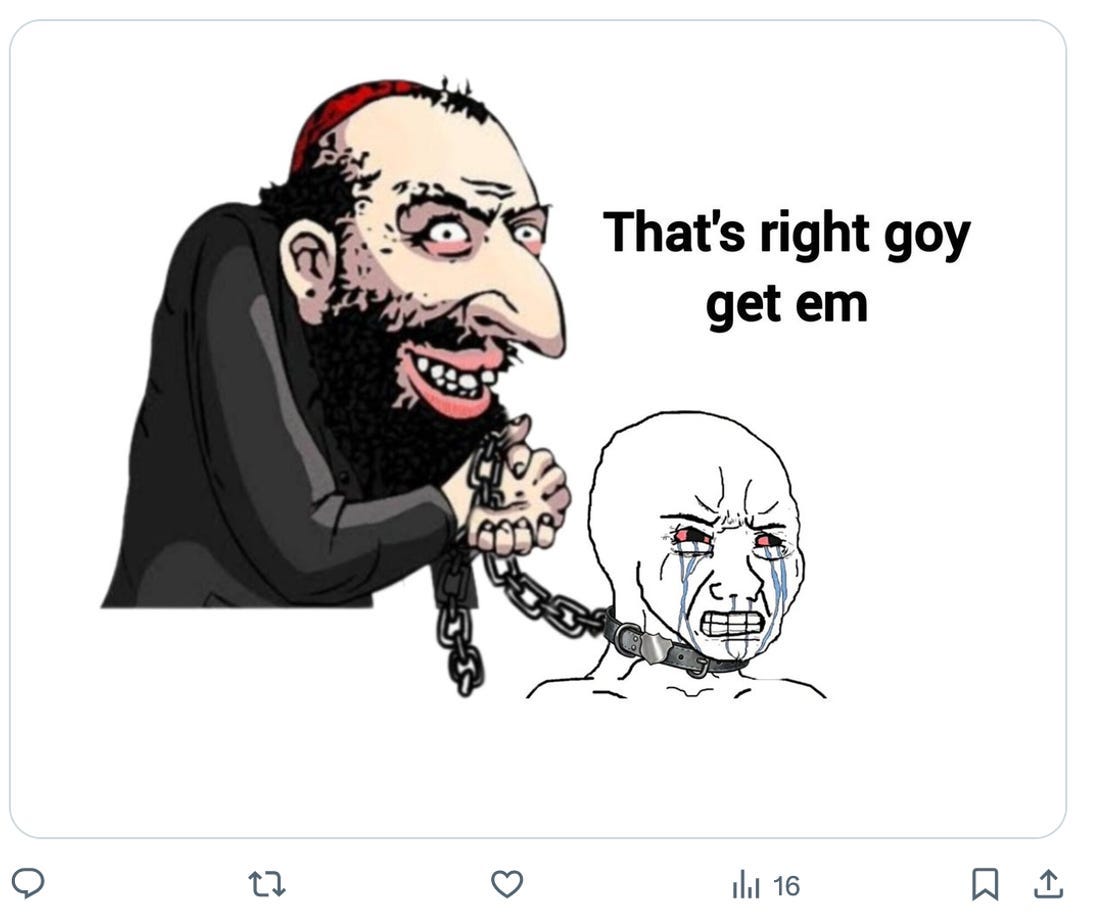
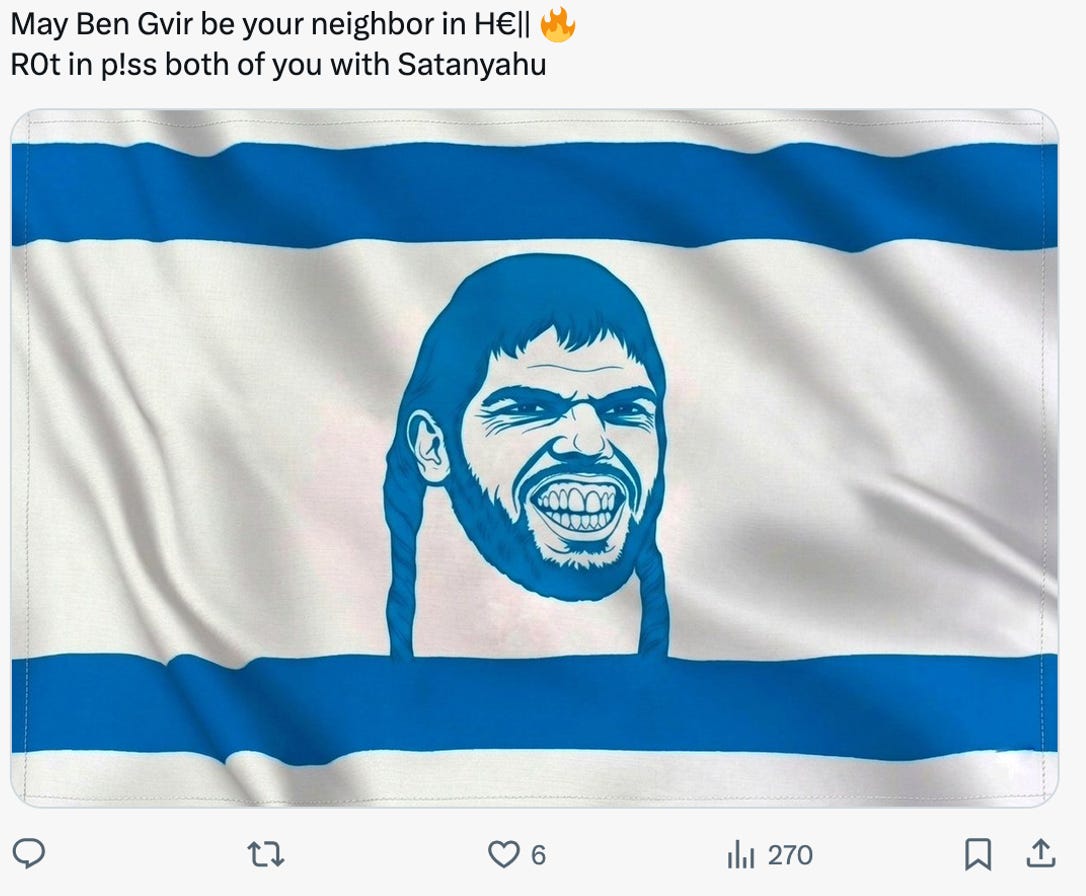
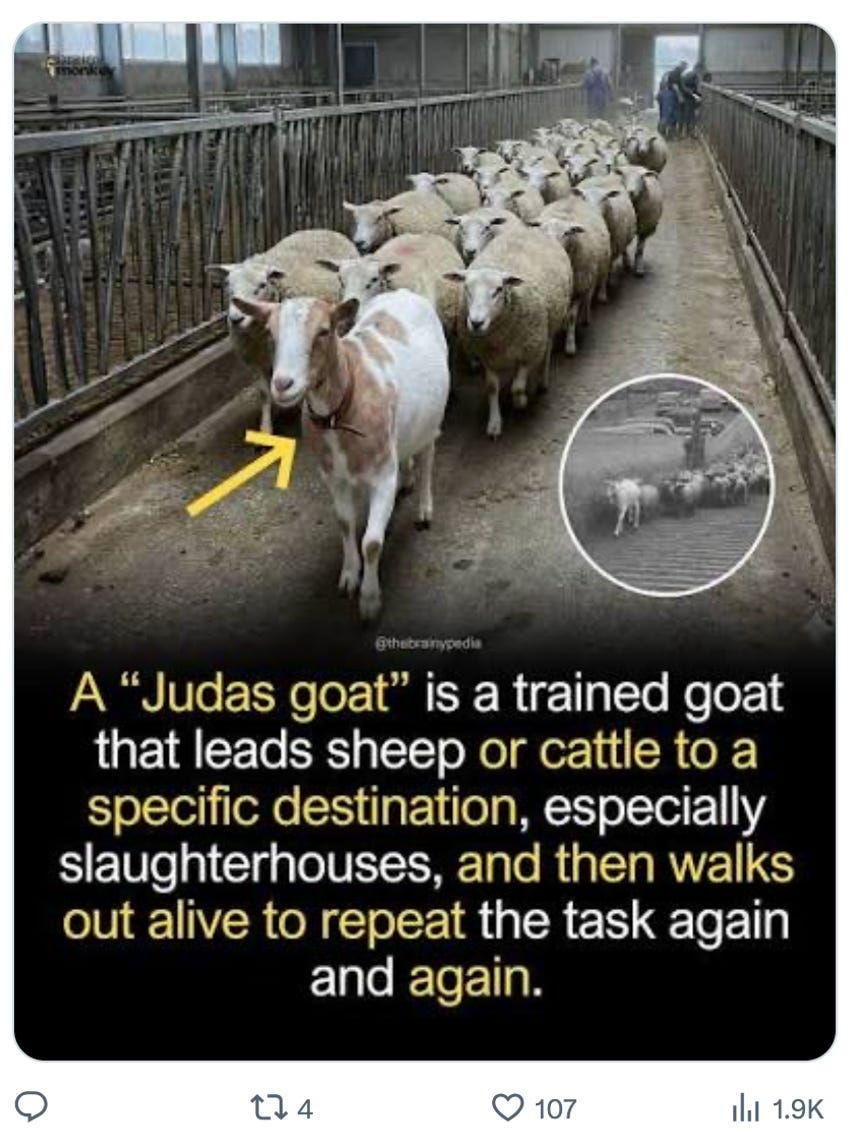
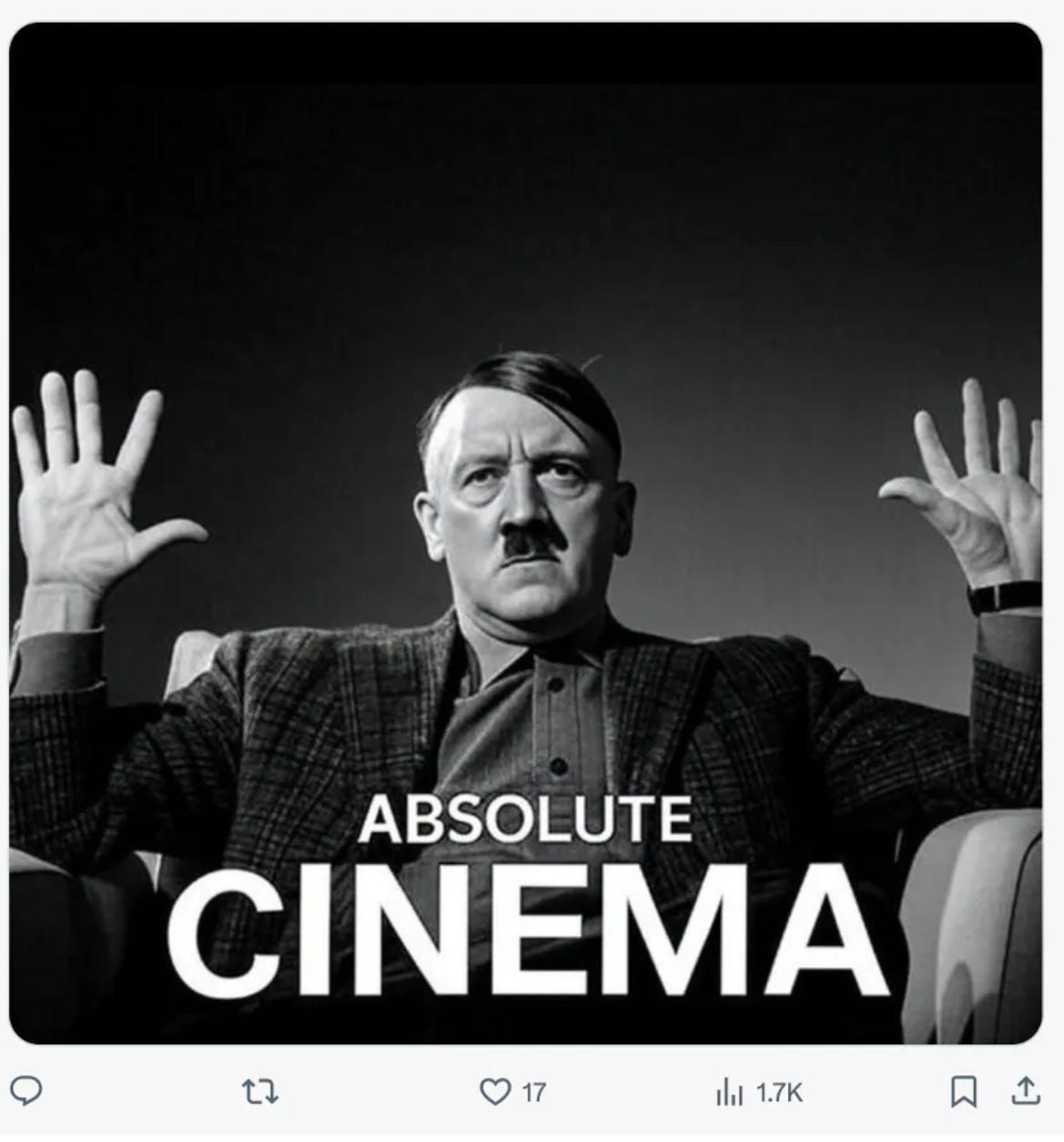
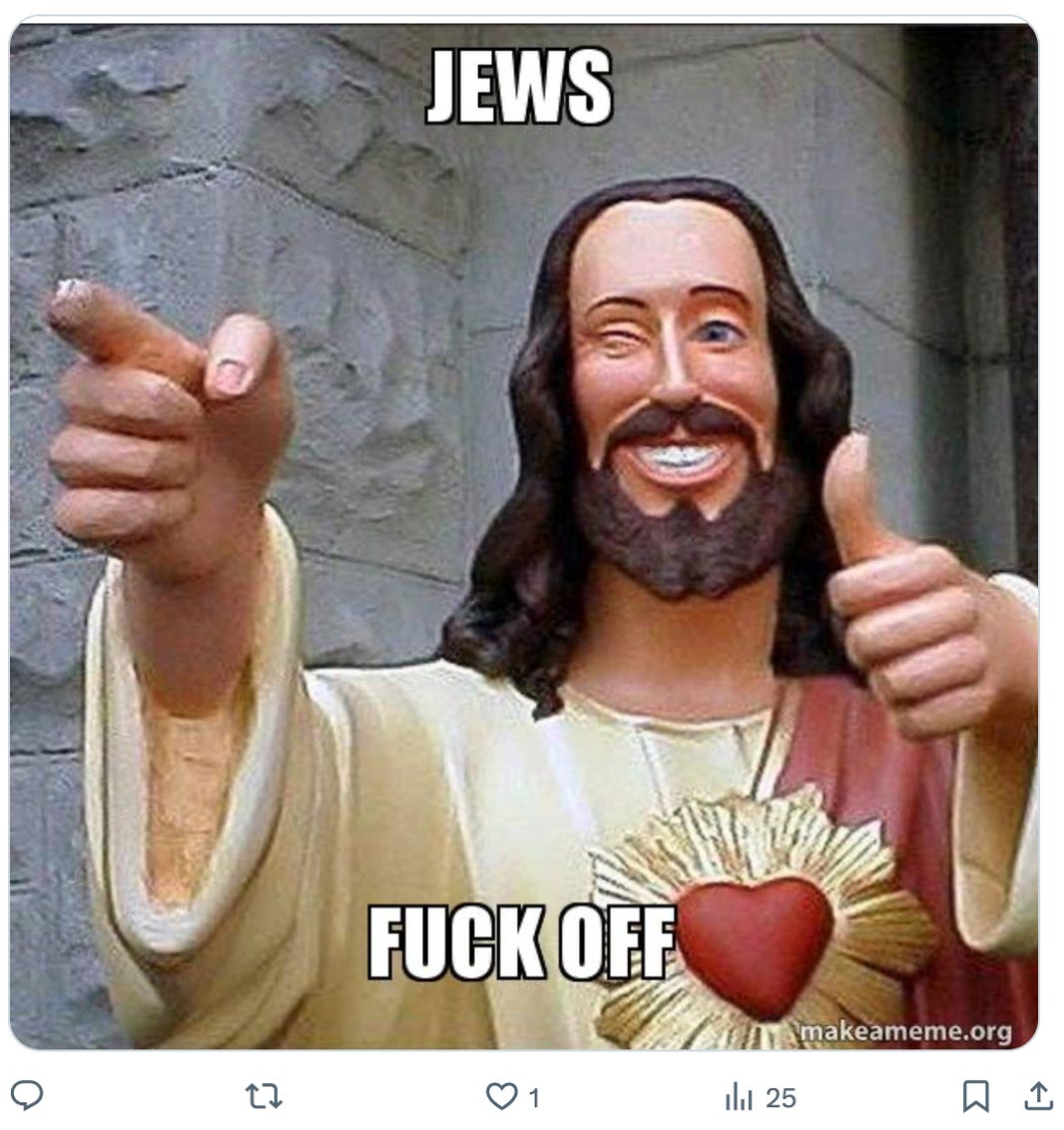
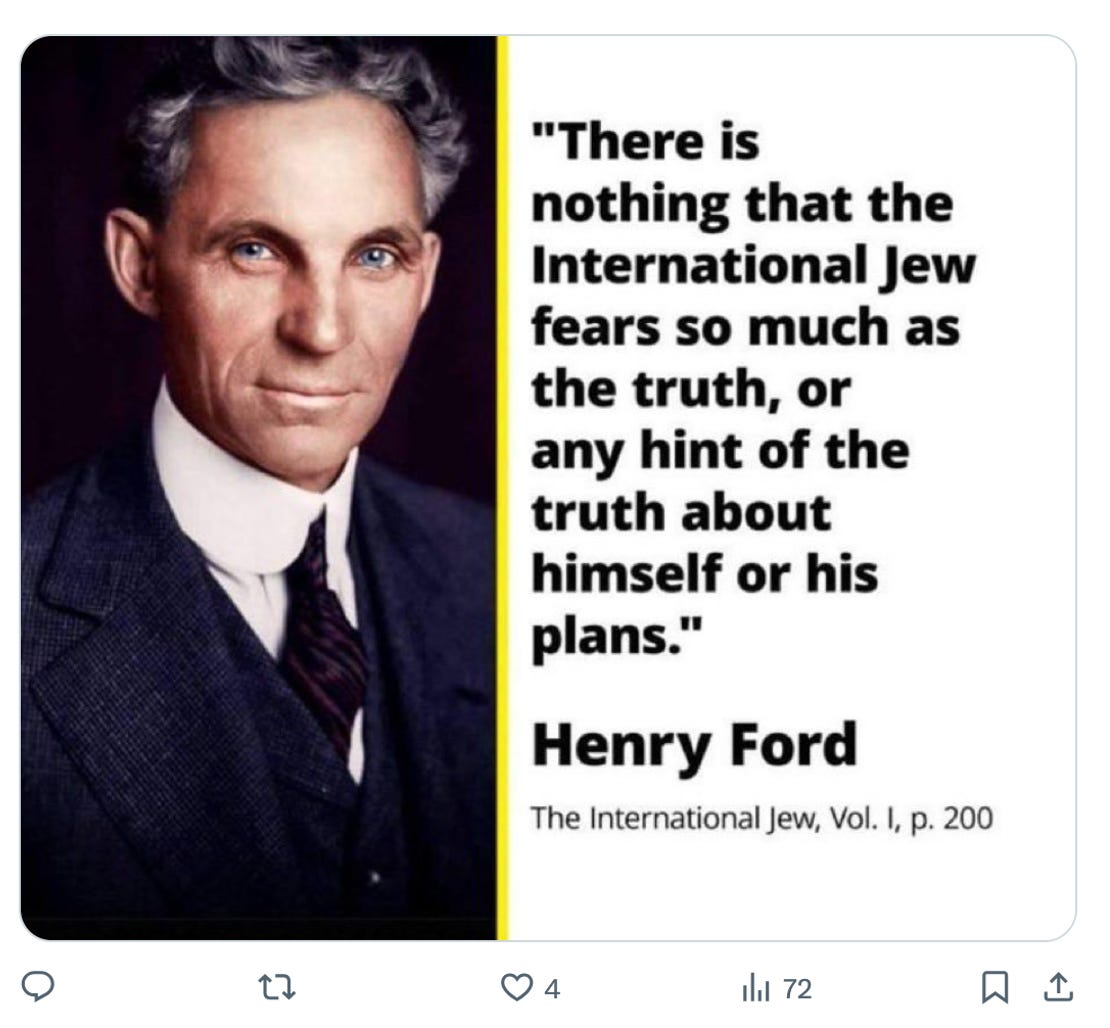
The image layer did not illustrate the discourse; it escalated it. Every major register that appears text-only in some units appears image-only in others: Holocaust denial entered the corpus exclusively as an image (a Flork meme mocking the “totally not made up, historically accurate number — 6 MILLION”); Holocaust derision fused with the greed stereotype in a single exhibit — “Ovenmaxxing oh vey” over a photograph of an open oven with a trail of dollar bills leading into it, the subculture’s morphology carrying a Shoah joke and the money stereotype simultaneously; Hitler valorization as an “ABSOLUTE CINEMA” macro; the canonical “happy merchant” caricature appears holding a chained, collared gentile on a leash (”That’s right goy get em”); a “Judas goat” explainer meme casts Peters as the trained animal that leads the sheep to the slaughterhouse “again and again”; theological antisemitism as a Revelation 2:9 “synagogue of Satan” scripture card; movement signaling as a “FREEDOM FROM ISRAEL & ZOG” t-shirt selfie and the apparent Rockwell photograph; and the ambient far-right meme repertoire — Pepe the Frog variants, Nazi meme templates, and the “happy merchant” leash image quoted above: goy servitude rendered literal — running through the threads as the discourse’s visual vernacular (the serpent-and-eagle control image is presented in §1). The purchase rumor acquired its own artifact — a fabricated State of Israel check:

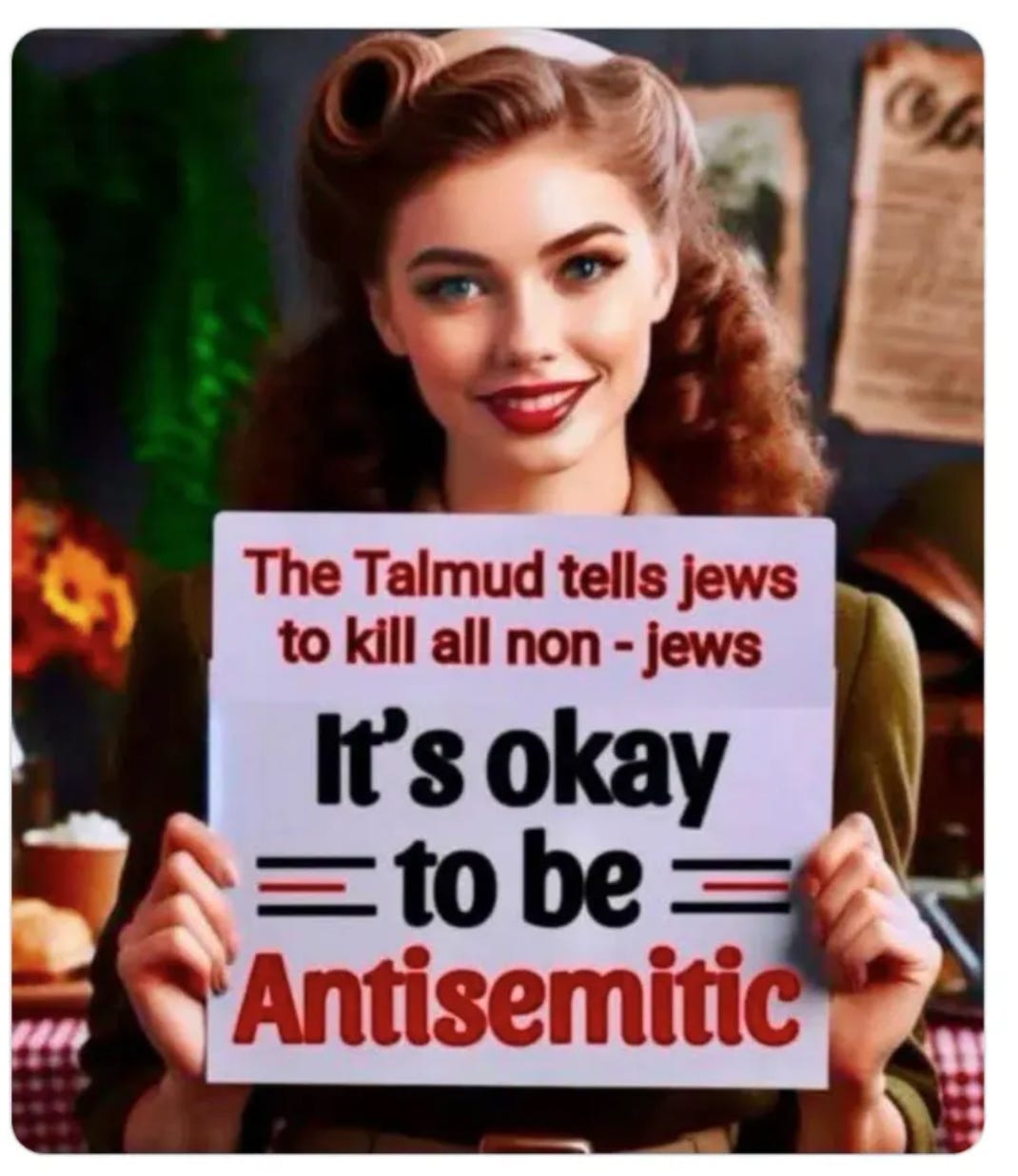
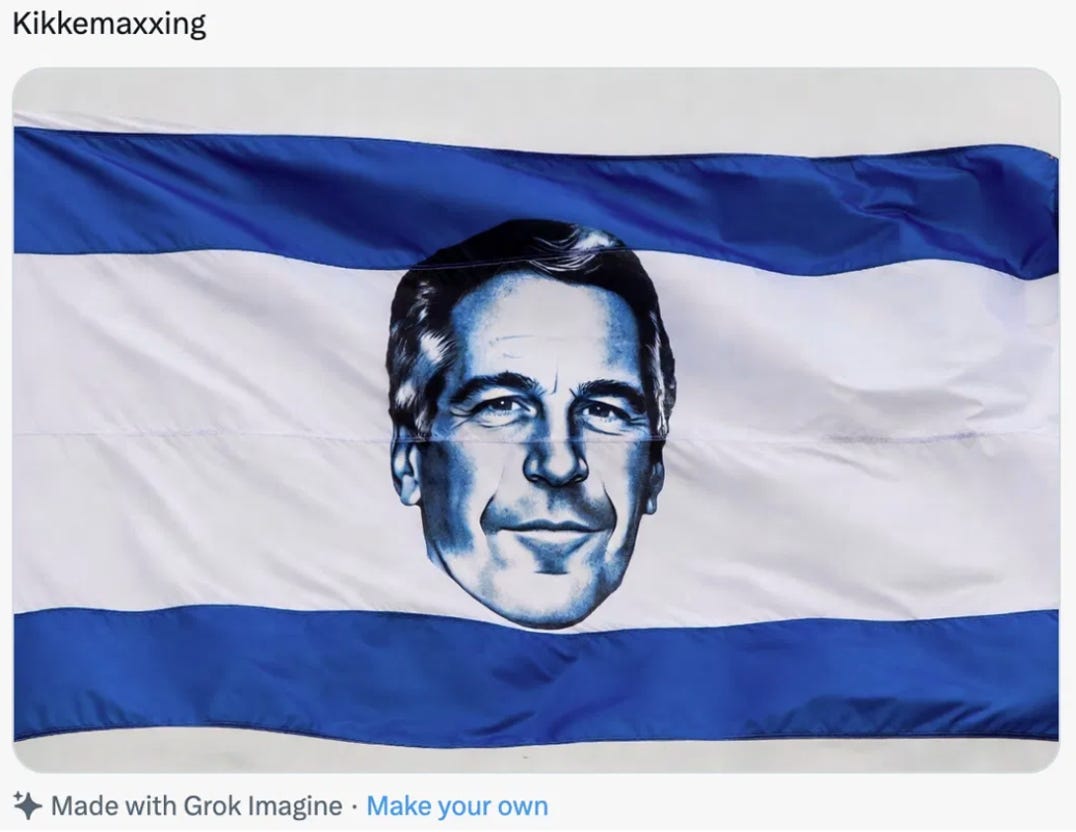
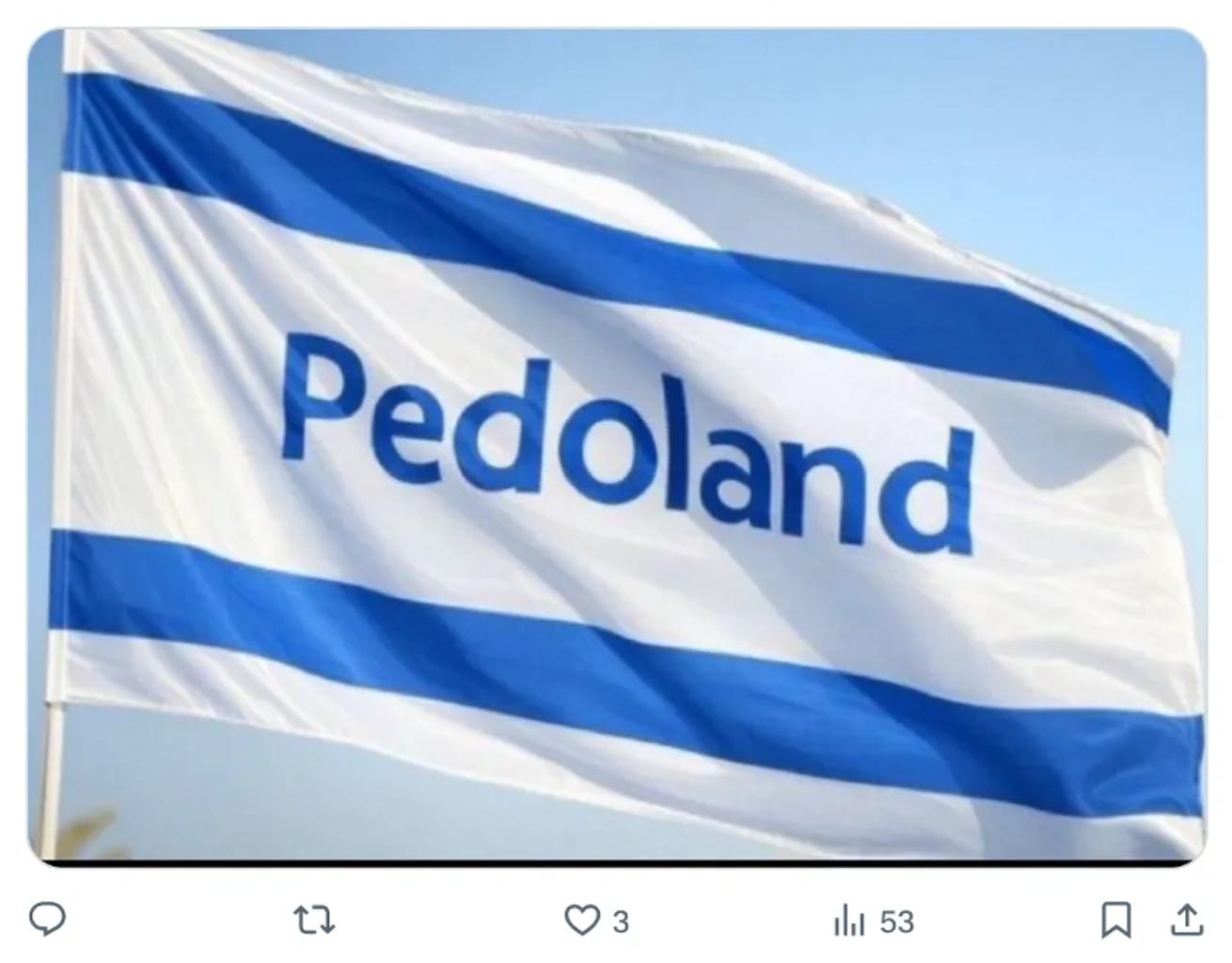
Most consequentially, part of the discourse responds to synthetic events. The early comment sections are flooded with deepfakes pairing Peters with National Security Minister Itamar Ben Gvir in front of the Wailing Wall — Peters giving a thumbs-up beside the minister — watermarked by a self-labeled parody account, the same source as a fabricated image of Peters kissing a kippah-wearing man. The image recurs at least six times in the arrival thread and continues circulating in subsequent threads, anchoring a measurable cluster of hostile replies, including a 915-like condemnation and units that treat the “meeting” as established fact:
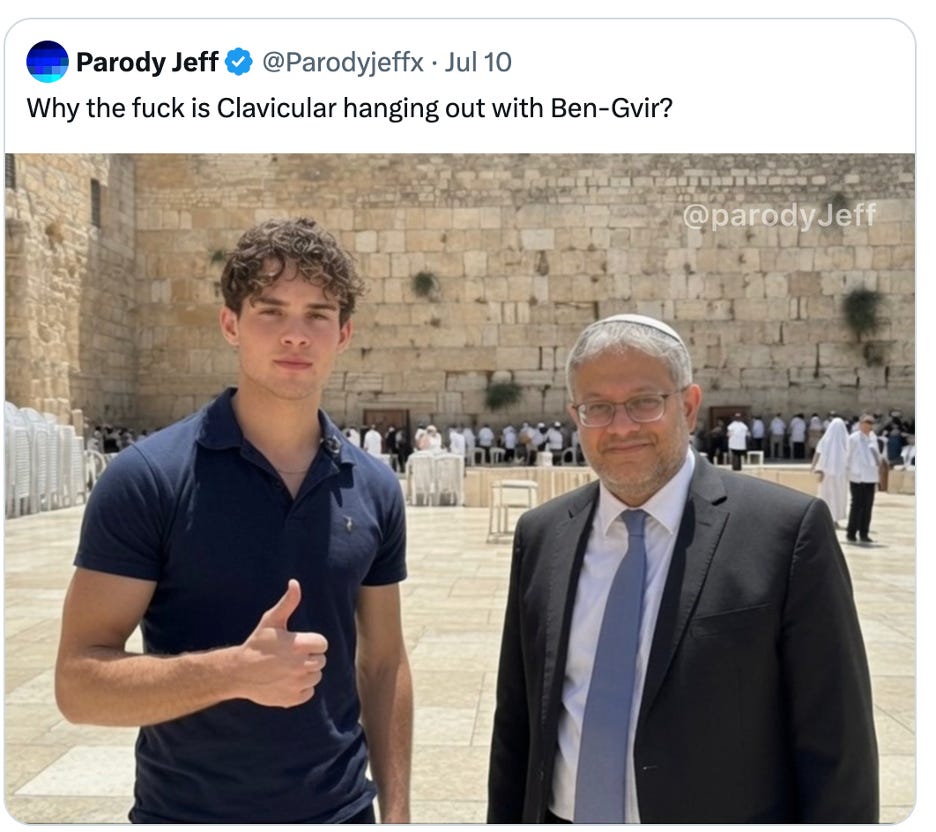
“Were you really chillin with Ben-Gvir?”
“Is that picture of you with Ben Gvir in front of the wall real?” (July 9 thread — the fabrication circulating as an open factual question)
No press coverage reports any Ben Gvir meeting; the detailed trip reconstructions record only a coincidental encounter with a Netanyahu adviser. Further judaisation imagery in the corpus is explicitly labeled “Made with Grok Imagine,” and commenters routed the discourse through AI systems in both directions. In one direction, racial classification itself is outsourced to the platform’s built-in model:
“Hey @grok is Clavicular jewish?”
Seven words, and the question “who is a Jew” — the reclassification apparatus of §3 — is handed to an AI system for adjudication. In the other direction, generative tools manufacture the “evidence” for both hostile narratives at once: the capture story (the wall-kiss image that drove “Free Clav”) and the far-right-alliance story (the Ben Gvir image). One parody account supplied the factual substrate for both. On the evidence available, the defensible formulation is this: a measurable cluster of replies treated an apparently fabricated image as evidence of a meeting for which no corroboration exists in any reporting or trip reconstruction.
Discussion
The controversy surrounding Peters’ visit produced sharply opposing normative judgments but almost no empirical evidence. The present findings allow that debate to be revisited from the perspective of the receiving audience.
What the community’s visible response contained. The corpus cannot measure silent viewers’ attitudes, livestream reception, or circulation on other platforms, and this limitation is stated plainly: reply sections over-represent engaged and hostile voices. The findings describe one influencer, one event, and one platform; how far they generalize remains an empirical question, for which the Peterson comparison provides only preliminary evidence. But the guiding question — what happened inside his own community — has a direct answer at its most public surface, the reply environment on Peters’ own account, the space every onlooking fan and creator could read. It contained: a 26,000-like verdict that Israel contact destroys careers; a 21,000-like delegitimization slogan; an 8,800-like child-murder attribution; a capture narrative so dominant it lexicalized into single words; and the systematic recoding of the visiting gentile as a Jew. Within this environment, presence in Israel is itself coded as a conspiratorial act — the “apolitical” framing collapsed under pressure from both political directions. Whatever happened in channels this study cannot observe, any strategy premised on influencer diplomacy toward this milieu must reckon with the finding that its most visible discourse space possesses a disciplinary apparatus already fitted to this case, and that within that space pre-existing disciplinary frames frequently displaced engagement with the substance of the visitor’s content.
Antisemitism as discipline, and the dethroning arc. A definition first. In-group discipline refers to the public punishment of a perceived group member for violating a norm of affiliation, loyalty, or identity. What distinguishes it from ordinary criticism is its structure: the target is construed as corrupted, his autonomy denied, his identity rewritten, his membership revoked — and the punishment is performed publicly, for others to see. What reads as insult functions as exemplary punishment. The theoretical core of the case is this: rather than expressing hostility toward Jews alone, the discourse in the reply environment studied here polices the boundaries of the in-group by transforming affiliation with Jews into evidence of corruption. The accusation performs a disciplinary rather than merely descriptive function — it does not only assert something about Jews; it does something to the affiliating member, and through him to every onlooker weighing the cost of proximity. The general form of the claim: antisemitic repertoires here operate as social technologies for regulating in-group boundaries — the tropes are old, but alongside their familiar out-group hostility they perform an additional function in this corpus: boundary maintenance.
These concepts join established literatures rather than replacing them. Boundary maintenance and symbolic exclusion are established objects of sociological research (Lamont & Molnár 2002); stigma and spoiled identity are central concerns of symbolic interactionism (Goffman 1963); and in-group policing has been examined in conflict research (Fearon & Laitin 1996). Affiliation punishment, in this framing, is a specific empirical manifestation of norm enforcement. What it specifies in the present analysis is that the sanction’s content is drawn from an out-group hate repertoire and that its terminal move reclassifies the sanctioned member into the stigmatized out-group itself. Generic norm enforcement disciplines a member as a deviant member; the mechanism documented here disciplines him by rewriting what he is — the punishment for proximity to Jews is to be made a Jew. That specification is what makes the process antisemitic in form and not merely in occasion. The register inventory identifies the mechanisms through which affiliation is converted into corruption: each register supplies part of the sanction’s vocabulary, and their density indicates how extensively the discourse performed this disciplinary function. The corpus’s central mechanism so understood — antisemitic concepts deployed against the affiliating gentile — closely reproduces the four-group sequence documented for the Peterson–Netanyahu reactions (Becker 2024): (A) disappointment and desacralization; (B1) victim of a vague external power — the servility register; (B2) victim of Jewish power — honeypot, handler, shekels, orchestration; (C) “true colors” — “There’s was always something about you we hated… Now we know”; (D) judaisation and exclusion — Kikevicular/Claviculberg as the exact suffix-pattern of “Juden Peterstein.” The recurrence of a closely related pattern across target type (academic intellectual → Gen-Z influencer), platform (YouTube → X), and four years suggests — pending a formal comparative analysis with a shared instrument — that the dethroning arc may be a recurrent interactional pattern of this milieu rather than a case-specific reaction — a hypothesis for systematic comparative testing. The Clavicular corpus adds a fifth stage the Peterson corpus lacked: AI-generated visual judaisation. The arc is an analytical sequence, ordered by conceptual escalation — its stages co-occur within threads, and the corpus demonstrates the recurrence of the configuration, not that individual authors traverse the stages in time. The arc, displayed:
Figure 3. The dethroning arc.
Affiliation
↓
Disappointment
↓
Servility attribution
↓
Capture (Jewish power)
↓
Judaisation / reclassification
↓
Expulsion
↓
Public disciplinary signal to the surrounding communitySynthetic media can inject fabricated “evidence” at any stage.
The arc’s function is therefore deterrent as well as expressive: it publicly demonstrates the costs of affiliation, addressing every onlooking creator as much as Peters himself.
The synthetic substrate. In plain language first: some users in this corpus were reacting not to events that happened but to fabricated images that supplied apparent evidence for narratives already circulating. The result is what this study calls a synthetic factual substrate — false visual material functioning as the evidentiary basis for real hostility. Hostile movements have always fabricated evidence — photographs, documents, quotations. What generative systems change is the economics: they lower the cost and time required to manufacture apparent visual evidence and insert it into an unfolding controversy, at platform speed, customized to the narrative that needs it. Conspiracy discourse has always fabricated explanations: hidden hands behind visible events. Here it fabricated the evidence as well — not an interpretation of a meeting, but the meeting itself. This corpus documents that operation in real time rather than in prospect. That one self-labeled parody account supplied the “evidence” for two mutually exclusive hostile framings — Peters as captured victim and Peters as far-right ally — and that the discourse absorbed both without friction, suggests the epistemic structure documented in the conspiracy-mutation literature operating at meme speed: the frames selected their evidence, and when reality declined to supply it, the tools did. The subject’s own reported attempt to have the content deleted (documented only in the fabricator’s self-published screenshot) completes the recursion: the sole testimony about the fake’s fakeness comes from the faker. The loop, displayed:
Figure 4. The synthetic evidence loop.
Real event (the visit)
↓
Fabrication (parody-account images, watermarked)
↓
Circulation stripped of framing (reposted as authentic)
↓
Uptake as evidence (hostile replies cite the image as fact)
↓
Contested only within the loop (the subject’s reported deletion demand survives solely in the fabricator’s self-published screenshot)Each pass hardens the fabrication’s status as shared factual ground.
Methodological implications. Three follow. First, text-only analysis materially undercounts and mischaracterizes this discourse: the visual pass raised the arrival thread’s coded rate by several points, flipped several units from harmless to explicit, and contained the corpus’s only Holocaust-denial and neo-Nazi-iconography units. Second, keyword-based detection is structurally blind to the corpus’s most consequential material — the total-loss family, the “-maxxing” coinages, the numeric codewords, the evasion orthography, and Bilzerian’s keyword-free verdict. Third, headline percentages are boundary-dependent: this study’s coding decisions — delegitimization and norm-affirmation counted as constitutive, servility reported adjacent to but outside the coded corpus — are therefore documented explicitly in the research design, and the servility boundary demonstrates that the instrument retains a genuine stopping point.
Why this matters
For influencers and creators: affiliation with a stigmatized out-group can trigger coordinated identity punishment rather than ordinary disagreement — the response documented here was not criticism of content but revision of the person.
For policymakers and platforms: moderation systems are built to detect hostility directed at protected groups; this corpus demonstrates hostility directed at a non-member through antisemitic repertoires — a category current governance frameworks do not name — and the disciplinary sequence runs through coded vocabulary, usernames, images, and fabricated evidence, with the nominal layer (hate worn as a handle) invisible to message-level moderation entirely.
For advocacy organizations: reach is not persuasion; before strategic engagement with any milieu, the receiving community’s norms — here, a ready-made apparatus for punishing this specific affiliation — need assessment, because the messenger’s audience may discipline the messenger faster than the message can land.
For educators: this case supports teaching how conspiracy narratives regulate in-group loyalty — antisemitism appearing not only as hostility directed at Jews but as a repertoire used to punish non-Jews for perceived proximity to Jews or Israel — several of this corpus’s most-liked units contain no Jewish referent at all and are legible only through that lens.
For researchers: the meaning here is distributed across text, imagery, handles, interaction, and prior discourse; instruments that read messages one at a time, in one modality, will systematically undercount the phenomenon.
Conclusion
The central disagreement surrounding the visit was never simply whether Peters should have been invited. It was whether such engagement would generate visible reconsideration within his public online environment. To our knowledge, this study provides the first empirical evidence bearing on that question. His own reply sections supply the one part of the answer that is directly observable — and it is stark. The visible milieu received the visit as a betrayal, processed it through a ready-made disciplinary apparatus, enforced it through casual enactments of a pariah norm, and pronounced its verdict through its two most prominent voices, whose three replies drew approximately 54,000 likes combined. In the dominant and most highly rewarded layer of the reaction, the gentile who publicly affiliated with Israel was not engaged on the substance of the visit; he was recoded and expelled.
The visit placed this community in front of an opportunity to reinterpret a familiar object through direct exposure. Within the observable reply environment, the findings consistently indicate one outcome: we found little evidence of public attitude revision — and the stronger formulation is warranted: the reply environment did not ignore the visit but repeatedly reinterpreted it through pre-existing narratives of betrayal, capture, and exclusion. The case is consistent with a broader capacity of established ideological frameworks to metabolize what contradicts them without altering themselves. Not new thinking, but the old thinking, reinforced — and armed with new tools.
References
Becker, M. J. (2024). Jordan Peterson and conservative antisemitism online: The dethroning of an intellectual icon following his interview with Netanyahu. In M. J. Becker, L. Ascone, K. Placzynta, & C. Vincent (Eds.), Antisemitism in online communication: Transdisciplinary approaches to hate speech in the twenty-first century (pp. 47–74). Open Book Publishers. https://doi.org/10.11647/OBP.0406.02
Becker, M. J. (2025). Charlie Kirk’s murder and the digital afterlife of political violence: A YouTube discourse analysis. Decoding Antisemitism Substack, September 2025. https://decodingantisemitism.substack.com/p/charlie-kirks-murder-and-the-digital
Becker, M. J. (2026a). Antisemitism in real time, Part III: “Israel made America do it” — YouTube reactions to the US–Israel campaign against Iran. Decoding Hate, NYU Center for the Study of Antisemitism. https://decodingantisemitism.substack.com/p/antisemitism-in-real-time-part-iii
Becker, M. J. (2026b). Antisemitism in real time, Part IV: “A fake feud” — YouTube reactions to the Trump–Iran deal and the Trump–Netanyahu rift. Decoding Hate, NYU Center for the Study of Antisemitism, June 29, 2026. https://decodingantisemitism.substack.com/p/antisemitism-in-real-time-part-iv
Becker, M. J. (2026c). From abuse to “organized state policy.” Decoding Antisemitism Substack, May 2026. https://decodingantisemitism.substack.com/p/from-abuse-to-organized-state-policy [responds to Kristof’s NYT column of May 11, 2026]
Becker, M. J. (n.d.). At the bottom of the iceberg. Decoding Antisemitism Substack. https://decodingantisemitism.substack.com/p/at-the-bottom-of-the-iceberg
Becker, M. J., Deutsch, I., & Verser, J. (2026). Catchy hatred: YouTube reactions to Kanye West’s “Heil Hitler” — Sympathetic amplification: Host framing and audience response across ten YouTube threads. Decoding Antisemitism Substack. https://decodingantisemitism.substack.com/p/catchy-hatred-youtube-reactions-to
Becker, M. J., Troschke, H., Bolton, M., & Chapelan, A. (Eds.). (2024). Decoding antisemitism: A guide to identifying antisemitism online. Palgrave Macmillan. https://link.springer.com/book/9783031492372
Fearon, J. D., & Laitin, D. D. (1996). Explaining interethnic cooperation. American Political Science Review, 90(4), 715–735.
Goffman, E. (1963). Stigma: Notes on the management of spoiled identity. Prentice-Hall.
Lamont, M., & Molnár, V. (2002). The study of boundaries in the social sciences. Annual Review of Sociology, 28, 167–195.
This case study was conducted under Decoding Hate, the research hub at NYU’s Center for the Study of Antisemitism, and draws on the Decoding Antisemitism Lexicon. It connects to the DH study “Catchy Hatred” — on the YouTube reception of Kanye West’s “Heil Hitler,” the song performed at the Miami club episode in which Peters participated — and to the Antisemitism in Real Time series.*